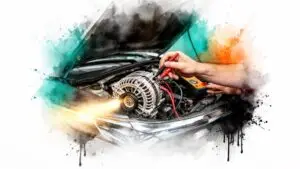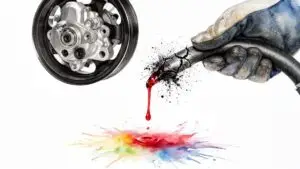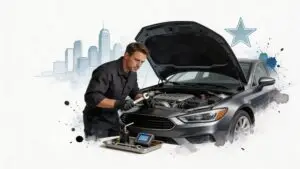

That's a sound no driver wants to hear. Whether you're pulling into a parking spot in Haltom City or navigating a turn on Denton Hwy, that awful grinding noise when turning the steering wheel is your car's way of telling you something is seriously wrong.
What That Grinding Noise Means When You Turn
A grinding, groaning, or whining sound when you steer is one of the most common—and concerning—issues we see at our Haltom City shop. Don't just turn up the radio and hope it goes away. Think of it as a smoke signal from your car’s steering or suspension system, warning you that metal parts are grinding against each other. This almost always means a critical component has worn out or is dangerously low on lubricating fluid.
The specific situation when you hear the noise is a huge clue. For example, a grinding sound you hear while sitting still or moving at a crawl often points to a problem with the power steering system. But if the noise only shows up or gets louder as you pick up speed, our Haltom City technicians start looking at parts like your wheel bearings or CV joints.
Common Causes at a Glance
For drivers in and around Haltom City, where stop-and-go traffic and varying road quality put a lot of stress on a car, pinpointing the sound can help narrow down the cause. Here's a quick breakdown of what our technicians typically look for based on the sound you describe:
- Grinding or whining when stationary: This almost always means the power steering system is in distress. The pump is struggling, usually because the fluid is low or has gone bad.
- Humming or grinding that gets worse with speed: This is the textbook symptom of a failing wheel bearing. You might also notice the sound changes pitch when you steer slightly to the left or right.
- Clicking or popping during sharp turns: If you hear a fast-paced clicking noise when making a tight turn, like in a Haltom City parking lot, a worn-out Constant Velocity (CV) joint is the likely suspect.
- Creaking or groaning at low speeds: These “rusty door hinge” sounds often come from worn suspension parts like strut mounts or ball joints, especially when you're parking or going over bumps.
Trying to ignore a grinding sound isn't just a bad idea—it's a serious safety risk. A component like a bad wheel bearing or a failing ball joint can suddenly fail, leading to a complete loss of steering control. Getting it professionally diagnosed by a Haltom City mechanic right away is non-negotiable.
Ultimately, that noise is your car crying out for help. Here at Express Lube & Car Care in Haltom City, our first job is to figure out exactly what’s going on, give you a clear diagnosis, and get it fixed right so you can drive with confidence again.
Is Your Power Steering System the Source of the Sound?
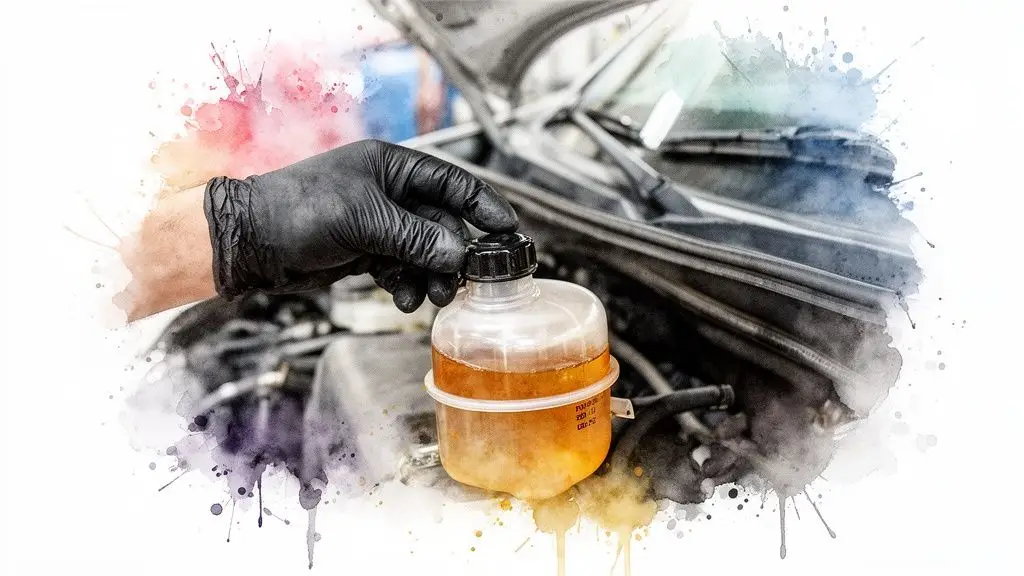
When you hear that awful grinding noise while turning, especially when the car is standing still, our Haltom City team’s first thought always goes to the power steering system. It’s the most common culprit. Think of the power steering pump as the system's heart; it works tirelessly to make turning the wheel feel light and easy. The power steering fluid is its lifeblood, creating the hydraulic muscle to do the heavy lifting.
If the noise you're hearing is more of a loud, strained groan or a high-pitched whine, that's almost always the pump crying out for help. This usually points to one of two things: the fluid is low, or the fluid itself is old, contaminated, and just not doing its job anymore. When the fluid level drops, the pump starts sucking in air, which creates a nasty grinding noise—a process mechanics call cavitation.
Low Fluid vs. Bad Fluid
Figuring out if the fluid is low or just plain bad is the next step. A quick top-off seems like an easy fix, but if you’re pouring fresh fluid into a system filled with dark, gritty sludge, you're only putting a bandage on the problem. Over time, that fluid breaks down and gets contaminated with tiny bits of metal and debris, turning from a clean reddish or clear liquid into a dark, murky mess.
Your power steering system is a sealed hydraulic environment. Old, dirty fluid can’t create the necessary pressure, forcing the pump to work harder and eventually fail. This is why a simple top-off isn't always enough; sometimes, a full system flush by a qualified Haltom City technician is required to restore performance and silence that grinding sound.
For drivers around Haltom City, it’s a sound you don't want to ignore. Imagine trying to get out of a tight parking spot, and every turn of the wheel is met with a sharp, grinding protest. That's a classic sign that something is starved for lubrication. In fact, about 60% of grinding or whining complaints that happen while a car is stationary trace back to low or contaminated power steering fluid. It's a common issue as cars get older, too. Data shows power steering problems pop up in 15-20% of cars between 5-10 years old, and that can jump to 40% in vehicles with over 150,000 miles.
The Danger of Using the Wrong Fluid
It’s also critical to know that not all power steering fluids are the same. Popping the cap and pouring in the first bottle you find at a Haltom City auto parts store can be a costly mistake. Modern cars are picky and often require specific types, like Dexron or Pentosin. Using the wrong one can be just as bad as running low, as it can eat away at seals, damage hoses, and lead to total system failure.
Depending on the diagnosis, here are the most likely repair paths:
- Simple Fluid Top-Off: The best-case scenario. This is an easy and cheap fix if you've just lost a little fluid from a minor weep.
- Power Steering Flush: This is what’s needed when the fluid is old, dark, or full of gunk. We drain the entire system and replace it with fresh, clean fluid.
- Pump or Hose Replacement: If the grinding won’t quit or if you have a visible, steady leak, it’s likely the pump itself or a connected hose has failed and needs to be replaced.
Knowing the difference can help you understand what to expect when you bring your car in to our Haltom City shop. If you're still trying to pin down the exact issue, our other guides can help. Check out our detailed article on common power steering problems and their symptoms.
How Worn Wheel Bearings and CV Joints Cause Grinding
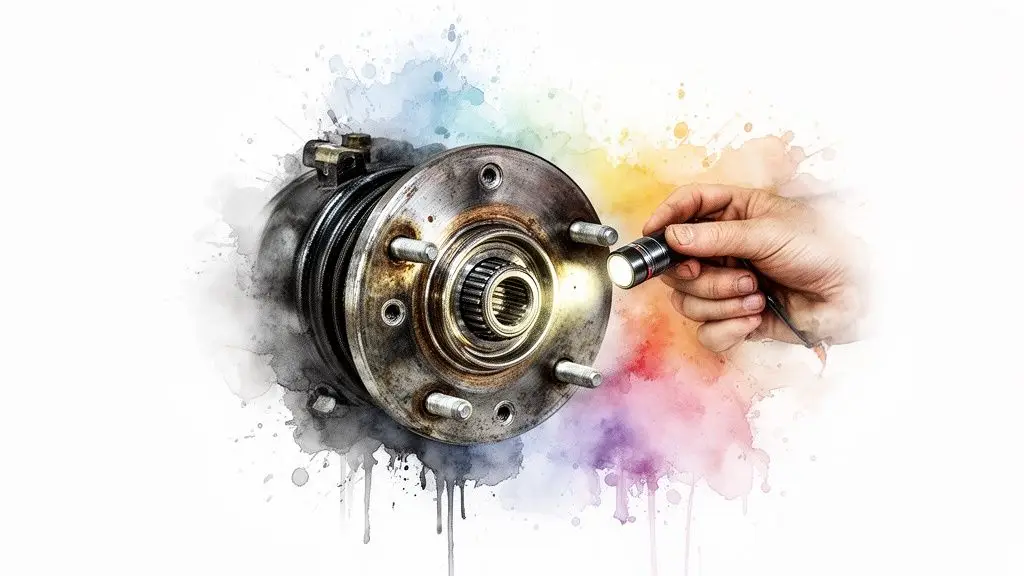
While your power steering system is a common source of grinding when you’re not moving, a totally different set of parts can be the problem once you're on the road. If you're hearing a grinding noise when turning the steering wheel that seems to get louder the faster you go, it's time to look at your wheel bearings and Constant Velocity (CV) joints. These components are critical for connecting your wheels to your car, and the sounds they make are clear cries for help.
Think of a wheel bearing as a simple but tough part that lets your wheels spin smoothly. It’s basically a ring full of super-strong steel balls, packed in grease to keep friction at bay. Every day you drive around Haltom City, these bearings take a beating. Over thousands of miles, that grease can break down or get contaminated by moisture, which leads to rust. Soon enough, you've got metal grinding on metal.
That’s when you’ll start to hear it—a low hum or a grinding that changes in pitch as your speed increases. One of the classic signs of a failing wheel bearing is a noise that gets noticeably louder when you make a slight turn on the highway, like changing lanes. This action shifts the car’s weight, putting more pressure on the damaged bearing and making it complain even more.
Differentiating Grinding From Clicking
CV joints, on the other hand, play a different role. They are flexible joints on your car's axles, designed to let your wheels turn left and right while also moving up and down with the suspension. When a CV joint goes bad, it usually doesn't grind. Instead, it makes a very distinct, rhythmic clicking or popping sound, which is most obvious during sharp, slow turns like when you’re pulling into a parking spot. That clicking is the sound of excessive looseness in the joint.
So, while that clicking is one problem, a steady grinding sound almost always points to a wheel bearing. This isn't just an annoying noise; it's a serious warning. Automotive repair data shows that bad wheel bearings account for roughly 25% of all steering noise complaints. For vehicles with over 100,000 miles—a common sight for drivers in Haltom City—that number jumps significantly, with 40-50% of grinding issues tracing back to failing bearings. You can learn more about how to pinpoint these noises in our guide on the symptoms of a bad rear wheel bearing.
A Critical Safety Warning: Ignoring a grinding wheel bearing is a dangerous gamble. The National Highway Traffic Safety Administration (NHTSA) logs over 12,000 bearing-related incidents in the U.S. each year, some of which lead to a wheel completely separating from the vehicle. A grinding noise means the bearing is actively falling apart. If it seizes up or fails entirely, your wheel could detach while you’re driving.
Catching this problem early is everything. A quick inspection on a vehicle lift at our Haltom City shop can confirm if a bearing is bad before it leads to a catastrophic failure on the road. Don't wait for the noise to get worse—getting a professional diagnosis right away is non-negotiable for your safety.
When Suspension Components Are the Problem
Alright, so if you've ruled out the power steering system and the wheel bearings, it's time to look at the suspension. Your car's steering and suspension systems are two sides of the same coin—they have to work together perfectly to give you a smooth, controlled ride. The parts that allow your wheels to turn left and right while also soaking up bumps are things like strut bearings, ball joints, and tie rod ends.
When these parts start to wear out, they can make some truly awful grinding noises whenever you turn the steering wheel. A lot of the time, the main culprit we find in our Haltom City shop is a worn-out strut bearing, which is also called a strut mount.
Pinpointing Suspension Noises
Think of the strut bearing as a pivot point that lets the entire strut assembly turn with your wheels. When it goes bad, it sounds almost exactly like an old, rusty gate hinge groaning in protest. You'll hear it most when you’re moving slowly, like when you're pulling into a tight parking spot at the grocery store.
This isn't just a random guess; it's a specific kind of failure. From our experience here in Haltom City, a harsh grinding sound that comes on strong as you turn the wheel is a classic symptom of a shot strut bearing. Industry-wide, these parts are behind as many as 20% of grinding complaints, especially in cars with over 75,000 miles on the clock. Once the grease inside dries up, it's just metal-on-metal grinding.
A broken ball joint is one of the most dangerous mechanical failures a vehicle can experience. It can cause the wheel to splay outwards, resulting in a sudden and complete loss of steering control. This isn't just a potential problem; it's a critical safety failure that requires immediate professional attention from a trusted Haltom City mechanic.
The Danger of Failing Ball Joints
Beyond the strut bearings, you absolutely have to consider the ball joints. These are critical pivot points that connect your wheel hubs to the suspension control arms. When a ball joint wears out, it usually makes a loud "clunking" or "creaking" sound, especially when you hit a bump or make a sharp turn. That noise is the sound of excessive play in the joint, with metal parts knocking around violently.
If you want to get a better idea of what these fixes can involve, you can read our guide on strut repair prices.
Let me be clear: ignoring these sounds is a huge gamble. A worn strut bearing is annoying, for sure. But a failed ball joint is genuinely catastrophic. If you hear any kind of grinding, groaning, or clunking coming from your suspension, you need a full inspection. Getting it checked out by a trusted Haltom City shop like Express Lube & Car Care is the only way to be sure your car is safe to drive.
Simple Checks You Can Safely Perform at Home
So, you're hearing that awful grinding sound. Before you immediately book a shop appointment in Haltom City, there are a couple of quick, safe checks you can do right in your driveway. Think of it as a bit of detective work. You’re not trying to fix the problem yourself, but gathering clues will help you and your mechanic pinpoint the issue faster when you bring it in.
Let's start with the simplest thing to rule out.
Check Your Power Steering Fluid
With the car parked on a level surface and the engine completely cool, pop the hood. You're looking for the power steering fluid reservoir—it usually has a small steering wheel icon right on the cap. Check the fluid level against the "MIN" and "MAX" marks, which are either on the side of the clear reservoir or on the dipstick attached to the cap.
Now, take a look at the fluid itself. Healthy power steering fluid is clear or has a reddish tint and a smooth consistency. If what you see is dark brown, murky, or worse, has tiny, sparkly metal flakes floating in it, that's a red flag. It means the fluid is contaminated, and the system needs a professional's touch.
This quick flowchart can help you visualize the process.
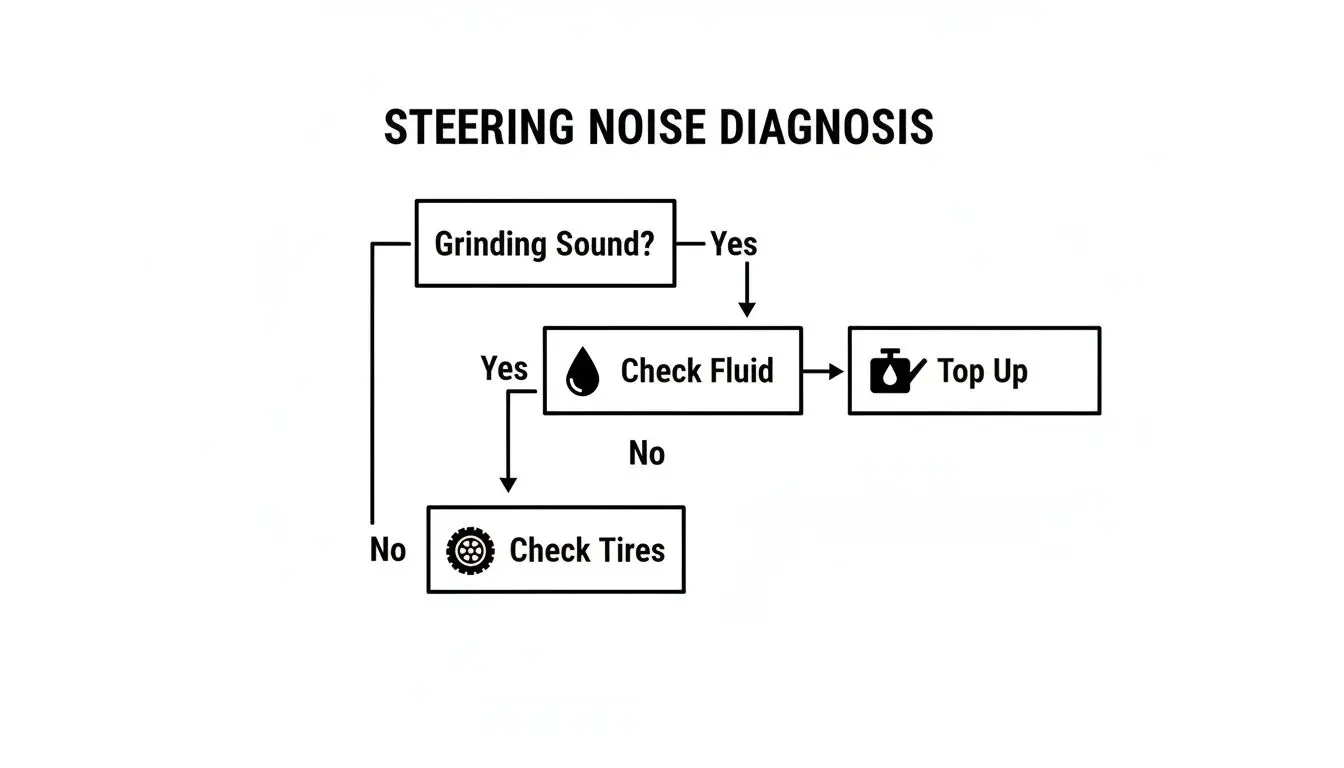
As you can see, checking the fluid is your first move. If it’s just low, topping it off might be a temporary fix, but any other issue means it's time for a deeper look.
Listen Carefully and Observe
Next, become a student of the sound. Start your car and, while it's still parked, turn the wheel lock-to-lock. Does the grinding noise when turning the steering wheel happen every time you turn, or only at specific angles?
Then, find a safe, empty Haltom City parking lot and drive slowly. Pay attention to how the noise behaves. Ask yourself:
- Does it grind when you're stopped, only when moving, or both?
- Is the noise more pronounced when you turn left compared to right?
- Does the pitch or volume of the sound change as you speed up or slow down?
Safety First: This is non-negotiable. Never get under a vehicle that isn't properly secured on certified jack stands. These checks are all designed to be done safely from inside or outside the car. Any inspection that requires getting underneath is a job for a trained technician with a proper lift, like those at our Haltom City facility.
Finally, take a quick peek at your front tires. Kneel down and look at the tread. If you see uneven wear patterns—like the inside or outside edges being much more worn down than the rest—it can point to a suspension or alignment problem. These issues often go hand-in-hand with steering troubles. To get a better idea of everything that gets looked at during a professional check-up, our car inspection checklist is a great resource.
Your Trusted Local Solution in Haltom City
We've walked through all the things that could be causing that awful grinding noise when you turn the wheel. If there's one takeaway from all of this, it's that you can't just turn up the radio and hope it goes away. That sound is your car sending out an S.O.S., and ignoring it will only lead to bigger, more expensive problems—and could even put your safety at risk.
For folks here in Haltom City, Watauga, and North Richland Hills, getting it sorted out doesn't have to be a headache. That's why we're here at Express Lube & Car Care.
We know car trouble is the last thing anyone wants to deal with. Our whole philosophy is built on being straight with you and earning your trust. When you roll into our Haltom City shop, you’re not just another repair order. You're getting the full attention of our ASE-certified technicians who have spent years diagnosing these exact kinds of problems for Haltom City drivers.
Why Haltom City Drivers Choose Us
We don't believe in guesswork. We pair our hands-on experience with up-to-date diagnostic equipment to pinpoint the real source of that steering noise. We'll methodically check everything from the power steering pump and fluid to the CV joints and strut mounts, making sure we find the actual culprit the first time.
Here at Express Lube & Car Care, we're committed to honest work for our Haltom City community. We'll show you what's wrong, walk you through the options, and give you a clear, straightforward estimate before any work begins. There are no surprises here—your trust is the most important thing we build.
Our shop is right here at 6211 Denton Hwy, ready to handle whatever your car needs. We have the tools and expertise to fix the systems that are usually behind that grinding sound, including:
- Power Steering Service: We can handle everything from a simple fluid flush to replacing a failing pump or leaking hose.
- Suspension and Steering Repair: We take care of worn-out strut mounts, bad ball joints, and loose tie rods.
- Wheel Bearing and CV Joint Replacement: These are crucial for your safety, and we'll get them replaced correctly.
Think of that grinding sound as your car's last warning before a small problem becomes a breakdown. Don't wait for it to get worse. Protecting your car and your peace of mind is as simple as scheduling an inspection with our team. Let us get you back on the road safely.
Frequently Asked Questions About Steering Noises
We've walked through the common culprits behind that grinding sound, from your power steering system to worn-out suspension parts. But you probably still have some pressing questions. Let's tackle the ones we hear most often from drivers right here in Haltom City.
Is It Safe to Drive My Car If It's Grinding When I Turn?
The short answer? We really don't advise it. Think of that grinding sound as your car's warning light—something is wrong, and it needs attention right away in Haltom City.
While it might just be low power steering fluid, it could also be a sign that a critical part, like a wheel bearing or ball joint, is about to fail. Pushing your luck could turn a small issue into a major, expensive repair, or worse, you could suddenly lose control of your steering. The smartest and safest move is to have a professional take a look right away.
How Much Does It Cost to Fix a Grinding Noise in Haltom City?
This is usually the first question on everyone's mind, and the honest answer is: it really depends on what's causing the noise. The fix for a grinding noise when turning the steering wheel can be quite simple or fairly complex, and costs in Haltom City reflect that.
Topping off your power steering fluid might only run you under $100. On the other hand, replacing a full wheel bearing assembly could be anywhere from $400 to over $1,000 for one wheel, depending on your car. The only way to know for sure is to get a proper diagnosis from a Haltom City shop, which will give you a firm, accurate price for your specific vehicle.
Don't let fear of the unknown cost keep you from getting an inspection. Finding out what's wrong is far cheaper than dealing with a complete component failure on the road. Once you know the problem, you can figure out a safe and affordable path forward.
Can Hitting a Pothole Cause This Grinding Sound?
You bet it can. Smacking into one of the many potholes around Haltom City sends a nasty jolt through your entire suspension system. That sudden, harsh impact can easily damage parts like ball joints, strut mounts, or tie rod ends.
If you start hearing a new grinding or clunking sound right after hitting a particularly bad bump, that's a huge red flag. It's a clear signal that something was likely damaged or knocked loose and needs to be inspected.
Does the Noise Happen Only When Turning Left or Right?
If you've noticed the sound is louder when turning in one particular direction, that's a fantastic clue for your Haltom City mechanic. It helps us zero in on which side of the vehicle the problem is on.
For example, a grinding or humming that gets worse when you turn the wheel to the right often points to a bad wheel bearing on the left side, because that's where the car's weight is shifting. Make sure to mention these specific details when you bring your car in—it helps us diagnose the issue much faster.
Don't let a strange noise put your safety at risk. For a trustworthy diagnosis and honest repair work here in the Haltom City area, put your trust in the experts at Express Lube and Car Care. You can visit us online to schedule your inspection today.