
If you live in Haltom City, Keller, Watauga, or North Richland Hills, you have probably had the same moment a lot of Texas drivers have had lately. You look at your windshield, think about registration, and wonder whether that old inspection routine still applies.
That confusion is normal. The law changed, but the need to keep a vehicle safe did not. Knowing how often to get car inspected in Texas now means separating the legal minimum from the maintenance schedule that protects your brakes, tires, steering, and engine.
What Your Inspection Sticker Really Means in 2026
A lot of local drivers are still operating on the old mental checklist. Sticker due. Get inspection. Renew registration. Done.
That used to be simple. It is not simple anymore.
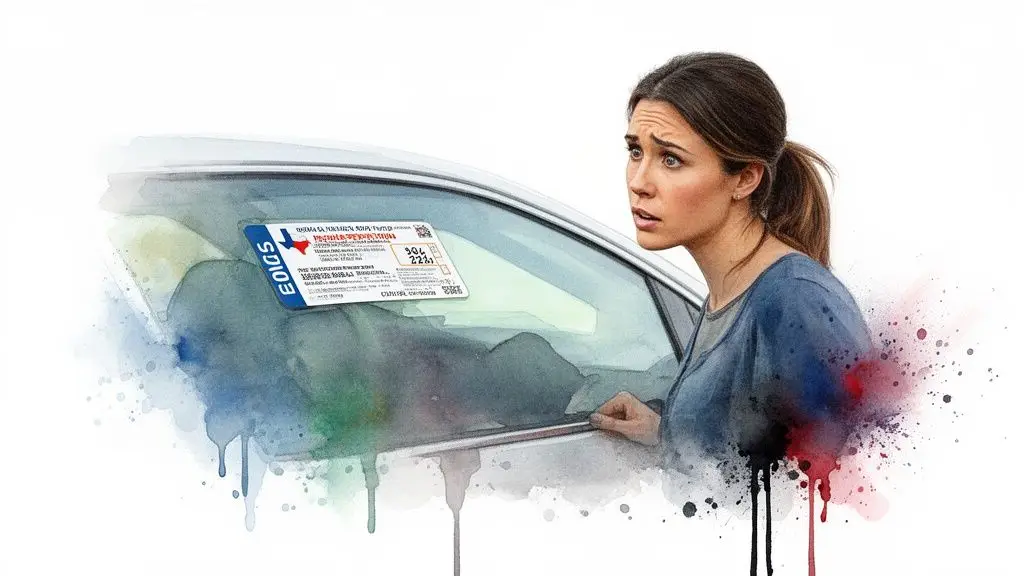
In the DFW area, Google Trends shows a 40% spike in searches for “Texas car inspection required?” after the 2025 changes, which lines up with what local drivers are asking every day in Tarrant County.
Why the sticker question still matters
The old sticker trained people to think in one-year intervals. That was useful because it forced most drivers to get eyes on the car at least once a year.
Once that habit goes away, small problems get ignored longer. Brake wear does not announce itself on a schedule. Tire edge wear does not wait for registration season. A weak battery, coolant leak, or loose front-end part can stay hidden until the day you are already late for work on Denton Highway or trying to merge onto Loop 820.
Legal compliance is not the same as vehicle safety
This is the point many generic articles miss. A vehicle can be legal enough to register and still need attention.
Local driving conditions make that even more important. Short trips, stop-and-go traffic, rough pavement, summer heat, and long commuter miles all put stress on the same systems that used to get looked at more routinely. If you are waiting for the state to remind you, you are already relying on a weaker system than drivers had before.
Tip: In 2026, the smart question is not only “Do I need an inspection for registration?” It is also “When did a trained technician last check the safety items that can strand me or put my family at risk?”
The New Texas Inspection Law Explained for Tarrant County
Texas changed the rules in a way that sounds simple at first but creates confusion in practice.
What changed on January 1, 2025
Texas House Bill 3297 eliminated mandatory annual safety inspections for most vehicles, but annual emissions testing still applies in 17 counties, including Tarrant County. The old process was replaced with a $7.50 Inspection Program Replacement Fee collected at registration.
For drivers in Haltom City, Keller, Watauga, and North Richland Hills, that means the old yearly safety inspection is gone for most non-commercial vehicles. But that does not mean inspections are irrelevant.
What was removed and what stayed
The easiest way to understand the law is to split it into two parts.
- Safety inspection removed: The state no longer requires the annual statewide safety check that used to cover items like lights, brakes, tires, steering, and suspension for most non-commercial vehicles.
- Emissions testing stayed: If your vehicle falls under the emissions program in Tarrant County, you still need the annual emissions portion.
- Registration fee changed: Instead of paying under the old annual safety-inspection framework, drivers now see the $7.50 Inspection Program Replacement Fee through registration.
If you want a wider snapshot of how Texas compares with other states, QuoteFii’s state vehicle requirement data is a useful reference because it helps put Texas changes in context.
What an emissions inspection is checking
Many drivers still assume the current required inspection is a full front-to-back safety review. It is not.
An emissions inspection focuses on exhaust-related compliance. In practice, that often involves an OBD-II check and related emissions procedures rather than the broad mechanical checklist people were used to under the old safety program.
That distinction matters. A vehicle can pass emissions and still have worn tires, weak shocks, poor brake condition, or failing suspension components.
What Tarrant County drivers should do with this information
Use the law for compliance. Do not use it as your maintenance strategy.
If your only goal is to satisfy registration requirements, confirm whether your vehicle needs the emissions test in Tarrant County and handle it on time. If you also want your car to stay dependable, build a separate inspection routine that is based on age, mileage, and use.
For drivers who are sorting out the administrative side, this overview of Texas inspection pricing can help clarify the process.
Recommended Inspection Schedules Beyond The Law
The state no longer forces most drivers to do a yearly safety check. That means the responsibility shifted to the owner.
That shift sounds freeing until a car develops a brake issue, a belt problem, or uneven tire wear that no one noticed early enough. Manufacturer guidance still matters because wear does not disappear when a law changes.
What works in practice
Brake pads worn to 3mm can increase stopping distance by 70%, and timing belt failure, often caught with checks around 60,000 miles, accounts for 8% of engine strandings.
That is why the best inspection schedule is not built around a sticker. It is built around how the vehicle is used.
A newer vehicle that gets regular service may only need a strong multi-point inspection during routine maintenance visits and before major trips. An older vehicle, a commuter car, or anything with high mileage needs more frequent attention because wear stacks up across several systems at once.
Recommended Vehicle Inspection Schedule
| Vehicle Category | Recommended Frequency | Key Items to Check |
|---|---|---|
| Newer vehicles, low mileage | At routine service visits and before long trips | Tires, fluids, battery condition, lights, wipers, visible leaks |
| Daily drivers in regular commute use | At least annually, plus whenever a warning sign appears | Brakes, tire wear, steering feel, suspension, belts, hoses, battery |
| Mid-life vehicles with growing mileage | Every routine maintenance cycle, with added checks before seasons change | Brake thickness, fluid condition, alignment-related tire wear, cooling system, underbody issues |
| Older or high-mileage vehicles | More frequently than newer vehicles, especially if driving conditions are demanding | Suspension play, steering components, leaks, brake system, exhaust condition, cooling system |
| Used vehicle before purchase | Before money changes hands | Engine condition, transmission behavior, leaks, brake wear, tire age and wear, warning lights |
| Pre-road-trip inspection | Before leaving town | Tires, battery, fluids, belts, hoses, brakes, lights, charging system |
A practical checklist helps drivers stay consistent. This guide is useful if you want a solid starting point for what should be reviewed.
How to decide your own interval
Use these three filters.
Vehicle age
A newer vehicle usually gives better warning before failure. An older one often does not. Rubber parts harden, seals seep, suspension parts loosen, and little issues start arriving in groups.
Mileage and trip pattern
A car that racks up commuter miles across Tarrant County needs different oversight than a car driven locally once or twice a week. Highway miles are easier on some components, but they can still hide brake neglect, tire wear, and fluid deterioration.
Driving conditions
Heat changes everything in Texas. So does stop-and-go traffic. A vehicle used for school runs, food delivery, service calls, or jobsite travel should be inspected more often than a lightly used weekend car.
Key takeaway: If you are asking how often to get car inspected after the law change, the safest answer is this. Follow registration rules for legality, then follow mileage, age, and driving conditions for reliability.
What does not work
Two habits fail drivers all the time.
One is waiting until a dashboard light appears. By that point, the problem has often moved from early wear to active fault.
The other is assuming an oil change alone counts as an inspection. A good service visit can include inspection points, but only if someone is deliberately checking the vehicle and documenting what they find.
Red Flags That Demand An Immediate Inspection
Scheduled inspections are one thing. Urgent symptoms are another.
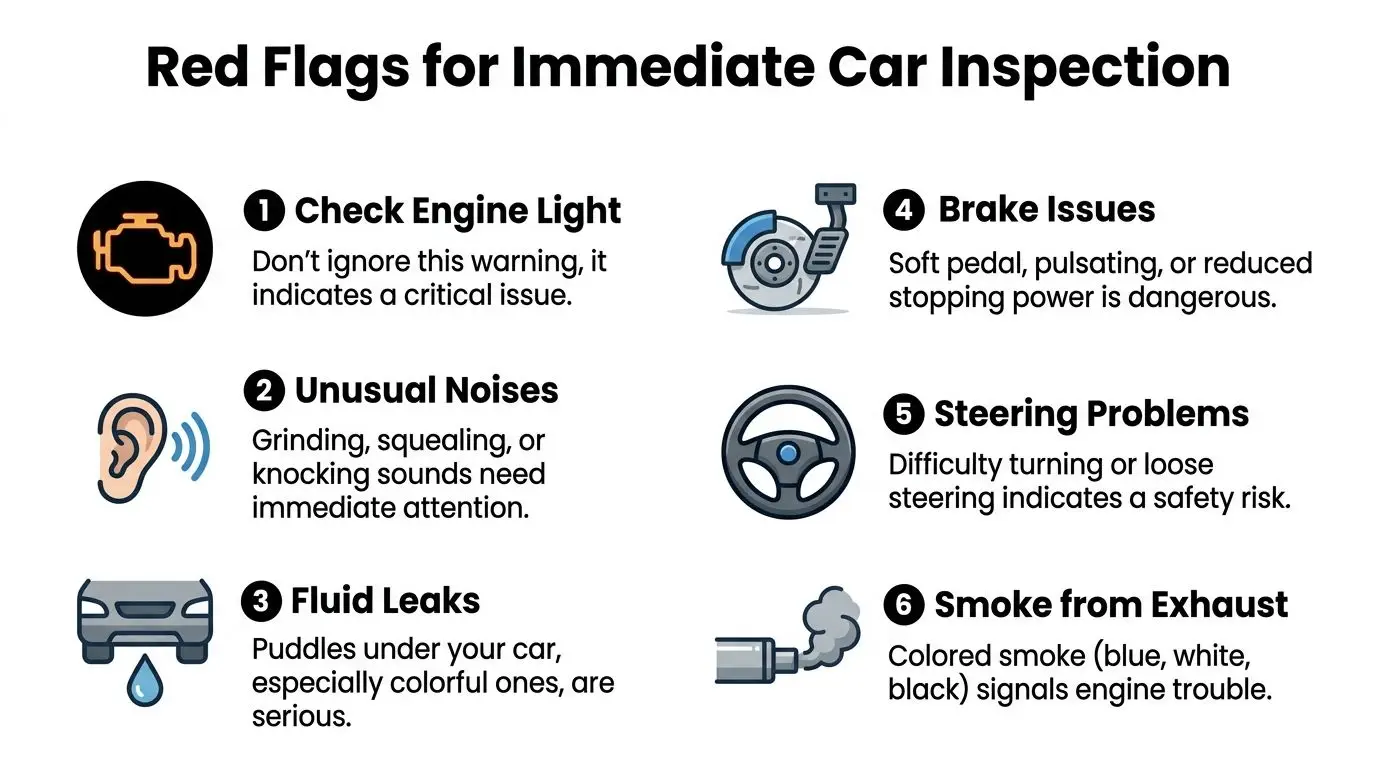
If a vehicle starts acting differently, do not wait for the next oil change. Some issues move from inconvenience to safety problem fast, especially with brakes, tires, steering, or engine performance.
What you hear
Grinding when braking is not a monitor-it-later issue. Squealing, clunking over bumps, knocking from the engine bay, or a humming wheel noise all deserve prompt inspection.
What you feel
Watch for:
- Brake pedal changes: A soft pedal, vibration, or longer stopping feel points to a braking problem.
- Steering changes: Pulling, looseness, or a steering wheel that no longer feels centered can indicate tire, alignment, or suspension trouble.
- Ride quality shifts: Sudden bouncing, nose-diving, or harsh impact over ordinary bumps often means worn shocks, struts, or related components.
What you see and smell
Fluid under the vehicle matters. So do dashboard warnings, smoke, and a hot or chemical smell after driving.
Brakes account for 30% to 40% of inspection failures, with lights and tires also among the most common causes, which is why changes in those systems should never be ignored.
A simple rule for local drivers
If the car is louder, harder to stop, harder to steer, visibly leaking, or showing a warning light, move the inspection forward. Do not keep driving it for another week just to see if it clears up on its own.
Tip: Drivers usually save money when they inspect early. Brake pads, a leaking hose, or a bad coil are cheaper to deal with before they damage rotors, overheat an engine, or trigger larger drivability problems.
Fleet Vehicle Inspections for Haltom City Businesses
For business owners, inspection frequency is not just a maintenance question. It is an operations question.
A fleet vehicle can still run and still be costing you money. If a van has uneven tire wear, weak brakes, or a suspension issue, the business pays for it through downtime, interrupted routes, and harder scheduling.
Why fleet schedules need more discipline
National vehicle inspection failure rates average 20% to 25%, often because of preventable issues involving brakes, suspension, and tires, which is exactly why fleets benefit from proactive checks before those issues create downtime.
A business vehicle usually sees tougher use than a personal car. More idling. More starts and stops. More curb contact. More miles with tools, products, or passengers onboard.
A practical fleet approach
Small local fleets do best with a simple system that drivers will follow.
- Pre-trip walkarounds: Drivers should check lights, tires, visible leaks, and anything that affects safe operation before heading out.
- Scheduled service inspections: Pair routine maintenance with a written inspection process so issues are documented and tracked.
- Consistent repair approval: Do not let small safety items sit because the vehicle is still technically drivable.
- Service records: Keep clean records for every unit so you can spot repeat wear patterns and make replacement decisions with confidence.
Fleet managers looking for a local service option can review available fleet support here:
What works and what does not
What works is a repeatable process. What does not work is waiting until the driver reports something serious.
A structured inspection routine helps businesses avoid surprise shop visits in the middle of the week and keeps vehicles more dependable for staff, customers, and delivery schedules.
Your Trusted Inspection Partner in Haltom City
Texas now asks less from drivers on the safety-inspection side. That makes smart maintenance more important, not less.
If you live in Haltom City, Keller, Watauga, or North Richland Hills, the practical move is to treat inspections as part of normal vehicle ownership. Handle any required emissions steps for Tarrant County, then add voluntary safety checks based on age, mileage, and use.
What local drivers should look for
Choose a shop that can do more than clear the bare minimum. A strong inspection visit should catch developing brake wear, visible leaks, tire issues, battery concerns, suspension looseness, and cooling-system problems before they turn into breakdowns.
You also want a shop that explains findings clearly. Good inspection work is not just spotting a problem. It is helping the driver understand what needs immediate repair, what can be scheduled soon, and what is still in good shape.

The local advantage matters
A Haltom City shop sees local driving patterns every day. That matters when diagnosing repeat issues tied to commuter traffic, rough pavement, hot-weather cooling strain, and brake wear from short-trip driving.
For drivers who need current state inspection information and service in one place, this page is the best next stop.
Key takeaway: In 2026, the best inspection plan is simple. Do what Texas requires for registration, then inspect often enough to catch wear before it turns into safety risk or expensive repair.
Frequently Asked Questions About Car Inspections
Do antique or classic cars follow the same inspection routine?
Registration rules can differ depending on how the vehicle is classified and used. The smart move with an older or classic vehicle is to verify its current registration category with Texas before assuming it follows the same process as a daily driver. Even when legal requirements differ, older vehicles benefit from more frequent safety reviews because age affects rubber, wiring, seals, and fuel components.
Do I need an inspection to sell my car privately in Texas?
A private sale and a registration requirement are not the same thing. Sellers should focus on handing over clear maintenance records, being honest about current condition, and making sure the buyer understands what the vehicle will need for registration in Tarrant County. A pre-sale inspection can also make the transaction smoother because it reduces guesswork.
Will a check engine light cause an emissions problem?
It can. Since the required inspection in Tarrant County centers on emissions compliance rather than the old broad safety checklist, an active check engine light can be a sign that the vehicle needs diagnosis before testing. The exact cause matters, but drivers should not assume the light is minor.
If safety inspections are gone, how often should I get my car checked anyway?
Use the legal requirement for compliance, then set a practical inspection routine around mileage, vehicle age, and driving habits. A commuter vehicle, an older SUV, or a work truck needs more attention than a lightly used newer car.
If you want clear answers and practical vehicle care from a local team, schedule service with Express Lube and Car Care. Their certified technicians help drivers in Haltom City, Keller, Watauga, and North Richland Hills stay on top of required inspections, routine maintenance, and the safety checks that matter after the law changed.