
If your car feels a little lazy pulling onto Denton Highway, idles rough at a long light in Haltom City, or seems thirstier at the pump than it used to, the problem isn’t always a failing part. Sometimes the engine is dirty inside.
That surprises a lot of drivers. While car cleanliness often brings to mind paint, wheels, or the engine bay, internal engine cleaning is different. It deals with the buildup you can’t see: carbon in combustion areas, deposits on injectors and valves, and sludge in the oil side of the engine.
In North Texas, that matters. Short trips, stop-and-go traffic, hot summers, long idle times, and plenty of dust all make it easier for deposits to build up. A cautious driver should ask two questions before agreeing to any service: what exactly is being cleaned, and is this the kind of buildup that responds to cleaning at all? Those are the right questions.
What Is Internal Engine Cleaning and Why Does It Matter
A lot of Haltom City drivers first notice the issue as a feeling, not a warning light. The car still starts. It still runs. It just doesn’t feel as smooth or as eager as it used to on a daily drive through Haltom City, Watauga, or North Richland Hills.

Internal engine cleaning means removing harmful buildup from the parts of the engine that handle fuel, air, combustion byproducts, and oil. Depending on the method, that can include injectors, intake valves, the combustion chamber, piston tops, oil passages, and related surfaces where deposits interfere with normal operation.
What builds up inside an engine
Similar to plaque in plumbing, flow gets restricted, heat doesn’t move away as well as it should, and components have to work harder under worse conditions.
Industry guidance on engine cleaning notes that fuel detergency can remove injector deposits, which are a major cause of lower mileage, often within a couple of tanks, and it also identifies oil sludge as harmful because it reduces oil effectiveness, impairs heat dissipation, and reduces the usable volume of oil in the engine, as explained in Bell Performance’s discussion of engine cleaning and deposit control.
That’s why internal engine cleaning isn’t some trendy add-on. It grew out of a long maintenance history tied to detergents in fuels and lubricants, along with shop procedures meant to control sludge and carbon before they caused drivability complaints or long-term wear.
Practical rule: A clean engine isn’t just about appearance. It’s about keeping fuel, air, heat, and oil moving the way the engine was designed to handle them.
Why local driving makes the issue more noticeable
DFW driving is hard on engines in ways people often overlook:
- Short errands: The engine may not stay at full operating condition long enough to burn off contamination cleanly.
- Extended idling: School pickup lines, traffic backups, and drive-thru time add heat and combustion byproducts without much airflow.
- Summer stress: High ambient temperatures make heat management more important, especially when sludge already limits oil performance.
- Dusty conditions: Fine debris around roadwork and dry stretches can add to overall contamination concerns during service.
When a car spends its life in those conditions, internal deposits can become part of the performance story.
Signs Your Vehicle Needs an Engine Deep Clean
Some symptoms are obvious. Others are subtle enough that drivers adapt to them and stop noticing. The key is paying attention to changes in how the vehicle feels during normal use around Haltom City and the larger DFW area.

What drivers usually notice first
A dirty engine often announces itself through drivability complaints rather than dramatic failure. You may notice:
- Rough idle: The engine shakes or stumbles more at stoplights.
- Sluggish acceleration: It hesitates when you merge or pull away from a light.
- Lower fuel mileage: You’re filling up sooner without changing your route.
- Persistent warning lights: The check engine light comes on and off without an obvious pattern.
- Stronger exhaust smell or visible smoke: Not always caused by deposits, but it deserves attention.
Those symptoms don’t automatically mean internal engine cleaning is the answer. A bad sensor, ignition issue, vacuum leak, or mechanical wear can create similar complaints. That’s why diagnosis matters before treatment.
One clue drivers often mention is unusually dark engine oil. Dark oil alone doesn’t prove sludge, but it does raise useful maintenance questions. If you want a plain-language explanation, this post on what causes engine oil to turn black gives a good starting point.
When deposits are a likely part of the problem
Deposits are more likely to be involved when the symptoms build gradually. A car that slowly gets rougher, less responsive, or less efficient over time often has contamination somewhere in the fuel, air, combustion, or oil path.
Rough idle and hesitation often come from restricted flow or poor combustion quality, not from one dramatic failure.
Here’s where many drivers get misled. They hear “engine cleaning” and assume one bottle or one service fixes every symptom. It doesn’t. A fuel-side deposit issue behaves differently from sludge in the oil system, and both are different from heavy carbon on intake valves.
A quick visual walkthrough can help if you want to see how technicians and drivers talk through common warning signs before deciding on the right service:
Signs you shouldn’t ignore
If the vehicle has severe knocking, metal noise, overheating, or major oil pressure concerns, don’t assume cleaning is the next step. Those symptoms can point to mechanical damage. Cleaning helps with deposits. It doesn’t repair worn bearings, broken components, or internal clearance problems.
For a cautious owner, that distinction matters more than any sales pitch.
Comparing Common Internal Engine Cleaning Methods
“Engine cleaning” covers several very different services. Some work through the fuel tank. Some work through the oil right before a change. Others target combustion and air-path deposits directly. The right method depends on where the contamination is.
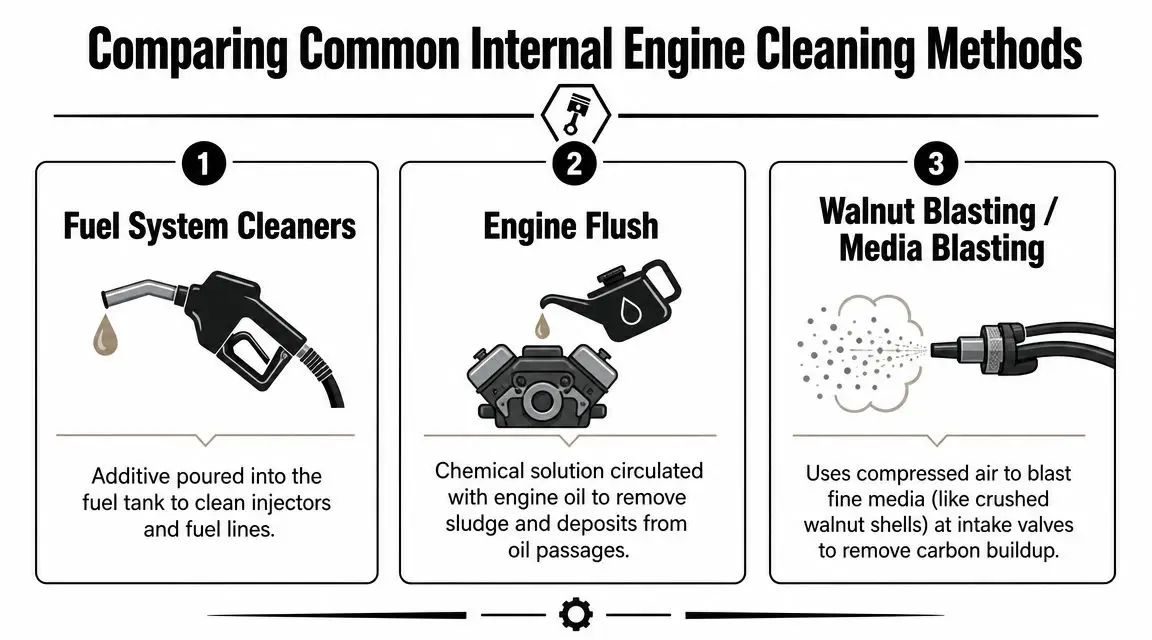
Engine cleaning methods at a glance
| Method | Target Area | Best For | Complexity |
|---|---|---|---|
| Fuel system cleaners | Injectors and fuel-side deposits | Light maintenance and drivability concerns tied to fuel delivery | Low |
| Engine flush | Oil passages and sludge-related contamination | Light to moderate sludge concerns before an oil change | Moderate |
| Walnut blasting or media blasting | Intake valves and heavy carbon in intake path | Engines with stubborn valve deposits that chemical methods won’t fully remove | High |
Fuel system cleaners
This is the simplest category. The product goes into the fuel tank and works over time as the engine burns treated fuel. It’s best for light deposit control, especially when injectors are the concern.
For a daily driver in Haltom City, this can make sense as maintenance if the vehicle still runs fairly well but has started to feel less crisp. It’s not invasive, and it fits routine care better than major corrective work. If you want a deeper look at where this service fits, this article on a fuel system flush covers the basics clearly.
What it doesn’t do is clean everything. A tank additive won’t physically scrape heavy sludge from an oil pan, and it won’t replace a direct intake-valve cleaning method on engines with serious carbon buildup there.
Engine flushes
An engine flush is used in the oil side of the engine. A cleaning chemical is added before an oil change, circulated briefly, and drained out with the old oil. The goal is to loosen and remove sludge and varnish from oil-contact surfaces.
This method can help in the right engine. It can also be the wrong choice in a neglected one. If sludge is heavy, dislodging too much contamination too quickly can create its own problems. That’s why a flush should be matched to the engine’s condition, not sold as a universal cure.
Induction and decarbonization services
These services target the air path and combustion side of the engine rather than the oil system. Advanced decarbonization methods such as oxyhydrogen are described as removing carbon from the combustion chamber, valves, and turbo without disassembly in as little as 30 minutes, according to Oxyhtech’s practical guide to engine cleaning products.
That makes them useful for rough idle, performance loss, and combustion-related deposit issues. They’re preventive or restorative, not a fix for internal wear.
Shop-floor reality: The best cleaning method is the one that reaches the dirty part without creating a new problem somewhere else.
When manual cleaning wins
Some buildup is too stubborn or too thick for chemical-only treatment. That’s where media blasting or teardown cleaning enters the conversation. It takes more labor, more access, and better judgment, but it can address deposits that won’t respond well to lighter methods.
If you like seeing how other shops communicate cosmetic and corrective care to customers, it can be useful to browse testimonials for Carbon Auto Spa. Not because every service is the same, but because customer feedback often shows whether a shop explains trade-offs clearly or just sells the word “cleaning.”
Benefits and Potential Risks of Engine Cleaning
A Haltom City driver may notice the problem first at a red light on Denton Highway. The idle gets a little rough, throttle response feels lazy pulling into traffic, and fuel mileage starts slipping even though nothing seems “broken.” In plenty of cases, deposits are part of that story, especially on vehicles that spend their time in short-trip DFW traffic, long summer idling, and stop-and-go commuting.
A properly chosen internal cleaning service can help restore how the engine was meant to run. That may mean a steadier idle, cleaner acceleration, fewer deposit-related drivability complaints, and better oil flow through areas that need lubrication. The key phrase is properly chosen. Cleaning helps most when buildup is the problem, not when wear or failed parts are hiding underneath.
AAA notes that carbon deposits can contribute to reduced performance and lower fuel economy in modern engines, especially direct-injection designs, in its guidance on engine carbon cleaning service. That lines up with what we see in the shop around Haltom City. Vehicles used for repeated short drives, school runs, and heavy congestion tend to build deposits faster than highway-driven vehicles that get fully warmed up on a regular basis.
Where engine cleaning helps most
The biggest gains usually show up in a few specific areas:
- Idle quality: Engines affected by intake or combustion deposits often run smoother after the right cleaning service.
- Throttle response: Restricted airflow and uneven combustion can make the vehicle feel sluggish, especially in city driving.
- Oil circulation: In engines with mild varnish or early sludge formation, careful cleaning may help oil move more freely through internal passages.
- Combustion stability: Cleaner chambers and valves can reduce deposit-related misfire tendencies and hesitation.
Customers sometimes confuse internal cleaning with cosmetic engine detailing. They are different services with different goals. If you want that distinction spelled out clearly, this guide on cleaning oil off engine surfaces versus addressing internal buildup helps.
Where customers get burned
Engine cleaning does not repair worn timing chains, bad piston rings, weak compression, sensor faults, or bearing noise. If the root issue is mechanical, cleaning may change nothing at all.
Risk goes up when the engine has been neglected for a long time. Heavy sludge can break loose during an aggressive flush and move into narrow oil passages or clog a pickup screen. That is why a cautious shop inspects first, asks about maintenance history, and matches the service to the condition of the engine instead of selling the strongest chemical on the shelf.
I tell customers the same thing we follow in the bay. Mild buildup often responds well to a measured service. Severe sludge changes the conversation and may call for physical inspection or a slower maintenance plan.
A good shop also explains the trade-offs clearly. Even outside automotive service, customer trust usually comes down to how well a business sets expectations before the work starts, which is one reason the Reviews To The Top auto marketing guide matters to service businesses that want long-term credibility.
The practical takeaway is simple. Internal engine cleaning can be worthwhile for the right engine, at the right time, with the right method. It should be prescribed with some judgment, especially for older vehicles and high-mileage DFW commuters.
DIY vs Professional Internal Engine Cleaning
DIY products have a place. Professional service has a place too. The hard part is knowing which situation you’re in before you pour something into the tank or crankcase.
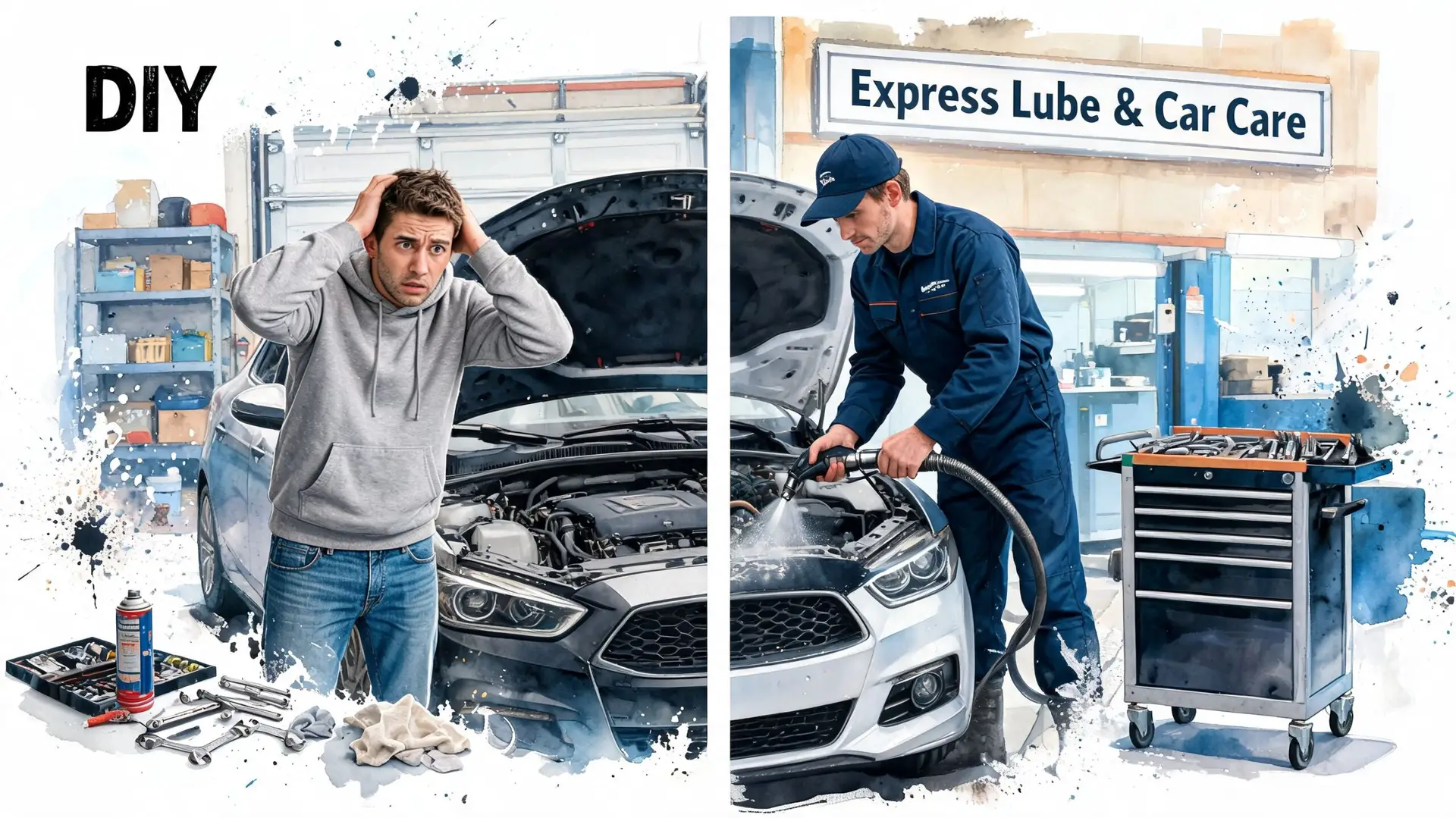
When DIY makes sense
For light maintenance, DIY can be reasonable. A quality fuel-system cleaner used at sensible intervals can help manage mild deposit formation in a vehicle that’s otherwise healthy. It’s simple, low effort, and usually appropriate when there are no severe symptoms.
DIY becomes less convincing when the vehicle already shows rough idle, significant hesitation, chronic warning lights, or signs of sludge. At that point, you’re no longer maintaining. You’re attempting correction without confirming the root problem.
A related task many drivers try at home is cleaning oil residue from the outside of the engine. That can be helpful, but it’s not the same thing as internal cleaning. This guide on how to clean oil off engine surfaces is useful for understanding that distinction.
Why professionals approach it differently
Professional internal engine cleaning is less about stronger chemicals and more about control. A technician has to identify where the deposits are, choose the right process, and keep loosened contamination from damaging the engine.
Technical guidance used in repair training treats particles larger than about 30 microns as harmful because they can bypass primary filtration, which is why contamination control matters so much during engine service, as described in engine cleanliness training material focused on contamination control.
That matters in practical terms. If residue, sludge, lint, or debris gets into the wrong place during a cleaning or repair, it can circulate through bearings and hydraulic components. A bottle on a shelf can’t manage that risk. A disciplined process can.
The safer decision framework
Use this rule of thumb:
- Choose DIY: for light, preventive fuel-side maintenance on an engine with no serious symptoms.
- Choose professional service: when drivability complaints are already present, when sludge is suspected, or when the vehicle has a modern engine design that’s sensitive to deposit-related airflow issues.
- Choose inspection before cleaning: when the engine has high mileage with unknown history, prior neglect, or symptoms that may point to wear rather than dirt.
If you’re interested in how auto shops build trust around services customers are often skeptical about, the Reviews To The Top auto marketing guide is worth a skim. It’s useful because it shows how transparent explanation often matters as much as the service itself.
Cost and Frequency Guide for DFW Drivers
A Haltom City vehicle that spends its week idling on Belknap, making short grocery runs, then sitting through another hot North Texas afternoon does not build deposits the same way as a car that runs I-35W every day and gets fully warmed up. That is why there is no honest one-size-fits-all interval for internal engine cleaning in DFW.
In the shop, I base timing on use pattern, oil service history, and what the engine is already telling us. Local heat, stop-and-go traffic, short trips, and long idle time all push an engine harder than a steady highway commute. Dust matters too, especially for drivers who spend time around construction zones, gravel lots, and job sites across Fort Worth and the Mid-Cities.
A practical frequency guide
For most DFW drivers, condition-based service is the safer call:
- Mostly short trips, school runs, and idle time: ask for a deposit check during routine service, especially if the engine rarely reaches full operating temperature for long.
- Mixed city and highway driving: inspection at normal maintenance visits usually makes more sense than scheduling automatic cleanings.
- High-mileage vehicle with unknown records: start with inspection. A mild service may be fine, but some engines are better left alone until sludge risk is ruled out.
- Work trucks, delivery vehicles, and rideshare use in Tarrant County: expect a shorter maintenance window because heat cycles and idle hours add up fast.
Cost depends on the method and on how far the problem has gone. A preventive oil-side treatment or fuel-side cleaning is usually straightforward. Corrective cleaning gets expensive when deposits are heavy, access is poor, or the engine needs parts removed for safe cleanup.
That labor difference is real. Engine Builder Magazine’s article on engine part cleaning techniques explains how cleaning can take a meaningful share of total engine rebuild time. In plain terms, a lightly dirty engine and a sludged engine are not the same job, and no careful shop prices them as if they are.
For Haltom City drivers, the practical move is to ask three questions before approving the work: What is being cleaned, what method is being used, and what problem are we trying to solve? If a shop cannot answer those clearly, keep asking.
If you want a ballpark before you call, our guide on how much an engine flush costs will help you set expectations. If you own a premium model and want to compare how specialty shops present maintenance standards, this overview of quality car services for luxury vehicles is a useful reference. The vehicles may differ, but the standard should not. Clear process, correct product choice, and honest inspection come first.
Your Haltom City Engine Cleaning FAQs
Is internal engine cleaning safe for a high-mileage vehicle
Sometimes yes. Sometimes no. Safety depends more on condition and maintenance history than the odometer alone.
A well-kept high-mileage engine may respond fine to a mild, targeted cleaning. A neglected one with heavy sludge may need inspection first, and in some cases manual cleaning is safer than a chemical flush.
Will internal engine cleaning void my warranty
A properly selected maintenance service usually shouldn’t, but warranty questions depend on your manufacturer terms and the exact procedure used. The safest move is to use approved service practices, keep records, and ask for a clear explanation of what product or process is being used.
How is this different from a regular oil change
A regular oil change replaces old oil and the filter. Internal engine cleaning goes further by targeting deposits that normal draining may leave behind. That said, cleaning is not a substitute for timely oil changes. It works best as support for good maintenance, not as a rescue plan after long neglect.
Can a flush fix sludge by itself
Light contamination may respond. Heavy sludge often won’t. In severe cases, the deposits need to be physically removed so they don’t break loose and create new restrictions.
The right answer to sludge is diagnosis first, treatment second.
How long does professional internal engine cleaning take
That depends on the method. Some decarbonization services are relatively quick. A more involved service, especially one that requires inspection or partial disassembly, takes longer. If a shop gives you one flat answer for every engine and every symptom, that’s a sign they may be oversimplifying the work.
What should I ask before approving the service
Ask these questions:
- What area are you cleaning: fuel system, oil system, intake, combustion chamber, or valves?
- Why do you believe deposits are the problem: what symptoms or findings support that?
- What are the risks for my engine: especially if the vehicle has high mileage or unknown maintenance history.
- What happens if cleaning doesn’t solve it: is there a next diagnostic step?
Is this worth doing for DFW driving conditions
For many drivers, yes, but not automatically. Frequent short trips, heavy traffic, heat, and idling can make deposit-related issues more common. What matters is choosing the right service at the right time, not assuming every rough-running engine needs the same treatment.
If your vehicle feels rough, sluggish, or just not quite right around Haltom City, get a real diagnosis before guessing. The certified team at Express Lube and Car Care can inspect the vehicle, explain whether internal engine cleaning makes sense for your engine’s condition, and help you choose the safest next step.