
Getting a repair estimate that leaves you more confused than when you walked in is one of the most frustrating experiences car ownership throws at you. Knowing how to verify auto repair estimates before you sign anything can save you hundreds of dollars and protect your vehicle’s safety. The problem is that most drivers focus only on the total price, and that single number tells you almost nothing about whether the estimate is fair, complete, or even comparable to the next one you receive. This guide walks you through every layer of an estimate so you can evaluate it with confidence.
Table of Contents
- Key takeaways
- How to verify auto repair estimates line by line
- Comparing multiple estimates effectively
- Collision repair and ADAS calibration verification
- Common pitfalls when validating estimates
- Putting it all together: approving repairs with confidence
- My perspective on why this matters more than most drivers realize
- Get transparent, verified estimates at Express Lube & Car Care
- FAQ
Key takeaways
| Point | Details |
|---|---|
| Total price misleads | Line-by-line review of parts, labor, and fees reveals true estimate fairness. |
| Parts type changes everything | OEM, aftermarket, and remanufactured parts differ in cost, quality, and warranty coverage. |
| ADAS calibration needs documentation | A passed scan alone does not confirm your advanced safety systems are properly calibrated. |
| Written estimates protect you | Always get an itemized written estimate before authorizing any repair work. |
| Scope must match to compare | Two estimates with similar totals can hide vastly different repair coverage. |
How to verify auto repair estimates line by line
The instinct to compare two estimates by looking at the bottom number is understandable, but it skips the only information that actually matters. Consumer Reports recommends detailed itemized estimates to verify whether you are being charged fairly, and that means examining every line before you agree to anything.
A complete auto repair estimate should break down into several distinct categories.
Parts listings should specify the type of part being used:
- OEM (Original Equipment Manufacturer) parts are made by or to the exact specification of your vehicle’s manufacturer. They cost more but match factory quality and typically carry better warranties.
- Aftermarket parts are made by third-party manufacturers. Quality varies significantly across brands, and a lower-priced aftermarket part is not always a worse choice, but you need to know that is what you are getting.
- Remanufactured parts are used components that have been rebuilt to meet certain standards. They can offer a middle ground on cost and reliability.
Labor charges are calculated by multiplying the shop’s hourly rate by the estimated time for each repair. Shops use standardized labor guides to estimate hours, so one shop charging 2.5 hours for a job and another charging 3.5 hours is a red flag worth questioning. Labor rates vary by location, shop type, and technician certification level.
Additional fees typically include diagnostic charges, shop supply fees (think rags, fluids, and small hardware), and applicable taxes. These are legitimate costs, but they should be clearly listed and not buried in the total.
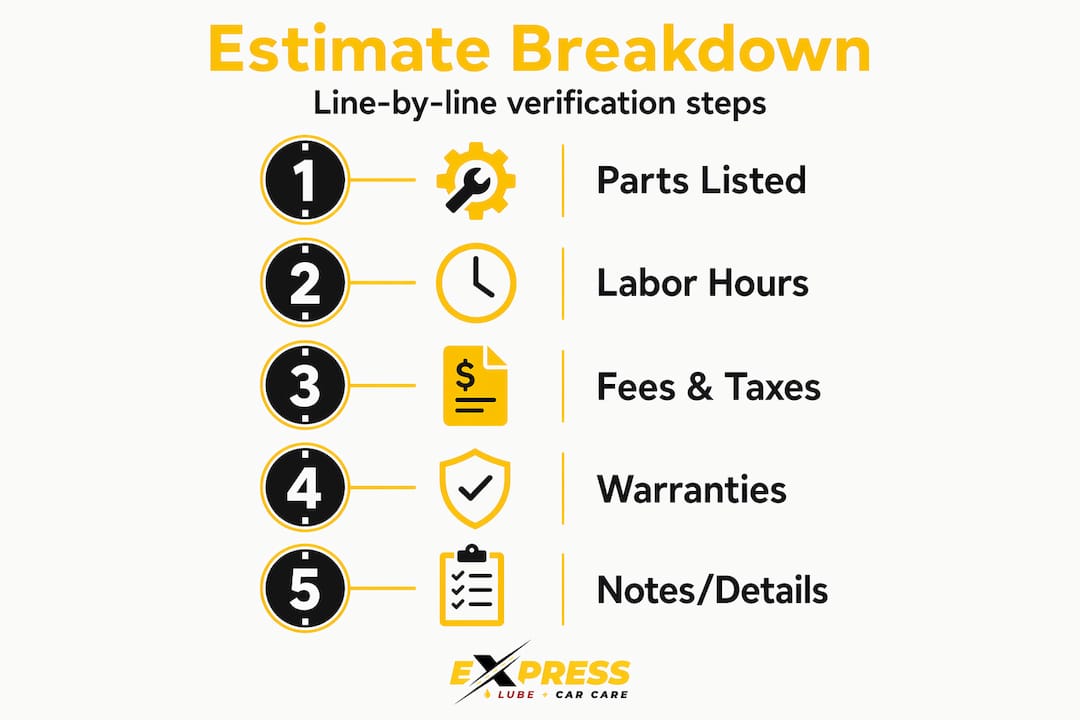
Warranties deserve close attention. A quality shop breaks out parts and labor separately and explains what warranty coverage applies to each. Parts and labor warranties can range from 90 days to several years depending on the shop and the parts used. Shorter or missing warranties on a lower-priced estimate can mean cheaper parts or less confidence in the repair.
Pro Tip: Ask the shop to note whether each part listed is OEM, aftermarket, or remanufactured. If they are not willing to specify, that tells you something about how transparent the rest of the process will be.
Comparing multiple estimates effectively
Once you have two or more estimates in hand, the goal is not to pick the cheapest one. The goal is to confirm you are comparing the same repair scope, the same parts quality, and the same level of work. When comparing estimates, the same repair strategy and scope must be covered on each document before you can draw any meaningful conclusion.
Here is how to approach that comparison:
| Comparison factor | What to look for |
|---|---|
| Repair scope | Are the same components being replaced or repaired on each estimate? |
| Parts type | Does each estimate specify OEM, aftermarket, or remanufactured? |
| Labor hours | Are estimated hours for each task consistent across estimates? |
| Labor rate | What is each shop’s hourly rate, and is it clearly stated? |
| Diagnostic fees | Is a pre-repair diagnostic included, or is it an add-on? |
| Warranty coverage | Does each estimate specify warranty terms for parts and labor? |
If Estimate A is $950 and Estimate B is $650, that price gap often means one shop included a diagnostic scan, used OEM parts, and quoted a factory-correct labor time, while the other skipped steps or priced in cheaper components. The lower estimate is not automatically better. It might simply be incomplete.

Pay close attention to what is missing from lower-priced quotes. A shop that omits a related alignment check after a suspension repair, or skips a diagnostic before replacing a sensor, may be cutting corners that cost you more later. You can also use resources like local engine repair cost guides to benchmark whether the labor and parts figures you are seeing fall within a reasonable range for your area.
Pro Tip: Create a simple spreadsheet with each shop’s estimate as a column and list every line item as a row. Cells that are blank on one estimate but filled in on another instantly show you where the gaps are.
Collision repair and ADAS calibration verification
Collision repair estimates come with a specific layer of complexity that standard mechanical estimates do not. The visible damage you see after an accident is rarely the full picture. Estimates based on visible damage alone can miss structural or safety system issues, which is why a thorough assessment requires disassembly, measurements, and diagnostic scanning before a number can be considered reliable.
Modern vehicles add another critical concern: Advanced Driver Assistance Systems, or ADAS. These include lane-keeping assist, automatic emergency braking, adaptive cruise control, and blind-spot monitoring. Almost any repair involving the windshield, bumper, suspension, or wheel alignment can affect ADAS sensor positioning and require recalibration.
Here is what you need to verify when evaluating a collision or ADAS-related estimate:
- The shop should document that a pre-repair scan was performed to identify all fault codes, not just visible damage.
- Any ADAS-related components should have a corresponding calibration step listed in the estimate.
- A passed scan alone is not enough verification; proper calibration requires documented workflows confirming setup, calibration procedure, and results.
- Ask for a calibration report, not just a verbal confirmation that the system “checked out.”
- The estimate should reference OEM procedures for any structural or safety-related repair.
Connected calibration workflows that link diagnostics, repair planning, and documentation are the standard in well-run shops. If the estimate you receive has no mention of calibration despite involving a bumper, windshield, or wheel component, ask directly why it was left out.
Accurate damage assessment also protects your vehicle’s long-term resale value by catching hidden structural damage before it compounds. A lower collision estimate that skips these steps is not a bargain. It is a liability.
Pro Tip: If a shop cannot produce a written calibration report for ADAS work, or refuses to explain which OEM procedures they follow, consider that a reason to get a second opinion before authorizing any repairs.
Common pitfalls when validating estimates
Even experienced car owners get caught off guard by practices that inflate costs or obscure what they are actually agreeing to. Protecting yourself starts before you hand over your keys.
- Never authorize work based on a verbal estimate. Get everything in writing before work begins. A written, itemized estimate is your primary protection if billing disputes arise later.
- Watch for vague line items. “Miscellaneous repairs” or “general labor” without a clear description gives you nothing to verify and everything to question.
- Ask about diagnostic fees upfront. Some shops charge for a diagnostic and then roll that fee into the repair cost if you proceed. Others charge it regardless. Know the policy before you commit.
- Understand storage fee rules. In California, for example, storage fees can only accrue after repairs are completed and the customer has been notified the vehicle is ready. Regulations like this exist in many states, and knowing your local consumer protection rules gives you standing if a shop tries to add fees improperly.
- Do not feel pressured to approve add-ons on the spot. If a technician discovers additional work mid-repair, they should stop, document the new finding, and get your approval before proceeding. This is standard practice.
A few questions worth asking your service advisor directly: What does this labor time include? Is this an OEM or aftermarket part? What warranty comes with this repair? Does the diagnostic fee apply toward the repair cost? These are not aggressive questions. They are normal, expected questions that good shops answer without hesitation.
Pro Tip: Look up your state’s automotive repair regulations before you visit any shop. Many states have a Bureau of Automotive Repair or equivalent agency that outlines your rights regarding written estimates, authorization requirements, and dispute resolution.
Putting it all together: approving repairs with confidence
Understanding the details of an estimate is only useful if you act on what you find. Here is how to move from evaluation to a confident decision.
- Benchmark your estimate using online labor guides or resources like electrical repair cost guides for your specific repair type to understand whether the figures are in a reasonable range.
- Document everything in writing. When you approve repairs, get a copy of the approved estimate with your signature and the shop’s. When repairs are complete, ask for a written record of what was done and what warranties apply.
- Prioritize safety-first repairs. If your budget requires phasing repairs, ask the technician which items affect vehicle safety or could cause additional damage if delayed. This helps you make a smart sequence of decisions rather than guessing.
- Use multiple estimates as a negotiating tool. If you have a preferred shop but their estimate is higher than a comparable competitor, it is completely acceptable to share that information and ask whether their pricing is flexible.
- Know when to trust expertise. If a shop has documented certifications, clear communication, and a willingness to explain their process, that track record matters. Verification does not mean distrust. It means being an informed customer.
My perspective on why this matters more than most drivers realize
I’ve watched drivers walk away from higher estimates and return weeks later after the cheaper shop missed something important. One of the most common patterns I see: a customer gets three estimates, picks the lowest, and comes back with a persistent warning light or a system that still doesn’t perform right because the root cause was never properly diagnosed.
The reality of checking auto repair quotes is that the process reveals as much about the shop as it does about the price. Shops that give vague, rushed estimates are often the same ones that cut corners mid-repair. Shops that itemize clearly, explain part types, and document their calibration work are telling you something important about their process before the work even begins.
What I’ve found is that car owners who ask specific questions get dramatically better outcomes. Not because asking questions forces honesty, but because it signals that you are paying attention. And shops that know you are paying attention tend to be more careful.
The push toward advanced safety systems in modern vehicles has made this even more true. ADAS calibration is not a checkbox. It is a documented procedure with measurable outcomes, and any estimate that brushes past it on a collision repair is leaving something significant out of the equation. Vehicle technology is only getting more complex, which means validating car service estimates will require more diligence going forward, not less.
— Express Lube & Car Care
Get transparent, verified estimates at Express Lube & Car Care
When you bring your vehicle to Express Lube & Car Care in Haltom City, you get itemized, written estimates with clear breakdowns of parts, labor, and any diagnostic fees before work begins. Our ASE-certified technicians follow OEM repair protocols, and every estimate comes with a clear explanation of what is included and why.
Whether you need engine diagnostics and repair or a full vehicle inspection, our team walks you through every line of your estimate and answers every question you have before authorizing anything. We are RepairPal certified, and we back our work with warranty coverage you can verify in writing. No appointments needed. Visit Express Lube & Car Care in the DFW area and experience what a transparent repair process actually looks like.
FAQ
What should every auto repair estimate include?
A complete estimate should itemize parts (with type noted as OEM, aftermarket, or remanufactured), labor hours, labor rate, diagnostic fees, shop supply charges, taxes, and warranty terms for both parts and labor.
Are auto repair estimates accurate before the shop sees the full problem?
Not always. Initial estimates based on visible symptoms or surface damage can miss underlying issues, especially in collision repairs where disassembly or diagnostic scanning may reveal additional damage that changes the scope and cost.
How many estimates should I get before approving repairs?
Getting two to three estimates gives you enough data to compare scope, parts quality, and pricing. Focus on matching repair scope across all estimates rather than defaulting to the lowest total price.
Why does ADAS calibration matter in a repair estimate?
ADAS sensors control safety-critical systems like automatic braking and lane assist. If a repair affects their positioning, recalibration is required. A shop that omits calibration from the estimate may be skipping a step that leaves your safety systems operating incorrectly.
Can I negotiate an auto repair estimate?
Yes. If you have multiple estimates for the same scope of work, you can present that information to your preferred shop and ask whether their pricing has flexibility. Many shops are willing to discuss pricing, particularly on parts costs.