
Your car rarely picks a convenient time to act up. It happens on the way to work, in school pickup traffic, or while you're merging onto Loop 820 and that warning light flips on.
In North Richland Hills and Haltom City, the hard part usually isn't finding a shop. It's deciding which one will diagnose the problem correctly, explain it clearly, and get you back on the road without wasting your time or money. For most drivers, that's what matters. Not flashy promises. Just honest answers, solid work, and repairs that hold up.
A good shop should help you make smart decisions, especially when the issue isn't obvious. That matters whether you need routine service, brake work, radiator attention, or a deeper engine diagnostic. It matters even more if you're managing several vehicles for a business and downtime affects your schedule every day.
Navigating Auto Repair in the North Richland Hills Area
North Richland Hills gives drivers a lot of choices. According to the AAA auto repair directory for North Richland Hills, the area has 20 AAA Approved Auto Repair Facilities within close proximity. More choice sounds good, but it can also make the decision slower when you're already dealing with a problem.
What matters more than the shop count
When a vehicle starts running rough, pulling during braking, overheating, or showing a check engine light, the key question isn't, "Who can get me in?" It’s, "Who can tell me what’s wrong?"
A dependable shop usually does a few things consistently:
- Inspects before recommending: Good technicians don't jump straight to parts replacement.
- Explains the why: You should know what failed, what caused it, and what happens if you wait.
- Separates urgent from routine: Safety items need immediate attention. Maintenance items can often be planned.
- Documents findings clearly: That matters for both personal vehicles and work vehicles.
For drivers in NRH, Watauga, Keller, and Haltom City, convenience also means route convenience. A shop on your normal path is often more practical than one that's technically closer but harder to reach during traffic.
How to narrow your options quickly
If you're comparing shops for auto repair north richland hills, keep the screen simple. Look for certified technicians, transparent estimates, and a service mix that covers more than just oil changes. If a shop handles diagnostics, brakes, cooling systems, and suspension, that's usually a better sign than a place that only advertises quick services.
If your current concern is basic upkeep, this guide on an oil change in North Richland Hills is a useful place to start because it helps you connect routine maintenance to bigger repair prevention.
Practical rule: The cheapest first answer often becomes the most expensive second repair if the original diagnosis was wrong.
A trustworthy shop doesn't need to oversell. It needs to be accurate.
Understanding Common Services Your Vehicle Needs in Texas
Texas driving is hard on vehicles. Heat, traffic, short trips, long commutes, and rough pavement all work on the same components over and over. Most repair visits come back to the same systems: oil, brakes, cooling, suspension, and engine diagnostics.

Brake work isn't just about squeaking
In local traffic, brakes deal with repeated heat cycles. That heat can change how the rotors wear and how the pedal feels. According to Callaway's Automotive brake service information, warped rotors can result from heat cycles exceeding 1,000°F during repeated hard stops, and that condition can reduce stopping distance by 10 to 15 feet from 70 mph.
That’s not a small difference. It can be the space between a close call and a collision.
Watch for these signs:
- Pedal vibration: Often points to rotor thickness variation or heat-related warping.
- Grinding noise: Usually means the brake friction material is worn far enough to risk metal-to-metal contact.
- Pulling under braking: Can indicate uneven brake operation, tire issues, or suspension problems.
- Soft pedal feel: Sometimes linked to hydraulic issues or air in the system.
Cooling system problems start small
A radiator issue doesn't always begin with steam. It often starts with a small coolant loss, weak hose, sticky thermostat, or fan problem. In North Texas heat, minor cooling problems turn into major engine problems fast.
If your temperature gauge climbs, don’t keep driving to "see if it settles down." Pull over safely and have it checked. Overheating can damage parts that are far more expensive than the original cooling system fault.
Oil changes are still foundational
Drivers sometimes treat oil service like the easiest thing to postpone. That's backward. Clean oil protects internal engine surfaces, helps control heat, and supports variable valve timing systems that rely on proper oil flow.
If you want a practical overview of what belongs on a real service plan, this article on what maintenance a car needs lays it out in plain language.
Suspension affects more than comfort
Shocks and struts are your vehicle's posture system. They help the tires stay planted and keep the body stable during turns, braking, and lane changes. When they wear out, drivers often say the car feels "floaty," "bouncy," or loose over dips.
That doesn't just change ride quality. It can change tire wear and braking control too.
If your car nosedives when stopping or keeps bouncing after a bump, don't wait for a dramatic failure. Suspension wear usually announces itself early.
Diagnostics matter because guessing gets expensive
A warning light doesn't automatically mean a major repair, but it does mean the vehicle has stored information that needs to be read and interpreted correctly. Good diagnostics save money because they stop parts-swapping. That's especially important on modern vehicles where one symptom can involve sensors, wiring, fuel delivery, or emissions controls.
What to Expect During Your Service Appointment
A professional service visit should feel organized, not mysterious. You should know what the shop is checking, what it found, what it recommends now, and what can wait.

Check-in should be specific
When you arrive, the best thing you can do is describe the symptom, not your guess. Say, "The steering wheel shakes when I brake at highway speed," not, "I think I need rotors." Say, "The check engine light came on after startup and fuel economy dropped," not, "It probably needs a tune-up."
That helps the technician start with evidence instead of assumption.
A strong front counter process usually includes:
- Concern review: What you're seeing, hearing, smelling, or feeling.
- Vehicle history: Recent repairs, warning lights, fluid loss, or overheating.
- Usage pattern: Highway commuting, short trips, towing, or fleet use.
- Approval limits: Whether you want diagnosis only first, or diagnosis plus repair estimate.
Diagnosis comes before the estimate
Good shops distinguish themselves from rushed ones. For check engine concerns, technicians use scan data and testing, not just the code description. According to Christian Brothers Automotive Rufe Snow, ASE-certified master technicians use advanced computer diagnostics to resolve check engine light issues, and timely repair of a common oxygen sensor failure can prevent a 15 to 20% drop in fuel efficiency and avoid over $1,500 in downstream catalytic converter repairs.
That’s why "just clearing the light" isn't a repair. The code is a clue. The diagnosis is the repair plan.
Shop-floor reality: A fault code tells you where to look. It doesn't automatically tell you which part to replace.
If you're curious how a modern shop keeps communication from slipping through the cracks, tools like automated reminder calls are useful because they help customers remember upcoming service, follow-up work, and approval timing without constant back-and-forth phone tag.
Approval should be clear and pressure-free
Once the inspection is complete, the advisor should separate findings into simple buckets:
- Safety issues: Brakes, steering, tire problems, fluid leaks with immediate risk.
- Operational issues: Check engine faults, cooling concerns, battery or charging problems.
- Maintenance items: Fluids, filters, tire rotation, wear items.
- Monitor later: Items worth watching but not urgent today.
A useful estimate is easy to read. It shouldn't bury the important repair under a pile of minor suggestions.
This short video gives a good sense of how repair communication should feel when it's handled well.
Pickup should answer two questions
Before you leave, make sure you know:
- What was fixed
- What to watch next
If those answers aren't clear, ask. A good shop would rather explain it twice than send you out uncertain.
Why Express Lube is a Smart Choice for NRH Drivers
For many North Richland Hills drivers, a key comparison isn't between one shop and another on the same block. It's between staying strictly inside city lines or making a short drive to Haltom City for a shop that fits your routine better.
That decision comes down to trust, speed, and whether the repair process feels straightforward.
The drive only makes sense if the service does
A nearby shop isn't automatically the practical option. If you have to wait longer for answers, chase updates, or return because the original issue wasn't nailed down, "closer" stops being more convenient.
A Haltom City location on Denton Highway can make sense for NRH drivers who already move through that corridor for work, errands, or school runs. For commuters, route convenience often matters more than map distance.
Look at the signals that actually matter
For auto repair north richland hills, I’d pay attention to these factors before I worry about lobby coffee or advertising claims:
- Diagnostic capability: Can the shop test systems properly, or does it guess?
- Parts quality: Premium parts usually cost more up front, but they help avoid repeat failures.
- Communication style: Clear estimates beat vague promises every time.
- Service range: A shop that can handle maintenance and real repair work saves you from juggling multiple locations.
One local reference point is RepairPal. Their North Richland Hills repair rankings show Express Lube & Car Care – Richland Hills at 3.8/5 stars from 28 reviews in a competitive market where customer experience in diagnostics, oil changes, and engine repairs matters.
That rating doesn't tell you everything, but it does tell you the shop is part of the local conversation, not operating in a vacuum.
What works better than sales talk
What usually works for busy drivers is simple:
- Fast intake
- Accurate diagnostics
- Straight estimates
- Repairs done with quality parts
- A process that respects your day
What doesn't work is a shop that treats every visit like a mystery or pushes every recommendation with the same urgency.
For drivers in NRH, Watauga, Keller, and Haltom City, the best fit is usually the shop that explains repairs in plain English and has the workflow to get routine service and tougher diagnostic work handled in one place.
A repair shop earns repeat business when customers don't have to wonder what happened to their car while it was in the bay.
Your Proactive Vehicle Maintenance Schedule and Tips
Most expensive repairs don't start as expensive repairs. They start as neglected maintenance, missed inspections, or a small symptom that never got checked. If you want your vehicle to stay dependable, use a schedule you can follow.
Basic Vehicle Maintenance Schedule
| Service | Interval (Miles) | Key Benefit |
|---|---|---|
| Oil change | 5,000 | Helps protect the engine and supports clean internal lubrication |
| Tire rotation | 5,000 | Promotes more even tire wear and steadier handling |
| Brake inspection | 15,000 | Catches pad and rotor wear before it turns into a safety issue |
| Fluid check | 15,000 | Helps spot early problems in cooling, braking, and driveline systems |
| Air filter inspection | 15,000 | Supports airflow and helps the engine breathe properly |
| Battery and charging check | 30,000 | Reduces the chance of unexpected starting problems |
| Suspension inspection | 30,000 | Identifies wear that can affect tire life, ride control, and braking feel |
| Cooling system inspection | 30,000 | Helps prevent overheating and coolant-related damage |
If you want a mileage-based reference you can keep handy, this car maintenance schedule by mileage is a practical companion.
North Texas habits that help
The local climate punishes neglected cars. A few habits make a real difference:
- Check coolant level regularly: Heat exposes weak cooling systems fast.
- Don't ignore small leaks: A little seep can become a roadside problem when temperatures rise.
- Pay attention to brake feel: Vibrations and noise usually show up before serious brake trouble.
- Inspect tires often: Uneven wear can reveal alignment or suspension issues early.
- Use warning lights as a starting point: They rarely shut themselves off for a good reason.
Seasonal reminders that save trouble
Summer and winter ask for different things.
In summer, watch battery performance, coolant condition, and tire pressure. Heat stresses all three. In winter, make sure the battery is strong, the wipers are in decent shape, and the cooling system has proper protection before a freeze.
A simple maintenance rhythm beats waiting for a breakdown. It also gives you more control over timing, which is often the difference between a scheduled repair and a rushed one.
Specialized Fleet Services for Local Businesses
Business vehicles need a different service model than family cars. One missed appointment can delay deliveries, service calls, site visits, or sales appointments. That's why fleet maintenance has to be built around uptime and organization, not just repair skill.
According to Callaway's Automotive, fleet vehicle maintenance for North Richland Hills businesses is an underserved market, with most local shops focusing on individual consumers and not addressing needs like bulk scheduling and downtime minimization.
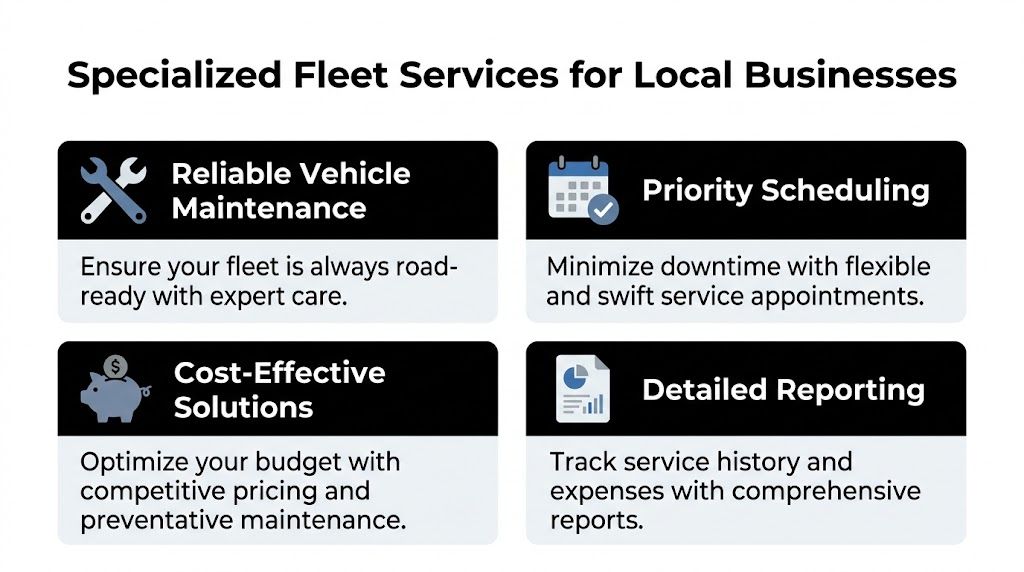
What fleet managers usually need
A consumer-style service process doesn't work well when you're tracking multiple units. Fleet service needs repeatability.
The basics matter most:
- Priority scheduling: Work vehicles can't sit around waiting for an open bay.
- Consistent records: You need service history by vehicle, not scattered receipts.
- Clear approvals: Managers need to know what is urgent and what can be grouped later.
- Broad capability: It's easier when one shop can handle maintenance, brakes, diagnostics, cooling, and suspension.
What helps reduce downtime
For fleets, speed alone isn't enough. The shop also needs process discipline.
A better approach looks like this:
| Fleet need | What works | What doesn't |
|---|---|---|
| Scheduling | Grouped service planning | One-off reactive visits |
| Repair approval | Clear estimates by vehicle | Mixed notes and vague callbacks |
| Recordkeeping | Trackable service history | Paperwork that’s hard to sort later |
| Maintenance planning | Preventive inspections | Waiting for failures |
For companies in NRH, Haltom City, Keller, and Watauga, a dedicated fleet page like this fleet service resource is useful because it reflects the kind of structure commercial customers usually need.
Fleet maintenance works best when the shop treats every vehicle like part of an operating system, not like a random walk-in.
Why this matters locally
A lot of local marketing talks to individual drivers. That's fine, but it leaves a gap for electricians, plumbers, sales teams, delivery operators, mobile techs, and other businesses that run several vehicles at once.
If you're managing a fleet, you don't just need repairs. You need predictability.
Your Local Auto Repair Questions Answered
Is a Haltom City shop practical if I live in North Richland Hills
Yes, if it fits your normal route and saves you time through better communication and fewer repeat visits. For many drivers, Denton Highway access is easier to work into the day than a shop that's technically closer but less efficient.
Should I keep driving with a check engine light on
Sometimes the car will still run, but that doesn't mean it's safe to ignore. A warning light needs proper diagnosis. Waiting can turn a smaller sensor or emissions issue into a more expensive repair.
When should brake vibration be checked
Right away. If the steering wheel or pedal shakes during braking, have it inspected before the problem gets worse. Brake feel changes rarely improve on their own.
What's the difference between maintenance and repair
Maintenance is planned service such as oil changes, inspections, fluid checks, and tire rotation. Repair fixes a fault after a part wears out, leaks, fails, or stops operating correctly.
Do local businesses really need a fleet program
If you manage more than one vehicle, yes. A fleet setup helps organize scheduling, records, approvals, and downtime control in a way that standard walk-in service usually doesn't.
How do I know if a shop is explaining things honestly
Listen for cause and effect. A good advisor should tell you what failed, how they confirmed it, and what happens if you postpone the work. If the explanation is vague, ask more questions.
What's the smart next step if my vehicle has a symptom now
Book an inspection while the symptom is still present. Strange noises, warning lights, overheating, pulling, or rough running are easier to diagnose early than after the condition changes.
If your car needs maintenance, diagnostics, brake work, cooling system service, or fleet support, the simplest next move is to schedule a visit with Express Lube and Car Care. Bring the symptom, the warning light, or the maintenance question. A good shop can take it from there.