

If you searched oil change mansfield, there’s a good chance you’re sitting in the same routine a lot of North Texas drivers know too well. You leave Haltom City, Keller, Watauga, or North Richland Hills with a full schedule, hit traffic, idle through lights, make a quick errand run, then do it all again in heat that feels like it’s coming up through the pavement. That kind of driving is hard on oil, even when the miles don’t look that high on the odometer.
The problem often goes unnoticed while it’s building. The engine still starts. The car still moves. But short trips, stop and go traffic, and hot weather wear oil out faster than most drivers expect. By the time the car gets noisy, sluggish, or starts burning through oil, the easy maintenance window may already be behind you.
That’s why drivers across the mid-cities often use the Mansfield search even when they live elsewhere. They’re not really looking for a zip code. They’re looking for straightforward help, no games, and service that fits real Texas driving.
Your Car's Lifeline Keeping You Moving in North Texas
You pull out of Haltom City for work, hit stop and go traffic, let the car idle at a long light, then make two short errands before heading home. By the end of the day, the odometer barely moved. Your engine still put in a full shift.

That is why oil change timing in North Texas cannot be based on mileage alone. Heat, long idle time, dusty roads, and repeated short trips all age oil faster than easy highway driving. I see it all the time with cars from Haltom City, Keller, Watauga, North Richland Hills, and drivers who searched oil change mansfield because they want a shop that understands the same DFW wear patterns.
What local driving really does to your oil
Oil has a hard job in this part of Texas. Summer heat raises engine temperatures. Traffic keeps airflow low. Short trips can leave moisture and fuel contamination in the crankcase longer than they should stay there. Even a car that feels lightly used can need service sooner than the owner expects.
The practical rule is simple. If the vehicle spends a lot of time idling, making short runs, or crawling through DFW traffic, treat it as severe service and set your maintenance schedule accordingly.
That matters because worn oil usually does not wave a flag early. The engine may still run smoothly while protection is slipping. By the time the oil is badly darkened, thinned out, or carrying too much debris, you are already giving up some margin against internal wear.
Drivers also care about how easy it is to get service scheduled and handled without wasted time. Shops that pay attention to customer communication often use tools such as receptionist solutions for dealerships, because missed calls and slow follow-up frustrate people just as fast as slow service in the bay.
If you want a plain-English breakdown of the basics, our guide on why cars need oil changes covers the main reasons without the fluff.
Why drivers around Haltom City search for Mansfield service
A lot of people using the Mansfield search are not strictly in Mansfield. They are in the mid-cities, comparing shops across the area and looking for someone who will give advice based on real driving conditions, not a canned sticker interval.
That is the difference people notice. A trustworthy shop looks at the vehicle, the oil type, the mileage pattern, and how the car is used in North Texas. Then it gives a service recommendation that fits the car in front of it.
Decoding Your Oil The Engine's Hardest-Working Component
Engine oil is the closest thing your car has to a circulatory system. It flows through tight spaces, protects moving parts, carries contamination away from critical surfaces, and helps control heat. When oil is clean and matched to the engine, parts glide on a protective film. When it breaks down, metal sees more heat, more drag, and more wear.
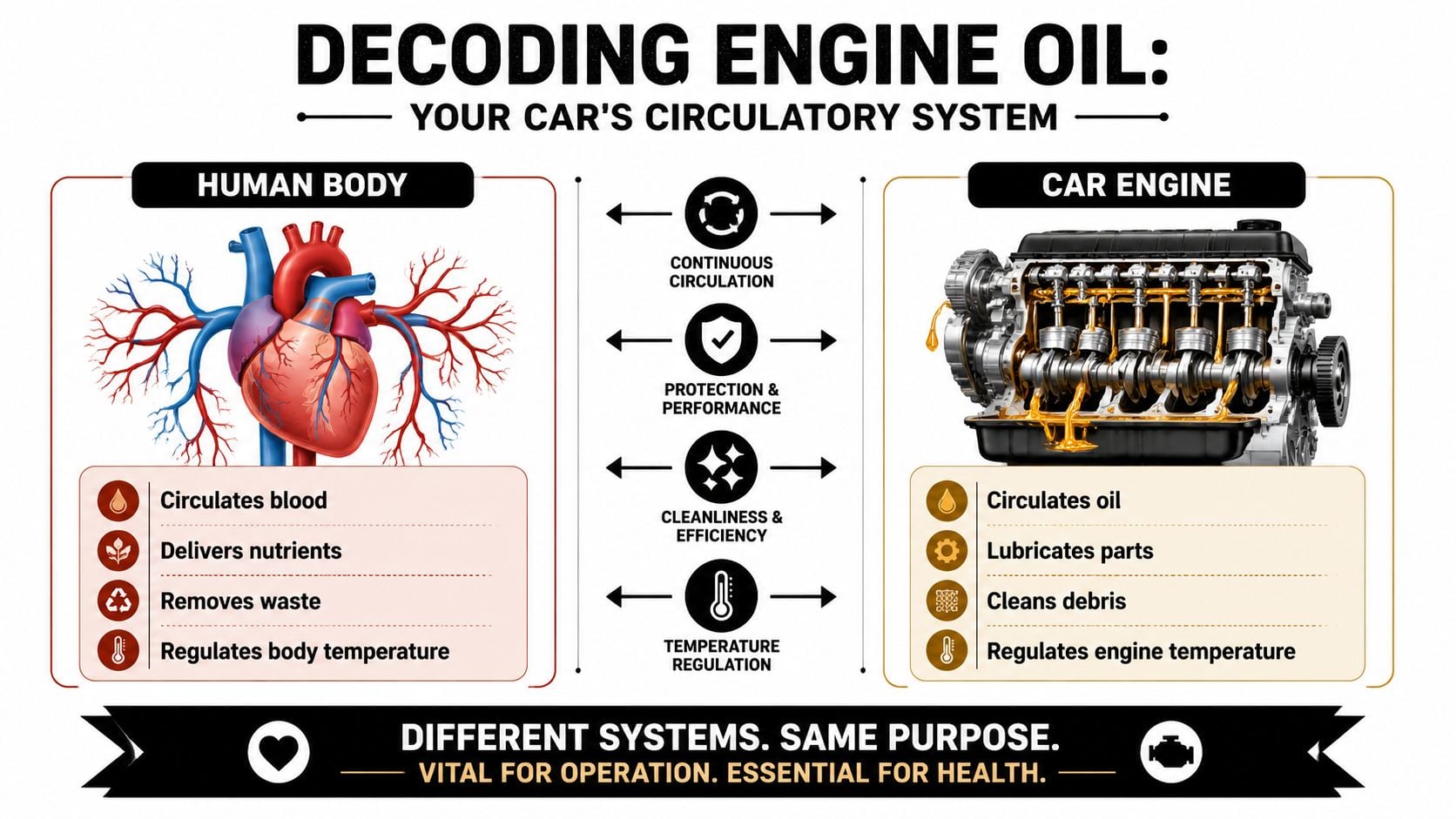
What oil is doing every minute you drive
A good way to think about it is this:
| Engine oil job | What it means in real driving |
|---|---|
| Lubrication | Keeps pistons, bearings, and cam surfaces from rubbing directly against each other |
| Cooling support | Helps carry heat away from internal parts |
| Cleaning | Suspends dirt and combustion byproducts so the filter can catch them |
| Protection | Reduces varnish, sludge, and metal wear when conditions get rough |
If one of those jobs starts slipping, the others usually suffer too. Dirty oil doesn’t cool as well. Thin, overheated oil doesn’t protect as well. Oil loaded with contaminants can’t keep internals as clean.
Conventional, blend, and full synthetic
Most drivers choosing an oil change mansfield service are deciding between three practical categories.
Conventional oil is the basic option. It works, especially for older engines with simple needs and light use. The trade-off is that it breaks down faster in hard heat and traffic. For North Texas drivers who idle a lot or take repeated short trips, conventional oil usually gives up its margin sooner.
Synthetic blend sits in the middle. It offers better resistance to heat and breakdown than conventional without going all the way to a premium full synthetic. For some drivers, especially mixed-use commuters, it can be a reasonable compromise.
Full synthetic is usually the strongest choice for modern engines, turbocharged setups, and heavy traffic use. It handles heat better, flows better on cold starts, and generally keeps its protective properties longer. In local conditions, that extra stability matters.
Oil choice should match the engine, the mileage, and the way the car is actually driven. Not just what’s cheapest on the menu.
Why viscosity matters more on older vehicles
The letters and numbers on the bottle matter. A grade like 5W-30 or 0W-20 tells you how the oil flows at different temperatures. The wrong viscosity can create problems on either side. Too thin, and the engine may lose protection under load. Too thick, and the oil may not flow where it needs to fast enough, especially on startup.
For high-mileage vehicles over 75,000 miles, AAA data cited by Pep Boys’ Mansfield oil change page says higher viscosity oils like 10W-40 can reduce leaks by 20 to 30% in hot Texas climates. That matters for a lot of drivers in Haltom City, Keller, and Watauga who are keeping older vehicles on the road instead of replacing them.
A few quick guidelines help:
- Newer engines: usually do best with the exact OEM-specified grade
- High-mileage vehicles: may benefit from a high-mileage formula and, in some cases, a different viscosity if the engine’s condition supports it
- Texas heat: makes it even more important to choose oil that maintains film strength under stress
If you want a plain-English breakdown of oil grades, this article on engine oil viscosity is worth a read.
The Truth About Oil Change Intervals in the DFW Metroplex
A Mansfield search often comes from drivers who spend most of their week in Haltom City, Keller, Watauga, or North Richland Hills. Their routine is familiar around our shop. Cold start, a few miles to work or school, long idle time in traffic, then a hot restart in the afternoon. That kind of use gets hard on oil fast.

Why the sticker in the windshield doesn't tell the whole story
The old 3,000 mile rule is not a law, but it is not nonsense either. It came from real-world driving that puts extra heat and contamination into the oil. In North Texas, that still describes a lot of vehicles better than the ideal conditions listed in an owner’s manual.
Manufacturer intervals usually assume a fair amount of steady driving at full operating temperature. Many DFW drivers do the opposite. They take short trips, sit in stop and go traffic on I-35W or 820, idle through pickup lines, and run the A/C hard for months at a time. That pattern keeps moisture and fuel dilution in the oil longer, and it adds heat cycles the engine has to live with.
That is why two drivers with the same vehicle can need different oil change timing.
When longer intervals make sense
Longer intervals can be fine with the right setup. Full synthetic oil, a healthy engine, the correct filter, and a driving routine with more highway miles than short-hop errands can support more distance between services.
I still tell drivers to use judgment, not just the reminder sticker.
A longer interval usually makes sense when these conditions line up:
- You are using the oil grade and specification the manufacturer calls for
- The engine is in good condition and not burning or leaking oil
- Your driving includes regular highway trips, not just short in-town runs
- You check the oil level between services and pay attention to the oil life monitor
The trade-off is simple. Stretching intervals saves a little time and money now. Changing earlier gives more margin when the vehicle sees hard use, high heat, or lots of short trips. For many cars around Haltom City and the wider Mansfield search area, the safer answer lands somewhere between the old 3,000 mile habit and the maximum interval printed in the manual.
Here’s a quick visual explanation that lines up with what many technicians tell customers about maintenance timing.
If your routine is heat, traffic, and short trips, err on the earlier side. Oil is cheaper than engine work.
For a practical baseline, this car maintenance schedule by mileage helps match oil service to the rest of your upkeep.
More Than Just an Oil Drain What a Quality Service Includes
A good oil change should leave you with more confidence than a fresh sticker on the windshield. Around Haltom City, Keller, Watauga, North Richland Hills, and the wider Mansfield search area, I see plenty of cars that got “quick service” but missed the things that protect the engine.
The oil and filter matter, of course. So does the care taken during the job. A technician should confirm the correct viscosity and specification for that engine, drain the old oil fully, install a quality filter, refill to the proper level, and verify there are no leaks before the vehicle leaves the bay. On many newer cars, the service also includes resetting the maintenance monitor correctly instead of just guessing at the interval.
That is the baseline.
Value is most apparent in the inspection done while the vehicle is already off the ground and the hood is open. On North Texas vehicles, that often means catching small problems early, before summer heat, traffic, or a long commute turns them into a tow bill.
A quality service commonly includes checks like these:
- Tire pressure and condition, because underinflated tires wear faster and change how the vehicle handles
- Air filter condition, since a clogged filter can affect airflow and everyday drivability
- Belts and visible hoses, which can dry out and crack in Texas heat
- Brake and coolant fluid levels, where low fluid may point to wear or a developing leak
- Signs of seepage underneath, especially around the oil pan, drain plug, filter housing, or valve cover area
Those checks are not filler. They are often where a shop earns your trust.
I have seen simple oil services uncover a loose splash shield, a slow valve cover leak, or tires worn badly on the inside edge that the driver never noticed. None of that gets fixed by pouring in fresh oil, but all of it matters if you depend on the car every day.
Price still matters. So does what you get for it. A low advertised oil change can make sense if the shop uses the right oil, the right filter, and takes time to inspect the vehicle properly. If they rush the job, use bargain parts, or skip the basics, the lower price does not stay low for long.
If you want to compare shops by what they actually do in the bay, review these oil change services in Haltom City. For local companies trying to get found online the same way drivers search for service, this guide can help unlock growth for service based businesses.
The Express Lube Advantage for Haltom City and Mansfield Drivers
A lot of drivers type in oil change mansfield even when they live closer to Haltom City, Keller, Watauga, or North Richland Hills. I see that all the time. What they usually want is not a zip code match. They want a shop that does the job right, explains what matters, and does not waste their time.

Why local accountability matters
A neighborhood shop has to live with its work. That changes how service gets handled. If a customer from North Richland Hills comes back in three months with a question about oil usage, filter choice, or a small seep we noted on the last visit, we need to remember the vehicle and give a straight answer.
That matters more in North Texas than many drivers realize. Summer heat, short trips, highway miles on Loop 820, and long idle times in traffic do not affect every engine the same way. A chain store process can miss that. A local shop should ask better questions and make better recommendations.
Older engines are a good example. Some do best on full synthetic. Some high-mileage vehicles are better served by staying consistent with a blend or conventional plan and changing it sooner. The right answer depends on condition, usage, and what the engine has already been living on. Good service is not about selling the most expensive bottle on the shelf. It is about choosing the option that fits the vehicle.
Fleet drivers need a different conversation
Fleet maintenance is less about one oil change and more about keeping the schedule under control. Contractors, delivery drivers, and small business owners around Haltom City and the Mansfield search area usually care about the same few things. Can the shop handle repeat visits without confusion? Can it track service history clearly? Can it spot a problem early enough to keep that vehicle working next week?
Here is what fleet customers usually need from a shop:
| Fleet concern | What matters |
|---|---|
| Downtime | Service completed on schedule, with fewer surprise repairs |
| Consistency | The right oil, filter, and process used every time |
| Record keeping | Clear notes for each vehicle and each visit |
| Vehicle mix | Support for work trucks, commuter cars, hybrids, and high-mileage units |
Price still counts, of course.
But for a fleet, the cheapest invoice is not always the lowest operating cost. If a rushed service misses a developing leak or uses the wrong spec oil, that vehicle may be back in the bay sooner than it should be. That costs time, scheduling effort, and sometimes a lost workday.
Shops have to stay organized to serve those customers well. Part of that comes from better systems and clearer communication. For business owners interested in the marketing side of running a local service company, this guide on how to unlock growth for service based businesses gives a useful look at that side of the operation.
The best shop for a fleet helps prevent avoidable downtime and keeps service records straight.
Common Questions About Car Maintenance in North Texas
A Mansfield search often starts the same way. Your sticker says service is due, the week is packed, and you want a straight answer from a shop that knows how North Texas driving really treats an engine. We hear that every day from drivers in Haltom City, Keller, Watauga, and North Richland Hills.
Will a local shop void my new car warranty
No. An independent shop can service a newer vehicle without voiding the warranty, as long as the work follows the manufacturer requirements and the shop uses the correct oil and filter.
Keep the invoice. Make sure it shows the oil grade, filter, date, and mileage. That paperwork matters if a warranty question ever comes up.
Do I need an appointment for an oil change
It depends on the shop, the hour, and your vehicle.
Some drivers can stop in without much wait. Others drive something that needs a specific filter or a harder-to-find oil spec, and calling ahead saves time. For drivers coming over from Keller or Watauga, that can be the difference between a quick service stop and a longer wait than expected.
What warning signs mean my oil change is overdue
Mileage and time are still the first things to check, but the vehicle usually gives clues too:
- Dirty or gritty oil on the dipstick
- More ticking or valvetrain noise than usual
- A burnt oil smell after normal driving
- An oil light or maintenance reminder
- Rougher idle or sluggish response
One symptom does not always mean the oil is the whole problem. A few signs together, especially on a car that is already due, usually mean it is time to service it and inspect for anything else developing.
Is dark oil always bad oil
No. Oil often gets darker as it suspends contaminants and moves heat through the engine.
What matters more is the full picture. Check the level, the texture, the smell, the miles since the last service, and how the engine sounds. In North Texas, repeated short trips, long idling with the A/C on, and summer heat can all make oil age faster than drivers expect.
Should I use synthetic on an older car
Often, yes. Many older engines benefit from synthetic oil because it handles heat better and holds up well in heavy commuting.
Condition still comes first. If an older engine already has seepage around seals, sludge buildup, or a sketchy maintenance history, the right answer may be a high-mileage formula or a cautious step-up plan instead of a simple switch. The label on the bottle does not matter as much as what the engine is telling you.
How do I choose between 5W-30, 0W-20, and 10W-40
Start with the spec on the oil cap or in the owner’s manual. That is the safe baseline.
From there, real-world use matters. A newer engine designed for 0W-20 usually needs that exact viscosity for proper flow and fuel economy. A vehicle built for 5W-30 should usually stay there. A thicker oil like 10W-40 can make sense in some high-mileage cases, but only after looking at wear, oil consumption, and the manufacturer range. Going thicker just because the car is older is not always smart.
What does a quality oil change usually include
A quality oil change should include more than draining old oil and spinning on a filter.
It should confirm the correct oil spec, replace the filter, check the oil level after refill, inspect for obvious leaks, and give the vehicle a quick look at fluid levels and basic wear items. That extra few minutes can catch a seep, a loose splash shield, or a tired battery before it turns into a bigger headache.
What is the normal cost range for an oil change
Cost depends on the vehicle, oil capacity, oil type, and filter. A basic conventional service on an older, simple engine usually costs less than a full synthetic service on a newer vehicle with a cartridge filter or larger oil capacity.
The better question is what the price includes. A lower price can still be a poor value if the wrong oil gets used, the filter is cheap, or no one checks the car over. A solid service should match the vehicle spec and give you a clear record of what was done.
How often should business vehicles come in
Business vehicles need a schedule based on actual use, not memory. A work truck that idles on job sites, makes short runs, or carries weight all week will usually need more attention than a personal commuter car.
For small fleets around Haltom City and the broader Mansfield search area, the goal is consistency. Track service by mileage, time, and operating conditions. That keeps one overdue van from turning into a bigger repair and an unexpected day off the road.
If your car is due, or you want a second opinion before a small oil issue turns into a bigger engine problem, Express Lube and Car Care is a solid local option for drivers in Haltom City and the wider Mansfield search area. They handle routine oil service, inspections, and ongoing maintenance with the kind of straight answers North Texas drivers usually want.