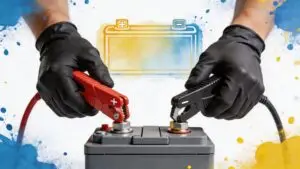

A dead battery never shows up at a convenient time. It happens when you’re already late for work in Haltom City, trying to leave for Watauga, or heading across North Richland Hills with a full day ahead.
Most drivers treat a jump start like a quick favor. Grab cables, find another car, clamp red to red, black to black, and hope for the best. The problem is that this is one of those jobs that looks simple right up until somebody gets hurt or a modern electrical system gets damaged.
That Dreaded Click A Haltom City Driver’s Dilemma
You turn the key, or press the button, and get that weak click. Maybe the dash lights come on. Maybe they flicker. Maybe everything looks normal until the engine refuses to crank.
That scene plays out all over the DFW area, especially on rushed mornings. A driver in Haltom City leaves the dome light on overnight. A parent in Keller is loading kids into the car and suddenly nothing happens. A work truck in North Richland Hills sits over the weekend and won’t fire Monday morning.
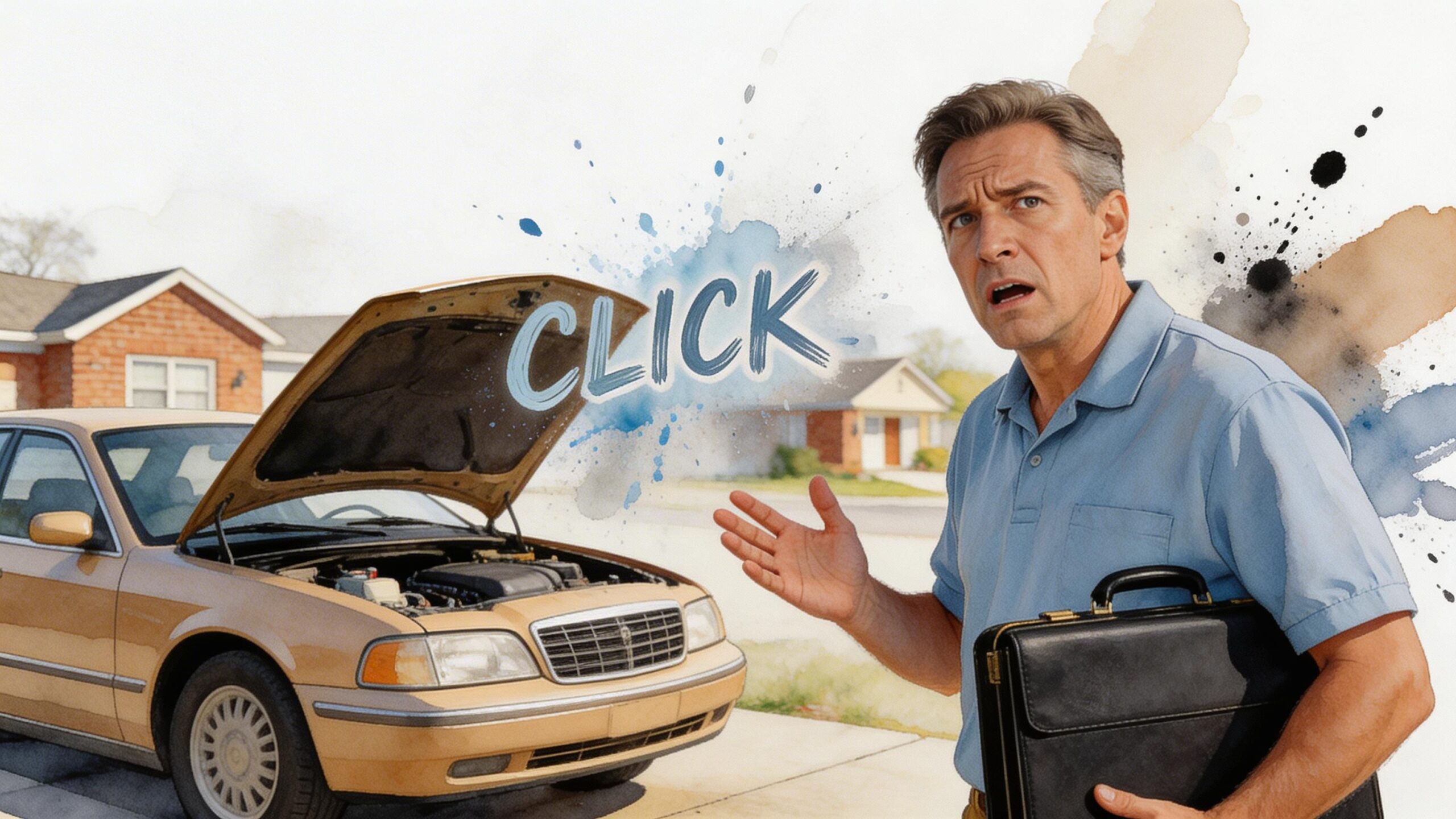
The first instinct is usually to attach jumper cables fast and get moving. That urgency is understandable, but it’s also where people make dangerous mistakes.
According to NHTSA data on motor vehicle battery injuries, jump-starting a vehicle accounts for 19% of all motor vehicle battery injuries. That puts it right up there with checking fluid levels. For something many people consider routine, that’s a serious warning.
Why this matters on a busy morning
Battery problems aren’t always just “dead battery” problems. A weak battery, corroded terminal, bad charging system, or starter issue can all look similar at first.
If you own an RV or trailer and you’re already familiar with charging-system confusion, a guide on RV converter not charging battery can help show how often people mistake one electrical problem for another. The same thing happens with passenger vehicles. The symptom feels obvious. The cause often isn’t.
A jump start should be treated like electrical work under the hood, not like a roadside shortcut.
What drivers usually get wrong
Some drivers rush the order. Others use bargain cables that can’t carry enough current. A lot of people connect the last clamp straight to the dead battery because it seems easier.
That’s exactly why knowing how to attach jumper cables safely matters. The right process protects you, protects the donor vehicle, and gives you a better chance of starting the car.
Gathering Your Gear and Checking Your Vehicle First
A good jump start begins before any clamp touches a battery post. The cable set matters. The condition of the battery matters. The vehicle itself matters.
Cheap cables cause more trouble than most drivers realize, especially around Haltom City where pickups, SUVs, and work vehicles are common.
Choose cables that can actually do the job
The best setup for most drivers is 4-6 AWG pure copper jumper cables in the 12-20 ft range. According to this jumper cable guide, low-gauge cables under 10 AWG have a 70% failure rate on V8 engines due to voltage drop.
That’s the issue with thin discount-store cables. They may work on a small sedan on a mild day. They often struggle on trucks and larger engines.
Here’s what to look for:
- Cable thickness: Go with 4-6 AWG if you want something dependable for real-world use.
- Material: Look for pure copper rather than copper-clad aluminum.
- Length: 12-20 ft gives you flexibility when cars can’t line up perfectly.
- Clamp quality: Strong spring tension helps maintain contact while you crank.
Inspect the dead battery before you touch anything
A jump start is unsafe if the battery is physically damaged. Don’t try to force it.
Check for:
- Swelling or a warped case: Heat can be brutal on batteries in Texas.
- Cracks or leaks: Stop immediately if you see battery fluid.
- Heavy corrosion: White, blue, or green buildup can interfere with contact and point to terminal issues.
- Loose terminals: A loose connection can mimic a dead battery.
If corrosion is part of the problem, this article on battery terminal corrosion prevention is worth reading after you get the vehicle sorted out.
Shop habit: Before I ever attach jumper cables, I look at the battery tray, the hold-down, and the cable ends. A battery that’s loose or badly corroded can turn a simple jump into a much bigger problem.
Check the vehicle setup
Modern cars don’t always make this easy. Some vehicles hide the battery under trim panels, in the trunk, or under a seat. Others give you designated jump posts under the hood.
Do these checks first:
- Confirm the battery voltage matches: If the systems aren’t compatible, don’t guess.
- Find the positive terminal clearly: Look for the plus symbol or red cover.
- Locate a proper ground point: You’ll need bare metal on the disabled vehicle.
- Turn off accessories: Headlights, blower motor, radio, seat heaters, and anything else drawing power should be off.
On newer vehicles with stop-start systems, multiple batteries, or unusual under-hood layouts, the owner’s manual matters more than habit. The right connection point may not be the battery post you expect.
The Safe Connection Sequence Step by Step
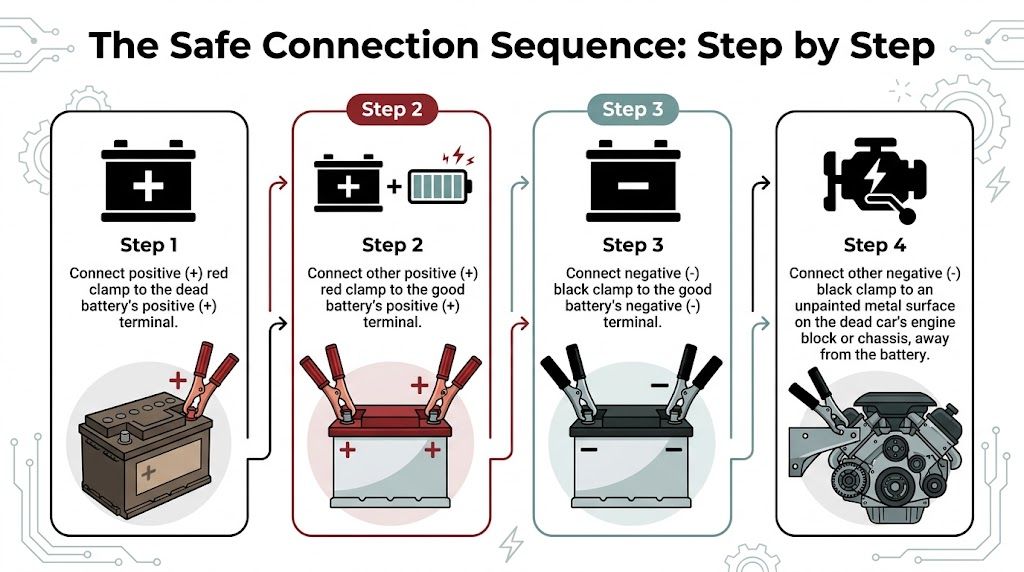
Once both vehicles are parked close enough but not touching, put them in park, set the parking brakes, and shut them off before you attach jumper cables.
The order matters because you’re controlling where sparks can occur.
First red clamp on the dead battery
Start with the red positive clamp on the dead battery’s positive terminal.
Make sure it bites onto clean metal. If the clamp is sitting on corrosion or a plastic edge, you won’t get a strong connection.
Second red clamp on the good battery
Take the other red clamp and connect it to the donor battery’s positive terminal.
At this point, keep the black clamps from touching anything they shouldn’t. You want deliberate contact, not accidental contact.
First black clamp on the good battery
Now connect one black negative clamp to the donor battery’s negative terminal.
This side of the circuit is straightforward. Given that the donor battery is the stable source, the negative battery connection belongs to it.
A quick visual helps most drivers remember the sequence better than text alone.
The final critical ground connection
The last clamp is the one people get wrong most often.
According to this jumper cable safety guide, the final black clamp should go to an unpainted metal surface 12-18 inches from the dead battery. That moves potential sparks away from hydrogen gas around the battery.
Connect the final black clamp to a solid, unpainted metal point on the disabled vehicle. Not to the negative post on the dead battery.
Good ground points include:
- An engine lifting bracket
- A heavy unpainted bolt on the engine block
- A sturdy chassis ground point
- A factory-designated jump ground, if the vehicle has one
Avoid thin brackets, painted surfaces, and anything near belts or fans.
Starting the vehicles the safe way
With all four connections secure, start the donor vehicle. Let it idle briefly, then try starting the disabled vehicle.
If it doesn’t start right away, don’t keep cranking over and over. Stop, recheck clamp contact, and reassess the battery condition.
A few practical reminders help here:
- Keep hands and sleeves clear: Engine bays have moving parts and sharp edges.
- Watch the cable routing: Don’t let cables hang near pulleys or fans.
- Stay calm: Most failed jump attempts come from poor contact or a battery that has another underlying issue.
Removing the cables in reverse order
Once the disabled vehicle starts, remove the cables in reverse order:
- Black clamp from the grounded metal point on the dead vehicle
- Black clamp from the donor battery
- Red clamp from the donor battery
- Red clamp from the revived vehicle
Don’t let the clamps touch each other during removal. Keep them separated until the set is fully off both vehicles.
Common Jump Starting Mistakes to Avoid
The most common jump-start errors aren’t complicated. They’re rushed. That’s why they keep happening.
Research from Wogalter and colleagues showed 0% of participants could correctly diagram the connection sequence without visual aids. That tells you the average driver often feels more confident than prepared.
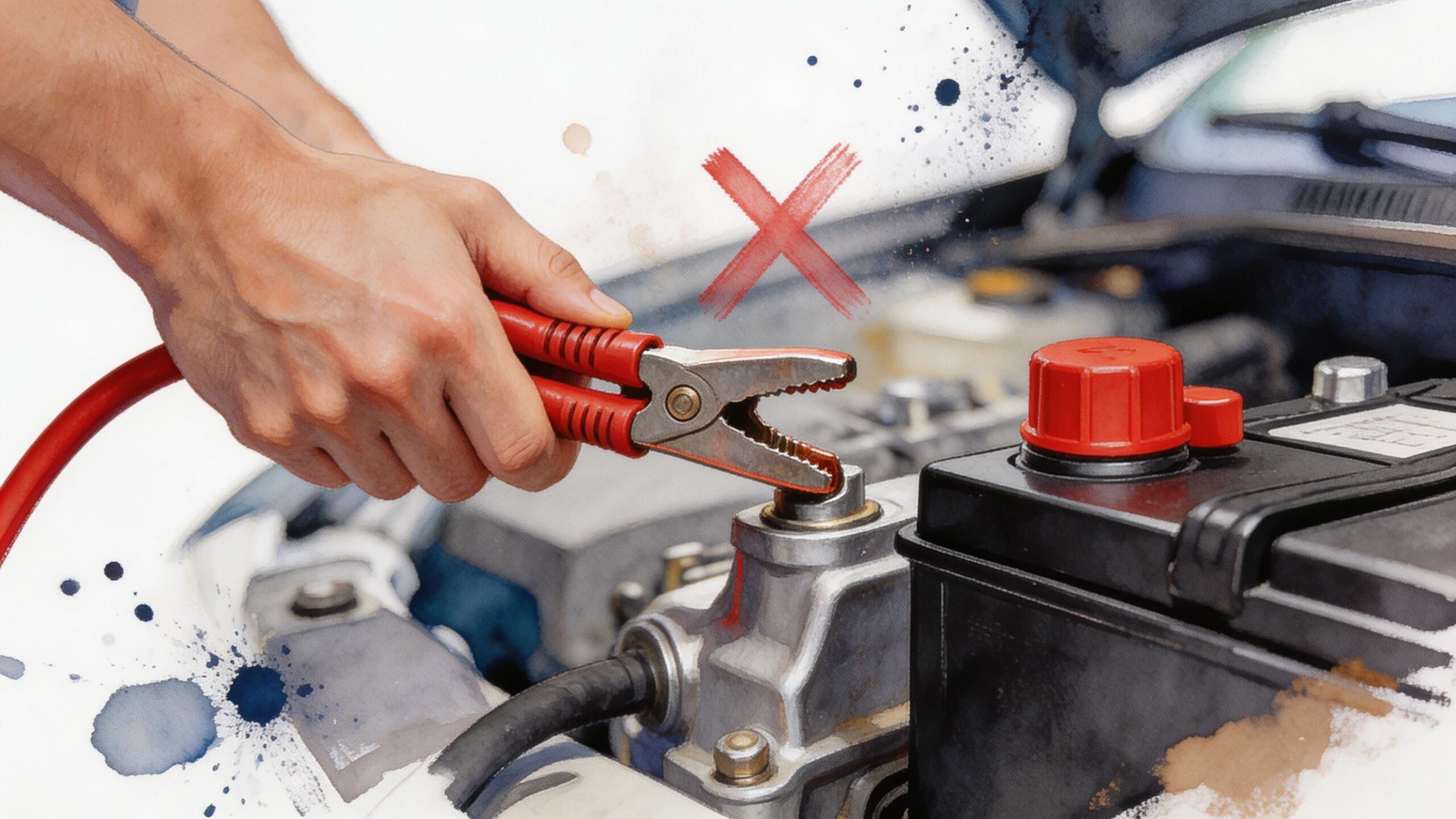
Mistake one is assuming black always goes on the dead battery
That shortcut is still everywhere. People learned it from a friend, saw it done once in a parking lot, or copied a half-remembered version from years ago.
The safer method is the remote ground connection covered above. It lowers the chance of creating a spark near battery gas.
Mistake two is reversing polarity
Red to positive and black to negative sounds simple until someone is leaning into a dark engine bay with faded battery markings.
Reversed polarity can damage fuses, control modules, and charging-system components. On newer vehicles, that risk is even higher because there are more electronics under management all the time.
Mistake three is ignoring the real reason the car won’t start
Sometimes the battery isn’t the main issue. If the engine only clicks, grinds, or acts inconsistent after a jump attempt, the problem may involve the starting circuit.
If that sounds familiar, this page on bad solenoid symptoms can help you separate a battery issue from a starter-related one.
Reality check: If the cable order is right and the vehicle still won’t crank normally, stop assuming more cranking will solve it.
Mistake four is using the wrong vehicle for the jump
A large truck with a discharged battery can overwhelm a small donor vehicle. On the other end, hybrids and EVs need extra caution because their systems don’t follow the same assumptions people make with older gas vehicles.
For hybrid, EV, or unusual start-stop systems, always check the manual first. If the manual isn’t clear, don’t experiment.
Mistake five is poor cable management
Loose cables cause preventable trouble under the hood.
Watch for these problems:
- Clamps near belts: They can get pulled into moving parts.
- Cables draped over fans: Electric cooling fans can kick on unexpectedly.
- Weak clamp contact: The connection slips as soon as the engine vibrates.
- Crossed routing: The cables touch where they shouldn’t.
A clean setup is safer and more effective than a fast sloppy one.
Your Car Started Now What Do You Do
A successful start doesn’t mean the problem is solved. It means the engine is running.
The next few minutes matter as they determine whether drivers give the battery a fair chance to recover or shut the car off and end up stranded again.
Remove the cables carefully
Take the cables off in reverse order, starting with the ground clamp on the revived vehicle and ending with the red clamp on that same vehicle.
Keep the clamps separated and don’t lay them where they can swing into metal. A rushed disconnect can create the same kind of trouble as a rushed hookup.
Drive the car instead of letting it sit and idle
Many guides tell drivers to let the car run for 20 minutes, but this practical guide on post-jump operation notes that driving is preferable to idling because the alternator works at a more effective RPM. It also advises avoiding high-load accessories like A/C or seat heaters during that period.
This holds true in practice. Idling in the driveway doesn’t help as much as getting the engine up to a steady operating speed.
A good approach is:
- Choose a steady drive: Avoid shutting the car right back off after a short move.
- Leave major accessories off: Give charging priority to the battery.
- Pay attention to warning lights: Battery or charging warnings matter.
Figure out whether this was a one-time drain or a deeper issue
A battery can go dead for a simple reason. A light left on. A door not fully latched. A vehicle sitting too long.
It can also go dead because the battery is failing, the alternator isn’t keeping up, or there’s an electrical drain in the system. If you want a better sense of what comes next, this article on how to repair car battery helps explain what can and can’t be addressed after a no-start event.
If the car starts after a jump and then struggles again later that same day, assume there’s an underlying problem until proven otherwise.
Signs you shouldn’t ignore
Watch for patterns after the jump:
- Slow cranking later
- Battery warning light
- Dim lights at idle
- Electrical glitches or resets
- Another no-start after a normal drive
Those clues point away from a simple one-time discharge and toward diagnosis.
When to Skip the Cables and Call Express Lube
Some situations aren’t worth a driveway gamble. The smart move is stepping back before you create a safety problem or an expensive repair.
That’s especially true with newer vehicles, damaged batteries, and repeat no-start complaints.

Skip the DIY jump if the battery looks physically wrong
Don’t attach jumper cables if the battery case is swollen, cracked, leaking, or looks heat-damaged. In North Texas heat, battery failure can show up fast, and visible case damage is a hard stop.
The same goes for a battery that smells unusual, feels unstable in its tray, or has terminal damage that prevents secure clamp contact.
Be cautious with modern electronics
According to AAA guidance on jump-starting, modern vehicles have sensitive electronics vulnerable to voltage spikes, and mismatched battery voltages can cause thousands in electrical damage.
That’s the part many generic how-to articles miss. A lot of newer vehicles in Haltom City, Keller, and Watauga have advanced driver-assistance systems, infotainment modules, and start-stop features that don’t tolerate guesswork well.
Repeated jump starts are a warning, not a solution
If you’ve needed more than one jump in a short period, stop treating it like bad luck. That pattern points to a battery, charging, starter, or parasitic-draw problem.
For homeowners, electrical troubleshooting follows the same logic. You don’t keep resetting a breaker forever and call it fixed. This guide to professional electrical troubleshooting is a good reminder that repeat symptoms usually mean there’s a deeper fault that needs proper testing.
Know when the alternator may be part of the problem
A dead battery and a bad alternator can feel similar from the driver’s seat. If the car starts after a jump but won’t stay healthy, charging-system diagnosis matters. This article on how to know if alternator is bad is a useful next read if you’re seeing repeat battery issues.
If you’re unsure where to clamp, unsure about voltage compatibility, or unsure whether the battery is even safe to jump, that’s already enough reason to stop and get help.
Frequently Asked Questions About Jump Starting
A few questions come up constantly from drivers around Haltom City, Keller, and Watauga. Here are the short answers.
| Question | Answer |
|---|---|
| Can I attach jumper cables in any red-black order as long as positive and negative match? | No. The sequence matters because it controls where sparks may occur. Follow the safe order and use a ground point on the disabled vehicle for the final black clamp. |
| Should the donor car be touching the dead car? | No. Park close enough for the cables to reach, but the vehicles shouldn’t touch. |
| Can I jump-start a hybrid or EV the same way as an older gas car? | Not automatically. Some hybrids and EVs have special procedures or dedicated jump points. Check the owner’s manual before doing anything. |
| What if the car still only clicks after I connect everything correctly? | Stop and reassess. The issue may be a weak connection, a severely discharged battery, or a starter or solenoid problem rather than a simple dead battery. |
| Is idling enough after the car starts? | Driving is usually better than idling because the alternator works more effectively at driving RPM. Keep heavy accessories off while the battery recovers. |
| Can I use very thin jumper cables if that’s all I have? | Thin cables often perform poorly, especially on larger engines. A proper cable set gives you a much better chance of a successful jump. |
| When should I avoid a DIY jump completely? | Avoid it if the battery is swollen, cracked, leaking, mismatched in voltage, or if the vehicle has a complex electrical setup you’re unsure about. |
If your vehicle in Haltom City won’t start, keeps needing jumps, or shows signs of a charging problem, the team at Express Lube and Car Care can help you sort it out safely. We handle battery checks, charging-system diagnosis, and the underlying issues that keep leaving drivers stranded.