
Deep inside your car's engine, there's a small but mighty gatekeeper that controls its temperature. This part, the thermostat, is one of the most important components you’ve probably never seen. It acts as your engine's personal climate control, working tirelessly to prevent overheating during a scorching Haltom City summer and helping your car warm up quickly on a cold day.
The Unsung Hero of Your Car's Engine
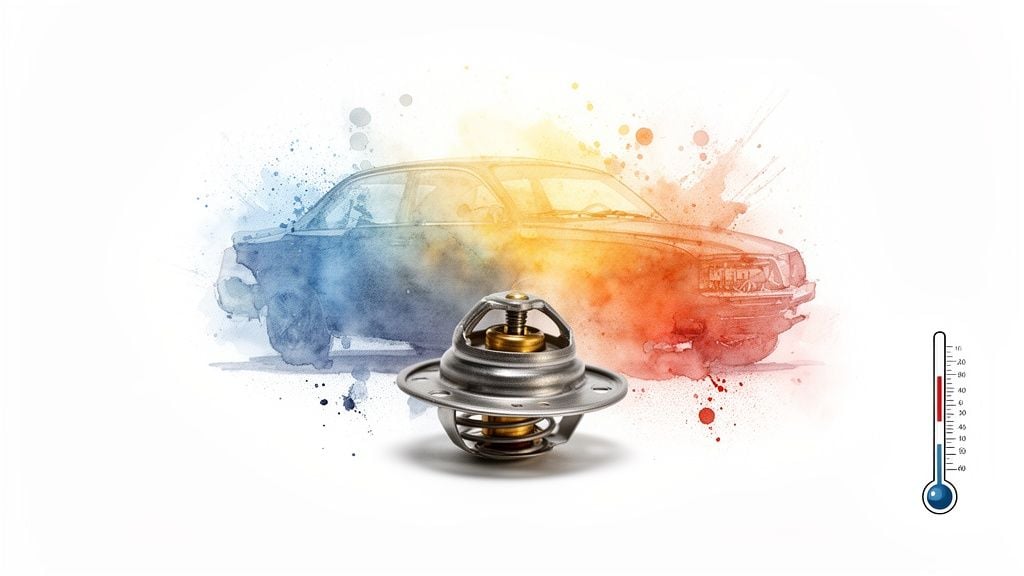
While most Haltom City drivers have heard of a thermostat, its critical role isn't always clear. At its heart, the thermostat is just a temperature-sensitive valve, sitting in the path between your engine and the radiator. Its only job is to decide when to let engine coolant flow to the radiator to get cooled off.
When you first start your car, especially on a chilly North Texas morning, the thermostat stays closed. This keeps the coolant circulating only within the engine block, which allows the engine to get up to its ideal operating temperature much faster. A properly warmed-up engine is not only more efficient but also produces fewer harmful emissions.
Once the engine hits its sweet spot—usually somewhere between 195°F and 220°F—the thermostat opens up. This action allows the now-hot coolant to flow out to the radiator, where air passing through cools it down before it cycles back into the engine. This continuous loop is what keeps your engine from overheating, a vital job for any vehicle in Haltom City, particularly during our intense Texas summers.
To put it simply, here’s a quick breakdown of what your thermostat is doing and what happens when it isn’t.
Car Thermostat At-a-Glance
| Function | Sign of a Healthy Thermostat | Symptom of a Failing Thermostat |
|---|---|---|
| Engine Warm-Up | The temperature gauge rises steadily to the normal range within minutes. | The engine takes forever to warm up, or the heater blows cool air. |
| Temperature Regulation | The temperature gauge stays stable, even in heavy Haltom City traffic or hot weather. | The engine overheats quickly, or the temperature gauge fluctuates wildly. |
| Coolant Flow | Coolant circulates to the radiator only once the engine is warm. | Coolant flow is either blocked (stuck closed) or constant (stuck open). |
This small, simple part has a massive impact on your car's overall health and your driving experience in Haltom City.
This little device, which has been a staple in cars since the 1930s, directly influences several key aspects of your vehicle's health:
- Engine Performance: By maintaining a consistent temperature, the thermostat ensures all the finely-tuned parts of your engine can work together harmoniously.
- Fuel Economy: An engine running at its proper temperature burns fuel far more efficiently, saving you money at the pump in Haltom City.
- Longevity: Preventing both overheating and major temperature swings puts less stress on critical engine components, helping your engine last longer.
How Your Car Thermostat Actually Works
Ever seen one of those pop-up timers on a Thanksgiving turkey? That's a surprisingly great way to think about your car's thermostat. It’s a simple, purely mechanical little device designed to open and close at a very specific temperature, and it does its job without any computers.
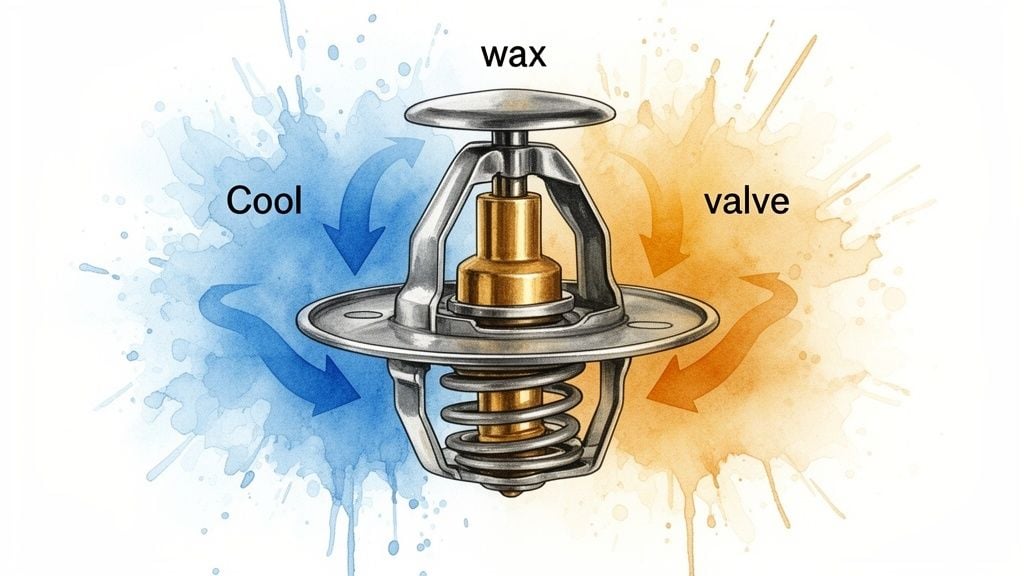
At the heart of the thermostat is a small cylinder filled with a special wax. This isn't just any wax; it's engineered to expand in a very predictable way as it heats up.
When you first crank your engine, everything is cold, including the coolant and the wax inside the thermostat. A spring keeps the thermostat's main valve held shut, which blocks the coolant from flowing to the radiator. This is by design. It forces the coolant to circulate only inside the engine block, helping it warm up to its ideal operating temperature much faster. A quick warm-up means better efficiency and lower emissions, which is important even on a hot Haltom City day.
The action really starts once the coolant hits the thermostat’s trigger point, which is typically around 195°F. At this temperature, the wax inside melts and expands, pushing a small pin that overpowers the spring and opens the valve.
The Flow of Coolant
With the valve now open, hot coolant can finally make its journey out of the engine and into the radiator. There, it gets cooled down by airflow before being sent back to the engine to absorb more heat. If you're curious about that part of the process, you can learn more about how car radiators work in our detailed guide.
This entire cycle is a constant balancing act. The thermostat's valve will continuously adjust—opening a little more or closing a bit—to perfectly regulate the flow and keep your engine running at a stable, happy temperature, whether you're on Denton Hwy or I-820.
Modern Thermostat Technology
While that classic wax-pellet design has been the standard for decades, many newer cars now use electronically controlled thermostats. Instead of relying only on heat, these thermostats get direct commands from the vehicle's main computer (ECU).
This allows for incredibly precise temperature control based on what you're doing. The ECU might keep the engine a little cooler when you're accelerating hard for maximum performance, then let it run warmer during a gentle cruise to boost fuel economy. It's an active system that helps optimize every aspect of your drive around Haltom City.
Critical Signs Your Thermostat Is Failing
A failing thermostat isn't just a minor headache—it's a serious risk to your engine's health. For drivers here in Haltom City, knowing what to look for can be the difference between a simple fix and a catastrophic engine failure. If your car starts showing any of these signs, it's telling you it needs attention.
The most obvious and dangerous red flag is a rapidly overheating engine. You’ll know it when you see it: the temperature gauge shoots into the red zone just a few minutes after you start driving. This almost always means the thermostat is stuck closed, trapping scorching-hot coolant inside the engine block. Pulling over immediately is a must, especially in Haltom City's summer heat.
On the other hand, you might have the opposite problem. An engine that never seems to warm up is the classic sign of a thermostat stuck in the open position. If your temperature needle stays stubbornly low and your heater only blows lukewarm air on a cold morning, your thermostat is likely the culprit. This quietly hurts your wallet by wrecking your fuel economy.
Other Red Flags to Watch For
Beyond the two most common failures, a few other symptoms can tip you off to a thermostat that's on its way out.
- Erratic Temperature Readings: Does your temperature gauge seem to have a mind of its own, bouncing from cool to hot and back again? This wild fluctuation often means the thermostat is starting to fail and can no longer open and close smoothly.
- Coolant Leaks: Look for puddles of green, pink, or orange fluid under the front of your car. A leak near the thermostat housing can indicate a failed gasket or a crack. Sometimes these leaks are slow and hard to spot, so our guide on how to find a coolant leak can help you pinpoint the source.
Don't underestimate these warnings. A bad thermostat is connected to 15-20% of all major engine breakdowns. It can also increase your fuel consumption by up to 15% because the engine isn't running at its proper temperature. For anyone driving around Haltom City and the surrounding areas, catching this early is key to saving money and avoiding a tow truck. You can learn more about this crucial part by reading these insights on engine thermostats.
4. Stuck Open vs. Stuck Closed: Understanding the Two Failure Modes
When a car thermostat goes bad, it doesn't just stop working—it usually gets stuck in one of two positions: open or closed. It's a classic "fork in the road" failure, and each path brings its own set of problems. Understanding the difference is key to diagnosing the issue and knowing just how urgent the repair is for a Haltom City driver.
Thermostat Failure: Stuck Closed
Let's start with the worst-case scenario: a thermostat that’s stuck closed. Think of it as a permanent roadblock. The valve is shut, trapping hot coolant inside the engine block. No matter how hot the engine gets, that coolant can't get to the radiator to cool down.
This is by far the more dangerous failure. It leads to rapid, severe overheating, which is a recipe for disaster, especially in stop-and-go Haltom City traffic.
A stuck-closed thermostat isn't something to ignore. The intense heat can quickly blow a head gasket or even warp the cylinder head—turning a simple part replacement into a repair job that costs thousands.
Thermostat Failure: Stuck Open
On the flip side, a thermostat can also fail by getting stuck open. This creates the opposite problem. The valve is wide open all the time, so coolant constantly circulates through the radiator, even when the engine is cold and trying to warm up.
While not as immediately catastrophic as a stuck-closed failure, an engine that never reaches its ideal operating temperature runs poorly. You'll notice your car's heater blows lukewarm air at best, and over time, you'll see a drop in fuel economy and a potential increase in long-term engine wear—a real problem for any Haltom City commuter.
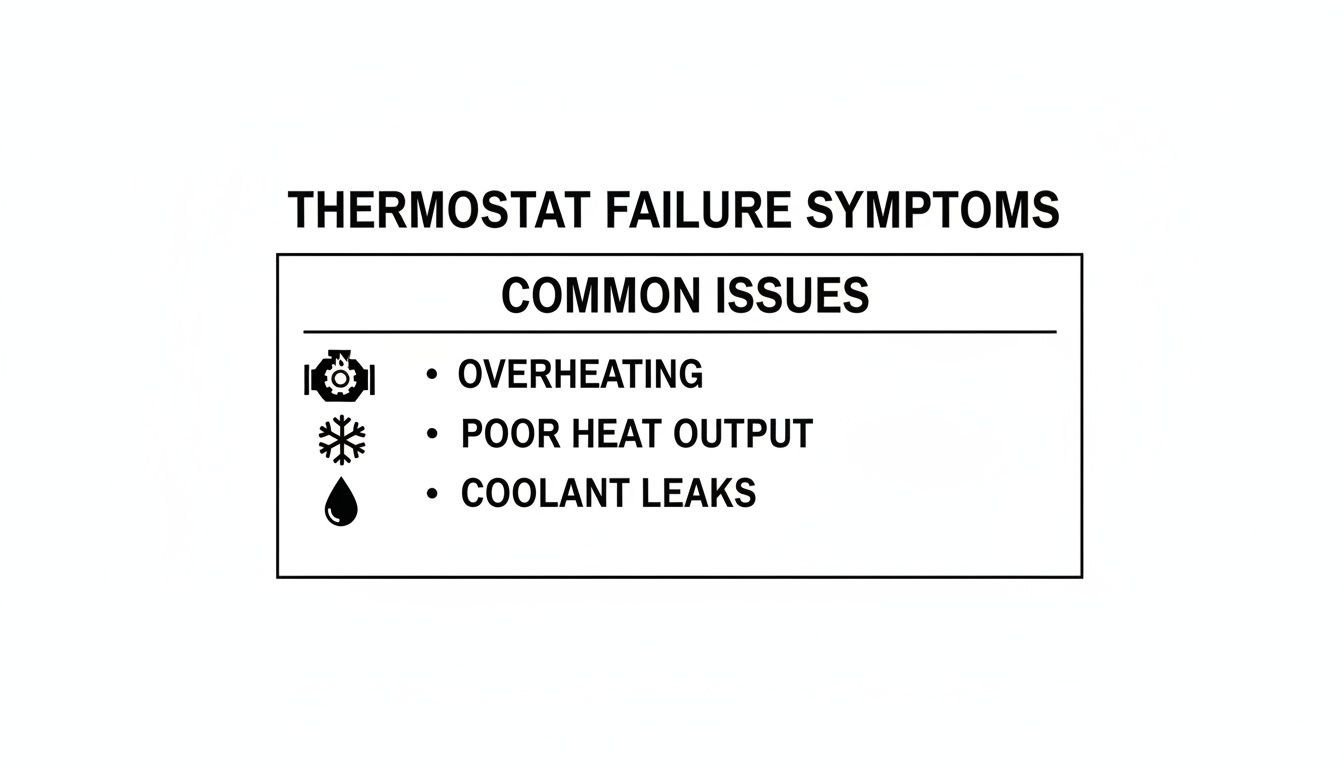
This quick comparison sums up the two main ways a thermostat can give you trouble.
Thermostat Failure Stuck Open vs Stuck Closed
| Failure Mode | Primary Symptom | Immediate Risk | Long-Term Consequence |
|---|---|---|---|
| Stuck Closed | Engine rapidly overheats | High: Severe engine damage (warped head, blown gasket) | Total engine failure if not addressed immediately |
| Stuck Open | Engine won't reach operating temperature; poor heater performance | Low: No immediate engine damage | Poor fuel economy, increased emissions, accelerated engine wear |
Whether it's the dangerous overheating from a stuck-closed thermostat or the performance-killing effects of a stuck-open one, both scenarios need attention.
Finally, keep an eye out for coolant puddles under your car. A leak around the thermostat housing is another common symptom. If you see coolant, it’s also a good idea to check your radiator cap, as it’s a critical part of the cooling system’s pressure regulation. For more on that, check out our guide on how to test a radiator cap.
Your Thermostat Replacement Options in Haltom City
So, you've figured out your car’s thermostat is on the fritz. Now comes the big decision: do you tackle the replacement yourself or hand the keys to a pro in Haltom City? Watching a quick video might make it look simple, but this is one of those jobs where a small mistake can create a much bigger, more expensive headache.
Replacing a thermostat isn't just about unscrewing an old part and popping in a new one. The entire cooling system has to be drained without making a mess, the new thermostat needs a perfect seal to prevent leaks, and then the system has to be refilled. Most importantly, all the air has to be "bled" out afterward.
An air pocket in your cooling system is a gremlin you don't want. That trapped bubble can stop coolant from circulating entirely, causing your engine to overheat just as badly as it did with the old, broken thermostat. It’s the most common mistake we see with DIY attempts here in Haltom City.
The Professional Advantage in Haltom City
That's where a trusted local shop like Express Lube & Car Care comes in. Our technicians in Haltom City have the right tools, experience, and patience to get the job done right the first time. We handle the whole process, making sure your cooling system is drained, sealed, and bled correctly to get you back on the road safely.
We're also picky about parts. The high-quality OEM or equivalent thermostats we use are built to last up to 150,000 miles. That's a huge step up from many off-the-shelf parts that might only last 70,000 miles. This focus on quality is why we have a 95% first-time fix rate and why our Haltom City customers avoid 75% of the hydrolock risks that can come from a botched repair. For a deeper dive into how these parts have changed, check out this great read on thermostat evolutions on Tomorrow's Technician.
Choosing the right service means you’re not just fixing a problem for today—you’re investing in your car's long-term health. Understanding repair costs is part of being a smart car owner; for comparison, you can see what a typical ignition switch replacement cost looks like. And since you're working with your cooling system, take a moment to learn about the dos and don'ts of mixing coolant and water.
Trust Haltom City Experts for Your Cooling System Needs
When it comes down to it, that little thermostat is one of the most important parts under your hood. It's the gatekeeper that protects your engine from its own heat. Seeing those warning signs we talked about—like overheating or an engine that just won't warm up—and choosing to ignore them is a real roll of the dice, especially in Haltom City's climate. You're betting against a problem that can quickly spiral into some seriously expensive and complicated engine repairs.
That’s why having a trusted local mechanic makes all the difference. For our customers and neighbors here in Haltom City, Keller, and North Richland Hills, we’re not just another auto shop; we’re part of the community. At Express Lube & Car Care, we’ve seen what Haltom City weather can do to a cooling system, and we know exactly how to diagnose the issue correctly and get it fixed with parts you can rely on.
Don't let a small cooling system problem turn into a full-blown breakdown on the side of a Haltom City road. Your engine's health is just too important to leave to chance. A little professional attention now goes a long way toward keeping your car safe and dependable for years to come.
Feel like your cooling system might be acting up? Swing by our shop on Denton Hwy in Haltom City or give us a call to schedule an inspection. Let our team give you the peace of mind that comes from knowing your car is ready for whatever the road throws at it.
Your Top Thermostat Questions, Answered
Even after getting the basics down, you probably still have a few questions. That's perfectly normal! Here are the straightforward answers to the questions we hear most often from drivers here at our Haltom City shop.
How Much Does Thermostat Replacement Cost?
This is usually the first thing people ask, and the honest answer is: it depends on your vehicle. For most cars, a complete thermostat replacement service in Haltom City will run between $150 and $450, which covers both the part and the labor. The thermostat itself is usually inexpensive, but the final bill can go up if it's buried deep in the engine bay and hard to get to.
How Often Should I Have My Thermostat Checked?
Thermostats aren't on a strict replacement schedule like oil or tires. A good rule of thumb, though, is to have your entire cooling system professionally inspected about every two years. A great time to do this is when you’re already getting a coolant flush. Being proactive can help you spot a weak part before it fails, which is peace of mind you'll want before a long road trip or another brutal Haltom City summer.
Here's the bottom line: prevention is always cheaper and easier than a breakdown. Trying to drive in Haltom City with a bad thermostat is a gamble that can lead to catastrophic engine damage if it gets stuck closed. If you even think something is wrong, it’s always safer to get it checked out right away.
Can I Replace a Thermostat Myself?
If you're a seasoned home mechanic with the right tools, you might be able to handle it. For most Haltom City drivers, however, we'd recommend leaving this one to the pros. It's not just about swapping a part; the process involves handling hot coolant and, crucially, bleeding every last bit of air out of the system afterward. A single trapped air bubble can cause the engine to overheat just as surely as a broken thermostat. Professional service is the safest bet to make sure the job is done right the first time.
If you're around Haltom City and worried about your car’s thermostat or cooling system, don't wait for a small headache to turn into a huge repair bill. Schedule an inspection with the trusted technicians at Express Lube and Car Care today. Visit us online at https://expresslubehaltom.com to book your appointment and get back on the road with confidence.