
That unsettling shudder you feel when you hit the gas pedal isn't just an annoyance—it's your car's way of telling you something is wrong. Most of the time, the culprit behind a car that shakes when you accelerate is something like unbalanced tires, a failing CV axle, worn-out suspension components, or even an engine misfire. Knowing what to look for is the first step any Haltom City driver can take to figure out what's going on.
A Quick Guide To Vehicle Vibrations
When your car starts vibrating as you pick up speed, think of it as a check engine light you can feel. It's a clear signal of a problem that could be a simple fix or a serious safety hazard. You definitely don't want to ignore it, especially when you're navigating busy Haltom City roads like Denton Highway or Loop 820. The key is to pay close attention to when and how the shaking starts.
Your car’s engine, transmission, and suspension are all designed to work in perfect harmony. When one part of that system is off—whether it’s a tire that's out of balance or a motor mount that’s worn down—it throws everything else off, too. That imbalance really shows itself under the strain of acceleration, sending vibrations right through your steering wheel, floor, or the entire car.
Identifying The Source Of The Shake
So, how do you start to narrow it down? Ask yourself a few questions. Does the shake only happen at a certain speed? Does it feel more like a side-to-side shimmy in the steering wheel, or is it a deep shudder you feel in your seat? The answers are your best clues for a Haltom City repair shop.
This chart is a great visual tool to help you see how different symptoms point to different problems.
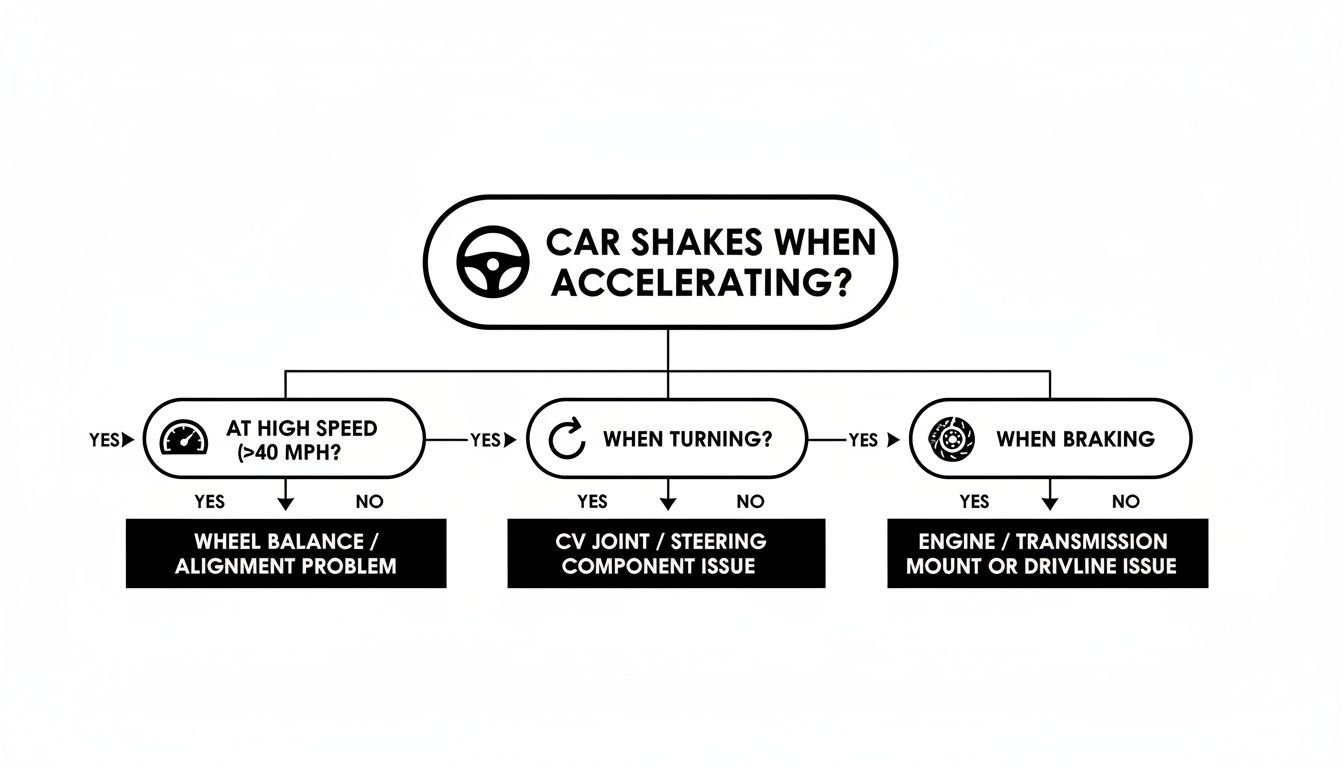
As you can see, a vibration that only happens when you brake or turn points to very different issues than one that appears just as you're speeding up. To get you started, this table gives a quick rundown of the most common causes we see here in Haltom City.
Key Takeaway: The location and timing of the vibration are everything. A shake you feel mostly in the steering wheel usually means a front-end problem like tire balance. If you feel the vibration more in the seat of your pants, the issue is likely further back with the driveshaft or rear axle.
| Potential Cause | What It Feels Like | How Urgent Is It? |
|---|---|---|
| Tire/Wheel Imbalance | Steering wheel shimmy, often at highway speeds. | Medium. Get it checked soon to avoid uneven tire wear. |
| Failing CV Axle | A pronounced shudder or vibration when accelerating, especially from a stop. | High. A broken axle means you're not going anywhere in Haltom City. |
| Worn Engine Mounts | A heavy shudder or "clunk" when you step on the gas. | High. Bad mounts can cause stress on other parts. |
| Engine Misfire | Feels like the car is jerking, sputtering, or hesitating. | High. This can quickly ruin your expensive catalytic converter. |
Diagnosing Tire, Wheel, And Suspension Problems
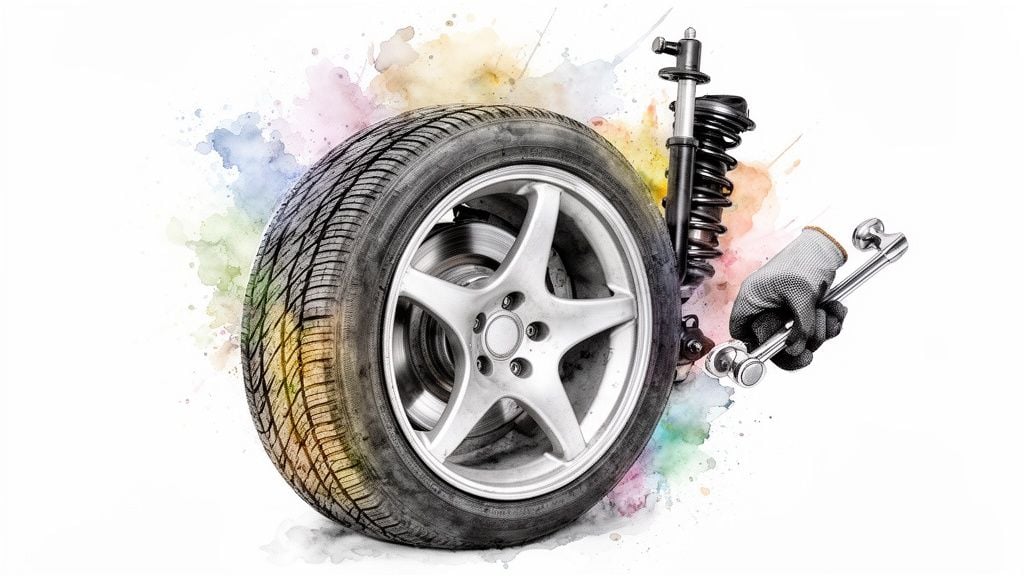
When Haltom City customers come in asking "why does my car shake when I accelerate?", the first place we often look is at the vehicle's connection to the road: its tires, wheels, and suspension. It’s a lot like a washing machine rattling from an unbalanced load—if a tire's weight isn't distributed perfectly, it creates a vibration you'll feel right through the steering wheel as you pick up speed.
This is a really common problem, especially around Haltom City. All it takes is one bad pothole on Watauga Road or Beach Street to bend a rim just enough to cause a shake. Sometimes, the cause is as simple as loose lug nuts, which can let the whole wheel wobble as you drive. These vibrations aren't just an annoyance; they're your car telling you something is wrong and needs a look.
Where To Look For Tire And Wheel Issues
More often than not, the prime suspect is tire imbalance. This is when the weight around the tire and wheel assembly isn't even, typically causing a distinct shimmy in your steering wheel between 50-70 mph. Another frequent cause is uneven tire wear, which creates a rough, vibrating ride as the misshapen tire rolls down the road. You can learn more about what causes that and how to protect your tires right here: https://www.expresslubehaltom.com/blog/what-causes-uneven-tire-wear/.
You can often spot the problem with a quick walk-around inspection:
- Bent Rims: Crouch down and look along the outer and inner lip of each wheel. Do you see any obvious dents or flat spots?
- Tire Bulges: Carefully check the sidewalls for any bubbles or bulges. These indicate internal tire damage and are a serious safety hazard that needs immediate attention.
- Uneven Wear: Run your hand across the tread of each tire. If it feels wavy, scalloped, or feathered, that’s a big clue you're dealing with an alignment or suspension issue.
Distinguishing between a tire vibration and a suspension-related shake can be tricky, as the symptoms sometimes overlap. This table breaks down what you're likely to feel with each.
Tire Vs Suspension Vibration Symptoms
| Symptom | Likely Tire Or Wheel Issue | Likely Suspension Issue |
|---|---|---|
| Vibration at Specific Speeds | Usually starts and stops at consistent speeds (e.g., 55-65 mph). | Can occur at various speeds but often worsens with bumps. |
| Steering Wheel Shimmy | A constant, rhythmic shimmy felt in the steering wheel. | A looser, more erratic shake, especially after hitting a bump. |
| Noise | A rhythmic "womp-womp" sound that matches tire rotation. | Clunking, rattling, or groaning noises over bumps or during turns. |
| Visual Cues | Visible tire bulges, bent rims, or uneven tread wear. | Leaking fluid from shocks/struts, or the car sits lower on one side. |
While this table is a great starting point, a professional diagnosis in Haltom City is the only way to be certain. Both issues can affect your car's safety and handling.
When Suspension Is The Problem
If your tires and wheels get a clean bill of health, the shaking might be coming from your suspension. The shocks and struts are responsible for absorbing bumps and keeping your tires planted on the pavement. When they wear out, they can no longer control the bouncing, and you'll feel every little road imperfection amplified into a vibration when you accelerate.
Vibration studies show that passenger car floor vibrations have increased by 0.13 to 0.3 m/s² in the last decade, much of which is traced back to degraded shocks. For the average Haltom City driver, suspension components can wear out in just 50,000 to 70,000 miles—roughly 4-6 years of daily commuting.
Another part we check is the wheel bearing, which lets the wheel spin smoothly. A failing bearing usually makes a humming or grinding noise that gets louder with speed, often accompanied by a vibration you can feel in the steering wheel. To properly diagnose these issues, a technician needs to know the difference between a hub bearing vs wheel bearing, as this determines whether just the bearing or the entire hub assembly needs replacement.
Digging Deeper: When Axles and Drivetrain Parts Cause the Shake
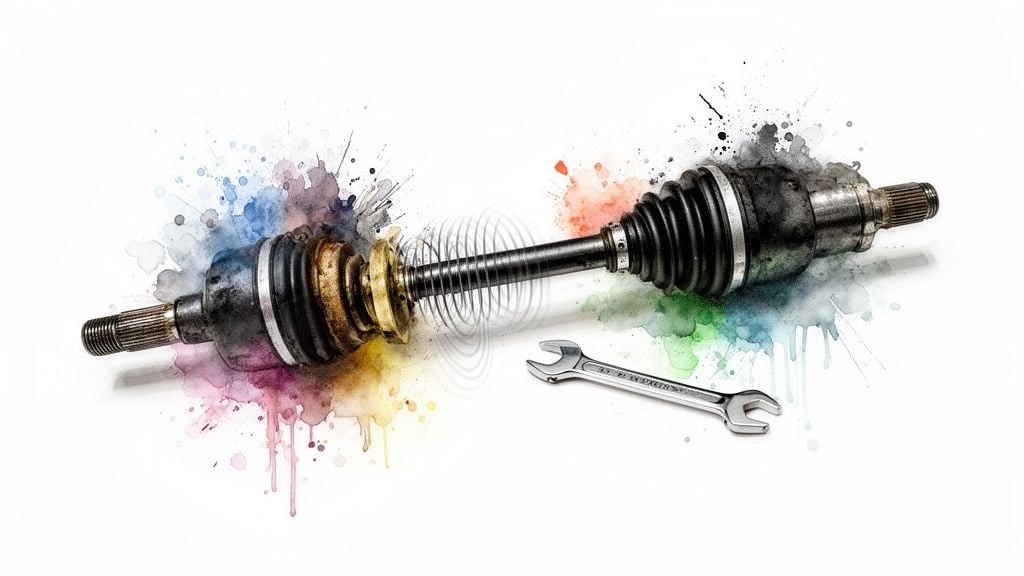
If your tires and wheels are in good shape, it’s time to look at the parts that actually turn them: the drivetrain. This system takes the power from your engine and puts it to the pavement, and these components work under incredible stress. Over time, wear and tear can introduce some very specific vibrations, especially when you hit the gas.
For most front-wheel-drive cars in Haltom City, the power gets to the front wheels through Constant Velocity (CV) axles. Each axle has a flexible joint on each end—an inner and an outer one. These joints are what allow your wheels to turn, go up and down with the suspension, and still receive power from the engine. It's a brilliant piece of engineering, but they don't last forever.
A worn-out inner CV joint is a very common source of shaking during acceleration. You’ll feel it as a distinct shudder when you first pull away from a stoplight, but then, almost like magic, it smooths out as you get up to a steady cruising speed. That’s because the worn joint only binds up and vibrates under the heavy load of getting the car moving.
Symptoms of a Failing Drivetrain
Knowing how to tell the difference between a tire vibration and a drivetrain vibration can save you a lot of guesswork. While a tire shake usually appears at a certain speed range (like 55-65 mph), a bad CV joint is almost always linked directly to the act of accelerating.
Here’s what to look for:
- Shudder From a Stop: The vibration is at its worst right as you accelerate from a complete stop.
- Vibration Disappears at Speed: Once you’re cruising and ease off the gas, the shaking often fades away completely.
- Clunking or Clicking Noises: This usually points to a failing outer CV joint. You'll hear a rhythmic click or pop when making sharp turns at low speeds.
- Grease on the Inside of Your Wheel: The CV joints are packed in grease and protected by a rubber boot. If that boot tears, it slings dark, thick grease all over the inside of your wheel and suspension parts. This is a dead giveaway.
A torn CV boot is more than a greasy mess—it’s a ticking clock. Once the protective grease is gone and dirt gets in, the joint will destroy itself. Ignoring it doesn't just risk a more expensive repair; it risks leaving you stranded on the side of a busy Haltom City road like Denton Hwy.
What About Rear-Wheel Drive Vehicles?
On rear-wheel and all-wheel-drive cars, the setup is a bit different. Power has to travel to the back of the car through a long, rotating tube called a driveshaft. This heavy-duty part can also cause a significant shake if it’s damaged.
The driveshaft connects to the transmission and the rear axle using Universal Joints (U-joints), which let it flex as the rear suspension moves. If a U-joint fails or the driveshaft itself gets bent or knocked out of balance—maybe by hitting a big pothole or road debris in Haltom City—you’ll feel a vibration. Unlike a CV axle shake, a driveshaft vibration usually starts at a lower speed and gets progressively worse the faster you go. To get a better look at how these parts work, you can check out our guide on changing a Universal Joint.
How Engine and Transmission Issues Create Vibrations
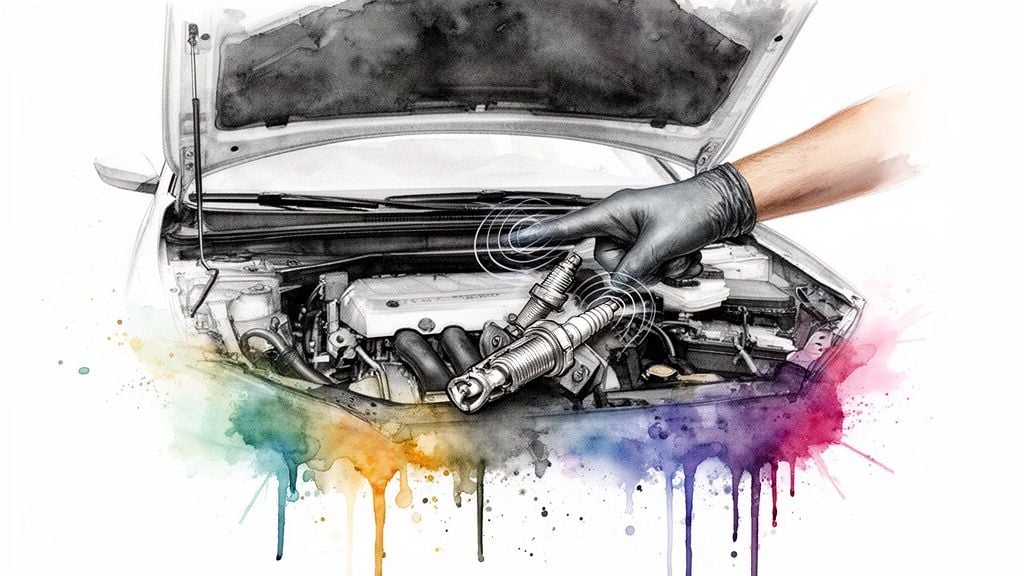
While it’s easy to blame tires for a shaky ride, sometimes the problem is rooted much deeper—right in the heart of your vehicle. If you feel a distinct shudder or hesitation the moment you step on the gas, there's a good chance your engine isn't delivering power as smoothly as it should. This is a very common answer to the question, "why does my car shake when I accelerate?"
This kind of shake feels different from a wheel-related vibration. It’s not a rhythmic shimmy that gets worse with speed. Instead, it feels like the car is stuttering or stumbling, especially when you’re asking it to work harder.
Engine Misfires and Power Loss
One of the most common culprits behind this sensation is an engine misfire. Your engine's cylinders are supposed to work together in perfect harmony. A misfire happens when one of those cylinders doesn't fire correctly, throwing the whole operation out of sync.
For a split second, the engine loses power, which you feel as a noticeable jerk or shudder. It’s a very distinct feeling. The most frequent causes are surprisingly simple:
- Worn Spark Plugs: These little parts are responsible for igniting the fuel. If they're old and tired, they can't produce a strong enough spark to get the job done.
- Clogged Fuel Injectors: Your engine needs a precise spray of fuel to run. If an injector gets blocked, a cylinder is essentially starved of fuel and can't fire properly.
- Bad Ignition Coils: These transform your car's battery voltage into the powerful zap the spark plugs need. A failing coil means a weak or nonexistent spark.
It's not just mechanical wear-and-tear, either. Issues like diesel fuel contamination can also throw your engine for a loop, leading to shaking and poor performance.
Failed Motor and Transmission Mounts
Another major source of acceleration shudders is worn-out motor or transmission mounts. These are tough rubber blocks designed to do two things: hold your engine and transmission securely in place and absorb their natural vibrations so you don't feel them in the cabin.
Over time, that rubber breaks down, cracks, and fails. When a mount gives out, the entire engine or transmission can physically lurch and shift every time you accelerate. That sudden movement sends a harsh jolt or a deep, jarring vibration right through the car’s frame. You'll feel it as a "clunk" or a shudder when you hit the gas.
In Texas markets like Haltom City, where summer temperatures regularly soar past 100°F, rubber and fluid-filled engine mounts can degrade up to 30% faster. This means they might fail after just 60,000 miles, transmitting powerful torque pulses directly into the car frame during acceleration.
Engine trouble and bad mounts are sneaky culprits that can make your car feel like it’s having a small earthquake. In fact, 25% of US repair shop visits in 2024 involved tracking down engine vibrations. If your car is shaking and you're also dealing with shifting problems, it's worth taking a moment to learn more about the signs of a slipping transmission.
Knowing When To See A Professional Mechanic in Haltom City
Not every little shake or shudder means your car is about to fall apart. But how do you tell the difference between a minor annoyance and a serious safety hazard that needs a mechanic right away? Learning to read the signs is one of the most important things you can do as a Haltom City driver.
Think of a slight, steady shimmy that only shows up at highway speeds. More often than not, that’s just a sign your tires need to be balanced. While you’ll want to get it fixed to prevent uneven tire wear and enjoy a smoother ride, it’s not an emergency. You can safely wait for your next planned visit.
Urgent Safety Warnings
On the other hand, some vibrations are your car’s way of waving a giant red flag. These are the shakes that signal a critical failure might be just around the corner, and they mean you should stop driving as soon as it's safe.
Get to know these tell-tale signs of a real problem:
- Sudden, Severe Shaking: If a violent shudder appears out of nowhere, especially when you hit the gas, it could be a failing CV axle or a broken motor mount. This isn't something to ignore.
- Vibrations with Loud Noises: Is that vibration accompanied by loud clunking, grinding, or banging? That's the sound of a major part that has either failed or is about to break completely loose.
- Shaking That Affects Steering: Any vibration so intense that it makes the steering wheel hard to control is a clear signal your car is no longer safe to operate. Period.
A Haltom City Mechanic's Straight Talk: Ignoring a severe vibration is a huge gamble. You're risking a catastrophic failure. A broken axle or driveshaft can leave you stranded with no power, and a failed steering or suspension component can cause you to lose control of the car entirely.
If you experience any of these serious symptoms, the right move is to pull over safely and call for a tow. Don't try to "limp" it to the shop. It's just not worth the risk to you or anyone else on the road in Haltom City.
For those less-severe vibrations, or if you're just not sure what you're feeling, getting a professional opinion is always the smartest play. Our Haltom City technicians can track down the source of the problem, and you can learn more about how they do it in our guide to auto diagnostic services.
Your Haltom City Solution For Vehicle Vibrations
Figuring out why your car is shaking when you accelerate can feel like a frustrating guessing game. Is it the tires? The engine? Something else entirely? For drivers here in Haltom City, taking the guesswork out of the equation is what Express Lube & Car Care does best.
We know you rely on your car for everything, from the daily commute on Denton Highway to running errands around town. A sudden vibration isn’t just annoying; it’s a disruption you don’t have time for. That's why we focus on getting you answers, and getting them fast. We use modern diagnostic tools to trace the vibration back to its source, so we’re not just guessing. We find the real problem, which saves you both time and money.
Your Local Haltom City Experts For Any Repair
Our team of ASE-certified technicians has seen it all. We’ve helped countless Haltom City drivers solve vibration issues, from the simple and obvious to the tricky and complex. Whatever the cause, we have the right fix.
We can handle every possibility, including:
- Tire Balancing & Alignment: To get rid of those shimmies that show up at certain speeds.
- Drivetrain Repair: We’ll sort out worn CV axles and U-joints that cause shuddering when you hit the gas.
- Engine & Transmission Service: We can track down a pesky engine misfire or replace a failed motor mount.
We believe you should never have to agree to a repair without knowing exactly what you’re paying for. That’s why our Haltom City shop gives you a clear, straightforward estimate before we even pick up a wrench. Our job is to get you back on the road safely, without any surprises.
Don’t let a vibrating car ruin your drive or compromise your safety. Let’s get that smooth, confident ride back. Stop by our shop at 6211 Denton Hwy in Haltom City, TX, or schedule an inspection with us today. Our technicians are ready to help.
Frequently Asked Questions About Car Vibrations
Even after narrowing down the possibilities, you probably still have a few questions. That’s completely normal. Getting to the bottom of a strange shake in your car can feel a bit like detective work. Here are some of the most common questions we hear from drivers who come into our Haltom City shop.
Can A Simple Oil Change Fix A Car That Shakes?
It’s a common thought, but almost always, the answer is no. An oil change is crucial for your engine's health, keeping everything lubricated and running smoothly for the long haul. However, it won't fix a mechanical vibration you feel while accelerating.
The only time an oil change might help is if your engine is so dangerously low on oil that it's struggling to function, causing it to shake violently. If you've reached that point, you're looking at serious engine damage, and the vibration is just one of many symptoms. The real culprits behind acceleration shakes are almost always physical parts like unbalanced tires, failing CV axles, or busted motor mounts.
How Much Does It Typically Cost To Fix A Car That Shakes in Haltom City?
This is the million-dollar question, and the honest answer is: it depends entirely on the cause. The cost can swing dramatically from one extreme to the other.
On one end, you might have a simple tire balance issue, which is one of the most affordable fixes you can get at our Haltom City shop. On the other end, you could be looking at replacing a major transmission component or a set of CV axles, which is a much more involved and significant repair.
Key Insight: The smartest money you can spend is on a professional diagnosis. Paying a small diagnostic fee upfront to find the exact problem is far cheaper than throwing parts at your car hoping something sticks. Guesswork gets expensive, fast.
Does Shaking Get Worse In Hot Or Cold Weather?
Weather can absolutely make a difference. Think about the rubber in your motor and transmission mounts. When it gets cold, that rubber becomes harder and less flexible, which can make an existing vibration much more obvious. Here in Texas, the intense summer heat can do the opposite, causing those same rubber parts to degrade and fail sooner than they otherwise would.
Tires are another great example. Cold weather causes air to contract, so your tire pressure can drop overnight. This can create or worsen a slight vibration that goes away as the tires warm up and the pressure stabilizes.
Is It Safe To Drive My Car If It Only Shakes A Little Bit?
Even a tiny shake is your car’s way of telling you something isn't right. If it's a minor vibration that you only notice at a specific highway speed, it's probably a tire balance issue. While it should be addressed, you can likely wait until your next scheduled service.
However, some symptoms demand immediate attention. If that shake is paired with a clunking noise, gets worse when you turn, or feels especially violent, you need to pull over. These are classic signs of a major failure in an axle, motor mount, or suspension part. Pushing your luck could lead to a complete breakdown or, even worse, a loss of control. When in doubt, it’s always safest to have it checked by a professional.
Don't let a vibrating car ruin your peace of mind. The certified technicians at Express Lube and Car Care have the right tools and years of experience to pinpoint the problem quickly and get it fixed correctly. Stop by our Haltom City location or schedule your diagnostic appointment online to get back to a smooth, safe ride.