

Mixing green and orange coolant is one of those mistakes you absolutely don't want to make. I've seen it firsthand in the shop, and the results are never pretty. This isn't just a friendly suggestion; it's a hard and fast rule based on some pretty gnarly chemical reactions that can bring your car's cooling system to a grinding halt.
Why Mixing Coolants Is a Critical Mistake
It seems simple enough, right? Your coolant is low, you run to the auto parts store, grab a bottle, and top it off. But grabbing the wrong color can kick off a chain reaction of problems inside your engine. The core issue boils down to the completely different chemical technologies behind these coolants. Each was engineered for specific engine materials and generations of vehicles, making them totally incompatible with one another.
Green coolant, the classic stuff, typically uses Inorganic Additive Technology (IAT) and was the standard for vehicles made before the year 2000. On the other hand, modern orange coolant uses Organic Acid Technology (OAT). When you pour these two together, their chemistries clash, and the mixture can quickly turn into a thick, sludgy mess that clogs up the works and torpedoes your cooling system's efficiency.
To make this easier to remember, here's a quick breakdown of why these fluids should never meet.
Quick Guide to Coolant Incompatibility
| Coolant Type | Technology | Primary Use | Mixing Result |
|---|---|---|---|
| Green Coolant | Inorganic Additive Technology (IAT) | Older vehicles (pre-2000) | Forms a thick gel or sludge, clogs passages, loses protection. |
| Orange Coolant | Organic Acid Technology (OAT) | Modern vehicles (post-2000) | Neutralizes anti-corrosion properties, can cause system blockage. |
Remembering this simple chart can save you from a world of expensive headaches down the road.
The Chemical Clash Inside Your Engine
Think of the additives in each coolant type as highly specialized tools, each designed for a specific job.
- Green (IAT) Coolant: This formula contains silicates and phosphates. Their job is to quickly coat the entire inside of the cooling system—which in older cars had a lot of steel and copper—to protect it from corrosion.
- Orange (OAT) Coolant: This one uses organic acids that provide targeted, long-lasting corrosion protection specifically for the aluminum and nylon components common in modern engines.
When you mix them, these additives don't work together; they basically declare war on each other. The silicates from the green coolant react with the organic acids in the orange coolant and drop out of the solution. This chemical reaction not only kills the protective qualities of both formulas but also creates that infamous gel or sludge.
This sludge is the real enemy. It's a sticky, thick goo that gets pumped through your entire cooling system, clogging up the tiny passages in your radiator, heater core, and water pump. That blockage is what leads to overheating and, if you're unlucky, catastrophic engine damage.
This is exactly why a simple mistake can turn into a massive repair bill. If you even suspect you've mixed coolants, don't wait. Getting a professional coolant flush and exchange isn't just a good idea—it's absolutely critical to prevent permanent damage to your engine. It's a small step that can save your vehicle's most important parts.
The Science Behind Coolant Conflict

When you pour orange coolant into a system with green coolant, you’re doing more than just mixing colors. You're starting a destructive chemical war inside your engine's most sensitive passages. The real problem isn't the color, but the completely different chemistry each coolant uses to prevent corrosion.
The classic bright green stuff is typically an Inorganic Additive Technology (IAT) coolant. It’s been around for decades and works by laying down a thick, protective blanket of silicates and phosphates over everything in your cooling system. This approach was great for the cast iron and copper components in older vehicles, but that protective layer wears out fairly quickly.
Newer, orange-colored coolants generally use Organic Acid Technology (OAT). This is a more modern, targeted approach. Instead of coating everything, the organic acids bond directly to metal surfaces, creating a thin, incredibly durable layer of protection right where it’s needed. This chemistry is specifically designed for the aluminum engines and plastic components that are common in cars today.
Why The Additives Don't Mix
So, what happens when these two different protection strategies meet? It’s not pretty. The silicates from the green IAT coolant react with the organic acids in the orange OAT coolant, and the result is a chemical mess. The silicates essentially fall out of suspension, becoming useless as corrosion inhibitors.
This reaction creates a thick, gel-like sludge that gets pumped through your engine. This gunk is the real enemy when mixing green and orange coolant, and it causes a devastating one-two punch:
- It clogs up the tiny, critical passages inside your radiator and heater core.
- It scours away the protective anti-corrosion layers, leaving the bare metal exposed to rust.
This whole shift from green to orange wasn't just a random choice by car manufacturers. It followed a major evolution in how cars were built, starting around the late 1990s. As automakers moved toward lighter-weight aluminum engines to boost fuel economy, they needed a coolant that could protect these newer materials without being abrasive. You can read more about this industry-wide transition in this deep-dive article from motor.com.
A Note on Hybrid Coolants
Just to make things more interesting, you'll also find Hybrid Organic Acid Technology (HOAT) coolants on the shelf, often colored yellow, gold, or even pink. As the name suggests, they're a mix of both worlds, using a small, fast-acting dose of silicates alongside the long-lasting organic acids.
Key Takeaway: While HOAT coolants are often more stable, they aren't a universal "fix" for a mix-up. Tossing a HOAT coolant into a system designed for pure IAT or OAT can still cause problems and reduce the coolant's effectiveness and lifespan.
At the end of the day, the science is straightforward. Each type of coolant is engineered for a specific job in a specific type of engine. When you mix them, their chemistries essentially cancel each other out, leaving your engine vulnerable to the very overheating and corrosion they were meant to prevent.
What Happens When You Mix Coolants? Recognizing the Signs of Trouble
When green and orange coolants get mixed, it's not just a color change—it's a chemical reaction with messy, expensive consequences. The two chemistries clash, forming a thick, gel-like sludge that your water pump then tries to force through the entire cooling system. This gunk is the last thing you want circulating in your engine's delicate pathways.
The first hint of trouble often isn't a dramatic cloud of steam from under the hood. It’s usually much more subtle. You might notice your car's heater just isn't blowing hot air anymore, even after the engine has had plenty of time to warm up. That's a classic sign that sludge has already clogged the narrow passages of the heater core, cutting off the flow of hot coolant.
From Minor Annoyance to Major Engine Threat
Another red flag will pop up right on your dashboard. Keep an eye on the temperature gauge. If it starts creeping higher than its usual spot, especially when you're stuck in traffic, your cooling system is struggling. That sludge is likely restricting flow through the radiator, and your engine is losing its ability to cool itself effectively.
Think of these symptoms as your car's early warning system. They aren't just small quirks; they are direct signs of a problem that could lead to catastrophic engine failure if ignored.
A Word From the Shop Floor: Don't roll the dice on this one. A partially blocked radiator can quickly cause an engine to overheat. That can lead to a warped cylinder head or a blown head gasket—repairs that run into the thousands. The cost of a proper coolant flush is nothing in comparison.
It's a surprisingly common issue. Some experts estimate that up to 15-20% of cooling system failures are tied to contaminated coolant, including the mess from mixing incompatible types. Mechanics will tell you that the gelling from mixing green and orange coolant can start within just a few hours, silently setting the stage for some serious damage down the road. You can find more details about these all-too-common failures over at mrtransmission.com.
Visual Clues: What to Look For Under the Hood
Performance issues aren't the only signs. If you suspect something is wrong, pop the hood and take a look at the coolant reservoir (the plastic overflow tank). What you see inside can tell you everything you need to know.
Instead of a clean, brightly colored liquid, you might find:
- A Muddy, Rusty Appearance: If the coolant looks like dirty, brownish water, the anti-corrosion additives have been compromised. Rust is now flowing freely through your engine.
- Thick, Goopy Sludge: Look for a nasty, almost mayonnaise-like substance clinging to the inside of the tank or caked onto the radiator cap.
- Visible Particles: Any solid bits floating around in the coolant are a dead giveaway that the chemical additives have fallen out of suspension and are now just debris.
If you see any of these signs, you have definitive proof of a bad chemical reaction. Your coolant has gone from protecting your engine to actively damaging it. The time for waiting is over—you need to take action right away to save your engine from a very costly repair bill.
Your Action Plan for Fixing a Coolant Mix-Up
So, you've realized you mixed the green and orange coolant. First thing's first: don't panic. But you do need to act quickly. The moment those two formulas met, a chemical reaction kicked off, starting the process of creating a thick, damaging sludge. Your mission now is to get that contaminated gunk out of your cooling system before it causes real trouble.
Letting it ride is the worst thing you can do. Every minute that mixed fluid circulates, more sludge builds up. It clogs the tiny, crucial passages in your radiator, water pump, and heater core. This is a one-way ticket to overheating and some seriously expensive repairs down the road.
This infographic paints a pretty clear picture of how quickly a simple clog can escalate.
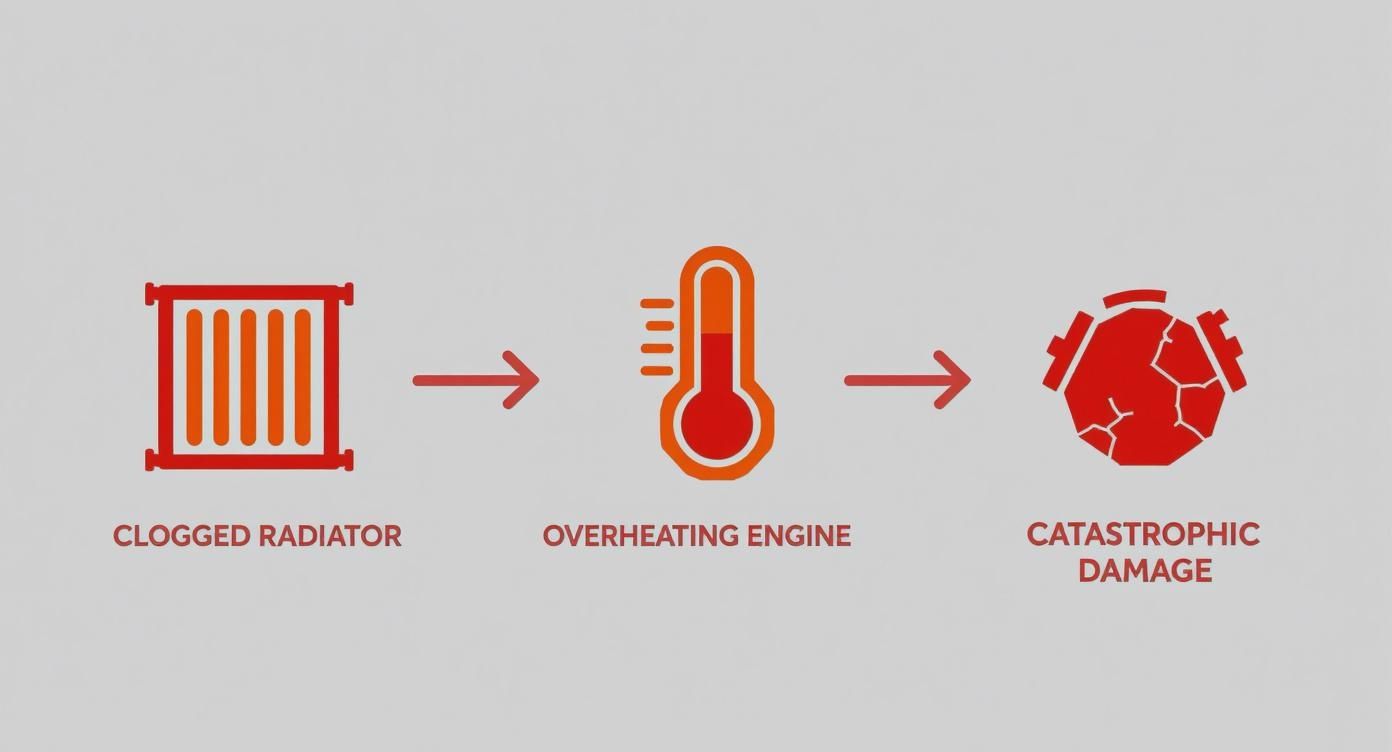
As you can see, a blocked radiator isn't just a minor issue—it's the first domino to fall on the path toward catastrophic engine damage.
The Critical Drain and Flush Process
There's only one real fix for this: a complete system drain followed by a very thorough flush. We're not just talking about emptying the radiator. The goal is to hunt down and purge every last drop of that contaminated mess and the sludge it created.
Start by draining all the old fluid, but make sure your engine is completely cool first. A hot cooling system is pressurized and can spray scalding liquid, causing nasty burns. Find the radiator drain plug, often called a petcock, at the bottom corner of your radiator and open it up, letting the old coolant empty into a catch pan.
With the system empty, the real work begins. A simple drain-and-refill isn't going to cut it. That sludge is stubborn stuff, clinging to the inside of your engine block, hoses, and radiator. You have to flush it out forcefully.
Pro Tip: Don't just use water. Grab a quality radiator flushing agent from the auto parts store. These chemical cleaners are made to break down the exact kind of scale, rust, and gel-like gunk that a water-only flush leaves behind. Just be sure to follow the instructions on the bottle to the letter.
Typically, you'll pour in the flushing agent with distilled water, run the engine for a bit to let the cleaner work its magic, and then drain it all out. You'll probably have to repeat the process with just distilled water until it runs perfectly clear. It’s not unusual for this to take two or even three cycles to get the system truly clean.
Refilling with the Right Coolant
Once the water runs clear from your final flush, you can breathe easy knowing the contaminated gunk is gone. Now comes the most important part: refilling the system with the correct, manufacturer-specified coolant. This is how you prevent the problem from ever happening again.
So, how do you know which one is right? Your vehicle's owner's manual is your best friend here. It will tell you the exact coolant technology your car needs, whether it's OAT, HOAT, or an older IAT formula. Never, ever rely on color to make your choice.
- Check Your Manual: Flip to the "fluids" or "maintenance" section. You're looking for a specific standard, like "meets GM Dex-Cool specifications."
- Read the Bottle: Before you buy, read the label on the coolant jug to confirm it matches the spec listed in your manual.
- Mix it Right: Most antifreeze is sold as a concentrate that you have to mix 50/50 with distilled water. Don't use tap water! The minerals in it will cause corrosion and scale to build up inside your engine.
After you've refilled the system, start the engine and turn your heater on high. This helps circulate the fresh coolant and works out any trapped air bubbles. Keep an eye on the reservoir and top it off as the level drops. If any of this feels out of your comfort zone, bringing your car in for professional radiator and cooling system services is the surest way to get the job done right.
When It’s Time to Call in the Pros
Sometimes, even with the best DIY effort, the damage from mixing green and orange coolant is just too much to handle at home. If you’ve gone through the trouble of flushing the system and you're still having problems, that’s a sure sign the issue is more serious than a simple drain-and-fill can fix.
Think of it as a set of red flags. The most glaring one? Persistent overheating. If that temperature gauge is still creeping into the red after you've flushed and refilled with the right stuff, that gunk has likely set up shop and created serious blockages. Another big clue is your heater blowing cold or lukewarm air. This usually points straight to a clogged-up heater core, which a basic home flush just can't clear out.
The Power Flush: A Professional-Grade Solution
When you're dealing with that stubborn, gel-like sludge, mechanics have a secret weapon: the power flush. This is worlds apart from just opening the drain plug and letting gravity do the work. A power flush uses specialized equipment to actively pump a cleaning solution and water through your entire cooling system at high pressure. It's designed to blast out the hardened deposits that are stuck deep inside the radiator, engine block, and tiny passages of the heater core.
A professional power flush isn't just a more thorough cleaning—it's often the only way to rescue components like your radiator or heater core from the brink. Getting it done can be the difference between a cleaning service and a bill for a complete replacement that runs into hundreds of dollars.
How to Talk to Your Mechanic
When you take your car in, be direct. Don't just tell them "it's overheating." The key piece of information they need is that you suspect or know that mixing green and orange coolant happened.
Giving them this heads-up right away points them in the right direction. It helps them diagnose the problem faster and skip straight to the most effective solution, which is likely a power flush. It saves them time on diagnostics and saves you money.
For this kind of in-depth work, you want a team you can trust. Here at Express Lube & Car Care, we handle everything from severe coolant contamination to complex engine diagnostics with our full range of professional automotive services.
Ultimately, keeping your car healthy is about more than just one-off fixes. If you're interested in learning more, there are great resources out there on general vehicle health monitoring that can help you stay ahead of trouble. Knowing the difference between a job you can tackle and one that needs an expert is one of the smartest skills any car owner can have.
Your Top Coolant Questions, Answered
Even knowing the risks, it's natural to have some lingering questions when you're standing in front of an open coolant reservoir. You start to second-guess yourself, especially when you know a simple mistake can lead to a world of hurt for your engine. Let's walk through some of the most common "what-if" scenarios people run into.
"I only added a little bit of the wrong stuff. Is it really that bad?"
This is probably the number one question we hear. Someone tops off their green coolant with just a splash of orange, thinking it can't be a big deal. Unfortunately, it is. Even a tiny amount is enough to kick off that damaging chemical reaction.
Think of it this way: the anti-corrosion additives in your coolant are a carefully balanced formula. Introducing a foreign chemical, even a small amount, instantly starts to break down that protection. The gelling and sludge formation might not happen as fast as if you mixed them half-and-half, but the damage has already begun. The only right move here is to get the system completely drained and flushed as soon as possible. Don't wait.
The second that incompatible coolants touch, the protective chemistry of both is ruined. Waiting just gives corrosion and sludge a head start, turning a simple mistake into a problem that could cost you an engine. Acting immediately is the only way to prevent serious, long-term damage.
"Can I just go by the color?"
This is a huge one. It used to be a decent rule of thumb—green was the old-school stuff, orange was the new stuff. But today? Absolutely not.
Manufacturers now use a whole rainbow of dyes: pink, blue, yellow, purple… you name it. The color has become more about brand identity and making leaks easier to spot than identifying the actual chemistry inside.
- Ignore the color: The dye tells you nothing about the coolant's technology.
- Read the bottle: The label is your best friend. It will clearly state the type (OAT, IAT, HOAT) and the vehicle specs it's designed for.
- Check your owner's manual: This is the ultimate source of truth. It tells you exactly what your car's manufacturer requires.
"How quickly does the damage actually start?"
The chemical reaction begins the moment the two coolants mix. You won't see it, but the process of gelling and sludge formation can start within just a few hours or days.
The real danger is that you won't see the consequences—like your engine overheating—for weeks or maybe even months. This delay is what catches people off guard. While you're driving around thinking everything is fine, silent damage is happening under the hood. Corrosion is eating away at metal parts and deposits are slowly building up, clogging the narrow passages in your radiator and heater core.
This is precisely why you can't afford to wait. The problem only gets worse, and every mile you drive increases the chances of turning a minor mistake into a major engine repair bill.
If you've run into a coolant mix-up or just want peace of mind, let the pros handle it. The team at Express Lube & Car Care has the right equipment and experience to do a complete, professional flush and refill, getting you back on the road safely. Book your service with us today.