
That colorful puddle under your car is more than just a messy stain on your driveway—it’s a major warning sign. Seeing bright green, pink, or orange liquid means your car is losing coolant, the very lifeblood of its cooling system.
When you see that puddle, you’re looking at a breach in the system responsible for keeping your engine from overheating. Driving with a serious leak is a recipe for disaster, potentially leading to catastrophic engine damage. Figuring out where it’s coming from and how bad it is should be your top priority.
What That Puddle Under Your Car Actually Means
Finding a vibrant, almost neon-colored puddle under your car can be jarring, and it should be. That liquid is toxic coolant, and its escape means there’s a problem somewhere in the pressurized network of hoses, passages, and components that make up your cooling system. When you’re thinking, “my antifreeze is leaking,” it’s not just an inconvenience—it’s a critical alert from your vehicle.
The color of the fluid is your first clue. Manufacturers use distinct dyes to help you identify it. It’s usually a bright green, orange, or pink, which helps differentiate it from motor oil (brown/black) or transmission fluid (reddish). The puddle’s size also tells a story. A few small drips might just be a loose hose clamp, but a large, growing pool points to something much more serious, like a cracked radiator or a failing water pump.

First Steps In Diagnosing The Leak
Before you’re tempted to start the car and “see what happens,” just take a moment for a quick visual check. Where is the puddle located? Is it forming toward the front of the engine? Closer to the passenger side firewall? Pinpointing the general area is a huge first step in narrowing down the list of potential culprits.
Key Takeaway: Don’t ignore a coolant leak. It’s one of the quickest ways to turn a relatively minor fix into a massive engine repair bill. The risk of overheating and causing permanent damage, like a warped cylinder head, is just too high.
To help you get a better idea of what you might be dealing with, here’s a quick rundown of the most common sources of coolant leaks.
Antifreeze Leak Sources at a Glance
This table can act as a quick-reference guide to help you make an initial assessment. It breaks down the usual suspects, how serious they tend to be, and whether you can reasonably spot the problem yourself.
| Leak Source | Typical Severity | DIY Check Possible? | Common Symptom |
|---|---|---|---|
| Radiator Hose | Low to High | Yes | Obvious drips from the big rubber hoses; visible cracks or bulges. |
| Radiator | Moderate to High | Yes | Fluid weeping from the radiator fins or seams; visible corrosion. |
| Water Pump | Moderate to High | Sometimes | Drips coming from a small “weep hole” on the pump’s housing. |
| Overflow Tank | Low | Yes | Visible cracks in the plastic reservoir or a leak from the cap. |
| Heater Core | Moderate | Difficult | A sweet, syrupy smell inside the cabin; a damp passenger-side floor. |
Think of this as your starting point. A cracked plastic overflow tank is often a straightforward fix you can handle yourself, but if you suspect a bad water pump or a leaky heater core, it’s almost always time to call in a professional.
First Things First: Safety Before You Hunt for the Leak
Before you even pop the hood to figure out where that sweet-smelling puddle came from, we need to talk about safety. Your car’s cooling system is no joke—it’s a high-pressure setup running at temperatures that will give you a nasty burn in a heartbeat.
The number one, non-negotiable rule is to let the engine cool down completely. Never, ever try to open the radiator cap when the engine is even slightly warm. The system is under intense pressure, and twisting that cap is like setting off a geyser of scalding-hot coolant and steam. It’s a recipe for serious injury.
Get the Right Gear for the Job
Once you’re 100% sure the engine is cool to the touch (give it at least an hour), it’s time to gear up. You’re going to be dealing with tight spaces, sharp edges, and some pretty toxic chemicals, so don’t skip the protective wear.
Before you get your hands dirty, always put on some durable gloves and a pair of quality safety glasses. It’s a simple step that protects you from a world of hurt.
Here’s your quick safety checklist:
- Safety Glasses: A must-have to protect your eyes from any unexpected drips or sprays.
- Gloves: Grab some nitrile or mechanic’s gloves. Antifreeze is nasty stuff you don’t want on your skin.
- Long Sleeves: A little extra protection from hot surfaces or scraping your arm on something sharp is always a good idea.
Create a Safe Workspace
Where you do the work matters just as much as how you do it. The main ingredient in most antifreeze is ethylene glycol, a chemical that’s highly toxic if ingested and has fumes you shouldn’t be breathing in an enclosed space. Make sure you’re working in a well-ventilated spot, like your driveway or an open garage.
Spills are another big deal. Antifreeze has a sweet smell that can attract pets and wildlife, and it’s extremely poisonous. If you see a puddle, clean it up right away. Keeping an automotive spill kit in your garage makes this a lot easier. A good universal spill kit bag can be a real lifesaver when you’re dealing with a mess.
A Quick Word of Warning: A small coolant leak might not seem like a big deal, but it’s often the first sign of a bigger problem. Cooling system failures are one of the leading causes of engine overheating, which can spiral into catastrophic—and very expensive—engine damage if you ignore it.
How to Pinpoint the Source of the Leak
Alright, with the engine stone cold and your gear ready, it’s time to play detective. The trick to finding a coolant leak is to be methodical. When a car with a mysterious puddle rolls into my bay, I always start with the most common culprits and work my way to the trickier ones. You can use the exact same logic in your own driveway.
Grab a good flashlight, even if it’s broad daylight. A lot of these parts live in the shadows of the engine bay. Your goal is to trace the coolant’s path from the highest wet spot you can find and follow it down. Gravity is your best friend here—the actual leak is almost always above or at the very top of the trail.
Begin with Hoses and Connections
The first place I always look is the network of rubber hoses. They are, by far, the most common failure point. Day in and day out, they handle intense heat and pressure, which eventually makes the rubber brittle and weak.
Run your gloved hand along the big radiator hoses—the fat ones at the top and bottom of the radiator. Do you feel any soft, spongy spots or sticky gunk? Those are dead giveaways that the hose is breaking down from the inside out. Pay extra close attention to where the hoses connect to the radiator and the engine. The hose clamps here can work themselves loose over time. Honestly, a loose clamp is the best-case scenario; a few turns of a screwdriver and you’re done.
- Check for Cracks: Bend the hoses slightly (if they have any give) to reveal tiny hairline cracks.
- Inspect Clamps: Make sure the clamps are tight and not rusted through. A corroded clamp can fail long before the hose does.
- Look for Bulges: A hose that looks swollen or bloated is a ticking time bomb. It’s about to burst and needs to be replaced immediately.
This simple diagram outlines the safety mindset you need before every inspection: let it cool, get your gear on, and make sure you have fresh air.
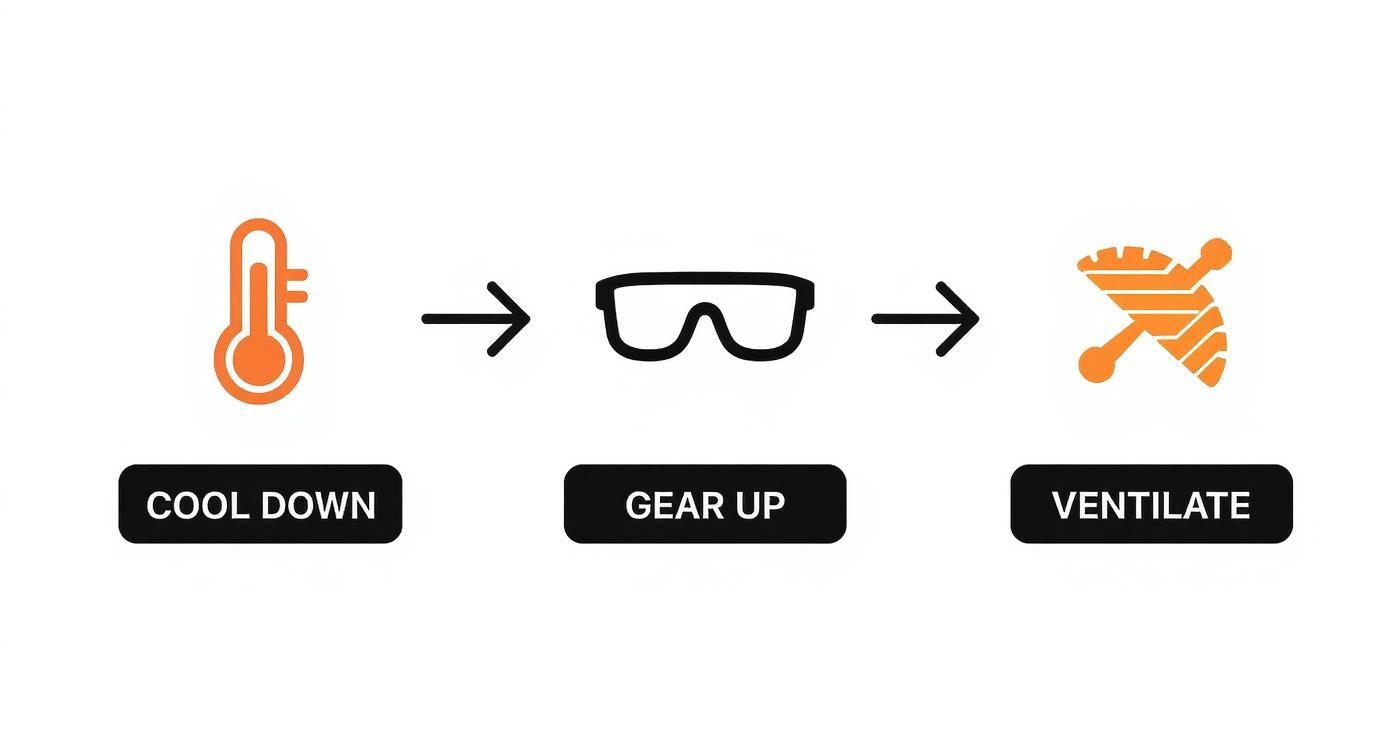
Running through these three checks creates a safe workspace before you start hunting for that pesky leak.
Examine the Radiator and Coolant Reservoir
If the hoses check out, turn your attention to the radiator itself, sitting right up front behind the grille. Scan its surface for any signs of corrosion, which usually looks like crusty white or rusty-colored stains on the cooling fins.
A really common cause of a sudden leak is road debris. It only takes one small rock flung up by the car in front of you to puncture the soft aluminum and create a pinhole leak you can barely see. Also, run your flashlight along the seams where the plastic tanks on the sides are crimped to the metal core. Those are known weak points that can crack under pressure.
Next up is the coolant overflow tank (or reservoir). It’s that semi-clear plastic bottle with a small hose running to the radiator. Over the years, that plastic gets brittle and loves to crack. Look for tiny fractures, especially around the spots where it’s bolted to the car or where the hoses connect.
Pro Tip: Slow leaks are sneaky because the hot engine evaporates the coolant before it can even drip, leaving a crusty residue behind. Look for chalky white or colored streaks—that’s the minerals left over from the antifreeze. Following that chalky trail can lead you right to a tiny leak you’d otherwise miss.
Check the Water Pump and Other Components
Still no luck? Time to dig a little deeper. The water pump is a prime suspect for those slow, nagging drips that are hard to place. Most have a small “weep hole” on their underside, which is a designed-in failsafe. When the internal seal starts to go, coolant is meant to drip from this hole as a warning sign.
Finding the water pump isn’t always easy; it’s usually buried behind the engine’s main drive belt. You might have to safely get under the car to get a good look at its underside. If you see a drip or a crusty coolant stain right below that weep hole, you’ve found your culprit. The water pump is shot. By checking these systems one by one, you’re narrowing down the possibilities and getting closer to a solid diagnosis.
What’s Actually Causing the Antifreeze Leak?
Once you’ve got a general idea of where the coolant is coming from, it helps to understand why that part is failing. When a customer comes into the shop pointing at a puddle and asks what’s wrong, the answer is almost always one of a few usual suspects. Each one tends to fail in its own unique, predictable way.
Think about it: your car’s cooling system is a pretty harsh place to live. It’s a high-pressure environment with wild temperature swings and constant vibration. After thousands of miles, that stress starts to take its toll on every single component.
Brittle Hoses and Loose Connections
The rubber hoses are the veins and arteries of the whole system, and frankly, they’re often the first things to give up the ghost. Day in and day out, they get baked by engine heat, which makes the rubber hard and brittle. Sooner or later, tiny cracks appear, and under pressure, those small cracks become a seep, a drip, or—in a worst-case scenario—a complete blowout.
- Heat Damage: The hose that gets the worst of it is usually the upper radiator hose. It’s closest to the engine and endures the highest temperatures, so it’s the one I check first.
- Worn Clamps: Sometimes the hose itself is fine, but the clamp holding it in place has loosened up from years of vibration. This allows coolant to drip right from the connection point. It’s an easy fix, but a very common source of slow, nagging leaks.
When the Radiator Takes a Hit
Your radiator sits right at the front of the car for a reason—to catch as much air as possible. Unfortunately, that prime location also makes it a magnet for every rock, stick, and piece of road debris you run over. A small stone kicked up by a truck can easily puncture the soft aluminum fins and cause a pinhole leak.
But it’s not just outside threats. Internal corrosion can be a silent killer. If old coolant loses its anti-corrosive additives, rust can slowly eat away at the radiator from the inside out, creating weak spots that eventually give way.
A Pro Tip: Many modern radiators have plastic tanks crimped onto the sides of the metal core. The endless cycle of heating up and cooling down causes the plastic and metal to expand and contract at different rates. Over time, this can lead to hairline cracks in the plastic, creating one of the most frustratingly slow and hard-to-spot leaks imaginable.
A Failing Water Pump
The water pump is the heart of your cooling system, pushing coolant through the engine block nonstop. All that work eventually wears down its internal seals and bearings. As a built-in warning system, most water pumps have what’s called a “weep hole.”
When the main internal seal starts to fail, coolant is designed to leak out of this tiny hole, giving you a heads-up. So, if you spot a steady drip from the side of the engine near the belts, a bad water pump is a very safe bet. For certain vehicles, like a Toyota Matrix, knowing the specific pump for the 2003-2008 models is crucial for getting the right part for the job.
Other Culprits to Keep an Eye On
While hoses, radiators, and water pumps are the big three, a few other components can spring a leak.
- Bad Radiator Cap: That cap is more than just a plug; it’s a precisely calibrated pressure valve. If the spring inside gets weak, it won’t hold the system at the right pressure, which can let coolant boil over and escape through the overflow tube.
- Leaky Heater Core: Deep inside your dashboard is a mini-radiator called the heater core, which is what gives you cabin heat. If it starts leaking, you’ll probably smell a sweet, syrupy odor inside the car or find the passenger-side floor mat is mysteriously damp.
- Cracked Coolant Reservoir: The plastic overflow tank where you add coolant isn’t immune to aging. Over time, it can get brittle and develop cracks, especially around the mounting points or where the hoses connect.
What’s This Going to Cost? Gauging Repair Bills and Knowing When to Call a Pro
So you’ve tracked down the leak. Great. Now for the million-dollar question—or hopefully, the twenty-dollar question: “How much is this going to set me back?”
The answer can be anything from the price of a fancy coffee to a serious dent in your wallet. It all boils down to what part failed and where it’s buried. This is that moment of truth where you decide whether to reach for your toolbox or your phone.
A simple fix, like tightening a loose hose clamp, literally costs you nothing but a minute of your time. Even replacing a leaky radiator hose is often a solid DIY job for a Saturday afternoon. You can pick up a quality braided hose for oil, water, or fuel for around $20 to $50. Easy win.
But the financial picture gets a lot more complicated when professional labor enters the chat.
Breaking Down Potential Repair Bills
When you’re trying to figure out what that puddle of antifreeze will cost you, remember that the part itself is only one piece of the puzzle. The real cost comes from how much stuff has to be taken off the engine just to get to the broken component.
- Radiator Replacement: The radiator itself might run you $150 to $400. But once you add a few hours of a mechanic’s time for draining the system, swapping it out, and refilling it, you’re usually looking at a total bill in the $400 to $900 ballpark.
- Water Pump Replacement: This one is almost always about the labor. The pump might only be $50 to $150, but it’s often tucked away behind timing belts and other engine accessories. That’s why the final cost often lands between $350 and $800.
- Heater Core Replacement: This is the one mechanics hate. The part is dirt cheap—often under $100. The problem? It lives deep inside your dashboard. Getting to it means a technician has to completely tear down and reassemble your car’s interior, easily pushing the total repair cost over $1,000.
Know Your Limits: Here’s a good rule of thumb I always share: if the job requires special timing tools (like for a water pump tied to a timing belt) or involves ripping out the dashboard, it’s time to call a professional. Don’t risk it.
When to Throw in the Towel
Some repairs are just not meant for the driveway. A blown head gasket, for instance, is a massive undertaking that requires pulling the engine apart. Trying to tackle something that complex without the right tools and years of experience can quickly turn a costly repair into a catastrophic one.
For those situations where you need a professional opinion or are looking for reliable automotive repair services, it pays to find a shop you trust.
It’s also interesting to see just how critical this system is. The global automotive antifreeze market was valued at about USD 4.02 billion in 2024 and is expected to hit USD 8.22 billion by 2033. That’s a whole lot of coolant keeping the world’s engines from melting down.
When in doubt, getting your car towed to an expert is the smartest—and often cheapest—move in the long run.
Your Questions About Antifreeze Leaks Answered
Finding a puddle of brightly colored fluid under your car is never a good feeling. Your mind immediately starts racing with questions. Is it serious? Can I still get to work? What does that color even mean? Let’s walk through some of the most common questions we hear from drivers worried about a coolant leak.
Can I Drive My Car if It’s Leaking Antifreeze?
This is the big one, and I’m going to give you the straight answer: it’s a huge gamble, and you probably shouldn’t. Driving with a coolant leak is playing Russian roulette with your engine. Without enough coolant, your engine’s temperature will skyrocket, and that can lead to catastrophic damage like a warped cylinder head or a blown head gasket. We’re talking about repairs that can easily run into the thousands.
Now, there are different levels of leaks, of course:
- A very slow drip: If you’re seeing just a few drops on the garage floor and the repair shop is just around the corner, you might make it. Before you go, pop the hood and top off the coolant reservoir with the correct 50/50 mix. Keep your eye glued to that temperature gauge.
- A steady leak or a noticeable puddle: Don’t even think about it. If the temp gauge is already climbing or you see steam billowing from under the hood, that’s your engine’s SOS signal. Pull over safely, shut it down, and call for a tow.
It’s just not worth the risk. A $100 tow bill is a bargain compared to a $3,000 engine replacement. Your safety and your car’s long-term health come first.
Is It Okay to Use Water Instead of Antifreeze?
In a real pinch—like you’re stranded on the side of the highway—yes, adding plain water is better than letting the engine run completely dry and overheat. Think of it as a temporary bandage to hopefully limp your car to a safe spot or the nearest mechanic.
But water is absolutely not a long-term fix. Antifreeze is a sophisticated fluid. Its additives do more than just prevent freezing; they also raise the boiling point far beyond water’s 212°F (100°C) and protect all the metal bits inside your engine from rusting away. Running on water alone is asking for your engine to boil over and will kickstart internal corrosion. As soon as you can, you need to get the system professionally flushed and refilled with the proper coolant mixture.
What’s the Difference Between Antifreeze Colors?
That bright color isn’t just for show—it’s a critical clue to the coolant’s chemical formula. Different colors correspond to different technologies designed for specific types of engines and materials.
- Green: This is the classic, old-school coolant (Inorganic Acid Technology, or IAT) you’d find in older vehicles.
- Orange/Red: This usually points to an extended-life formula called Organic Acid Technology (OAT).
- Pink/Purple/Blue: These are often Hybrid Organic Acid Technology (HOAT) or other specialized coolants for modern engines.
Using the wrong kind is a recipe for disaster. Mixing different types of antifreeze can trigger a chemical reaction that turns the fluid into a thick, gunky sludge. That sludge will clog up everything—your radiator, heater core, and tiny passages in the engine block—leading to massive overheating and wallet-emptying repairs. Always, always check your owner’s manual to see exactly what kind of antifreeze your car needs.
When you’re facing an antifreeze leak and need a professional, trustworthy diagnosis, the certified technicians at Express Lube and Car Care are here to help. We’ll pinpoint the source of the problem and provide a clear, honest estimate to get you back on the road safely. Visit us for reliable radiator and engine cooling repairs.