
Wondering where your transmission fluid is? Good. That’s a great first step in taking care of your car. The location of the dipstick really depends on what kind of car you drive.
In most front-wheel-drive cars, you’ll find the transmission dipstick right up front, near the engine, usually sporting a brightly colored handle that’s hard to miss. If you’re driving a rear-wheel-drive vehicle, it’s probably tucked a bit further back in the engine bay, closer to the firewall.
Your Quick Guide to Finding the Transmission Dipstick

Popping the hood can feel a little daunting, but finding the transmission dipstick is usually pretty simple once you know what you’re looking for. Think of it as a quick treasure hunt where the prize is a healthier car that lasts longer. That dipstick is your direct window into the health of your transmission.
The fluid itself sits in the transmission pan, where it gets pumped throughout the system to cool, clean, and lubricate all those moving parts. It’s so vital that the global market for transmission fluid was valued at USD 15.67 billion in 2024 and is still growing. Staying on top of fluid changes every 30,000 to 60,000 miles can head off roughly 40% of all transmission failures. For those interested in the industry side of things, you can see more on this at MarketsandMarkets.com.
Common Dipstick Locations
To make the hunt easier, let’s break down where you’ll most likely find that dipstick. Sometimes the biggest challenge is just getting a good look in a crowded engine bay. A simple upgrade like an Under-Hood LED Light Kit can make a world of difference, helping you find what you need safely, day or night.
To get you started, here’s a quick reference guide.
Transmission Dipstick Location Quick Reference
This table helps you quickly identify the likely location of the transmission fluid dipstick based on your vehicle’s drivetrain.
| Vehicle Drivetrain | Common Dipstick Location | Typical Dipstick Handle Color |
|---|---|---|
| Front-Wheel Drive (FWD) | Usually found at the front of the engine, near the radiator. It’s often located on the transaxle. | Red, Orange, or Yellow |
| Rear-Wheel Drive (RWD) | Typically positioned toward the back of the engine, closer to the vehicle’s firewall. | Red, Pink, or Black |
Keep in mind that some newer vehicles, especially those with “lifetime” fluid or sealed transmissions, don’t have a dipstick at all. If you’ve searched everywhere and still can’t find one, your car might be one of those models.
Finding Fluid in Automatic vs. Manual Transmissions
Where you look for the transmission fluid depends entirely on what kind of car you drive. The process is night and day between an automatic and a manual.
For the vast majority of cars with automatic transmissions, your target is a dipstick. It’s a long metal rod, pretty similar to your engine oil dipstick, but manufacturers go out of their way to make it stand out. Keep an eye out for a brightly colored handle—usually a circular or T-shaped grip in a vibrant red, orange, or yellow. They do this so you don’t accidentally grab the wrong one.
What About Manual Transmissions?
If you’re driving a stick shift, forget about looking for a dipstick. You won’t find one. Manuals use a completely different system: a fill plug located right on the side of the transmission case itself.
This means you’ll have to get under the car, which is a job you need to approach with caution.
- Get It Secured: First things first, safety. Never, ever get under a car that’s only held up by a jack. Always use a solid pair of jack stands on level ground.
- Find the Plugs: Once you’re safely underneath, look at the side of the transmission housing. You’ll spot two plugs. The one on the bottom is for draining, and the one a little higher up is the one you want—the fill plug.
- Grab the Right Wrench: These aren’t your typical small bolts. You’ll likely need a specific, larger wrench or socket to get the fill plug off.
A quick word of advice from someone who’s spent a lot of time under cars: take safety seriously. Use jack stands, chock the wheels, and make sure everything is stable before you start working. No shortcut is worth the risk.
The New Challenge: Sealed Transmissions
Just to make things interesting, a lot of newer vehicles now have what’s called a sealed transmission. These are built without any dipstick or accessible fill plug. The idea is that they are “filled for life” and don’t require routine checks.
While that sounds nice, “for life” can be a very optimistic term, especially if you put a lot of miles on your car. If you notice any signs of trouble with a sealed unit, it’s not a DIY job. This is where you need a professional. Here at Express Lube & Car Care in Haltom City, we have the specialized equipment to properly check and service these sealed systems without causing damage.
How to Get an Accurate Transmission Fluid Reading
Alright, you’ve found the dipstick or fill plug. Now comes the part that really matters: getting an accurate reading. The process is completely different for automatic and manual transmissions, so following the right steps is crucial. Getting it wrong can lead to overfilling or thinking you’re low when you’re not.
For an automatic transmission, you actually need the engine warmed up and running. The best way to do this is to take the car for a short drive, maybe 10-15 minutes. Once you’re back and parked on a level surface, leave the engine on.
Slowly shift the gear selector through all the gears—P, R, N, D, and any lower gears—pausing for a couple of seconds in each. This gets the fluid circulating properly throughout the transmission. Finally, put the vehicle back into Park (or Neutral, depending on what your owner’s manual says). Now you’re ready for a reading.
Reading the Dipstick on an Automatic
With the engine still running, pull the transmission dipstick out. Grab a clean, lint-free cloth and wipe the dipstick completely clean. You don’t want any stray fibers getting into your transmission, so something like a quality Drying Towel 24×36 Inch Microfiber Towel works perfectly for this.
Push the dipstick all the way back in, then pull it out one more time for the actual reading. You’ll likely see two sets of marks on it:
- Cold: This is really just a baseline. It’s not the mark you should rely on for an accurate check.
- Hot: This is the range that matters. The fluid level should be somewhere between the “add” and “full” lines within this section.
Checking the fluid this way ensures you’re measuring what’s actually available to lubricate the gears and provide hydraulic pressure while the system is operating. Given the global transmission fluids market is expected to hit USD 8,828.6 million in 2025, it’s clear this is a vital component of vehicle health that shouldn’t be overlooked.
This flowchart lays out the different steps for both automatic and manual vehicles.
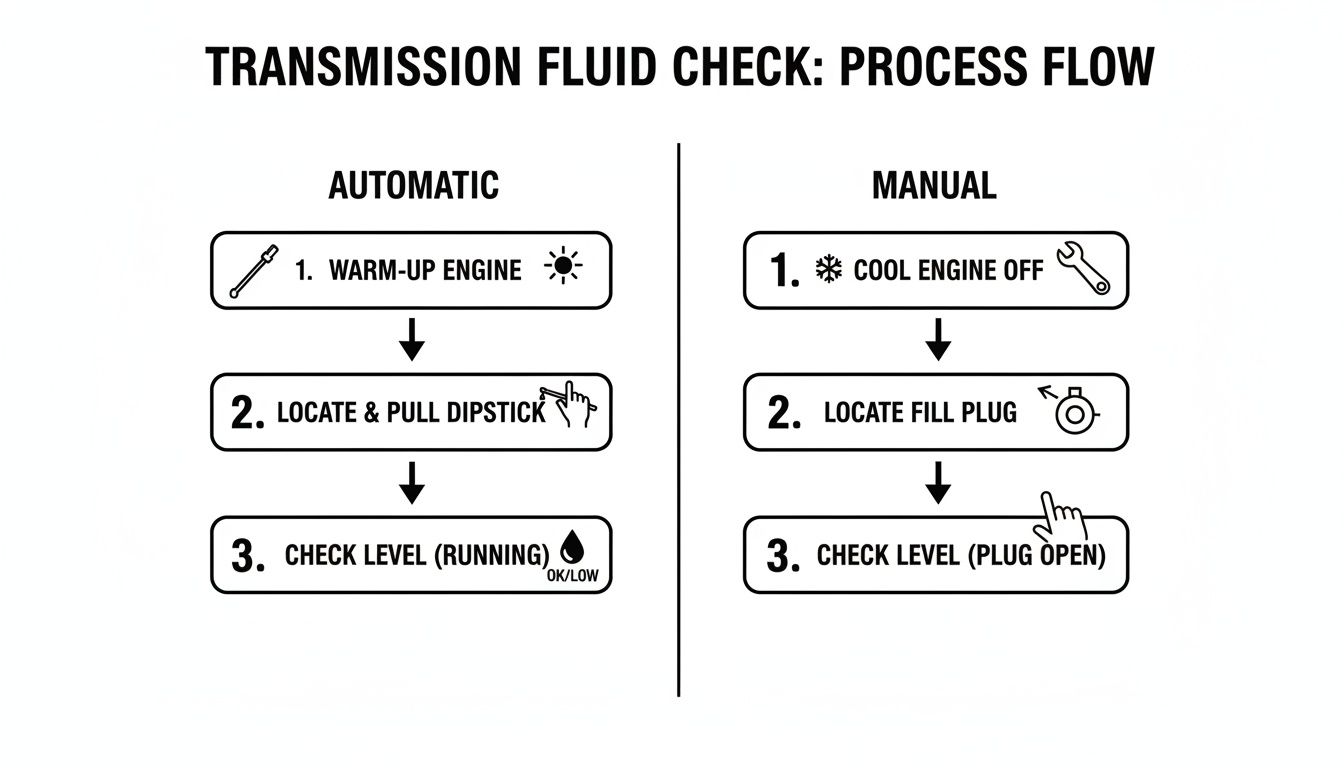
The key takeaway from the visual is pretty clear: automatic checks are done with the engine on, using a dipstick. Manuals are checked with the engine off, using a fill plug.
Checking Fluid on a Manual Transmission
If you’re driving a stick shift, the process is totally different. First and foremost, the engine must be off and the car should be cool. You’ll also need to get under the vehicle, which means safely raising it on level ground.
Safety First: Never, ever get under a car that’s only held up by a jack. Always secure it with properly rated jack stands and chock the wheels to keep it from rolling.
Once you’re safely underneath, find the fill plug on the side of the transmission case. You’ll need the right size wrench to loosen and remove it.
The rule of thumb for manual transmissions is simple: the fluid level should be right up to the bottom edge of the fill hole. The easiest way to check is to carefully stick your finger into the hole. If you can feel the fluid on the tip of your finger, you’re good to go. If not, it’s time to add more.
What Bad Transmission Fluid Looks and Smells Like

Finding the dipstick is just the first step. The real skill is knowing how to “read” what the fluid is telling you about the health of your transmission. Healthy automatic transmission fluid (ATF) is easy to spot—it’s translucent, bright red, and has a slightly sweet, oily scent. If you see anything different, it’s your car’s way of asking for help.
When you wipe that dipstick on a clean paper towel, you’re looking for that vibrant red. If it’s dark brown or black, the fluid is old and has broken down. It’s lost its ability to keep things cool and lubricated, which is its entire job.
Reading the Signs: Smells and Textures
Don’t underestimate your sense of smell here. If the fluid smells burnt and acrid—kind of like scorched toast—that’s a serious red flag. It means your transmission is running way too hot, and heat is the number one killer of transmissions.
Pay attention to what you feel and see on that paper towel, too. Clean fluid is smooth and uniform, but if you notice any of these, you’ve got a problem brewing:
- Metallic Specks: See little flecks that sparkle in the light? That’s not a good thing. It’s “glitter” made of tiny metal shavings from your transmission’s internal parts grinding against each other. This is a sign of serious wear.
- A Frothy or Foamy Look: If the fluid looks milky or bubbly, almost like a strawberry milkshake, it’s likely been contaminated with coolant or water. This contamination destroys the fluid’s ability to lubricate properly.
Your transmission fluid is the lifeblood that moves through a complex maze of gears and clutches to get power to your wheels. It’s no surprise that low or bad fluid is a factor in 70-80% of all transmission failures. Catching these signs early can be the difference between a simple service and a catastrophic breakdown.
The automatic transmission fluid (ATF) market is huge, accounting for over a 56% market share of the total lubricant industry. This shows just how many cars on the road depend on this specific fluid, and why maintaining it is so critical. You can dig deeper into ATF market trends over at Data Bridge Market Research.
When It’s Time to Call in the Pros
If you notice any of these warning signs—a dark color, a burnt smell, metal flakes, or a frothy texture—don’t just top it off and cross your fingers. That’s like putting a bandage on a broken arm. These are symptoms of an underlying issue that adding more fluid simply won’t solve.
This is where you need a professional. Bring your vehicle into Express Lube & Car Care in Haltom City, and let our technicians figure out what’s really going on. We can tell you if it’s a simple fluid flush or something more serious. Ignoring the problem will almost certainly lead to a much bigger, and more expensive, repair bill later on.
When to Skip the DIY and Call a Mechanic
Knowing how to check your transmission fluid is a fantastic skill for any car owner. But, and this is important, you also need to know when to put the rag down and call a professional. Drawing that line can be the difference between a simple fix and a catastrophic, wallet-draining failure.
One of the biggest red flags is finding your fluid is critically low. Sure, you can top it off, but why is it low in the first place? Fluid doesn’t just evaporate. A low level almost always means there’s a leak somewhere. Just adding more fluid is like putting a band-aid on a broken bone—it doesn’t fix the real problem. A mechanic can get under the car, find that leaky seal, cracked pan, or failing cooler line, and fix it for good.
Signs That Demand Professional Attention
The condition of the fluid is another major tell. If you pull out the dipstick and the fluid is dark brown, smells burnt, or has a thick, sludgy consistency, that’s your transmission crying for help. This isn’t just old fluid; it’s a sign of serious internal wear and contamination. A simple fluid change won’t cut it.
Putting in the wrong kind of fluid is another surefire way to cause thousands of dollars in damage. Automatic Transmission Fluid (ATF) isn’t a one-size-fits-all product. There are dozens of specific formulations, and using the wrong one for your car can be disastrous.
I can’t stress this enough: never guess when it comes to transmission fluid. The wrong type can make seals swell, cause clutches to slip, and cook your transmission from the inside out. It’s an expensive mistake that’s easily avoided by letting a pro handle it.
Finally, a lot of newer cars don’t even have a dipstick. These are called sealed transmissions, and they’re designed to be serviced by a shop with special tools. Attempting to check or fill one of these in your driveway is a recipe for disaster.
If you run into any of these issues, it’s time to seek out professional local auto repair services for assistance. Here at Express Lube & Car Care, our technicians have the right diagnostic gear and experience to handle any transmission—sealed or not. We can also source specialty parts like this Black Aluminum Transmission Oil Pan Kit if you’re looking at a more involved repair or performance upgrade.
Common Questions About Transmission Fluid
Even after walking through the steps, you might still have a few questions rolling around in your head. That’s perfectly normal. Let’s tackle some of the most common things people ask about their transmission fluid so you can feel confident under the hood.
A big one we hear all the time is, “Can I just top off my transmission fluid?” Technically, yes, you can add a little if the level is just a hair low. But here’s the thing you really need to know: transmission fluid isn’t like engine oil. It doesn’t just “burn off” or disappear. If it’s low, it’s almost always a sign of a leak somewhere in the system, and that needs a professional’s eyes on it sooner rather than later.
Other Key Questions Answered
Another frequent question is whether you can just grab any bottle of transmission fluid off the shelf. The answer is a definite no. Vehicles are incredibly picky about the type of Automatic Transmission Fluid (ATF) they use. Pouring in the wrong kind can cause shifting problems, overheating, and even catastrophic transmission failure. Always, always double-check your owner’s manual for the exact specification.
So, how often should you be looking at it? Make it part of your monthly routine. When you check your engine oil and tire pressure, pop the transmission dipstick too. A quick check once a month is one of the best ways to catch a small problem before it becomes a big, expensive one.
It’s worth remembering that the fundamentals of good vehicle care are pretty universal. For example, many of the same principles apply whether you’re driving a car or an RV. Learning about essential motorhome maintenance tips can actually give you a broader perspective on why these regular fluid checks are so crucial for any vehicle’s longevity.
Getting familiar with these details helps you move from just a car owner to a smart, informed one who can stay ahead of maintenance issues.
If you’ve checked your fluid and it looks dark, smells burnt, or is just consistently low, don’t wait. The certified technicians at Express Lube & Car Care in Haltom City are ready to figure out what’s going on. Schedule your service with us today by visiting https://www.expresslubehaltom.com.