

Ever walked down the oil aisle and felt a little lost staring at all those numbers on the bottles? You’re not alone. Those numbers, like 5W-30 or 10W-40, all come down to one crucial thing: engine oil viscosity.
Simply put, viscosity is a fluid’s resistance to flow—or, more plainly, its thickness. It’s the single most important property of your engine oil, and getting it right is key to a long and healthy engine life, especially for drivers in Haltom City, where Texas temperatures can swing wildly.
Your Quick Guide To Engine Oil Viscosity
Think of it this way. Picture yourself pouring cold honey from a jar. It moves slowly, clinging to the sides. That’s a high viscosity liquid. Now, picture pouring a glass of water. It flows freely and quickly. That’s a low viscosity liquid.
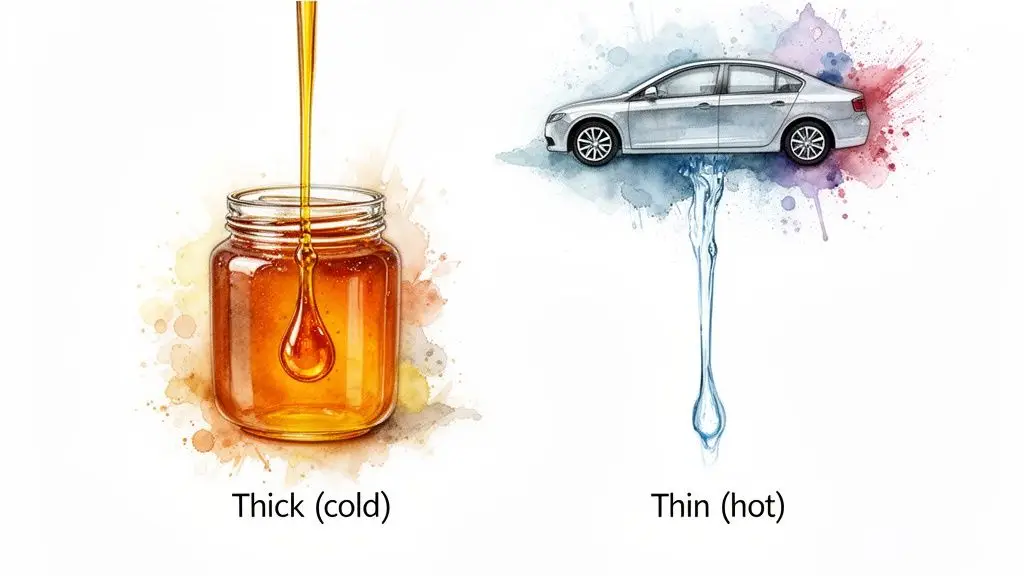
Your engine oil has the tough job of behaving like both.
When your car sits overnight during a chilly Haltom City winter, the oil inside thickens up just like that honey. On startup, you need that oil to flow immediately to protect critical components. If it’s too thick (too high of a viscosity when cold), it can’t circulate fast enough, momentarily starving vital parts of lubrication when they need it most.
But what happens when you’re driving through Haltom City and your engine gets up to full operating temperature? The oil thins out. During a scorching Texas summer, it has to be resilient enough to not get as thin as water. It must maintain enough thickness (high enough viscosity when hot) to keep a protective film between all those fast-moving metal parts. If it gets too thin, that protective barrier breaks down, leading to metal-on-metal contact, friction, and serious wear.
The Role of Viscosity in Engine Protection
At its core, motor oil’s main job is to create a slick, protective barrier between all the moving parts inside your engine. The right viscosity ensures that barrier holds up, no matter the driving conditions in Haltom City.
Here’s why it’s your engine’s first and best line of defense:
- On Cold Starts: The correct viscosity allows the oil to get where it needs to go in seconds, shielding parts like cams and lifters from damage during those first crucial moments after you turn the key.
- At High Temperatures: It maintains a strong, consistent film that prevents metal surfaces from grinding together. This drastically reduces friction and the damaging heat it creates, especially in Haltom City’s stop-and-go traffic.
- For Fuel Economy: Believe it or not, viscosity impacts your gas mileage. If the oil is too thick, your engine has to work much harder just to pump it, which burns more fuel.
Viscosity isn’t just some random number on a label; it’s a precisely engineered balance between protection and performance. Using the oil viscosity your manufacturer recommends is one of the easiest and most important things you can do for your car.
Understanding this balance is the first step toward smart vehicle maintenance. To see how this fits into the bigger picture, you can learn more about why your car needs regular oil changes in our other guide. It all comes back to ensuring the longevity of your engine, whether you drive a daily commuter in Haltom City or a heavy-duty truck.
Decoding the Numbers on Your Oil Bottle
Ever found yourself in the auto parts aisle, staring at a wall of motor oil bottles and feeling completely lost? All those numbers like 5W-30 and 0W-20 look more like a math problem than a simple choice for your car. Don’t worry, it’s not as complicated as it looks. Let’s decode what those numbers really mean for your engine.
Think of these numbers as the oil’s performance rating. They tell you how the oil will behave at different temperatures—from a frosty morning to a sweltering afternoon commute. This is what’s known as a multi-grade viscosity rating, and it’s the secret to protecting modern engines in a place like Haltom City, where the weather can be all over the map.
The First Number and the “W”
Let’s start with the first part of the code: the number followed by a “W,” like the “5W” in 5W-30. Right off the bat, most people think the “W” stands for “Weight,” but it actually stands for Winter.
This number is all about how well the oil flows when it’s cold. The lower the number, the thinner the oil is at low temperatures, and the more easily it will circulate through your engine on startup. An oil rated 0W or 5W will flow much more freely on a cold morning than a 10W oil.
This is a bigger deal than you might think. A staggering 75% of all engine wear can happen in those first few critical moments after you turn the key. A lower “W” number ensures that oil gets to your engine’s vital parts almost instantly, protecting them from damage.
For drivers in Haltom City, a lower winter rating means better protection during those surprisingly cold snaps, ensuring your engine isn’t starved for lubrication when it’s most vulnerable.
The Second Number: Protection at High Heat
Now, what about the second number—the “30” in our 5W-30 example? This number tells the other half of the story: how the oil performs once the engine is fully warmed up to its normal operating temperature, typically around 212°F (100°C).
As your engine heats up, oil naturally thins out. The second number indicates the oil’s ability to resist becoming too thin. A higher number means the oil maintains a thicker, more robust film of protection between moving metal parts. This is absolutely essential for preventing damaging metal-on-metal contact, especially when you’re stuck in traffic on a hot Haltom City summer day.
This impressive dual-rating capability is all thanks to the SAE J300 standard, a classification system that has been refined constantly since its debut way back in 1911. Modern multi-grade oils are true engineering marvels. A 5W-30 oil, for instance, is designed to act thin and flow quickly for cold starts but maintain its strength and thickness at high heat. It’s this technology that allows our certified technicians at Express Lube & Car Care in Haltom City to pick the perfect grade to protect your engine year-round.
How Texas Heat Changes Your Oil’s Performance
Temperature is the ultimate test for your motor oil. Especially here in the Haltom City area, where the weather can swing from a chilly morning to a scorching afternoon, your oil’s ability to adapt is what stands between your engine and serious wear and tear. The first big challenge of the day happens the moment you turn the key.
Ever tried to pour syrup straight out of a cold fridge? It’s thick, sluggish, and fights you the whole way. That’s exactly what your oil is doing on a cold start. It gets more viscous (thicker), and for those first critical seconds, it struggles to circulate. This can briefly starve vital engine parts of lubrication right when they need it most.
The Challenge of High Temperatures
Once you’re on the road in Haltom City and the engine gets up to temperature, the complete opposite happens. Cruising down the highway, your engine can easily top 200°F. All that heat makes the oil thin out. The real trick is for the oil to remain just thick enough to form a tough, protective film between moving metal parts, preventing the friction and damage that can kill an engine.
This is where multi-grade oils, like the incredibly common 5W-30, really prove their worth. They are engineered with a split personality—thin enough to flow when cold, yet thick enough to protect when hot.
This graphic gives you a great visual for how those numbers on the bottle translate to real-world performance.
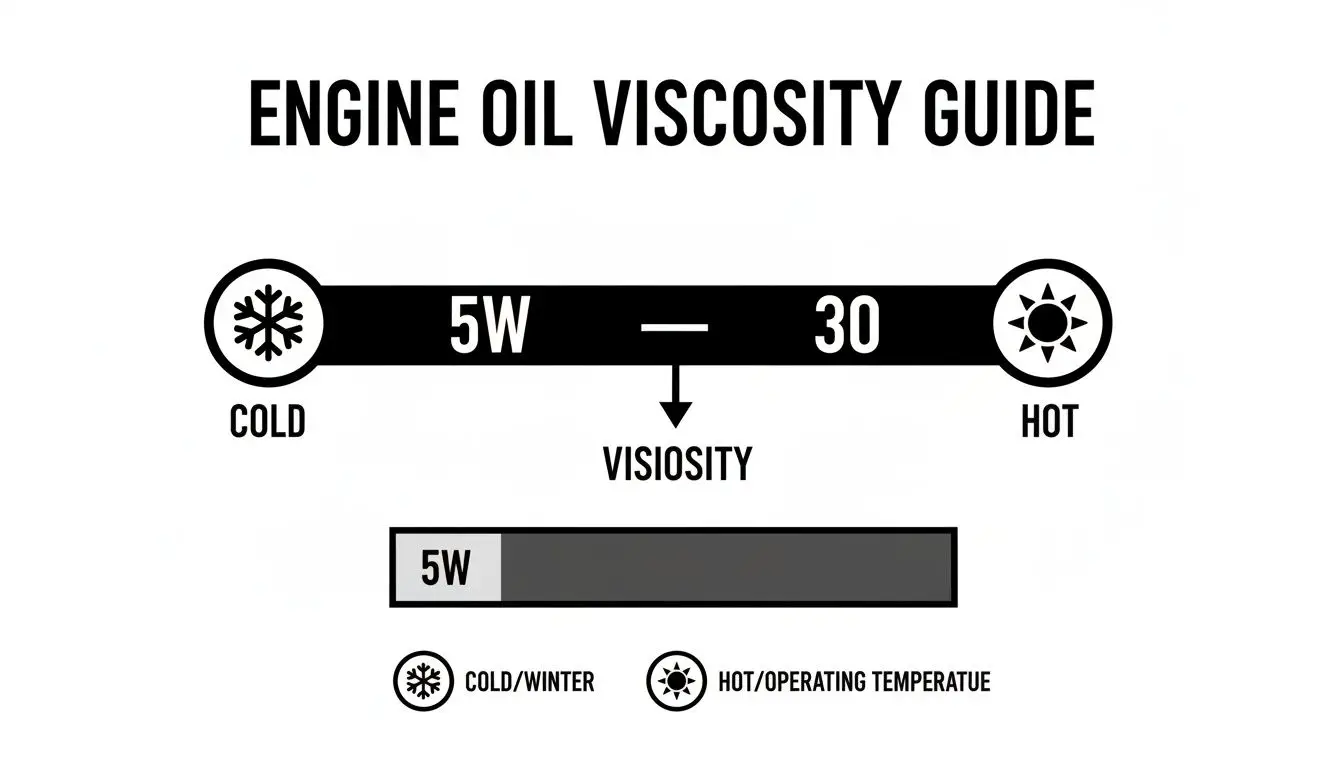
As you can see, the “5W” (the ‘W’ stands for ‘Winter’) is all about its performance in the cold. The “30” tells you how well it holds up under the intense heat of a fully warmed-up engine.
Understanding Viscosity Index and Why It Matters
An oil’s ability to resist thinning out as it gets hotter is a measurable quality called the Viscosity Index (VI). Think of it as a measure of stability. An oil with a high VI doesn’t change its viscosity as dramatically when the temperature swings, which is one of the main reasons synthetic oils consistently outperform conventional oils.
A higher Viscosity Index means your oil provides more stable and reliable protection, whether you’re starting your car on a cold Haltom City morning or stuck in traffic on a hot afternoon. This stability directly impacts your engine’s long-term health.
The change is pretty dramatic. As an engine warms from a cold start (around 20°C) to a more optimal lubricating temperature (60°C), its viscosity drops significantly. But since your engine’s normal operating temperature is much hotter—typically 80-100°C—the oil must maintain a very specific viscosity (9-16 cSt) to provide peak protection.
Getting this right is non-negotiable. With 70% of vehicles on the road today specifying thinner oils like 0W-20 to 5W-30, using the wrong grade isn’t a small mistake. It can spike engine wear by a shocking 20-30%. If you want to dive deeper, you can explore more expert analysis on viscosity charts and see just how much temperature affects performance.
The Real Risks of Using the Wrong Oil
Using the wrong engine oil viscosity isn’t a minor slip-up—it’s a shortcut to major engine trouble. Those numbers on the bottle, like 5W-30, aren’t just suggestions; they represent a precise formula engineered to protect your specific engine. Get it wrong, and a simple oil change in Haltom City can quickly spiral into a hefty repair bill.
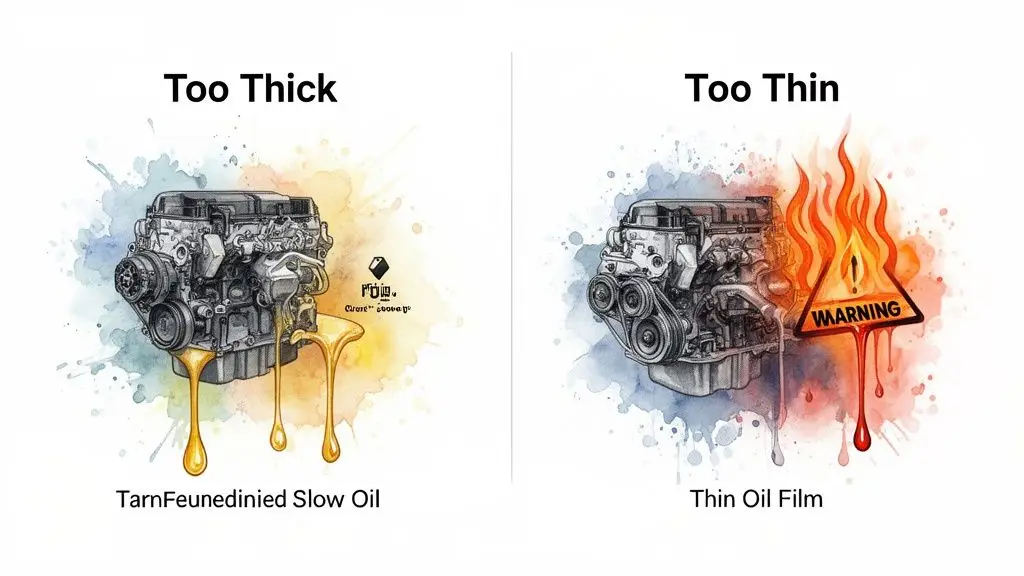
To really get what’s at stake, let’s look at two different scenarios: one where the oil is too thick, and another where it’s far too thin. In both cases, the engine is headed for a world of hurt.
The Danger of Oil That’s Too Thick
Picture this: you’ve put a heavy 20W-50 oil into an engine designed for a modern, thin 0W-20. On a chilly Haltom City morning, that thick oil has the consistency of cold molasses. When you turn the key, the oil pump struggles just to get the sludge moving.
For the first critical moments after starting, your engine’s most important parts are essentially running dry. This “dry start” grinds away at components like camshafts and bearings, causing accelerated wear. On top of that, your engine has to burn extra fuel just to churn through that thick fluid, so you’ll feel the pain at the pump, too.
The Hazard of Oil That’s Too Thin
Now, let’s flip the script. Imagine an engine filled with oil that’s too thin, trying to cope with the brutal Haltom City heat. As your engine gets up to its normal operating temperature, the oil thins out even more, becoming almost watery.
This flimsy oil can’t maintain a strong protective film between moving metal parts. The results are swift and damaging:
- Metal-on-Metal Friction: Instead of gliding smoothly, components grind against each other, generating intense heat.
- Engine Overheating: The oil can no longer help dissipate heat effectively, putting your entire cooling system under strain.
- Catastrophic Failure: Without that essential lubricating barrier, parts can seize up completely, leading to a seized engine.
Think of it like this: using the wrong viscosity is like sending a worker to do a heavy-lifting job with the wrong equipment. Whether the oil is too thick or too thin, you’re asking for trouble—more wear, worse performance, and a significantly shorter life for your engine.
It’s clear that guessing is not a strategy when it comes to your engine’s lifeblood. If the wrong oil has been used, an engine flush might be necessary to clear it out, and you can learn more about engine flushes in our guide. To avoid these problems entirely, getting professional advice in Haltom City ensures your vehicle receives the exact protection it was built for.
Choosing the Right Oil for Your Haltom City Driving
So, how does all this talk about viscosity actually help you with your car? It all starts with one simple, but absolutely critical, step: check your owner’s manual. Your car’s manufacturer has invested a massive amount of research into determining the exact engine oil your vehicle needs to run at its best.
That recommendation is your north star. For most modern cars, you’ll likely see a grade like 0W-20 or 5W-30. These oils are engineered for great fuel economy and to get flowing quickly on startup. But what happens when your real-world driving in Haltom City doesn’t quite fit the textbook definition?
When to Consider a Different Approach
Think of your owner’s manual as the starting point. But certain factors, especially here in Haltom City, might mean a different oil is a smarter choice. This is where the expertise of a certified technician comes in—we look beyond the book to understand your specific situation.
Here are a few common scenarios we see in Haltom City where a different oil might be a better fit:
- High-Mileage Vehicles: Is your odometer showing over 75,000 miles? A high-mileage oil contains special conditioners that can help re-swell aging seals, which in turn reduces the leaks and oil consumption that often plague older engines.
- Towing and Hauling: If you regularly tow a boat, trailer, or heavy work equipment around the Haltom City area, your engine is under a lot more stress. That extra strain generates a ton of heat, demanding a more robust oil that won’t thin out and break down under extreme temperatures.
- Fleet and Work Trucks: Local Haltom City commercial vehicles face a tough life of constant stop-and-go traffic and heavy loads. For these workhorses, a durable full synthetic oil is often the best investment for protecting the engine and safely extending the time between oil changes.
Choosing the right oil viscosity is all about matching the lubricant’s properties to your engine’s specific needs and your driving habits. Sticking to the manufacturer’s recommendation is a great start, but consulting a professional ensures your vehicle gets the precise protection it needs to thrive in local Haltom City conditions.
The whole system of SAE J300 viscosity grades has changed dramatically since it was first established way back in 1911, mostly driven by engines being built with tighter and tighter tolerances. Think about it: during a scorching Texas summer, oil temperatures can easily climb to 120-140°C. For a truck hauling a heavy load near North Richland Hills, a higher-viscosity oil like a 5W-40 can maintain a protective film of 12-16 cSt. That’s a huge advantage over a 0W-20 oil, which thins out to just 8.2 cSt at those temperatures. It’s amazing to see the historical evolution of lubrication standards and how far the technology has advanced.
Our goal is to give you the information you need to make a smart decision. While a basic conventional oil works for some drivers, you might want to read our guide comparing synthetic blend oil vs. conventional oil to see if an upgrade is right for you. Here at Express Lube in Haltom City, we can help you navigate these choices, making sure your car or truck has what it needs for the long haul.
Your Trusted Partner for Engine Health in Haltom City
We’ve covered a lot of ground, from what oil viscosity actually is to why that SAE number on the bottle is so important. You now know how temperature can turn a good oil into a bad one and why the right viscosity is a make-or-break factor for your engine’s long-term health.
But knowing the “what” and “why” is one thing. Getting it right is another. When it comes to protecting the most expensive component in your vehicle, the surest path is to rely on experienced professionals. Here in Haltom City, that’s exactly who we are.
More Than Just an Oil Change
At Express Lube & Car Care, we don’t just drain and fill. An oil change with us is a check-up for the heart of your car. Our technicians are trained to look at the whole picture: your vehicle’s make and model, its mileage, and how you drive it day-to-day in Haltom City.
We’re all about honest, practical advice. We’ll recommend the right oil for your engine, using premium products that meet or exceed what the manufacturer demands. Our focus is on doing the job right, so you can count on your engine for the long haul.
Don’t leave your engine’s health to guesswork. Let our experts in Haltom City give you the clarity and peace of mind you deserve every time you turn the key.
We’re proud to serve our neighbors in Haltom City and the surrounding areas with integrity. Given our hot Texas summers and stop-and-go traffic, a full synthetic oil is often the best defense for modern engines. If you’re curious whether it’s the right move for your car, take a look at our guide on the benefits of a full synthetic oil change service.
Ultimately, we want to be the local Haltom City team you trust to keep your vehicle running strong. When it’s time for your next service, count on the folks who put your engine’s health first.
Got Questions About Oil Viscosity? We’ve Got Answers.
All this talk about viscosity, temperature, and additives can leave you with a few lingering questions. It’s completely normal. Let’s tackle some of the most common ones we hear from drivers around Haltom City.
In an Emergency, Can I Mix Different Oil Viscosities?
In a pinch, topping off with a different viscosity is absolutely better than letting your engine run on low oil. Think of it as a temporary band-aid, not a long-term solution.
When you mix oils, you’re diluting the carefully balanced properties of both. The final mixture won’t perform as intended, putting your engine at risk. As soon as you can, schedule a full oil and filter change with us in Haltom City to get the right, manufacturer-recommended oil back in your system.
Are Synthetics Really That Much Better Than Conventional Oil?
When it comes to handling temperature extremes, the answer is a definite yes. Synthetic oils are designed in a lab with uniform molecules, giving them a very high Viscosity Index (VI). This is just a technical way of saying they don’t get super thin when hot or turn to molasses when cold.
For anyone driving in the Haltom City area, that stability is a huge win. Whether you’re starting your car on a chilly morning or stuck in bumper-to-bumper summer traffic, synthetic oil provides consistent, reliable protection against wear and tear.
Do Older, High-Mileage Cars Always Need Thicker Oil?
Not anymore. That old rule of thumb—switching to a heavier oil like 10W-40 or 20W-50 once your car gets older—is mostly outdated advice from a different era of engine technology.
Today’s high-mileage oils are fantastic for cars with over 75,000 miles, but they don’t necessarily have to be thicker. You can often find them in the same grade your car was designed for, like 5W-30. The real magic is in their extra additives, which are designed to condition older seals, prevent leaks, and reduce oil burn-off. Unless a trusted mechanic in Haltom City has diagnosed a specific wear issue that thicker oil can help, your best bet is to stick with the manufacturer’s recommended viscosity, even when choosing a high-mileage formula.
You don’t have to be a master mechanic to take great care of your car—that’s what we’re here for. If you’re ever unsure about what your engine needs, the certified technicians at Express Lube and Car Care in Haltom City are ready to help with honest advice and expert service. We’ll make sure you leave with the perfect oil for your vehicle’s specific needs. Book your appointment online today!