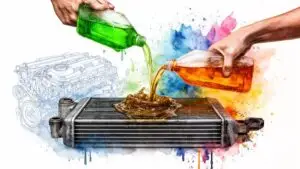

Yes, you absolutely can mix coolant and water. In fact, for most coolants sold as a concentrate, you have to. The key is getting the ratio right. For the vast majority of vehicles and climates in Haltom City, the magic number is a 50/50 mix of coolant and distilled water. Not tap water—we’ll get into why that’s a big deal in a moment.
Why The Right Coolant Mix Matters In Haltom City
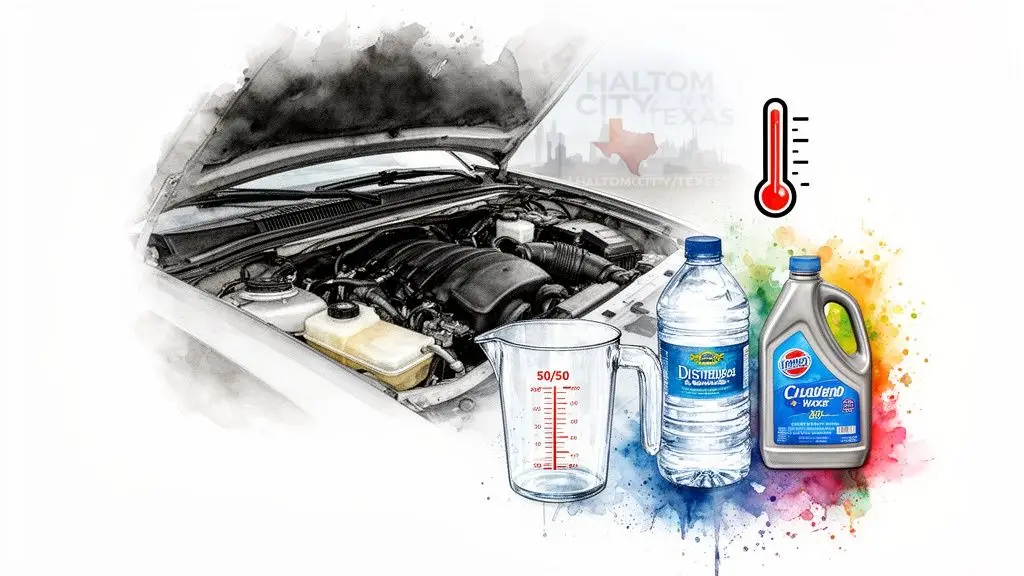
For anyone driving around Haltom City, that intense Texas heat is more than just uncomfortable; it's a constant threat to your engine. Your car’s cooling system is its only defense, and its effectiveness comes down to the fluid running through its veins. Simply pouring in water or guessing at the coolant mixture is a surefire way to wind up with an expensive repair bill, something no Haltom City driver wants.
A proper 50/50 blend of antifreeze and distilled water does more than just prevent your engine from freezing during a rare North Texas cold snap. Its primary job here in Haltom City is to raise the fluid's boiling point. This is absolutely critical for preventing your engine from overheating in rush hour traffic on Denton Highway or during a scorching August afternoon.
The Dangers Of An Improper Mixture
When that coolant-to-water ratio is off, your engine is left vulnerable. But the risks run much deeper than just overheating. Modern antifreeze is packed with a sophisticated cocktail of chemical inhibitors that are specifically designed to fight off rust, scale, and corrosion inside your engine and radiator.
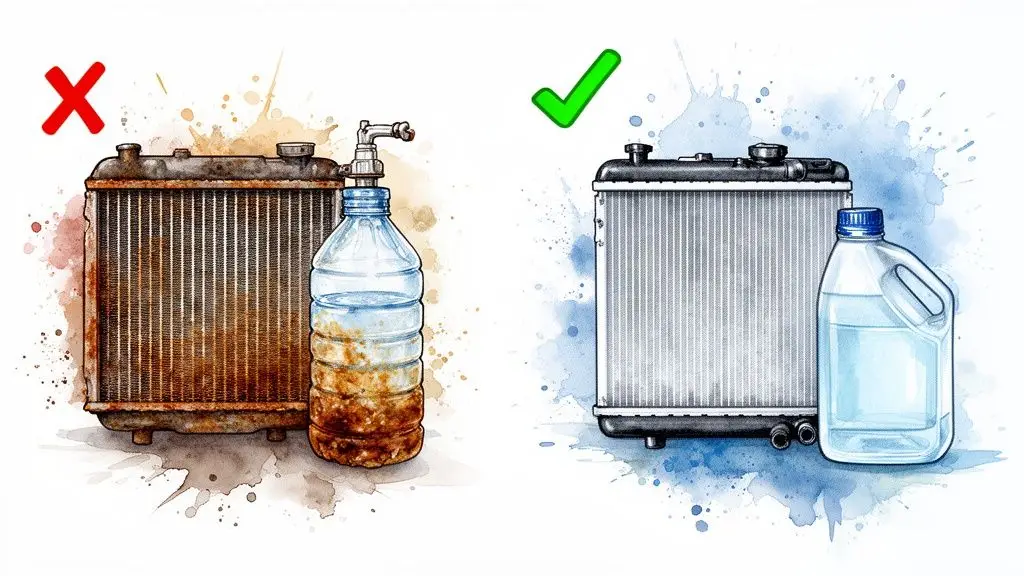
Running straight water or a mix that's too diluted is just asking for trouble, especially with the hard water we often have in the Haltom City area. The minerals found in tap water will leave behind scaly deposits, clogging up the tiny, delicate passages in your radiator and heater core. This chokes off coolant flow and cripples your car's ability to cool itself. You can learn more about how a clean system is vital by reading our guide on how car radiators work.
Worse yet, without those protective additives, corrosion starts eating away at metal components like the water pump and engine block from the inside out.
Over time, this internal corrosion creates a thick, nasty sludge that gets pumped throughout your entire cooling system. This gritty gunk grinds away at your water pump, clogs everything up, and can eventually lead to catastrophic engine failure right here on a Haltom City street.
Protection In All Seasons
While our summer heat is the main event in Haltom City, a proper coolant mixture provides crucial year-round protection. Those anti-corrosion additives work around the clock to keep your engine healthy.
That same balanced mix also ensures your car is ready for those sudden winter temperature plunges. Getting the coolant mixture right is a key step when you prepare your car for winter, as it prevents the fluid from freezing solid and cracking the engine block or cylinder head.
Getting this simple maintenance step right is one of the most important things a Haltom City driver can do. It’s a cheap and easy way to protect against some of the most expensive auto repairs, ensuring your car stays reliable on the roads of Haltom City, Keller, and beyond.
What Kind of Coolant Does My Car Take? A Quick Guide
Walking into a Haltom City auto parts store can be confusing. You’re hit with a wall of colorful jugs—green, orange, pink, yellow—all promising to protect your engine. Can you just grab any one? The short answer is a hard no. Using the wrong coolant can cause some serious, and expensive, damage.
For a long time, things were pretty simple. Nearly every car on the road in Haltom City and elsewhere used the classic, bright green antifreeze. This is what we in the industry call an Inorganic Additive Technology (IAT) coolant. It gets the job done, but its anti-corrosion ingredients wear out relatively fast. That’s why cars using it need a coolant flush every two years or 30,000 miles. You'll still see it on shelves, and it's perfectly fine for many older vehicles.
The Shift to Modern, Long-Life Coolants
As car manufacturing changed, so did engine parts. Aluminum became more common than cast iron, and automakers needed coolants that could protect these new materials for much longer. This led to the development of Organic Acid Technology (OAT) coolants.
These are the formulas you often see in orange, red, or even dark green. They’re designed for a much longer service life, some lasting as long as five years or 150,000 miles.
Perhaps the most famous—or infamous—OAT coolant is General Motors' Dex-Cool. It works great in the engines it was designed for. The problems start when people mix it with the old-school green stuff. The chemistry is totally incompatible, and the reaction creates a thick, brown sludge that clogs everything up. We’ve seen this firsthand in our Haltom City shop, and it’s a mess.
Key Takeaway: Coolant color means almost nothing anymore. Manufacturers use all sorts of dyes, so a "green" coolant could be an old IAT formula or a modern OAT type. The only way to know for sure is to check your owner's manual.
This gelling isn't a small problem. It can clog your radiator, heater core, and the small passages inside your engine, leading to major overheating. Back when this mixing mistake was more common, repairs for a gummed-up cooling system could easily run from $1,000 to $2,000. GM even dealt with lawsuits in the early 2000s over engine damage directly linked to this issue.
What About Hybrid Coolants?
To create a middle ground, chemists developed Hybrid Organic Acid Technology (HOAT). As the name suggests, it’s a blend of IAT and OAT, offering long-life protection that’s compatible with a wider range of engine materials. Just to make things more confusing for Haltom City drivers, HOAT coolants come in various colors like yellow, turquoise, and pink.
This just reinforces the main point: you can’t shop by color.
If you want to get deeper into the specifics, especially between the two most common older types, our guide on green coolant vs red coolant is a great resource.
Ultimately, the rule is simple and absolute for every car in Haltom City. Always use the specific type of coolant recommended by your vehicle’s manufacturer. Your owner's manual has the final say, and following its advice is the easiest way to keep your engine running smoothly for years to come.
How To Properly Mix Coolant For Your Car
For any Haltom City driver who likes to get their hands dirty under the hood, knowing how to mix coolant is a core skill for keeping your engine happy. It seems simple enough, but getting the details right is what prevents expensive problems down the road. The good news is, with the right supplies and a bit of care, you can tackle this job with confidence.
Let's start with the most overlooked ingredient: the water. You can't just grab the garden hose. Understanding the importance of using pure water is non-negotiable for a healthy cooling system. Tap water, like the kind supplied to homes in Haltom City, is loaded with minerals like calcium and magnesium, which will build up inside your radiator and engine passages, creating a nasty scale.
Think of that scale like cholesterol in your engine's arteries—it chokes off coolant flow and is a fast track to overheating. Those same minerals also speed up corrosion, eating away at crucial parts like your water pump from the inside. That’s why distilled water is an absolute must-have. It’s been purified of all those damaging minerals, so your coolant can do its job without any interference.
Achieving The Ideal 50/50 Ratio
For year-round driving here in North Texas, the magic number is a 50/50 ratio—that’s 50% coolant concentrate and 50% distilled water. This blend gives you the best of both worlds, raising the boiling point to survive Haltom City summers while also lowering the freezing point for those unpredictable winter freezes.
Getting the mix right is easy:
- Grab a clean, empty gallon jug, preferably one with measurement marks.
- Pour in a half-gallon of the coolant concentrate specified for your vehicle.
- Carefully add a half-gallon of distilled water to top it off.
- Screw the cap on tight and give it a good shake to mix everything together.
Just like that, you have a full gallon of perfectly formulated, ready-to-use coolant for your Haltom City vehicle.
Safety First: Never, ever work on a hot engine. The cooling system is pressurized, and opening it can spray you with scalding fluid, leading to serious burns. Always wear safety glasses and gloves because coolant is toxic.
The image below shows exactly what happens when you use the wrong types of coolant together.
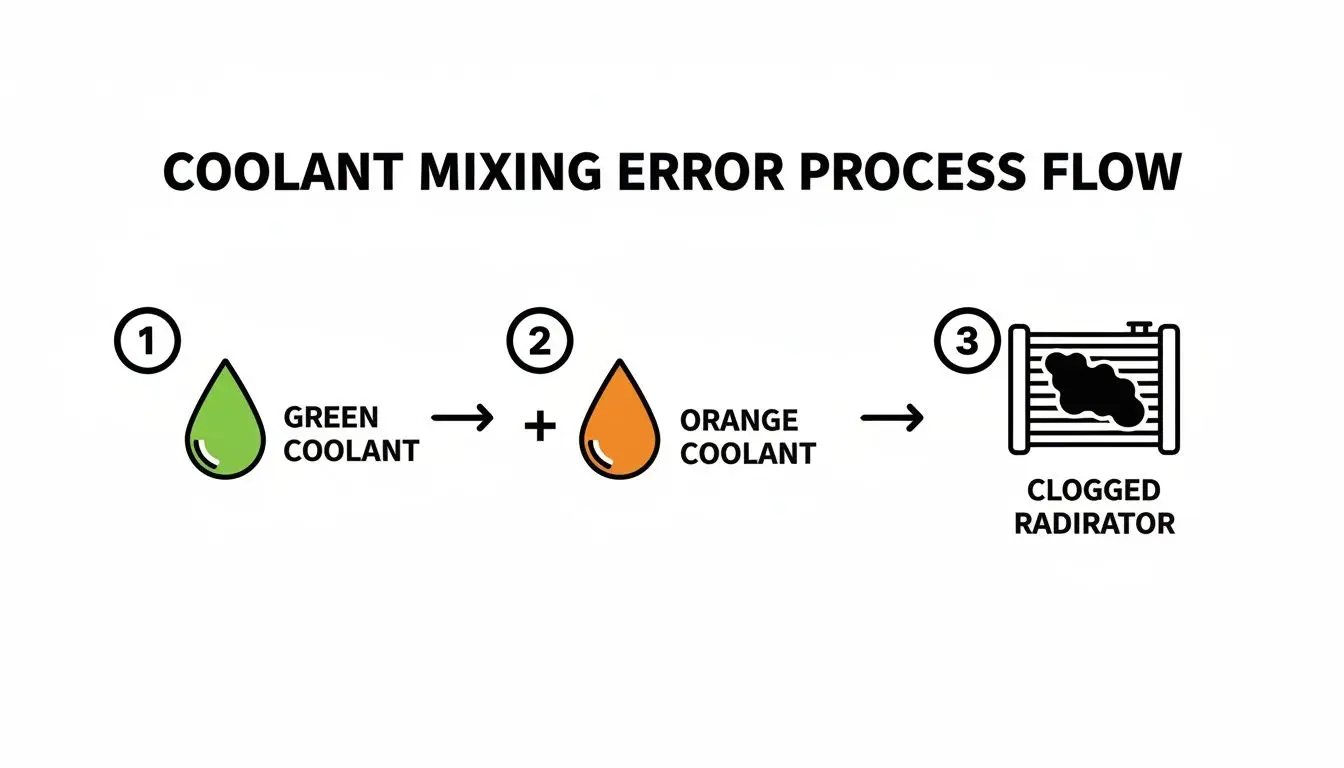
As you can see, combining different chemistries—like old-school green with modern orange coolant—creates a thick, damaging sludge that will clog your radiator in no time.
Top-Off Or Full Flush?
It's also crucial to know whether you just need a quick top-off or if it's time for a full system flush. If you peek at your coolant reservoir and it's just a little below the "full" line, adding some of your pre-mixed 50/50 solution is perfectly fine.
However, if that reservoir is bone dry, or if the fluid inside looks dirty, rusty, or sludgy, you've got a bigger problem on your hands. This is a tell-tale sign of a leak or that the coolant’s anti-corrosion additives have completely broken down. Just adding more fluid won't fix it. Your vehicle needs a complete flush to purge all the old, contaminated gunk before you refill it with a fresh, proper mixture. This is the only way to ensure the entire system is clean and fully protected for the roads of Haltom City.
Common Coolant Mistakes To Avoid
When you've been working on cars as long as we have in Haltom City, you see how simple mistakes can turn into massive repair bills. Here in the shop, we’ve witnessed countless drivers from Haltom City, North Richland Hills, and Watauga dealing with expensive damage from some very common and avoidable errors.
One of the easiest traps to fall into is grabbing the wrong bottle of coolant. It might not seem like a big deal to top off your system with whatever's on sale, but mixing incompatible coolants is a recipe for disaster. The additives in different formulas can have a violent chemical reaction, creating a thick, gunky sludge that clogs everything up.
This is particularly true when you’re mixing coolant and water with the wrong types. For instance, pouring modern orange Organic Acid Technology (OAT) coolant into an older system using green Ethylene Glycol (EG) creates a corrosive cocktail that eats away at aluminum engine parts. Industry data shows failure rates can jump by as much as 30% in these mismatched systems. Just look at Volkswagen’s February 2024 settlement over faulty coolant pumps—it cost millions to compensate owners for repairs directly linked to improper coolant mixes. You can reviewing the latest industry research for more on the market impact.
The Tap Water Trap
It’s not just the coolant type that matters; what you mix it with is just as critical. A lot of Haltom City residents reach for the garden hose or kitchen sink, but using tap water instead of distilled water is another costly mistake.
Why? Because the tap water here in Haltom City contains minerals and other dissolved solids. These impurities form chalky scale deposits inside your radiator and engine block, restricting coolant flow and crippling the system's ability to shed heat. On top of that, the minerals and chlorine in tap water dramatically speed up corrosion, rotting out your cooling system from the inside.
Ignoring A Low Coolant Level
Finding your coolant level is consistently low is a huge red flag for any Haltom City driver. Simply topping it off week after week isn’t a fix—it’s ignoring a cry for help from your engine.
A low coolant reservoir is almost always a symptom of a hidden leak. Ignoring it and simply adding more fluid is like putting a band-aid on a major wound. The underlying issue—a cracked hose, a failing seal, or a damaged radiator—will only get worse.
There's a big difference between routine maintenance and a recurring problem. Topping off a reservoir that's just a little low once in a blue moon is perfectly normal. Having to refill an empty or nearly empty one all the time means you need a professional inspection before you end up stranded on the side of a Haltom City road. If you're seeing signs of trouble, our guide on mixing green and orange coolant offers more insight into compatibility issues. Steering clear of these common blunders is the best way to avoid a headache and keep your car reliable.
When To Get Professional Coolant Service
Knowing how to top off your coolant is a fantastic skill to have in your back pocket. It can definitely get you out of a tight spot here in Haltom City. But some cooling system problems go way beyond a simple fluid top-off, and knowing the difference is crucial for your engine's health.
Think of it this way: if you’re constantly having to add more coolant, you’re only treating the symptom, not the cause. Recognizing the warning signs that point to a deeper issue will save you from major, expensive engine repairs down the road.
The most obvious sign, of course, is an overheating engine. If you're stuck in Haltom City traffic and you see that dreaded temperature needle start to climb into the red, your cooling system is crying for help. A simple top-off won't solve a faulty thermostat, a dying water pump, or a clogged radiator.
Another clear signal is the puddle under your car. Finding a bright green, orange, or pink puddle on your Haltom City driveway is more than just an annoyance—it's a sign of a persistent leak. No matter how much coolant you pour in, it's just going to end up on the pavement until a professional finds and fixes the source.
Red Flags That Demand Expert Attention
Sometimes the signs aren't as dramatic as a puddle or a sky-high temperature gauge. You have to use your other senses.
Trust your nose. If you catch a distinct, sweet smell either inside your car or around the front bumper, that's burning antifreeze. It often means you have a small leak in a hose or the heater core that's dripping onto a hot part of the engine.
You also need to trust your eyes. Pop the hood and look at the fluid in the coolant reservoir. It should be a bright, clean color. If you see coolant that looks:
- Murky or rusty-brown
- Thick and sludgy
- Has an oily film on top
…your system has a serious problem. That could mean there's widespread corrosion happening inside, or worse, you could be looking at a blown head gasket.
For busy drivers in Haltom City, there's no substitute for the peace of mind that comes with professional service. Our Haltom City shop uses specialized equipment to perform a complete coolant flush, powerfully removing old fluid, rust, and sludge that a simple drain-and-fill just can't touch.
A professional technician will also accurately diagnose the root cause of the problem instead of just guessing. If you're curious about what goes into a deeper cleaning, our article discussing the costs and benefits of an engine flush is a great resource. Bringing your car to the team at Express Lube & Car Care in Haltom City means your cooling system gets the expert attention it needs to protect your engine for many more miles.
Common Questions We Hear About Mixing Coolant
Even when you know the basics, real-world situations pop up. We get a lot of great questions from Haltom City drivers, so we’ve pulled together the most common ones our technicians answer every day. Here’s some straightforward advice to help you protect your engine.
Can I Just Top Off My Coolant with Water If It's Low?
We've all been there—you're out on a hot Texas day and notice your coolant is low. In a true emergency in Haltom City, adding a bit of distilled water is far better than letting the engine overheat. Think of it as a temporary patch, not a permanent solution.
Here's the catch: adding plain water dilutes the whole mix. This weakens its ability to fight boil-overs and, more importantly, waters down the anti-corrosion additives that protect your engine from the inside out.
A coolant level that keeps dropping is a classic sign of a hidden leak. The right move for any Haltom City driver is to have a technician inspect the system, pinpoint the problem, and then refill it with the correct 50/50 mixture.
Is a 70/30 Coolant Ratio Better Than 50/50 for Texas?
While a 70/30 coolant-to-water mix offers extreme freeze protection, it's actually the wrong choice for our climate here in Haltom City. The higher concentration of antifreeze is less efficient at transferring heat, which means your engine can actually run hotter during those brutal summer months.
For year-round driving in Haltom City and the rest of North Texas, nothing beats the 50/50 blend. It gives you the perfect balance: fantastic protection against boiling over, more than enough freeze protection for our mild winters, and the most effective heat transfer to keep your engine running right where it should be.
How Often Do I Really Need to Change My Coolant?
This is a great question, but there's no single answer that fits every car driving down Denton Highway in Haltom City. It all comes down to your vehicle's age and the specific type of coolant it uses.
- Older Cars: If your vehicle uses the traditional green IAT coolant, you’re likely looking at a flush and refill every 30,000 miles or about every two years.
- Modern Cars: Newer vehicles with long-life OAT or HOAT coolants can go for much longer—some even up to 150,000 miles between changes.
Your owner's manual is always the best source of truth for your specific car. That said, tough Haltom City driving conditions like constant stop-and-go traffic can wear out your coolant faster. We always recommend getting it tested during your regular oil changes, just to be safe.
Mixing coolant and water correctly is all about creating a stable fluid that keeps your engine safe. When you're not sure, getting a professional opinion from a Haltom City expert is always a smarter move than guessing and risking the health of your cooling system.
If you're unsure about your coolant's condition or think you might have a leak, don't let a small issue turn into a major repair bill. The certified technicians at Express Lube and Car Care in Haltom City are here to help. Schedule your professional coolant service with us today and drive with confidence.