

A lot of North Texas drivers ask about cold air intakes after the same kind of day. The car feels flat leaving a light on Denton Highway. Throttle response seems lazy in afternoon heat. You press the pedal harder than usual to merge, pass, or get moving with the A/C running, and the engine just doesn’t feel as eager as it should.
That’s usually when the question comes up. Is a cold air intake useful, or is it just a loud aftermarket part with a fancy filter?
For the right vehicle and the right kit, it can be a smart upgrade. Benefits of cold air intake systems aren’t limited to peak horsepower on a dyno sheet. Around Haltom City, Keller, Watauga, and North Richland Hills, the bigger story is how an engine behaves in heat, traffic, and dust. A well-designed intake can help the engine breathe cooler, less restricted air, which supports stronger combustion, quicker throttle response, and in some cases better fuel economy.
It’s also an upgrade with trade-offs. Some kits work well on daily drivers. Some don’t. A sealed system that manages engine-bay heat is a very different product from an open filter setup sitting next to a hot radiator and exhaust manifold. In Texas, that difference matters.
A cautious driver should look at this mod the same way a technician does. Start with function, not hype. Ask where the intake pulls air from, how it handles heat soak, what kind of filter media it uses, and how easy it is to maintain. If those answers are solid, a cold air intake can be one of the more practical bolt-on upgrades for a daily driver.
Introduction Unlocking Your Engine's Potential
If your vehicle feels stronger on a cool morning than it does in late afternoon traffic, you’re not imagining it. Heat changes how an engine breathes. On a hot Haltom City day, under-hood temperatures climb fast, and that hotter air isn’t as useful for combustion as cooler outside air.
That’s where a cold air intake earns attention. It isn’t a major engine rebuild or a complicated performance package. It’s a replacement for the factory intake path that aims to reduce restriction and pull in cooler air from outside the hottest part of the engine bay.
For many drivers, the appeal is simple. You want the car to respond better when you press the throttle. You want highway merging to feel easier. You’d also like an upgrade that doesn’t turn the vehicle into a maintenance headache.
Why local drivers ask about it
North Texas puts extra stress on intake systems because of three everyday conditions:
- Summer heat: Stop-and-go traffic and long idle periods raise engine-bay temperature quickly.
- Dust and roadside debris: Filters have to do real work here, especially on heavily traveled roads and construction corridors.
- Mixed driving: A daily driver around Haltom City might spend one trip in town and the next on SH-183 or I-820.
Those conditions make intake design more important than marketing language. A good system has to move air efficiently, protect the engine, and stay consistent when the weather isn’t helping.
Practical rule: If an intake only looks aggressive but doesn’t manage heat well, it may sound better than it performs in Texas traffic.
The benefits of cold air intake setups are real, but they’re best understood in context. This upgrade can add power, sharpen throttle response, and improve efficiency in the right conditions. It can also disappoint if the kit is poorly designed, badly installed, or ignored after installation. That difference is what matters most to a cautious local driver.
How a Cold Air Intake System Works
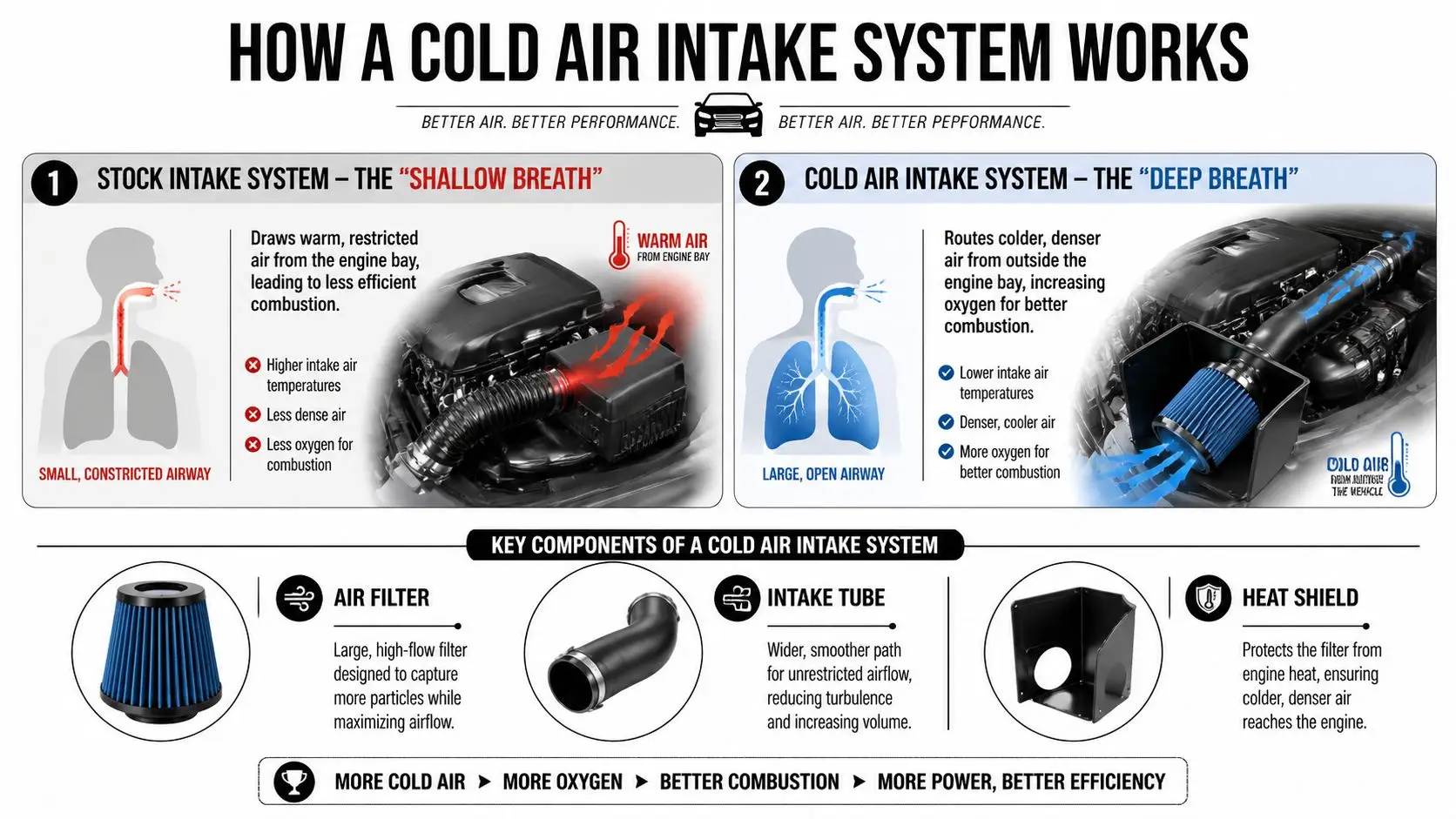
An engine makes power by mixing air and fuel, then igniting that mixture in the cylinders. If airflow is restricted, hot, or turbulent, the engine has a harder time making efficient power. That’s the basic reason cold air intakes exist.
A stock intake system often prioritizes packaging, cost, and noise control. That’s fine for reliability and everyday use, but it can create a more restrictive path for incoming air. Think of it as breathing through a narrow straw. The engine still gets air, but not through the smoothest or coolest path possible.
A cold air intake is closer to taking a deeper breath. It uses wider, smoother tubing, a larger high-flow filter, and usually a better route to cooler outside air.
What changes compared with stock
According to S&B Filters' explanation of cold air intake operation, stock air boxes often force air through narrow paths with bends and resonators that create turbulence and resistance. A cold air intake replaces that path with wider, straighter, smoother tubing and a large conical filter inside a sealed enclosure, which reduces pressure drop and supports higher airflow.
That matters because cooler air is denser. The same S&B source notes that cooler air contains about 3% more oxygen per unit volume for every 10°C drop in temperature, which helps the engine achieve more complete combustion.
The parts that do the work
A quality system usually improves airflow through a few specific components:
- Air filter: Typically larger than the factory panel filter and shaped to expose more filter area to incoming air.
- Intake tube: Smoother and less restrictive than stock tubing, with fewer sharp transitions.
- Heat management: Often handled by a sealed box or shield that separates the filter from under-hood heat.
- Air pickup location: Routed to pull air from a grille, fender area, snorkel, or another cooler source outside the hottest engine-bay air.
A cheap kit can copy the look without delivering the function. That’s why placement matters so much. If the filter sits exposed in hot engine-bay air, the system may not behave like a true cold air intake in real driving.
Why this matters in Haltom City heat
Hot weather changes the equation. The cooler the intake charge, the better the engine can support efficient combustion. In Texas, the difference between outside air and trapped under-hood air can be noticeable in how the vehicle responds after a long stoplight or a slow crawl through traffic.
The best daily-driver setup isn’t always the loudest one. It’s the one that keeps intake air cooler and airflow more stable when the vehicle is heat-soaked.
For local drivers, that’s the point. A cold air intake isn’t magic. It helps the engine breathe better by reducing restriction and sourcing air from a better place.
The Real-World Performance Benefits
The most common question is straightforward. How much difference can you feel from a cold air intake?
The honest answer is that results vary by engine, factory intake design, and the quality of the replacement kit. Still, there is a realistic performance range. According to CORSA Performance's cold air intake overview, cold air intake systems typically deliver 5 to 20 horsepower. That same source notes 5 to 15 horsepower as a consistent range cited by RealTruck.
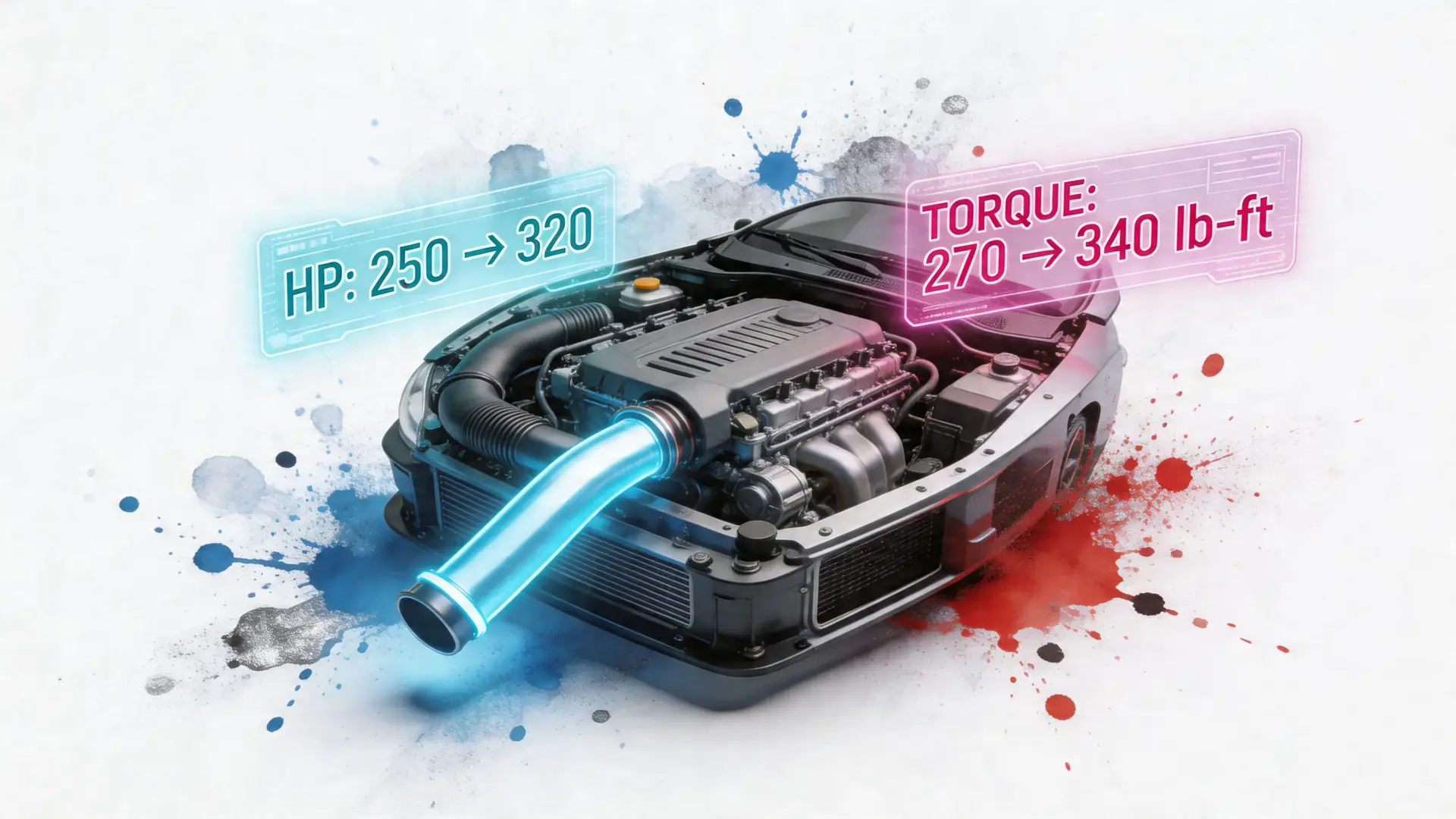
Those numbers sound modest, and that’s exactly why they’re credible. A cold air intake isn’t a miracle part. What it often changes most is how the vehicle feels during normal driving.
Where drivers usually notice it
A moderate power gain shows up in places that matter more than bench racing:
| Driving situation | What you may notice |
|---|---|
| Merging onto I-820 | Less hesitation when getting up to speed |
| Passing on a two-lane road | Stronger mid-range pull when you ask for more throttle |
| Stop-and-go traffic | Quicker response from small pedal inputs |
| Driving with A/C on in heat | The engine may feel less bogged down |
Throttle response is a big part of the appeal. Even before you talk about peak horsepower, a less restrictive intake can make the engine react more promptly. That gives the vehicle a more alert feel, especially if the stock intake was heavily muffled or restrictive.
What works and what doesn’t
A lot depends on vehicle type and intake design.
- Works well on vehicles with restrictive factory systems: Trucks, V8s, turbo applications, and engines that feel choked from the factory often respond better.
- Works best with sealed heat management: A true cold air path tends to deliver steadier results than an exposed filter under the hood.
- Works poorly when expectations are unrealistic: If you expect a cold air intake to transform the vehicle into something radically faster, you’ll be disappointed.
That’s also why this upgrade should be viewed as part of an overall efficiency package. Intake airflow, clean filters, proper spark plug condition, and healthy fuel delivery all affect how much benefit you’ll feel. Drivers interested in improving everyday efficiency can also look at practical ways to increase MPG alongside airflow upgrades.
A quick visual helps show why some drivers like this mod:
The practical takeaway
The best way to describe the performance side is this: the engine often feels less strained. It may pull more cleanly, respond faster, and hold power better when conditions are hot. For a Haltom City driver who spends more time merging, accelerating with traffic, and running the A/C than chasing dyno records, that’s a meaningful improvement.
Beyond Horsepower Gains
The discussion often begins with power. A better question is whether the upgrade improves the vehicle you drive every day. In many cases, that’s where the benefits of cold air intake systems make more sense.
Fuel economy is part of that discussion. According to RealTruck's cold air intake guide, cold air intakes can improve fuel economy by 1 to 2 MPG on average, with some users reporting 3 to 5 MPG gains under highway conditions. That same source says 70% of users in surveys reported benefits, while also noting that aggressive driving can offset them.

Why mileage can improve
When an engine gets cooler, denser air through a smoother intake path, combustion can become more efficient. That doesn’t guarantee savings in every commute. It does mean the engine may need less throttle input to do the same job during steady cruising.
Highway driving is where people usually notice the difference first. If you spend time on SH-183 between Haltom City, Watauga, and North Richland Hills, that kind of steady-state driving gives an intake the best chance to help.
For drivers who are already focused on combustion quality, fuel injector service also fits into the same conversation. The intake side and the fuel side work together, so airflow improvements won’t cover for injectors that aren’t performing well.
The sound change is part of the experience
A cold air intake also changes how the engine sounds. On a good system, the change is usually most noticeable under acceleration. You hear more induction noise and a deeper intake tone when the engine is working, but normal cruising often stays civil.
That matters more than some people expect. A vehicle that sounds more responsive tends to feel more connected, even when value is still in airflow and drivability. The key is moderation. Daily drivers usually benefit more from a refined intake note than from a loud, exposed setup that drones or pulls hot air.
There can be a long-term upside too
A well-filtered, well-maintained intake helps the engine breathe without unnecessary restriction. That supports cleaner combustion and steadier operation. It’s not a substitute for oil changes, filter service, or diagnostics, but it can complement a maintenance-minded approach.
A cold air intake makes the most sense when you want the vehicle to feel better every day, not just look modified when the hood is open.
Drivers who see the intake as part of a broader maintenance and efficiency strategy usually end up happiest with the result. The gains may be modest on paper, but better response, possible MPG improvement, and a cleaner engine note can add up to a more satisfying daily drive.
Myths and Realities for Texas Drivers
Texas drivers are right to be skeptical. A cold air intake has to work in real heat, not just during a cool dyno session. Around Haltom City, the question isn’t whether outside air is cold in an absolute sense. It’s whether the intake draws air that’s cooler than the trapped air under the hood.
That’s where good design matters. According to COBB Tuning's analysis of cold air intake pros and cons, hot under-hood air often reaches 100 to 150°F, and that heat can reduce oxygen density by up to 10% versus ambient 70°F air. The same source explains that well-designed systems relocate the filter low and forward and use heat shields to isolate it from engine-bay temperatures. COBB also notes that composite intake material rejects heat better than metal, listing thermal conductivity at 0.2 W/mK for plastic composite versus 50 W/mK for aluminum, and reports intake air temperatures 15 to 25°F cooler in that design context.

Myth that all intakes turn into hot air intakes
Some do. That’s the truth.
An exposed cone filter sitting in the engine bay can struggle in slow traffic and summer conditions. It may still sound aggressive, but sound isn’t airflow quality. A sealed or better-isolated system has a much better chance of staying consistent when the vehicle is heat-soaked.
A simple comparison helps:
| Intake style | Typical Texas street behavior |
|---|---|
| Open filter in engine bay | More exposed to heat and dust |
| Sealed or shielded cold air setup | Better control of heat soak and airflow consistency |
Dust is a real issue in North Texas
Heat gets most of the attention, but dust is just as important. Intake filters in this area deal with fine dirt, roadside debris, and the kind of grime that builds up faster than many drivers expect. That means filter choice and maintenance matter as much as raw airflow.
A reusable filter can be a good option if you service it on schedule. If not, neglect cancels the benefit quickly. An intake with excellent airflow but a dirty or poorly maintained filter is not helping the engine.
The right concern is filtration, not just performance
Drivers sometimes focus only on power and forget that the intake is the engine’s front door. The filter has to protect the engine while still flowing well. That’s why quality kits and proper servicing matter more than polished tubing or a loud induction note.
In North Texas, the wrong intake usually fails in two ways. It pulls too much heat, or it gets ignored until the filter is overdue for service.
The practical reality is simple. Cold air intakes can work well in Texas, but only if they manage heat and dust better than the stock setup. A poor kit may add noise. A good one adds consistency.
Installation Maintenance and Warranty Concerns
A cold air intake is often marketed as an easy bolt-on, and on many vehicles the installation itself is straightforward. That doesn’t mean every install goes smoothly. Fitment errors, loose clamps, sensor issues, and incorrect filter servicing are the problems that usually turn a simple upgrade into a check-engine-light visit.
A professional install helps because the technician can verify more than just bolt alignment. The mass airflow sensor has to be positioned correctly. Couplers need to seal evenly. The filter must sit where it won’t rub, shift, or pull unnecessary heat. A small mistake in any of those areas can affect drivability.
What maintenance actually involves
Reusable filters are one of the selling points of many systems, but they’re only an advantage if they’re maintained correctly. In dusty North Texas conditions, it’s smart to inspect the filter regularly and clean it according to the manufacturer’s instructions rather than waiting until the engine feels sluggish.
For drivers who want a broader look at service timing, how often to change an air filter in a car is worth reviewing before choosing a reusable setup. Maintenance style matters. Some drivers prefer the simplicity of replacement filters. Others don’t mind cleaning and re-oiling or washing a reusable element.
If you clean filters or nearby intake hardware at home, use methods meant for automotive parts, not harsh household shortcuts. Resources like Evo Dyne's automotive cleaning solutions are useful for understanding safer cleaning approaches when grime builds up on engine-related components.
Warranty worries are common, but context matters
A lot of drivers hesitate because they’ve heard any aftermarket part will automatically void the warranty. That’s not how the issue is usually handled. The key concern is whether the part or the installation caused a specific problem.
That’s why these steps matter most:
- Choose a vehicle-specific kit: Generic parts create fitment and sensor problems more often than properly engineered systems.
- Keep installation clean: No loose clamps, no damaged seals, no wiring strain, no poorly seated sensors.
- Follow the service schedule: A neglected filter can create the same kind of trouble as a neglected factory filter.
- Save documentation: Keep the installation instructions, part information, and maintenance records.
When this upgrade makes sense
If you want a low-drama intake upgrade, pick quality over appearance. A system that fits correctly, protects the sensor readings, and has a realistic maintenance routine is the one that tends to stay trouble-free.
The intake itself isn’t complicated. The ownership experience depends on whether the kit matches the vehicle and whether the person installing it treats it like an airflow system instead of a cosmetic accessory.
Your Next Steps with Express Lube and Car Care
For a Haltom City driver, the value of a cold air intake comes down to one question. Will it make the vehicle better in the conditions you drive in?
If the answer means stronger response in summer heat, easier merging, a more satisfying engine note, and the possibility of better fuel efficiency during steady highway driving, then the upgrade can make sense. If the kit is poorly designed, exposed to too much under-hood heat, or likely to be ignored after installation, it probably won’t.
That’s why the smartest next step isn’t buying the first intake that shows up in a search result. It’s getting the vehicle evaluated first. Engine layout, filter location, driving habits, and maintenance expectations all matter. The right intake for a truck that sees highway miles and jobsite dust may not be the right intake for a commuter car that spends most of its life in city traffic.
What to ask before you install one
Use this short checklist before making a decision:
- Is it a sealed or heat-managed design: In DFW heat, this matters more than polished looks.
- How is the filter serviced: Reusable sounds great until the owner realizes they won’t maintain it.
- Will it fit the exact engine and sensor setup: Vehicle-specific fitment is the safer path.
- What are you trying to improve: Response, sound, efficiency, or all three.
A good shop can answer those questions without overselling the part. That’s what protects you from buying an intake that looks impressive online but isn’t well suited to a North Texas daily driver.
If you’re ready to compare options, filter replacement service information is a useful place to start because it ties the performance conversation back to airflow, filtration, and routine maintenance. That’s the right frame for this upgrade. A cold air intake should help the engine breathe better, not create a new problem to manage.
The best result is simple. The vehicle feels more responsive, stays easy to live with, and keeps doing its job in heat, traffic, and dust.
If you want help deciding whether a cold air intake is a smart fit for your vehicle, schedule a visit with Express Lube and Car Care. The team at 6211 Denton Hwy can inspect your current intake setup, discuss daily driving conditions around Haltom City, Keller, Watauga, and North Richland Hills, and give you clear guidance on whether a heat-managed intake upgrade makes sense for your car or truck.