

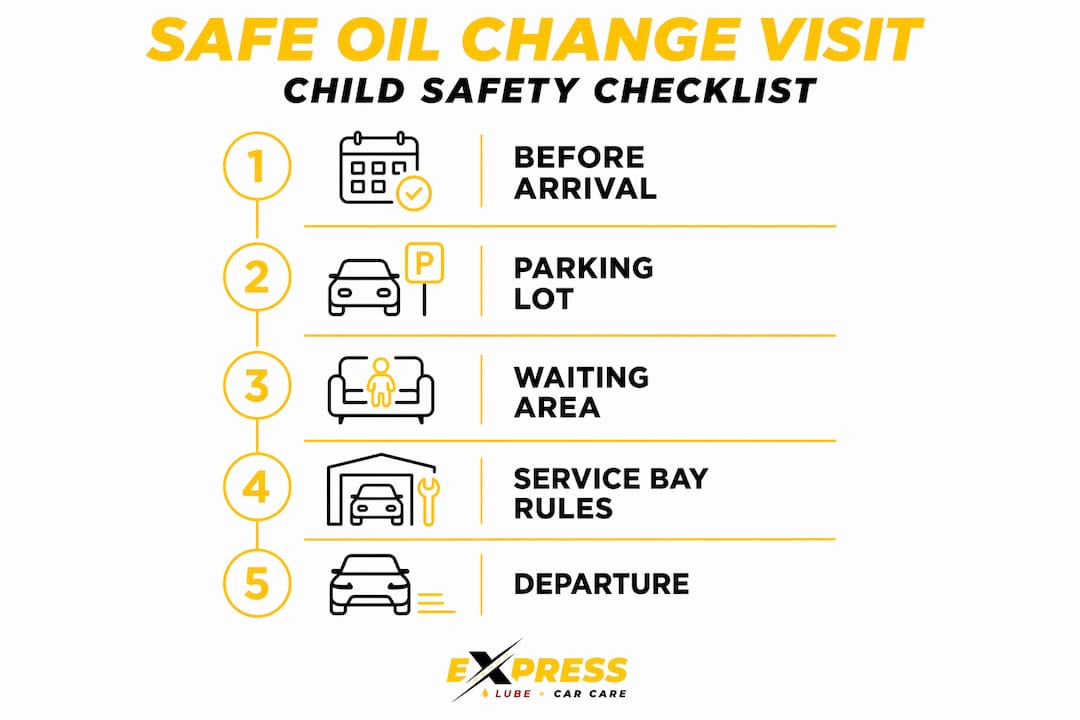
Taking your child along for an oil change feels routine. You pull in, hand over the keys, and wait. But child safety during an oil change visit is something most parents haven’t thought through carefully, and that gap creates real risk. Service bays hold hot oil, raised vehicles, moving equipment, and floors slick with fluids. Parking lots have backing cars and blind spots. Even the waiting room can present hazards if a child wanders. This guide walks you through exactly what to watch for and how to handle it.
Table of Contents
- Key Takeaways
- Child safety during an oil change visit: the real risks
- Car seat rules that apply before and during the visit
- Supervising children safely at the service center
- What to expect from a professional service center
- Additional safety tips and emergency preparedness
- My honest take on keeping kids safe at the shop
- Bringing your family to Express Lube & Car Care
- FAQ
Key Takeaways
| Point | Details |
|---|---|
| Service bays are high-risk zones | Hot oil, raised vehicles, and moving equipment make bays off-limits for children at all times. |
| Back seat is the safest position | Children under 13 should always ride in the back seat to stay protected from airbag deployment. |
| Supervision cannot be passive | Constant, focused adult supervision prevents children from drifting into dangerous areas. |
| Plan your visit strategically | Scheduling during off-peak hours reduces wait time and limits your child’s exposure to active service zones. |
| Ask your service center directly | Reputable shops will tell you where children should wait and what safety boundaries are in place. |
Child safety during an oil change visit: the real risks
Most parents think the danger starts and ends with the car ride. It doesn’t. The service environment itself introduces a separate set of hazards that are easy to underestimate when you’re filling out paperwork or scrolling your phone in the waiting room.
Here’s what’s actually happening in and around a service bay during a typical oil change:
- Hot engine components. The engine block, exhaust manifold, and oil drain plug can reach temperatures that cause serious burns on contact. A curious child who touches the wrong surface has no warning before the damage is done.
- Raised vehicles and jacks. Vehicles supported only by a jack without jack stands can shift unexpectedly. A child near a raised vehicle is in serious danger if anything moves.
- Spilled fluids. Used motor oil, coolant, and brake fluid create slippery surfaces. These fluids are also toxic if touched or ingested.
- Tools and hoses. Wrenches, drain pans, and air hoses left on the floor are tripping hazards. Active maintenance zones are unsafe for children due to these overlapping risks.
- Moving vehicles. Cars pulling in or out of bays move slowly but unpredictably. Children are small enough to fall outside a driver’s sightline.
The parking lot carries its own risks. Backing vehicles, hot engines, and equipment left near parked cars make the lot a hazard zone, not a play area. Many parents treat it as neutral ground. It isn’t.
Pro Tip: Before you get out of the car, tell your child clearly: “You stay with me the whole time. No running ahead, no touching anything.” Setting that expectation before you open the door is more effective than correcting behavior once you’re inside.
Car seat rules that apply before and during the visit
Getting to the service center safely is part of the equation. Car seat and seating decisions during the drive matter just as much as what happens once you arrive.
The American Academy of Pediatrics recommends that all children under 13 ride in the back seat. This isn’t a suggestion based on preference. It’s about airbag deployment. Front passenger airbags are designed for adult bodies, and they can cause serious injury to a child seated in front, even in a minor collision.
Beyond seat position, proper installation makes a significant difference. Use the seat belt or LATCH system with tethers as the manufacturer specifies. Correct LATCH and tether use greatly reduces injury risk in a crash. A seat that looks installed correctly but isn’t tethered properly offers far less protection than you’d expect.
“Riding in the back seat reduces risk from airbags, which can injure children seated in front, even at low deployment speeds.” — Cleveland Clinic
One thing parents often miss: car seat safety doesn’t pause while you’re waiting in the service lot. If your child is young enough to be in a rear-facing or forward-facing seat and you’re sitting in a parked car, don’t let them slump or unbuckle while you wait. If you’re moving inside to the waiting area, bring the child with you rather than leaving them buckled and unattended in the car.
If you have any doubt about whether your car seat is installed correctly, a professional car seat inspection takes less than an hour and gives you verified peace of mind. Many fire stations and pediatric clinics offer this service at no cost.
Supervising children safely at the service center
Good supervision at a mechanic shop is not the same as keeping an eye on your child at a park. The environment is more compressed, the hazards are less obvious, and things change quickly as technicians move equipment and vehicles shift positions.
Here’s a practical approach to managing supervision during the visit:
- Identify the safe zone before you sit down. Walk in and locate the designated waiting area. Make sure it’s separated from the service floor. Sit where you have a clear sightline to your child at all times.
- Set physical boundaries out loud. Tell your child exactly where they can and cannot go. “You can sit in these chairs or stand next to me. That door and everything past it are off-limits.” Children respond better to specific rules than general warnings.
- Put your phone away during active transitions. The highest-risk moments are when vehicles are moving in or out of bays and when technicians are repositioning equipment. These are exactly the moments when a distracted parent loses track of a child.
- Bring something to keep them occupied. A tablet with headphones, a small activity book, or a favorite toy gives your child a reason to stay in one spot. Boredom is what drives kids to wander.
- Never leave a child unattended. Even stepping away for two minutes to speak with a technician is long enough for a child to move into a dangerous area. Bring them with you or wait until they’re settled with another trusted adult.
Pro Tip: If you’re bringing a toddler or a child who is difficult to keep still, ask a friend or family member to come along. One adult handles the service transaction while the other stays focused on the child. It sounds like extra effort, but it removes the split-attention problem entirely.
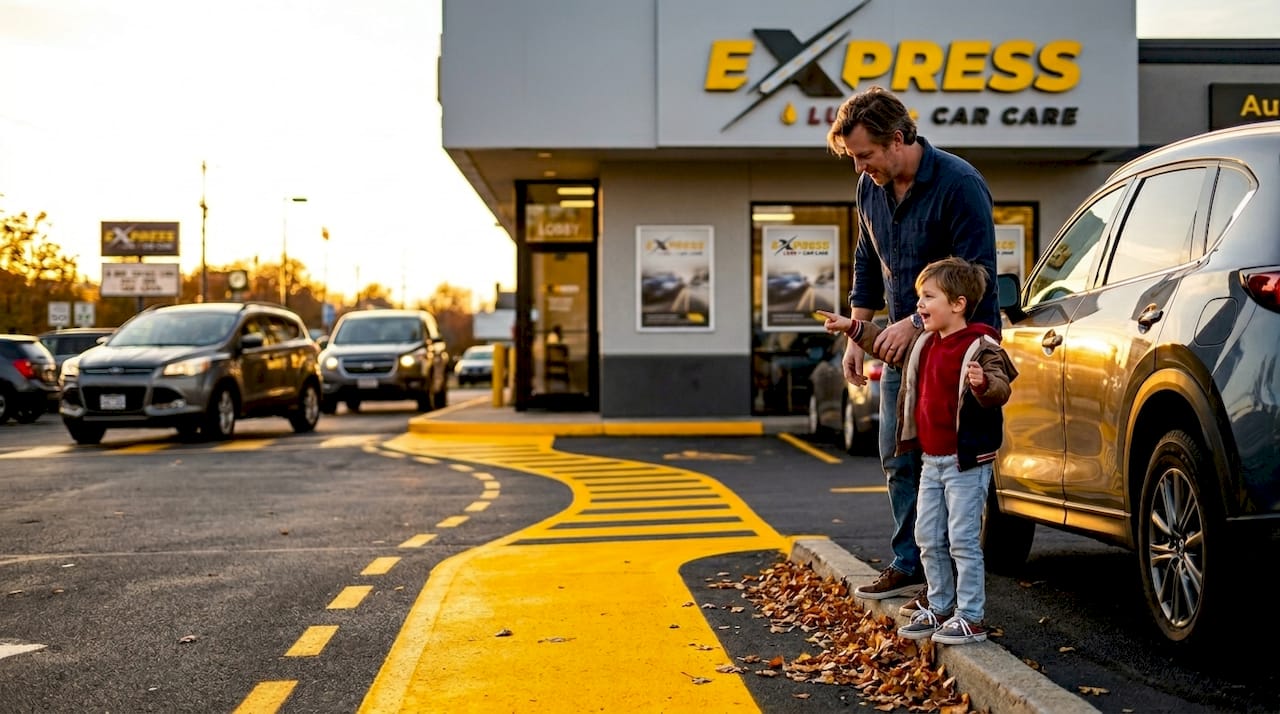
Many parents overlook that the parking lot requires the same level of active supervision as the bay area. Hold your child’s hand from the moment you exit the vehicle until you’re inside the building. Don’t assume they’ll stay close.
What to expect from a professional service center
A well-run shop takes oil change service family safety seriously, and there are clear signs you can look for when you arrive.
- Clear physical separation. The waiting area should be visibly separated from the service floor. There should be a door, a window, or at minimum a clear boundary between where customers sit and where work happens.
- Signage and verbal guidance. Staff at reputable centers will tell you where to wait and where children should not go. If no one mentions it, ask directly: “Where is the safest place for my child to wait?”
- Clean, organized waiting spaces. A shop that keeps its waiting room tidy is generally a shop that takes its overall environment seriously. Clutter in a waiting room is a minor hazard in itself, especially for young children.
- Responsive staff. Good technicians understand that parents have competing attention demands. They’ll come to you with updates rather than expecting you to approach the service floor.
You don’t need to be aggressive or demanding to get this information. A simple question at the front desk, “Is there a specific area where my kids should stay?” signals that you’re paying attention and gives staff the opportunity to guide you appropriately. Reading through oil change tips before your visit can also help you understand what a standard service process looks like so you know what to expect.
Additional safety tips and emergency preparedness
Beyond supervision and car seat positioning, a few practical preparations can make the visit go more smoothly and reduce the chance of an incident.
- Carry a basic first aid kit. A small kit with bandages, antiseptic wipes, and gloves handles minor scrapes or contact with fluids. It’s not paranoia. It’s preparation.
- Keep emergency contact information accessible. Have your pediatrician’s number and the nearest urgent care address saved in your phone before you leave home.
- Schedule during off-peak hours. Early morning visits typically mean fewer vehicles moving through the bay, shorter waits, and less overall activity in the service area. Less activity means fewer variables to manage with a child present.
- Talk to your child about hazards beforehand. For children old enough to understand, a brief conversation in the car about why the shop is not a playground goes a long way. “There are hot parts and heavy machines in there, so we stay in the waiting area.” Age-appropriate explanations build cooperation.
- Keep younger children buckled if they stay in the car. If you choose to wait in the vehicle, keep children properly restrained and never leave them alone. A parked car in a service lot is still a dynamic environment.
- Have a backup plan. If your usual co-parent or support person is unavailable, consider rescheduling rather than managing a difficult child solo in an unfamiliar environment.
Reviewing a vehicle safety checklist before your appointment can also help you consolidate service visits, which means fewer trips to the shop overall.
My honest take on keeping kids safe at the shop
I’ve seen a lot of parents come through with children in tow, and the pattern I notice most is this: parents are careful during the drive and then relax the moment the car stops. That shift in attention is where the risk actually begins.
What I’ve learned from working in this environment is that the most dangerous moments are the transitions. A car pulling into a bay. A technician moving a floor jack. A child who got bored three minutes ago and is now standing closer to the service door than anyone realized. These aren’t dramatic accidents waiting to happen. They’re quiet, fast, and preventable.
The parents who handle this best aren’t the most anxious ones. They’re the most prepared ones. They’ve had the conversation with their child before they walked in. They know where they’re going to sit. They’ve got something to keep their kid occupied. They’re not trying to manage everything at once because they’ve already reduced the number of things that need managing.
My take: don’t wait until you’re standing in the parking lot to figure out your plan. Think it through before you leave home. That’s the difference between a stressful visit and a routine one.
— Express Lube & Car Care
Bringing your family to Express Lube & Car Care

At Express Lube & Car Care in Haltom City, we understand that bringing children along for a service visit adds a layer of responsibility to an already busy day. Our waiting area is clearly separated from the service floor, our ASE-certified technicians work efficiently to minimize your time on-site, and our staff is always ready to answer questions about where your family should wait. No appointment is needed, and our quick oil change service gets you back on the road fast. You can also schedule your visit online to plan around your child’s schedule and avoid peak hours.
FAQ
Where should children wait during an oil change?
Children should stay in the designated waiting area, fully separated from the service floor. Never allow children near the service bays, parking lot, or any area where vehicles or equipment are moving.
Are service bays dangerous for kids?
Yes. Active maintenance zones expose children to hot engine parts, spilled fluids, raised vehicles, and moving equipment. Children should not enter these areas under any circumstances.
Should children stay buckled in the car during an oil change?
If your child remains in the vehicle, keep them properly restrained and never leave them unattended. The safer option for most families is to bring children into the waiting area where you can supervise them directly.
What age can a child sit in the front seat at a service visit?
The American Academy of Pediatrics recommends that all children under 13 ride in the back seat during travel. Apply the same standard when deciding where a child sits if waiting inside the vehicle.
How can I make an oil change visit easier with young children?
Schedule during off-peak hours, bring a quiet activity to keep your child occupied, set clear boundaries before entering the shop, and consider bringing a second adult to share supervision responsibilities.