

You follow the sticker on your windshield, change your oil every 5,000 miles, and figure you are covered. Then a fleet manager tells you their linehaul trucks go 35,000 miles between changes. A local contractor’s diesel is due every 7,500 miles. Same oil, same basic engine concept, wildly different schedules. Understanding why truck oil change intervals vary is not just an academic exercise. It directly affects your maintenance costs, your engine’s lifespan, and how much unnecessary downtime you absorb over the life of a vehicle.
Table of Contents
- Key Takeaways
- Why truck oil change intervals vary: the core reasons
- How severe operating conditions shorten oil life
- Modern tools that take the guesswork out of intervals
- Building a smarter truck maintenance schedule
- My take on variable intervals after years in the shop
- Get expert truck oil change service at Express Lube & Car Care
- FAQ
Key Takeaways
| Point | Details |
|---|---|
| Intervals are not one-size-fits-all | Duty cycle, engine type, oil chemistry, and operating conditions all shape the right interval for your truck. |
| Severe conditions shorten intervals significantly | High idle, cold starts, and dusty environments can reduce safe oil life by 25 to 45 percent compared to standard recommendations. |
| Technology enables smarter scheduling | Onboard oil-life monitors and oil sample analysis let you base service timing on real data, not calendar guesswork. |
| OEM intervals are built for worst-case | Manufacturers set conservative baselines to protect the hardest-working trucks, which means milder operators may safely extend their intervals. |
| Oil analysis is the safest way to extend drains | Baseline sampling followed by stepwise interval increases gives you the evidence needed to push drains further without risking engine health. |
Why truck oil change intervals vary: the core reasons
The short answer is that oil does not degrade on a fixed schedule. It degrades based on what it goes through. Class 8 diesel intervals range from 15,000 miles all the way past 50,000 miles, depending on the engine platform, oil specification, and actual duty cycle. That range is not a discrepancy. It is the correct answer for different trucks doing different jobs.
Engine platform matters more than most owners realize. A modern Cummins X15 running full synthetic CK-4 oil under highway conditions is a fundamentally different operating environment than a vocational diesel spending most of its day idling at a job site. The chemistry inside the crankcase, the heat cycles, the combustion byproducts, all differ dramatically between those two scenarios.
Oil type is the other critical variable. Conventional oil breaks down faster under heat and shear stress. Full synthetic oils maintain viscosity longer, resist oxidation better, and carry more robust additive packages. OEM intervals are deliberately conservative to protect worst-case operators who run cheaper oil, push harder duty cycles, and may skip other maintenance items. If your truck runs quality synthetic oil on a clean highway route, the OEM manual interval is almost certainly shorter than what your oil actually needs.
Here is a practical breakdown of the primary factors:
- Engine design and displacement: Larger displacement diesels with lower combustion byproduct per liter of oil volume dilute contaminants more effectively, supporting longer drains.
- Oil viscosity grade and specification: API CK-4 or FA-4 certified synthetics outperform older CJ-4 oils at high temperatures and shear stress, which directly extends safe drain intervals.
- Duty cycle: Highway miles at steady load produce far less oil stress than stop-and-go urban routes or high-idle vocational work.
- Fuel quality: Low-sulfur diesel reduces acid formation in the oil. Biodiesel blends above B5 accelerate additive depletion and shorten intervals noticeably.
- Load and ambient temperature: Sustained heavy loads and extreme heat accelerate oxidation, while frequent cold starts cause condensation buildup and fuel dilution.
Pro Tip: Check your OEM manual for both “normal” and “severe service” interval specifications before setting any maintenance schedule. Most manuals list both, and the difference can be 30 to 50 percent. Knowing which category your operation falls into is the first decision you need to make.
How severe operating conditions shorten oil life
Knowing the factors is one thing. Understanding exactly how real-world conditions accelerate oil degradation gives you the context to act on that knowledge. Severe service conditions accelerate acid and soot generation while depleting additives 25 to 45 percent faster than standard operating conditions. That is not a minor adjustment. That is the difference between a 15,000-mile interval and a 10,000-mile one.
Here is how the most common severe conditions actually affect your oil:
-
High idle time. When your truck idles for long periods at a construction site or loading dock, the engine runs hot but produces low power output. This raises combustion temperatures without the cooling effect of moving air, accelerating oxidation and soot contamination in the oil.
-
Short trips and incomplete warm-up. City delivery trucks that run 20 to 30 minutes before returning to the yard never fully warm the oil. Condensation forms in the crankcase, water mixes into the oil, and unburned fuel dilutes it. This problem compounds quickly with repeated short cycles.
-
Cold weather operation. Temperatures below negative 20°C cause faster oil oxidation and viscosity loss during the cold start phase. Frequent cold starts in sub-zero conditions can require interval reductions of 30 to 40 percent compared to a truck operating in moderate climates.
-
Dusty and off-road environments. Dirt and fine particulates bypass air filters and enter the oil as abrasive contaminants. Construction and agriculture trucks working unpaved roads see oil particle counts rise dramatically between changes.
-
Biodiesel blends above B5. Higher biodiesel concentrations pull moisture and oxidize faster than petroleum diesel, stripping antioxidant additives from the oil well before the mileage marker would suggest it is time.
Pro Tip: If your truck spends more than 30 percent of its operating time idling, treat every interval as a severe service interval. Idle hours are hard on oil and easy to undercount. Many fleet managers use engine hour meters alongside odometer readings to get a truer picture of oil stress.
You can find a solid breakdown of how city versus highway use affects maintenance timing across different vehicle types, which is useful context if you manage a mixed fleet.
Modern tools that take the guesswork out of intervals
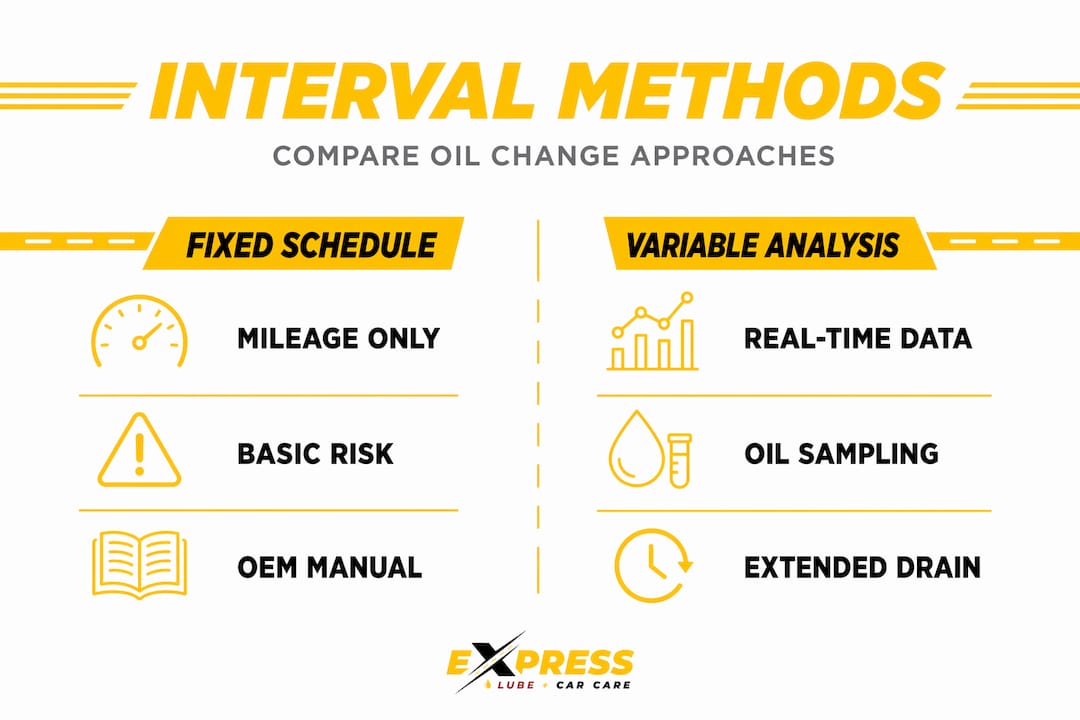
Fixed mileage schedules were the best option available when truck technology was simpler. Today, you have tools that track what your oil is actually experiencing, not just how many miles it has traveled.

Onboard oil-life monitoring systems
Modern heavy-duty engines like the Cummins X15 use ECM-embedded variable maintenance monitors that calculate remaining oil life from real-time inputs including load, temperature, idle percentage, and trip frequency. These systems treat oil change intervals as dynamic recommendations tailored to each individual truck, not fixed mileages applied across an entire fleet. The practical result is that oil life monitors reduce unnecessary early oil changes by up to 35 to 40 percent on highway fleets. That translates directly to fewer service events, less downtime, and lower fluid costs per year.
Oil sample analysis programs
Oil analysis is the most precise tool available for interval management. A lab measures wear metals, total base number (TBN, the oil’s remaining acid-neutralizing capacity), viscosity, and contamination levels. Here is how a well-run program works:
- Draw 2 to 3 baseline oil samples early in the truck’s service life to establish normal wear patterns for that specific engine.
- At each subsequent drain, pull a sample before changing the oil to compare against the baseline.
- If all markers remain within spec, extend the next interval incrementally, typically 10 to 15 percent at a time.
- Continue quarterly analysis and repeat the cycle, building a data record that supports your decisions.
The payoff is significant. Fleet programs using oil analysis safely extend drain intervals to 50,000 miles or more on linehaul trucks running quality synthetic oil, while vocational trucks get shorter intervals validated by actual chemistry rather than guesswork.
| Approach | Basis for interval | Typical drain range | Risk level |
|---|---|---|---|
| Fixed OEM mileage | Worst-case scenario estimate | 15,000 to 20,000 miles | Low but potentially wasteful |
| Onboard oil-life monitor | Real-time duty cycle data | 20,000 to 35,000 miles | Low with proper oil spec |
| Oil sample analysis | Lab-confirmed oil condition | 25,000 to 50,000+ miles | Very low with consistent sampling |
Building a smarter truck maintenance schedule
Understanding the theory is only useful if you put it into practice. Here is how to build a maintenance schedule that actually fits your trucks rather than just defaulting to whatever interval came on the last service sticker.
Start by classifying your duty cycle honestly. Pull your engine hour logs alongside your odometer data. If your idle percentage is above 25 percent or your average trip length is under 30 minutes, you are in severe service territory regardless of what your total mileage looks like. Linehaul trucks can safely stretch oil changes to 50,000 miles with proper analysis, while vocational trucks typically need intervals in the 10,000 to 20,000-mile range even with synthetic oil.
- Confirm your truck meets the oil specification required for any extended drain interval. Running a CK-4 synthetic in a truck spec’d for CJ-4 conventional oil is not a minor upgrade. It is a prerequisite for longer drain cycles.
- Do not extend intervals without oil analysis backing you up. The cost of a lab sample is typically under $30. A spun bearing or premature engine failure costs thousands. The math is straightforward.
- Use telematics data if your fleet has it. GPS and engine monitoring systems log idle time, load events, and temperature cycles automatically, giving you the inputs needed to categorize each truck accurately without manual tracking.
- Review your intervals seasonally, especially if your trucks operate in Texas summers or northern winters. Extreme ambient heat above 35°C stresses oil chemistry just as aggressively as cold weather, and summer peak loads often coincide with peak heat.
The goal is not to stretch intervals as far as possible. The goal is to match the interval to what the oil actually needs. Over-maintaining costs you money and downtime. Under-maintaining costs you engines. Both are avoidable with the right information.
Pro Tip: If you manage a fleet, start your oil analysis program with your highest-mileage trucks first. They give you the fastest feedback on whether your current intervals are appropriate and build your baseline data faster than low-mileage units.
Getting the right oil type is foundational to any interval strategy. The synthetic versus conventional comparison is worth reviewing if you are still deciding which direction to take your fleet.
My take on variable intervals after years in the shop
I’ve watched fleet managers walk in with maintenance schedules built entirely around a fixed mileage number someone decided on years ago, and they hold onto that number like it is written in stone. What I’ve learned working with trucks across a wide range of duty cycles is that rigid fixed intervals are almost always wrong for somebody. They are either too conservative for highway operators who could safely go longer, or too relaxed for vocational trucks grinding through idling and short hauls.
The mindset shift that matters is moving from “when is the next oil change due” to “what does this specific truck’s oil actually need right now.” That shift feels uncomfortable at first because it requires more data and more attention. But the downtime and cost savings from eliminating even one or two unnecessary oil changes per year per truck add up quickly across a fleet.
What I’ve seen work consistently is a simple combination: use onboard monitors as a first filter, then back up your interval decisions with oil analysis. You do not need to do both for every single truck in your fleet. Start with your highest-use units, build the data, and let the results guide your schedule across the rest of your operation. The fleets that do this spend less on maintenance, experience fewer unexpected breakdowns, and protect their engines more effectively than any fixed-interval shop ever could.
— Express Lube & Car Care
Get expert truck oil change service at Express Lube & Car Care
If you are in the DFW area and want oil change service that actually accounts for how your truck operates, Express Lube & Car Care in Haltom City is set up to help. The ASE-certified technicians understand the difference between a highway fleet truck and a vocational diesel running in severe conditions. They work with the oil specifications your truck needs and can walk you through interval decisions based on your actual duty cycle. No appointment is needed, turnaround is fast, and you get clear answers without guesswork. Whether you manage a single work truck or a larger fleet, getting your oil change and diagnostics handled by technicians who understand variable intervals is one of the most straightforward ways to protect your investment.
FAQ
Why do truck oil change intervals differ so much from car intervals?
Heavy-duty truck engines operate under significantly higher load, temperature, and idle cycles than passenger car engines, and they use specialized oil formulations rated for those conditions. The combination of engine size, duty cycle, and oil spec creates a much wider range of appropriate intervals than you see with standard passenger vehicles.
Can I extend my truck’s oil change interval with synthetic oil?
Yes, but only if your engine’s OEM spec supports it and you confirm the extension with oil sample analysis. Synthetic oil supports longer drains for trucks on clean highway cycles, but severe duty conditions can still break down synthetic oil faster than the mileage suggests.
How do onboard oil-life monitors work on heavy-duty trucks?
These systems use real-time engine data including load, temperature, idle percentage, and trip frequency to calculate remaining oil life rather than counting miles. The Cummins X15, for example, uses an ECM-embedded algorithm that generates per-truck interval recommendations based on actual operating conditions.
What is the biggest mistake fleet managers make with oil change intervals?
Applying a single fixed interval across an entire mixed fleet is the most common and costly error. Duty cycle multipliers vary significantly between linehaul and vocational trucks, and treating them identically either wastes money on unnecessary changes or risks engine damage from running oil too long.
How many baseline oil samples do I need before extending drain intervals?
Start with two to three baseline samples taken at your current standard interval to establish normal wear metal and TBN patterns for each engine. From there, extend incrementally and continue sampling at each drain to verify the oil is holding up before pushing the interval further.