
That unnerving click when you turn the key, or a sudden, clumsy gear shift can really put a damper on your day. More often than not, these frustrating moments for Haltom City drivers point to a tiny, hardworking part giving up the ghost: a solenoid.
Think of a solenoid as a small but mighty gatekeeper, controlling some of your car’s most important functions. It’s the electrical switch that gives your starter motor the green light to crank or tells your transmission it’s time to shift.
Is Your Car Sending You Warning Signs?
Let’s break down the common bad solenoid symptoms you might run into on the roads of Haltom City. By understanding the key differences between a starter, transmission, or fuel system solenoid problem, you’ll have a much better idea of what your car is trying to tell you. Knowing these signs is the first step to getting the right fix and avoiding a breakdown.
At its core, a solenoid is just a simple electromagnet. When your car sends an electrical current through a coil of wire, it creates a magnetic field. This field moves a small plunger, which then opens a valve or completes a circuit. It’s a simple but vital job.
The catch? These little devices are constantly working under stressful conditions like high heat and vibration. Over time, they just wear out.
The Three Main Culprits
When a solenoid acts up, the problem usually traces back to one of three key systems: the starter, the transmission, or the fuel system. Each one has its own unique set of symptoms that can help you and your Haltom City mechanic pinpoint the issue.
Here’s a quick look at how these different symptoms manifest.
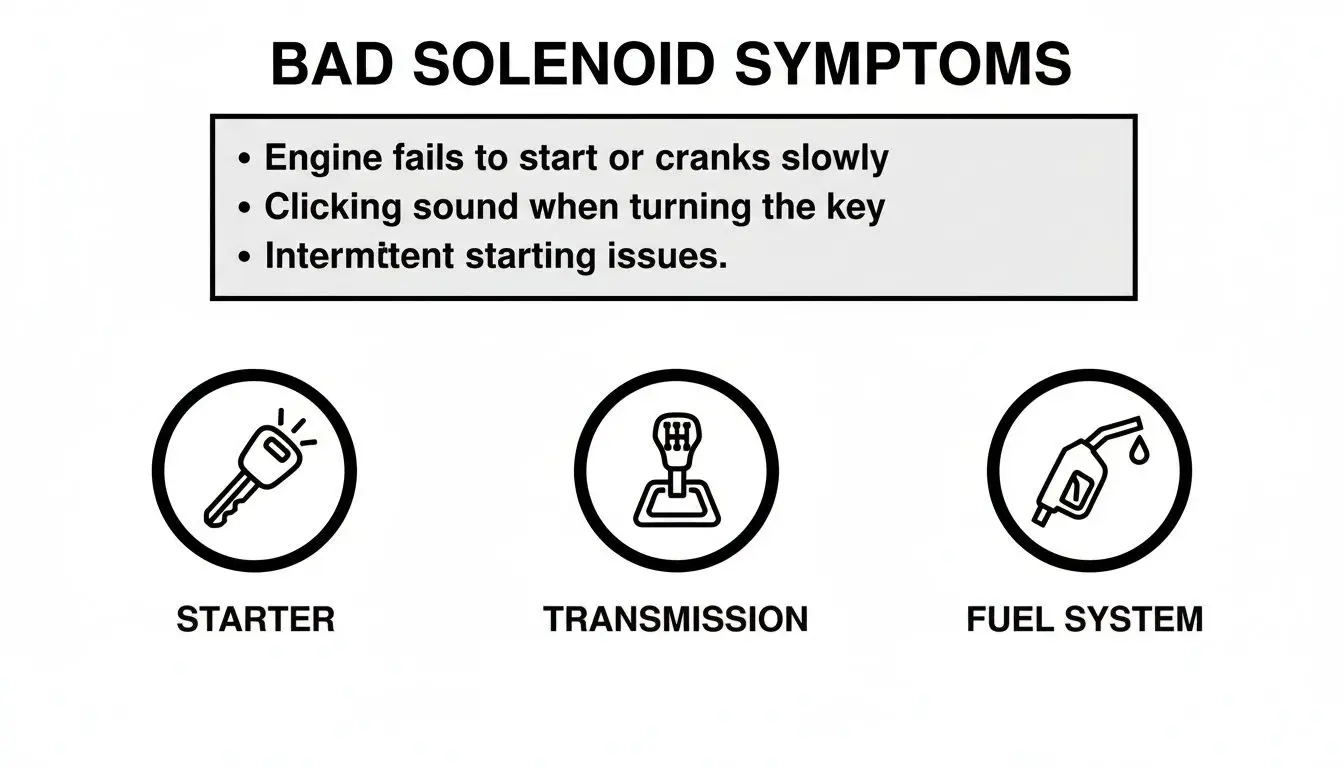
As you can see, this one type of component can cause very different problems depending on its location. A click, a jolt, or even the smell of gas can all point back to a solenoid. Understanding what you’re experiencing helps you communicate the problem clearly, which means a faster, more accurate diagnosis and no money wasted on the wrong repairs.
To make it even simpler, here’s a quick guide to help you connect the symptom you’re experiencing with the likely culprit.
Quick Guide to Bad Solenoid Symptoms
| Solenoid Type | What You Might Experience | What It Means |
|---|---|---|
| Starter Solenoid | A single, loud click when you turn the key, but the engine doesn’t crank. Or, intermittent starting issues. | The solenoid isn’t successfully engaging the starter motor to turn over the engine. |
| Shift Solenoid | Harsh or delayed shifting, getting stuck in one gear, or a “Check Engine” light related to the transmission. | The solenoid isn’t properly controlling the flow of transmission fluid needed for smooth gear changes. |
| Purge/Fuel Solenoid | Rough idling, poor engine performance, difficulty starting after fueling, or a strong fuel odor. | The solenoid is failing to manage the flow of fuel vapors from the gas tank to the engine, disrupting the air-fuel mixture. |
This table is a great starting point. If any of these symptoms sound familiar, you’re on the right track to figuring out what’s going on under your hood.
That Dreaded Click from Under the Hood
You know the feeling. You slide into the driver’s seat, turn the key expecting your engine to roar to life, and instead… you get a single, loud click. That disheartening sound is one of the most classic bad solenoid symptoms, and it’s almost always pointing to a problem with your starter solenoid.
Think of the starter solenoid as a heavy-duty gatekeeper for your engine’s starter motor. When you turn the ignition key, you’re just sending a small electrical request. The solenoid’s job is to take that tiny signal and throw open the main gates, allowing a massive surge of power from the battery to hit the starter motor and crank the engine.
When that solenoid starts to fail, it can’t properly manage that huge electrical load. The click you’re hearing is literally the sound of the solenoid trying to do its job but not having the strength to follow through, leaving your starter motor high and dry.
Distinguishing the Clicks
Now, not all clicks are created equal, and knowing the difference can point you in the right direction. When a starter solenoid is on its way out, you’ll typically hear one of two sounds:
- A Single, Loud Click: This is the classic symptom. It means the solenoid is getting the signal from your ignition but the internal components are too worn out to pass the power along to the starter.
- Rapid, Machine-Gun Clicking: If you hear a fast-paced click-click-click-click, your problem is more likely a weak or dying battery. The solenoid is engaging, but the battery doesn’t have enough power to hold it, so it snaps back and forth.
These clicking sounds are a huge clue. In our experience here in Haltom City, and backed by industry service data, these noises are present in roughly 40-50% of all complaints related to a car not starting, making it a primary diagnostic tool. You can find more technical explanations of this process in starter maintenance guides from experts at Edmunds.com.
Is It the Solenoid or the Battery?
Before you assume the worst, here’s a simple test anyone can do. Just turn on your headlights and then try to start the car.
If your headlights stay bright and strong but the engine just gives you that single click, your battery is probably fine. The starter solenoid becomes the main suspect. But if the headlights dim significantly or go out completely when you turn the key, you’re almost certainly looking at a dead or weak battery.
This quick check can save you a lot of guesswork. Of course, a bad connection can sometimes act like a bad battery. It’s always worth making sure your terminals are clean by following our guide on preventing battery terminal corrosion. Knowing the difference between these bad solenoid symptoms helps you avoid paying for repairs you don’t need and gets you back on the road in Haltom City faster.
When Your Engine Gives You the Silent Treatment

Okay, so a clicking sound is bad. But what about when you turn the key and get… nothing? Just complete, dead silence. No crank, no click, not even a whisper from the engine. It’s one of the most sinking feelings you can have as a Haltom City driver.
Your first instinct is probably to blame the battery. And you’re not wrong—a dead battery is the usual suspect. But it’s not the only thing that can cause this frustrating silence.
A totally fried starter solenoid can mimic a dead battery perfectly. This is one of the most clear-cut bad solenoid symptoms you can get, pointing to a complete failure in the chain of command that starts your car.
Think of the solenoid as the gatekeeper between your battery and the starter motor. When it gets the signal from your key, it swings open, letting a huge surge of electricity rush through to crank the engine. When the solenoid is shot, that gate is rusted shut. The power is there, but it has nowhere to go.
The Anatomy of a Silent Failure
So, why does it fail so silently? This happens when the solenoid’s internal parts are so worn, burnt out, or corroded that they can’t even try to make a connection. The little plunger inside that’s supposed to move and complete the circuit just sits there.
The command from your ignition key arrives, but the solenoid gives it the cold shoulder. No click, no action, nothing.
We see this a lot in our Haltom City shop. Industry data shows that a complete, silent failure to start accounts for roughly 25-35% of all starter solenoid-related service calls. It means the part has completely lost its ability to act as the electrical bridge between the battery and the starter. You can get a deeper technical dive into these kinds of starter solenoid issues and see how technicians diagnose them.
Knowing this can save you a real headache. It’s frustrating to spend money on a new battery only to find out it wasn’t the problem in the first place.
If you’re stuck in Haltom City with a car that won’t make a sound, don’t just assume it’s the battery. A quick, professional diagnostic check can pinpoint the real culprit, whether it’s a silent solenoid or something else entirely. It ensures you get the right fix the first time.
The Unpredictable Nature of Intermittent Failures

There’s nothing more maddening than a car that starts perfectly one day but completely refuses to crank the next. This is the classic, frustrating sign of an intermittent solenoid failure—and a clear warning that the part is about to give out for good.
It’s just like a flickering light switch in your house. Sometimes it works, but other times you have to jiggle the switch to get a connection. A dying starter solenoid acts the exact same way. The power is there, but the connection inside the solenoid itself is failing.
This happens for a few reasons. Internal wear and tear, a bit of corrosion on the electrical contacts, or even changes in temperature can make it work one moment and fail the next. You might find it starts fine when the engine is cold, but after a drive through Haltom City, the heat makes the metal parts expand just enough to break that fragile electrical connection.
Why You Should Never Ignore Intermittent Problems
It’s tempting to just write off a problem that only happens sometimes. But when it comes to your car starting, ignoring these little hiccups is a gamble you will eventually lose. Every successful start is just borrowing time before the solenoid fails completely.
Trust me, this is an incredibly common scenario. From what we see in our Haltom City shop, intermittent starting issues account for roughly 20-30% of all diagnosed starter solenoid problems. It’s a textbook example of a part that’s failing gradually, not all at once. You can learn more about the signs of a struggling solenoid and see just how often this symptom pops up.
An intermittent solenoid problem is not going to fix itself. It’s a clear signal that a critical component is failing, and the “good” starts are just temporary reprieves before a permanent breakdown.
Getting it checked out now is the smartest move you can make. It means you can schedule a repair on your own terms, rather than waiting for an emergency tow from a crowded Haltom City parking lot at the worst possible time.
If your car is giving you these now-and-then starting troubles, it’s time for a professional look. Our auto diagnostic services can pinpoint if the solenoid is the true culprit before it leaves you stranded for good. Don’t wait for “sometimes” to become “all the time.”
Symptoms Beyond the Starter Motor
While that classic click-click-click is the most famous sign of a bad solenoid, it’s just the tip of the iceberg. Many drivers think solenoid problems are only about starting the car, but these little electro-mechanical parts are working all over your vehicle. If your car is acting up around Haltom City but still starts, a different kind of solenoid might be the real troublemaker.
It’s not just a traditional engine issue, either. Modern vehicles, especially hybrids with their complex powertrains, rely on a whole host of solenoids to operate. A deeper understanding of how hybrid cars actually work can really open your eyes to all the components that need to work in perfect harmony.
Transmission and Shift Solenoid Problems
Let’s talk about your automatic transmission. Inside, you have a group of shift solenoids that basically act as traffic directors for your transmission fluid. This fluid is what makes the magic happen, creating the hydraulic pressure needed to switch gears. When everything is working as it should, your drive around Haltom City is completely smooth.
But when a shift solenoid starts going bad, that smooth operation disappears. The solenoid gets stuck, disrupting the fluid’s path, and suddenly your drive becomes a lot less pleasant.
Think of a shift solenoid as a small hydraulic gate. When your car’s computer says “shift,” the solenoid opens the gate to let fluid flow into a specific channel, engaging the next gear. A bad solenoid is like a gate with a rusty hinge—it either doesn’t open on time, or it slams shut unexpectedly.
You’ll definitely feel it when a transmission solenoid is on its way out. Look for these signs:
- Harsh or Delayed Shifting: The car might jerk or clunk hard when changing gears. Or, you might notice a long, awkward pause before the next gear engages.
- Getting Stuck in Gear: This is a big one. Your transmission might refuse to shift up or down, or it may even go into “limp mode”—a self-preservation state where it stays in one gear (usually 2nd or 3rd) to prevent further damage.
- Check Engine Light: A faulty shift solenoid is a surefire way to trigger the check engine light. Your car’s computer is smart enough to know something is wrong with the transmission and will store specific error codes.
Fuel System and Purge Solenoid Issues
Sometimes, performance problems feel mechanical but are actually rooted in your car’s emissions system. Your EVAP (Evaporative Emission Control) system has a critical component called a purge solenoid. Its job is to control fuel vapors, preventing them from escaping into the atmosphere by directing them from a charcoal canister back into the engine to be burned.
When this little part fails, it can cause a whole host of seemingly unrelated symptoms, like a rough idle or terrible gas mileage. It’s easy to mistake these for other problems, which is why a proper diagnosis is so important. For example, if you’re also noticing dimming lights, you might be looking at a different issue entirely; it’s worth reading up on how to know if your alternator is bad.
Your Haltom City Solution for Solenoid Problems
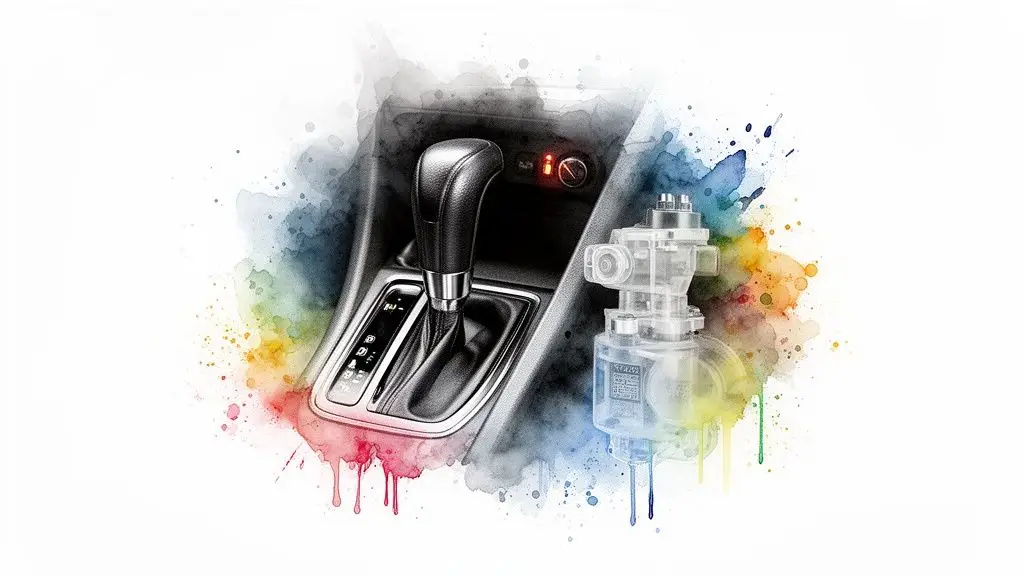
We’ve covered the strange and frustrating bad solenoid symptoms your car might be throwing at you, from that unnerving click when you turn the key to gears that just won’t shift smoothly. Understanding what might be wrong is one thing, but getting it fixed right here in Haltom City is what truly matters. And for that, you need to move from educated guesses to a concrete diagnosis.
Here at Express Lube & Car Care, this is what we do day in and day out for our neighbors in Haltom City. Our technicians have the right diagnostic tools and, more importantly, the hands-on experience to figure out if it’s a starter, transmission, or fuel system solenoid causing you grief.
Why Professional Diagnosis Is Key
Chasing down an electrical gremlin in a modern car can be a costly and maddening game of whack-a-mole. You might hear “no start” and immediately think “bad starter solenoid,” but the real culprit could just as easily be a weak battery or a failing alternator. Replacing parts one by one is a quick way to empty your wallet without solving the problem.
For a deeper dive into these related parts, you can see how we approach diagnostics and repairs for alternators and starters to get the full picture.
We’re big believers in total transparency for our Haltom City customers. Our team will show you exactly what our scanners find, explain what’s happening with the faulty solenoid, and lay out your repair options in plain English—no pressure, just honest advice.
Our goal is always to find the root of the problem, not just slap a bandage on the symptom. It’s about getting the repair done correctly the first time, so you can get back on the road with confidence.
Your Next Steps in Haltom City
Most of the time, replacing a faulty solenoid is a straightforward and cost-effective fix that gets your vehicle running reliably again.
That said, we’ll always give you an honest assessment. If your car is getting on in years and facing a mountain of repairs, we’ll tell you. In some rare cases, it might make more sense to look into local junk car removal services. But for the vast majority of drivers, a targeted repair is the smartest path forward.
Don’t let a small electrical part leave you stranded in Haltom City. Schedule an inspection with our team today, and let’s get you a definite answer.
We Answer Your Top Questions About Solenoid Problems
When a solenoid starts acting up, it can be a real mystery. We hear a lot of the same questions from drivers around Haltom City, so we’ve put together some straight-shooting answers to help you figure out what’s going on with your car.
Can I Keep Driving With a Bad Transmission Solenoid?
In a word: no. We strongly advise against it, especially on busy Haltom City roads like the NE Loop 820 or Denton Highway. A transmission solenoid is what tells your car when to shift gears. When it fails, you can experience all sorts of chaos, from sudden, violent jerks between gears to being completely stuck in one gear.
That’s not just annoying—it’s a major safety hazard that could easily lead to an accident. Pushing your luck can also cause a domino effect of damage inside your transmission, turning a relatively minor solenoid fix into a full-blown, wallet-draining transmission rebuild. It’s much smarter (and cheaper) to get it checked out right away.
How Much Does Solenoid Replacement Cost Around Here?
This is a tough one to answer without seeing the car, as the cost really depends on which solenoid is failing and how hard it is to get to. For instance, a bad starter solenoid is often the easiest to access, so you might be looking at a repair cost between $150 and $500 for the part and the labor involved here in Haltom City.
Transmission solenoids are a different story. They’re usually tucked away inside the transmission pan, which makes the job much more involved.
- Diagnosis First: The most important step is a proper diagnosis. You don’t want to pay for a transmission solenoid replacement only to find out that wasn’t the problem.
- Location Matters: Because they are harder to reach, the labor time is naturally longer, which affects the final price.
- The Bottom Line: For transmission solenoids, costs can easily range from $300 to over $800+, depending on your vehicle.
The only way to get a firm number for your car here in Haltom City is to have a professional technician take a look.
Is It a Bad Solenoid or Just a Dead Battery?
Ah, the classic “click but no start” problem. This is probably the most common mix-up we see from drivers in Haltom City. You turn the key, hear a single, sharp click, and then… silence. It’s easy to blame the battery, but that’s not always the case.
Here’s a quick trick you can try right in your driveway: turn on your headlights before you try to start the car. If they are bright and strong, but you still just get that one click when you turn the key, you’re likely dealing with a bad starter solenoid. If your headlights are dim or go out completely when you try to start it, the battery is the main suspect.
Keep in mind, this isn’t a 100% foolproof diagnosis. Corroded cables or other electrical gremlins can cause similar symptoms. The only way to know for certain is to have a professional run a diagnostic test to pinpoint the exact cause of the failure.
If you’re noticing any of these bad solenoid symptoms, don’t put it off and risk a breakdown. The team here at Express Lube and Car Care can perform a professional diagnosis and get you back on the road safely. We’re proud to serve the Haltom City community. Schedule your appointment online or just swing by the shop. You can learn more at https://www.expresslubehaltom.com.