
You’re driving through Haltom City, maybe heading down Denton Highway, when a small, ominous light pops up on your dashboard: the brake fluid warning light. Of all the warnings your car can give you, this is one you absolutely cannot ignore. It’s signaling a critical issue with the single most important safety system in your vehicle—your brakes.
This isn’t a "check engine soon" situation. It demands your immediate attention, especially on the busy streets of Haltom City.
Your Immediate Action Plan
Seeing that light can definitely spike your heart rate, but knowing exactly what to do next will keep you in control. Think of this light not as a suggestion, but as a direct order from your car to take action right now. Your number one priority is to get yourself and your vehicle off the road safely.
The second you see that light, start looking for a safe place to pull over. A parking lot in Haltom City, a quiet side street—anywhere you can get away from traffic. Once you're safely stopped, put the car in park, engage the parking brake, and turn off the engine.
Now, it’s time for a quick, telling test. Press your foot down on the brake pedal.
Testing Your Brake Pedal
How does the pedal feel under your foot? The answer gives you a huge clue about what’s going on.
- Soft or Spongy: Does the pedal sink easily toward the floor? Does it feel mushy or squishy? This is a classic sign of a serious hydraulic problem, like a fluid leak or air that has gotten into the brake lines.
- Firm and Normal: If the pedal feels solid, just like it always does, the immediate danger might seem less severe. However, that warning light is still on for a reason, pointing to an underlying fault that needs a professional eye, and it's best to consult a Haltom City mechanic.
This chart is a great visual guide for what to do in that moment. It walks you through the decision-making process from the second you see the light.
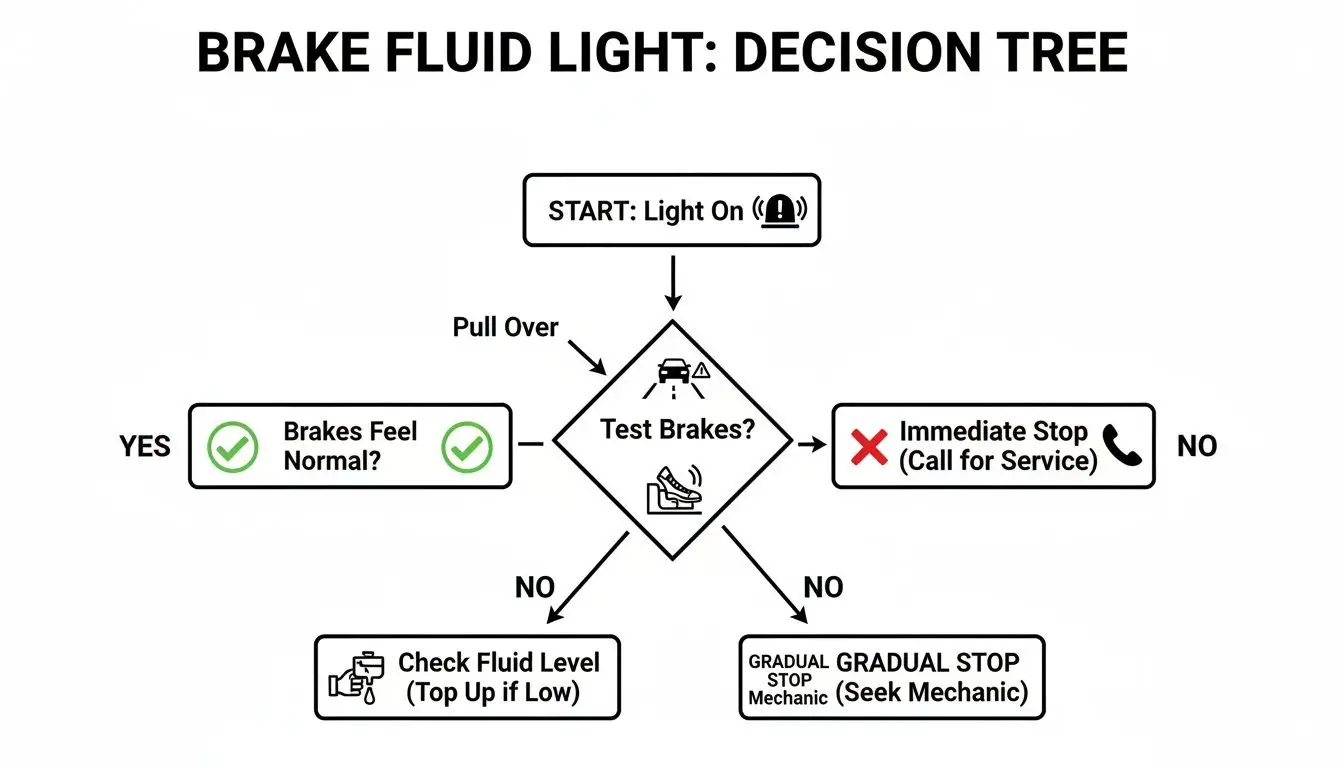
Notice that no matter what you find, the final step is always the same: get your vehicle to a professional.
When that light comes on, your car is telling you its ability to stop is compromised. To help you react quickly and safely in Haltom City, here's a quick-reference table.
Immediate Actions for a Brake Fluid Warning Light
| Action | Reason | Next Step |
|---|---|---|
| Pull Over Safely | Your car's stopping power may be severely reduced. Continuing to drive puts you and others at risk. | Find a parking lot or a safe shoulder away from traffic. |
| Test the Brake Pedal | The feel of the pedal (spongy vs. firm) provides clues about the severity of the hydraulic issue. | With the car off, press the pedal to assess its resistance. |
| Do Not Drive | Even if the brakes feel okay, the warning indicates a definite problem in the system. | A spongy pedal means it's unsafe to drive. A firm pedal still requires a tow. |
| Call for Help | Driving with a compromised brake system is never worth the risk. It's time to call in the professionals. | Contact a tow service or a trusted Haltom City auto repair shop. |
This isn't a situation where you "limp" home. The risk is just too high.
Brake system warnings are your car's most urgent safety alerts. The system is designed to monitor fluid levels and pressure, which are essential for creating the force needed to stop your vehicle. As you can find in more depth on resources like Championautoparts.com, a drop in either can lead to brake failure.
No matter how the pedal feels, please, do not continue driving. The light is on for a very good reason, and the last thing you want is to find out why at 50 mph. For anyone in the Haltom City area, the safest bet is to give a local expert a call. Here at Express Lube & Car Care, we’re ready to help. We can get your vehicle towed to our Haltom City shop, find the source of the problem, and give you a clear, honest plan to get you back on the road safely.
Why Your Brakes Depend on Healthy Fluid

To really get why a brake fluid warning light is a big deal, you have to understand the job this fluid is doing. Your car’s braking system is a hydraulic powerhouse, and brake fluid is the non-compressible liquid that makes the whole thing go. It’s truly the lifeblood of your ability to stop.
Here’s how it works: when you step on the brake pedal, you’re not using your own strength to stop the car. You’re actually pushing a small plunger into a component called the master cylinder, which pressurizes the brake fluid inside a sealed network of lines and hoses.
This incredible hydraulic force shoots through the lines almost instantly, arriving at the calipers on each wheel. The fluid pressure then forces pistons to clamp the brake pads against your spinning brake rotors. It's this friction that brings a two-ton vehicle to a safe, controlled stop, a crucial function on Haltom City roads.
The Science of Stopping Power
Now, here's where it gets critical. Brake fluid is engineered to have a very high boiling point because that friction we just mentioned creates an enormous amount of heat, often climbing to several hundred degrees. If that fluid boils, it turns from a solid liquid into a compressible gas—basically, steam.
This is a complete disaster for your brakes. Instead of transferring force, those new gas bubbles will just squeeze together when you hit the pedal. You’ll feel the pedal go soft and "spongy," sinking right to the floor with almost no stopping power to show for it.
Your braking system relies on the fundamental principle of hydraulics: a liquid cannot be compressed. When brake fluid boils, it introduces air bubbles, breaking this principle and causing a dangerous loss of braking ability. This is why a brake fluid warning light often points to a problem that compromises this entire process.
This total loss of function is exactly why maintaining your brake fluid is a non-negotiable part of vehicle safety. Any problem with the fluid is a direct threat to your ability to stop your car.
Water Is the Enemy of Your Brakes
Unfortunately, standard brake fluid has one major weakness: it's hygroscopic. That’s a fancy way of saying it loves to absorb moisture right out of the air. Over time, water molecules find their way into the system through microscopic pores in the rubber hoses and past seals.
As more water gets in, it tanks the fluid's boiling point. For example, fresh DOT 3 brake fluid might boil at over 400°F. But with just 3.7% water contamination, that boiling point can plummet to below 284°F—a temperature you can easily hit during a hard stop or while driving in the Texas heat around Haltom City. If you're concerned, you can learn more about how to check for issues by exploring our detailed guide on your brake fluid level.
This contamination is the number one reason brake fluid needs to be replaced on a regular schedule. Old, water-logged fluid is an accident waiting to happen, creating the exact conditions for brake failure that the brake fluid warning light is trying to warn you about.
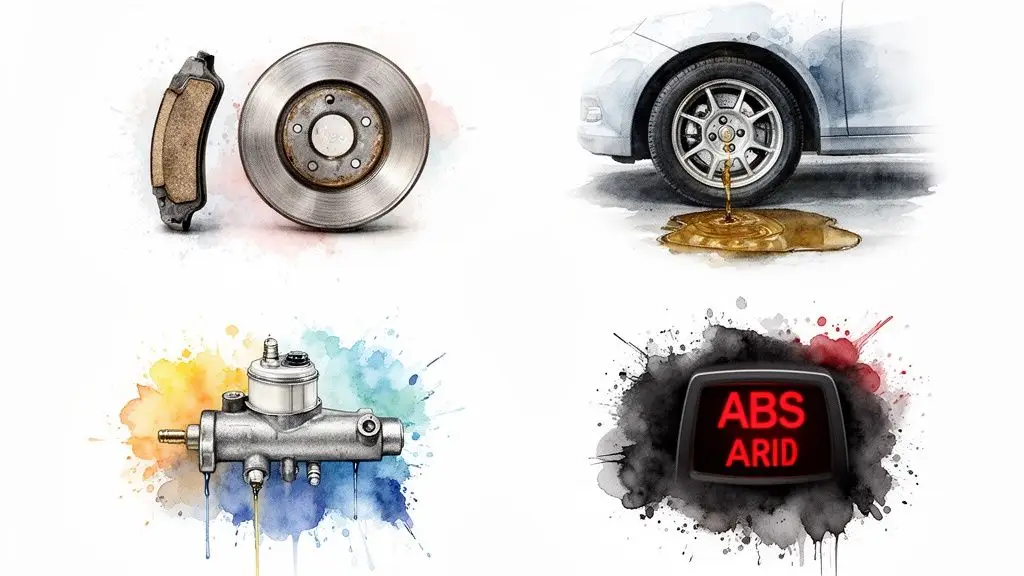
Four Common Reasons Your Brake Fluid Light Is On
Seeing that red or yellow brake fluid warning light pop up on your dashboard can be unnerving. It’s your car’s way of waving a red flag, and it's definitely not something to ignore. For drivers here in Haltom City, understanding what that light is trying to tell you is the first step toward keeping yourself safe on the road.
Let's walk through the four most common culprits behind that illuminated warning.
Normal Brake Pad Wear
Believe it or not, sometimes this light comes on for a reason that's a completely normal part of your car’s life. Think about it: as your brake pads wear down from thousands of miles of stopping in Haltom City traffic, the brake calipers have to push their pistons further out to make contact with the rotors.
This extra travel needs more brake fluid to fill the space. Your car pulls this extra fluid from the master cylinder reservoir, causing the level to slowly drop. If it gets low enough to trip the sensor, voilà—the light comes on. This isn't a five-alarm fire, but it’s a solid heads-up that your brake pads are getting thin and will need to be replaced soon.
A Leak in the Brake System
This is the big one—the reason you need to take this warning light seriously every single time. Your brake system is a completely sealed hydraulic circuit. If there’s a leak, it means fluid is escaping, and your ability to stop the car is literally draining away.
A leak can spring from a few weak points:
- Brake Lines: The long metal lines running underneath your car are exposed to everything the road throws at them. Over time, moisture and road salt can cause them to rust and develop tiny, but critical, holes.
- Rubber Hoses: At each wheel, a flexible rubber hose allows for suspension movement. These can crack, dry-rot, or even bulge as they age.
- Calipers or Wheel Cylinders: The seals inside these components can fail, causing fluid to seep out right at the wheel.
If your brake pedal feels soft and spongy, or if you spot oily, yellowish-brown puddles under your car, you likely have a leak. Don't risk it. Stop driving immediately and call a Haltom City tow service.
A Failing Master Cylinder
The master cylinder is the heart of your braking system. When you press the pedal, it converts that mechanical force into the hydraulic pressure that stops your car. Inside, there are complex seals that can wear out.
When these internal seals fail, fluid can bypass them, leading to a loss of pressure. You won't see a puddle in your driveway, but you'll feel something even scarier: the brake pedal slowly sinking to the floor while you’re holding it down at a stoplight. This is a critical failure that demands immediate professional attention from a trusted Haltom City mechanic.
It's a sobering thought, but sometimes the warning system itself can be the problem. In a 2024 incident, a major automaker recalled over 449,000 vehicles because a software glitch could prevent the brake warning light from ever coming on, even with dangerously low fluid. This is a powerful reminder of why that light must be respected and why routine brake checks are non-negotiable. You can learn more about this specific recall from news sources like this report on YouTube.
An Anti-lock Braking System (ABS) Fault
On many modern cars, a single warning light does double duty, covering both the basic hydraulic brake system and the Anti-lock Braking System (ABS). If an issue pops up with the ABS module, one of its wheel speed sensors, or the hydraulic pump, it can trigger that same brake warning light.
In this case, your primary brakes might feel perfectly normal. However, the ABS safety net—which prevents your wheels from locking up during a hard stop—will be disabled. That’s a huge safety compromise you don’t want to face in an emergency situation on I-820 near Haltom City.
To help you sort through these possibilities, it's useful to look at the symptoms side-by-side.
Diagnosing Your Brake Fluid Warning Light
This table breaks down the common causes, what you're likely to experience, and just how urgently you need to act.
| Potential Cause | Common Symptoms | Urgency Level |
|---|---|---|
| Normal Brake Pad Wear | Warning light is on, but brake pedal feels firm and normal. No visible leaks. | Medium: Safe to drive to a shop, but get your brakes inspected soon. |
| Brake System Leak | Spongy or soft brake pedal. Pedal goes further to the floor. Oily puddles under the car. | Critical: Do NOT drive. Your brakes could fail completely. Call for a tow. |
| Failing Master Cylinder | Brake pedal slowly sinks to the floor when held down. May not have any visible leaks. | Critical: Do NOT drive. This is an imminent brake failure risk. Call for a tow. |
| ABS System Fault | Brake light is on, but pedal feels normal. The separate "ABS" light may also be on. | High: Your primary brakes should work, but a key safety feature is disabled. Get it checked right away. |
No matter the suspected cause, an illuminated brake fluid light is a clear signal from your car that something in its most important safety system needs professional eyes on it.
A Simple Under-The-Hood Check You Can Do Safely
While a brake fluid warning light is a definite signal to call in the pros, there's a quick and perfectly safe visual check you can do yourself. This isn't about fixing the problem—it’s about getting the lay of the land so you can have a smarter conversation with your mechanic. For drivers in Haltom City, this little bit of know-how can make a stressful situation feel much more manageable.
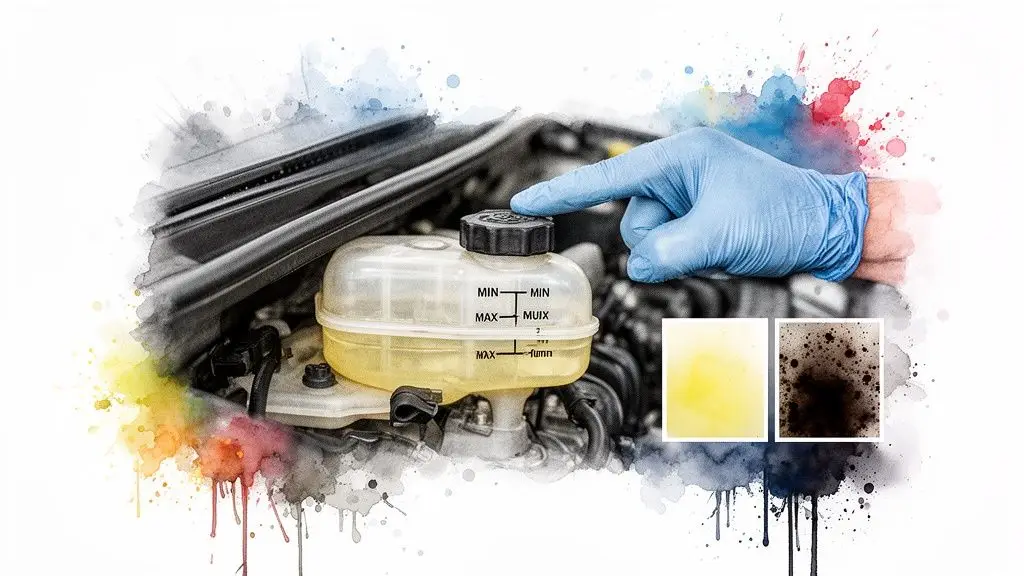
First, make sure your vehicle is parked on level ground with the engine off and cool to the touch. Pop the hood and look for the brake fluid reservoir. It’s a small, see-through plastic tank, usually mounted on the firewall on the driver's side.
Identifying the Fluid Level and Condition
Once you've found the reservoir, you’re looking for two things: how much fluid is in there and what it looks like. The good news is you can see everything you need right through the plastic, so there's no need to open the cap.
Most reservoirs have two lines molded right into the side:
- "MAX" Line: This is the full line, showing the maximum amount of fluid the system should have.
- "MIN" Line: This marks the minimum level for safe operation.
If the fluid is sitting below the "MIN" line, you’ve just confirmed the most common reason for that warning light. Now, take a look at the fluid's color. Healthy, new brake fluid should be a pale, clear-yellowish color, almost like vegetable oil.
The color of your brake fluid is a direct report card on its health. If it's dark, murky, or looks like used coffee, it's contaminated with moisture and tiny bits of deteriorating rubber from inside the system. This contamination is bad news—it lowers the fluid’s boiling point and can eat away at expensive parts like the ABS module.
What Not to Do
Remember, you’re just playing detective here. It’s vital to know what not to do, as trying a "quick fix" can either mask a dangerous problem or even make it worse.
Crucial Safety Reminders:
- Never Just Top Off the Fluid: Adding more fluid might make the light turn off for a little while, but it doesn't solve the real issue, whether it's a leak or worn-out brake pads. All it does is give you a false sense of security while you drive a potentially unsafe car.
- Do Not Open the Reservoir Cap: Brake fluid is hygroscopic, which is a fancy way of saying it loves to absorb moisture right out of the air. Popping the cap, even for a few seconds, lets humidity in. That water compromises the entire brake system and can cause internal rust and corrosion.
Armed with this information, you’re in a much better position. When you call Express Lube & Car Care in Haltom City, you can say, "My brake light is on, and I checked the reservoir. The fluid looks really dark and it's below the minimum line." A single sentence like that gives our technicians a massive head start, saving you time and helping us get you back on the road safely.
What to Expect from Professional Brake Service in Haltom City
Seeing that brake fluid warning light pop up on your dash is enough to put anyone on edge, especially driving around Haltom City. The last thing you need is uncertainty about what happens next. At Express Lube & Car Care, we pull back the curtain on the repair process. We want you to feel confident and informed from the moment you hand us your keys.
When your car rolls into our Haltom City bay, our ASE-certified technicians get right to work. Think of it as a full-on investigation. It all starts with the simple things, like checking the brake fluid reservoir to confirm the level and see how clean the fluid is—much like the check you can do yourself.
But that's just the starting point. From there, we dig deeper, methodically inspecting every part of the system to find the real root of the problem. No guesswork, just facts.
The Diagnostic Journey
First, we need to rule out a leak. We’ll get your vehicle up on a lift for a good, clear look at everything underneath. Our technicians know exactly what to look for: the subtle wetness of seeping fluid, tell-tale rust on the metal brake lines signaling corrosion, or dangerous cracks and bulges in the rubber hoses.
If we don't find any obvious external leaks, we turn our attention to the two most likely internal suspects:
- The Master Cylinder: This is the heart of your brake's hydraulic system. We run specific tests to check its internal seals, because a master cylinder can fail internally and cause a spongy or sinking pedal without ever dripping a drop of fluid on your garage floor.
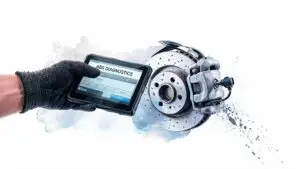
- The ABS Module: Using specialized scanners, we communicate directly with your car's Anti-lock Braking System computer. A faulty wheel speed sensor or a problem within the ABS pump itself can trigger the warning light, even if the main hydraulic system is perfectly fine.
This step-by-step process is how we pinpoint the exact failure, ensuring we fix the right thing the first time.
Today’s cars are smarter and safer than ever, with warning systems that are incredibly sensitive. It’s a huge industry—the market for automotive brake wear indicators is projected to hit over $1.05 billion by 2027 as safety standards get stricter. This just goes to show why a professional diagnosis is so essential for Haltom City drivers. You can see the full report on this trend at DataInsightsMarket.com.
Repairing the Problem with Quality Parts
Once we’ve nailed down the cause, we'll walk you through exactly what’s going on, show you the problem part if possible, and give you a clear, no-nonsense estimate for the repair.
Whether it’s a full brake fluid flush to get rid of old, contaminated fluid, replacing a weak, corroded brake line, or installing a new master cylinder, you can trust that we only use high-quality parts that meet or exceed what the factory installed.
Our goal is simple: get you back on the road safely in Haltom City. We believe that by explaining the "what" and the "why," we empower you to make the best decision for your vehicle. If you’re curious about our overall approach, check out our guide on what brake service typically includes.
Your Proactive Guide to Preventing Brake Problems
Honestly, the best way to handle a brake fluid warning light is to make sure you never see it light up your dash. It all comes down to shifting from a reactive "fix-it-when-it-breaks" approach to simple, proactive care. For drivers here in Haltom City, a consistent maintenance routine is your absolute best defense against the kind of surprise brake trouble nobody wants.
Getting ahead of brake problems isn't nearly as complicated as it sounds. The secret is focusing on two key services that work together to protect your entire braking system, both inside and out.
A Simple and Effective Maintenance Schedule
Think of this as your car's annual check-up, specifically for its most important safety feature. Following a simple plan can save you a world of headaches, costly repairs, and genuinely dangerous situations on Haltom City roads.
- Annual Brake System Inspection: At least once a year, have a trusted mechanic do a full top-to-bottom inspection of your brakes. We’re talking about more than just a quick peek—it means checking the life left on your pads, carefully examining the rotors for wear, and inspecting every line and hose for tiny cracks, rust, or potential leaks.
- Brake Fluid Flush Every Two Years: Let’s be clear: this isn't an upsell. It's one of the most critical maintenance items for your brakes. A fluid flush completely replaces the old, moisture-soaked fluid with fresh, clean brake fluid, restoring the system's performance and protecting it from itself.
Proactive maintenance is your best insurance policy against brake failure. A brake fluid flush removes moisture that can lower the fluid's boiling point by over 100°F, which is more than enough to cause a spongy pedal during a hard stop on a hot Texas day.
A fluid flush is a small investment that pays huge dividends by protecting expensive components like your ABS module and master cylinder from the corrosive damage that water contamination causes over time. If you’re the hands-on type and want to see what goes into a check-up, our guide on how to inspect brake rotors is a great place to start.
For our fellow Haltom City drivers, keeping your vehicle safe and dependable is what we're all about. Don't wait for a warning light to tell you something's wrong. Be proactive and give Express Lube & Car Care a call to schedule your annual brake inspection or a fluid flush today. Let's make sure your brakes are ready for anything.
Your Brake System Questions, Answered
When that little red brake light flashes on your dashboard, a dozen questions probably pop into your head right away. As the go-to mechanics for drivers around Haltom City, we've heard them all. Here are some straightforward answers to the most common ones we get.
My Brakes Feel Fine, So Can I Keep Driving with the Light On?
This is probably the biggest gamble you can take with your car. Even if the brake pedal feels perfectly normal, that light is your vehicle’s way of screaming that something is wrong.
It might be an early warning—maybe your brake pads are getting thin, or you have a tiny, slow leak that hasn't affected performance yet. It could also signal an issue with the ABS computer. Ignoring it and continuing down a busy road like Denton Highway is a risk that just isn’t worth taking for any Haltom City driver.
The Fluid Looks Low. Can I Just Top It Off Myself?
That’s a definite no. Here’s why: your brake system is designed to be a completely sealed hydraulic circuit. If the fluid is low, it means one of two things is happening:
- Your brake pads are extremely worn down, causing the calipers to extend further and draw more fluid from the reservoir.
- You have a leak somewhere in the system.
Simply adding more fluid is like putting a bandage on a problem that needs stitches. It hides the real issue and creates a false sense of security, while the underlying—and potentially dangerous—problem gets worse. You can learn more about what different lights mean in our guide to brake lights on your dashboard.
How Often Should I Get My Brake Fluid Checked?
Staying ahead of problems is always the smartest (and cheapest) way to go for Haltom City drivers. We recommend having a technician perform a full brake system inspection at least once a year.
As for the fluid itself, it should be completely flushed and replaced every two years or whatever your car's manufacturer suggests. This isn't just an upsell; it's critical maintenance that removes moisture and gunk that can corrode expensive components from the inside out.
A regular brake fluid flush is one of the most important safety services for your vehicle. Old, contaminated fluid can actually boil under the heat and pressure of a hard stop, which leads to a spongy pedal and a terrifying loss of stopping power.
Following this simple maintenance schedule is the best way to keep your brakes working perfectly, so you never have to see that warning light in the first place.
When you need clear answers and service you can rely on, trust the local experts who know Haltom City roads. Bring your vehicle to Express Lube and Car Care. Our certified technicians will give you an honest diagnosis and get you back behind the wheel safely. Schedule your appointment today at https://www.expresslubehaltom.com.