
When you press the brake pedal, you trust your car will stop. Simple as that. A huge part of making that happen rests on your brake calipers, but have you ever wondered, how long do brake calipers last?
In a perfect world, you could see a solid 75,000 to 100,000 miles out of them. But here in Haltom City, real-world driving conditions tell a different story.
The Lifespan of Brake Calipers in the Haltom City Area
Think of your brake caliper as a powerful C-clamp with a hydraulic punch. When you step on the brake, it squeezes the brake pads against the spinning rotor, creating the friction that slows you down. It’s a tough, repetitive job, and while calipers are built to be incredibly durable, they aren't invincible.
That factory-suggested mileage is a good benchmark, but it doesn’t quite capture the reality of driving around Haltom City. Our blistering summer heat and the endless stop-and-go traffic on roads like Denton Highway (Hwy 377) or Loop 820 put a ton of extra strain on every single component in your braking system.
How Haltom City Driving Affects Caliper Longevity
Brake calipers are workhorses. They're designed to last, often clocking in anywhere from 75,000 to 100,000 miles under ideal circumstances. That’s a lot more than brake pads, which typically need swapping every 30,000 to 50,000 miles. While this makes calipers one of the more resilient parts of your brakes, you can't just set it and forget it—especially not here in the Haltom City area.
For example, navigating the heavy traffic around North Richland Hills with constant, hard braking generates a massive amount of heat. Automotive experts agree this kind of driving can easily slash a caliper's lifespan by 20-30%. You can dive deeper into how these parts wear differently in our guide on the life of brake pads.
Your driving habits and our local Haltom City environment are the two biggest wildcards. A caliper on a car cruising down open highways will almost always outlast one on a vehicle stuck in daily city traffic.
To give you a better idea, here's a quick look at how typical Haltom City driving scenarios can impact your brake calipers.
Brake Caliper Lifespan in Haltom City Conditions
| Driving Condition | Typical Lifespan (Miles) | Primary Haltom City Factor |
|---|---|---|
| Highway Commuting (I-35W) | 80,000 – 100,000+ | Less frequent braking, smoother stops |
| Suburban Driving (Watauga/Keller) | 70,000 – 90,000 | Moderate stop-and-go, occasional heavy traffic |
| Heavy City Traffic (Loop 820) | 50,000 – 75,000 | Constant braking, high heat buildup from traffic jams |
| Aggressive Driving | 40,000 – 60,000 | Hard, last-minute braking generates extreme heat |
As you can see, where and how you drive in and around Haltom City makes a huge difference. Let's break down exactly why our local conditions are so tough on them.
This reality check is crucial for every Haltom City driver. Several local factors directly chip away at how long your calipers will work safely:
- Intense Heat: Haltom City summers are no joke. The extreme heat under the hood can cook the rubber seals and protective boots inside the caliper, causing them to become brittle and fail prematurely.
- Stop-and-Go Traffic: Every time you brake, you generate friction and heat. In constant Haltom City traffic, that heat doesn't have a chance to dissipate, which can degrade your brake fluid and lead to sticky or seized caliper pistons.
- Humidity: All that moisture in the air can, over time, work its way into the brake fluid. Water in the system is a recipe for internal corrosion, which is a leading cause of caliper failure.
Why Your Brake Calipers Wear Out Faster in Haltom City
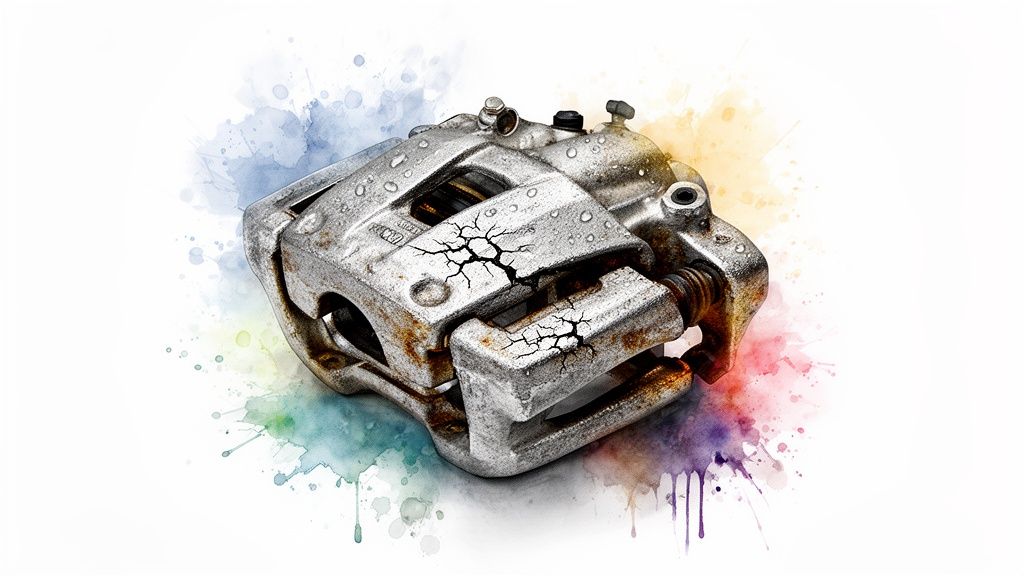
It’s tempting to assume mileage is the only thing that ages your brakes, but that's not the full story. The real culprit is often where you drive, not just how far. Here in Haltom City, our local conditions team up to put some serious stress on your braking system, often cutting a caliper's life short.
Imagine the delicate rubber seals and boots on your caliper—they’re the first line of defense. Now, picture the stop-and-go grind on Loop 820 during rush hour. That kind of driving creates a ton of heat. This constant cycle of getting intensely hot then cooling down essentially bakes those rubber parts until they become brittle, hard, and cracked.
Once those seals give way, your caliper is left exposed. Dirt, moisture, and road grime can now work their way inside, and that’s when the real trouble begins.
The Hidden Impact of Haltom City Humidity
It’s not just the heat from braking, either. Our local climate itself has a surprisingly destructive secret weapon: humidity. Brake fluid is hygroscopic, which is a technical way of saying it loves to absorb moisture right out of the air.
As that moisture builds up, it lowers the fluid's boiling point—a big reason for a spongy-feeling brake pedal. But more importantly, it injects water directly into your hydraulic system, right into the heart of your brake calipers.
This moisture is the number one cause of internal corrosion. It quietly rusts the caliper piston and the cylinder it slides in, causing it to stick, bind, and eventually seize up completely.
You can't see this kind of rust from the outside. It’s a silent destroyer that works from the inside out, often showing no symptoms until your brakes start acting up in a serious way.
The Maintenance Task Haltom City Drivers Forget
Honestly, the biggest reason we see calipers fail prematurely in Haltom City comes down to one simple, overlooked task: flushing the brake fluid. Forgetting this is like deciding never to change your engine oil. You’re just letting contaminants build up until something breaks.
Old, water-logged brake fluid is the perfect recipe for rust. This turns what should be a straightforward maintenance item into a major safety hazard. A seized caliper doesn't just mean you can't stop as well; it can cause your car to pull sharply and dangerously to one side when you hit the brakes.
So, let's break down the top culprits here in the Haltom City area:
- Extreme Heat Cycles: The intense heat from constant, hard braking in city traffic cooks the rubber seals and can even boil old brake fluid.
- High Ambient Humidity: Haltom City humidity is always trying to sneak moisture into your brake fluid, kicking off that hidden internal corrosion.
- Neglected Brake Fluid: Old, contaminated fluid loses its anti-corrosion properties, giving rust a free pass to attack the caliper’s piston and bore.
Knowing what you’re up against is half the battle. When you understand how our local Haltom City environment affects your brakes, you can take the right steps to keep your car stopping safely and reliably for years to come.
Spotting the Warning Signs of a Failing Caliper
Your car has a way of telling you when something's wrong. It doesn't use words, but it sends signals through strange sounds, odd feelings, and even unusual smells. A failing brake caliper is a perfect example of this. Knowing how to read these signals early can save you from a major headache and a dangerous situation, especially on the busy roads around Haltom City.
The clues a bad caliper gives you usually fall into three camps: things you feel, things you hear, and things you see. Let's break down what to look out for.
What a Failing Caliper Feels Like
The most urgent signs are the ones you feel behind the wheel. These sensations are your car’s way of letting you know that the hydraulic clamp responsible for stopping you—the caliper—isn't doing its job right.
The classic tell-tale sign of a stuck caliper is your car pulling distinctly to one side when you hit the brakes. If the right caliper is seized, the car will lurch right. If it's the left, you'll feel it pull left. It’s a pretty unmistakable feeling.
You should also pay close attention to the brake pedal itself. A bad caliper can make the pedal feel soft and mushy, almost like you have to push it way down to the floor to get any braking power. On the flip side, a dragging caliper can sometimes make the pedal feel unnaturally stiff and hard to press. For a deeper dive into braking issues, check out our guide on common brake problem symptoms.
Unusual Sounds and Visual Clues
Your own eyes and ears are fantastic diagnostic tools. A faulty caliper often makes noises that are impossible to ignore, and a quick glance at your wheels can reveal a lot.
Listen for a high-pitched squealing or a metallic grinding noise that keeps going even when your foot is off the brake. This is a dead giveaway that a caliper is stuck and isn't letting go of the rotor, causing constant friction. You might also hear a loud clunking noise right when you first press the brake pedal, which can point to a loose or failing caliper.
Next time you're near your car, take a moment to visually inspect the wheels. Here’s what you might find:
- Brake Fluid Leaks: Keep an eye out for any wet, oily spots on the inner side of your wheel or on the pavement where you park. Brake fluid is the lifeblood of your braking system, and a leak is a serious safety hazard.
- Uneven Brake Pad Wear: If you can peek through your wheel spokes, see if one brake pad looks way thinner than the other on the same wheel. This happens when a stuck caliper piston forces one pad against the rotor constantly.
- Burning Smell: Do you smell something hot and chemical-like coming from one of your wheels after a drive? That's the classic scent of a dragging caliper creating massive amounts of heat.
These aren't subtle hints; they're clear warnings that your caliper needs attention right away. Putting off a repair not only risks your safety but can also cause expensive collateral damage to your rotors and other parts. If you notice any of these signs, the best thing you can do is get a professional inspection from a trusted Haltom City mechanic.
Should You Repair or Replace a Faulty Brake Caliper
So, you've got a bad brake caliper. Now what? You’re faced with a big question: is it better to try and fix the one you have, or just swap it out for a new one? For most of us driving around Haltom City, the answer is pretty clear-cut, but it’s smart to understand both sides of the coin before you decide.
Rebuilding a caliper is an old-school approach. It means a technician completely disassembles the unit, meticulously cleans every part, and replaces the rubber seals, dust boots, and sometimes the piston itself. This really only makes sense for classic or rare cars where finding a brand-new part is either impossible or costs a fortune. It’s a delicate, time-consuming job.
For the vast majority of cars on the road today, though, replacement is the way to go.
Why Replacement Is Almost Always the Best Option in Haltom City
For modern vehicles, simply replacing a faulty brake caliper is faster, far more reliable, and often cheaper when you look at the big picture. When you buy a new or professionally remanufactured caliper, you’re getting a complete unit that’s already been tested and typically comes with a warranty. That’s a level of confidence a simple repair just can't offer.
The real villain here is internal corrosion. You can't see it from the outside, but rust and pitting can form inside the caliper bore where the piston slides. A simple seal replacement won't fix that underlying damage. Before you know it, that hidden corrosion will chew up the new seals, and you'll be right back at square one with another brake failure.
The core issue is safety. A professionally replaced caliper eliminates the risk of hidden internal damage. When you're asking how long brake calipers last, a new unit effectively resets the clock. A repaired one is still an old part with an unknown history.
This flowchart can help you trace the symptoms you're experiencing—whether it's a sound, a feeling, or something you see—back to the likely cause.
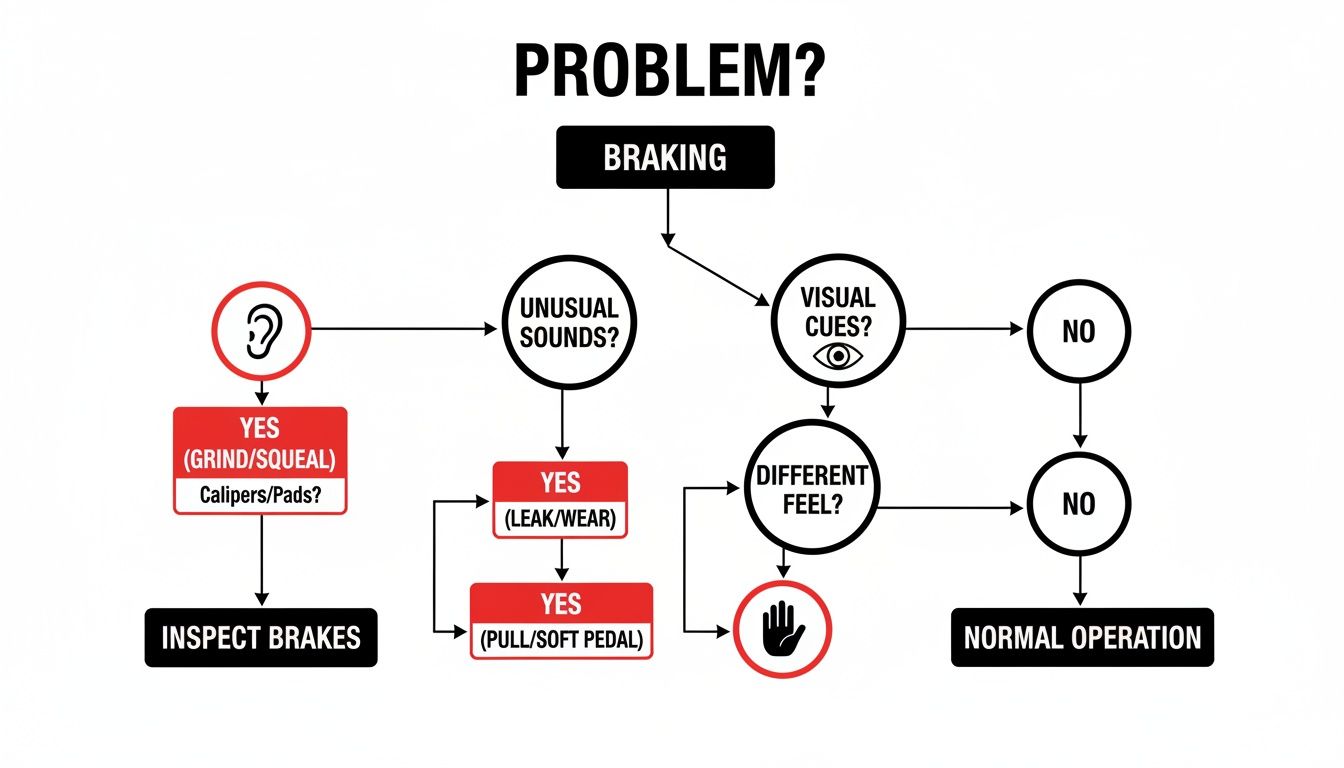
As you can see, whether you feel the car pulling, hear a nasty grinding sound, or spot a fluid leak, the trail always leads to a professional inspection to figure out the best fix.
The Golden Rule: Always Replace in Pairs
Here’s a non-negotiable rule in any professional Haltom City brake shop: always replace calipers in pairs. If the right front caliper is shot, the left front one has to be replaced, too. No exceptions.
This isn’t a mechanic trying to upsell you; it’s a critical safety standard. A brand-new caliper will clamp down with different force and react quicker than the old, tired one on the other side of the car. This imbalance can cause your vehicle to dive sharply to one side when you brake hard, which is a recipe for losing control.
By replacing them as a matched set, you ensure your brakes work in perfect harmony. You get the even, predictable stopping power you need to stay safe on the roads around Haltom City. It’s all about making sure your braking system is a balanced, reliable unit.
Understanding the Caliper Replacement Process and Cost in Haltom City
The idea of any brake repair can be a little intimidating, but knowing what goes on behind the scenes helps take the mystery out of it. When you bring your car to a professional Haltom City shop for a caliper replacement, you’re getting a precise, safety-first procedure. It's about a lot more than just swapping an old part for a new one.
Our certified technicians start with a full inspection of your entire brake system. We're talking a close look at the brake pads, rotors, and hoses to spot any related wear and tear. This first step is critical to make sure we’re fixing the real problem, not just patching up a symptom.
Once we confirm a new caliper is the right move, we get to work.
The Professional Replacement Steps
For your safety, the process is systematic, with no detail left to chance. A technician will safely lift your vehicle, remove the wheel, and start disassembling the brake components around the bad caliper.
Here’s a look at what the job involves:
- System Prep: First things first, the technician clamps the brake hose. This keeps brake fluid from leaking out and, more importantly, prevents air from getting into the lines.
- Caliper Removal: Next, the old caliper is unbolted from its mounting bracket and carefully disconnected from the brake line.
- Component Check: With the caliper out of the way, we get a clear view of the brake pads and rotor. We're looking for uneven wear or heat damage—tell-tale signs that the failing caliper caused other problems. If they're compromised, we'll recommend replacing them.
- Installation: The new caliper is bolted on, and the brake line is reconnected with fresh sealing washers to ensure a leak-proof fit.
- Bleeding the Brakes: This final step is absolutely essential. We bleed the brake system to push out every last air bubble, which is what gives you that firm, responsive brake pedal. A poor bleed job leads to a spongy pedal, and that's a serious safety hazard.
Breaking Down the Cost
So, what does a caliper replacement cost here in Haltom City? It really depends on a few things. The biggest factor is the make and model of your vehicle. Parts for a performance or European car will naturally cost more than for a common domestic sedan.
The total cost covers the caliper itself (we often replace them in pairs for balanced braking), any other necessary parts like new pads or rotors, and the labor to get it all done right.
To get a feel for the whole picture, it helps to understand what a comprehensive brake service includes and see how all the pieces fit together. You can also read our guide on what our brake service includes to see our approach. Here at Express Lube & Car Care, we always provide a clear, detailed estimate before we pick up a wrench, so you’ll never be in the dark about what you’re paying for.
Proactive Care to Maximize Your Caliper Lifespan in Haltom City
The best repair is often the one you never have to make. Instead of waiting for a problem to pop up, you can take a few simple, proactive steps to get the most life out of your brake calipers. This will save you a headache and some serious money down the road, all while keeping your car stopping safely in and around Haltom City.
Believe it or not, the single most powerful thing you can do is also one of the most overlooked: regular brake fluid exchanges. Think of brake fluid like the lifeblood of your braking system. Over time, it naturally absorbs moisture from the air, and that's where the trouble starts.
The Power of Clean Brake Fluid
That trapped moisture leads to internal corrosion, silently eating away at the caliper's piston and bore from the inside out. This hidden rust is the number one reason calipers seize up. By flushing the system with fresh, clean fluid every two or three years, you're not just replacing old fluid; you're removing that damaging water and refreshing the anti-corrosion additives that protect every component. Knowing how often should brake fluid be changed is crucial because it directly impacts your calipers' health.
Beyond the fluid, your driving habits play a huge role. Things like avoiding hard, last-minute stops and giving yourself plenty of following distance can make a big difference. Smoother driving generates less extreme heat, which prevents the caliper's rubber seals from becoming brittle and failing prematurely.
Investing in preventative maintenance isn't just about avoiding a repair bill. It’s about maintaining the performance and safety of the most critical system on your vehicle.
Finally, nothing beats a set of professional eyes. When a technician checks your brakes during routine service, they can spot the early warning signs of trouble. A sticking guide pin or a tiny tear in a dust boot can be a quick fix now, but if ignored, it can lead to a complete caliper failure later. Sticking to a good service plan is your best defense, and you can get a better idea of what that looks like by checking a typical car maintenance schedule by mileage.
- Brake Fluid Flushes: This is your best weapon against internal rust and moisture buildup.
- Smoother Driving: Easing up on the brake pedal reduces heat and stress on all brake components.
- Routine Inspections: A technician can catch small issues before they become expensive problems.
For a professional brake inspection or fluid exchange service in Haltom City, trust the certified technicians at Express Lube & Car Care. We're committed to keeping your vehicle safe and reliable. Visit us at https://expresslubehaltom.com to schedule your appointment today.