

If you've been dealing with dimming headlights, a battery warning light that just won't quit, or a car that seems to hate starting, you're in the right place. These classic symptoms often point a finger directly at your car's alternator, the unsung hero that powers all your electronics and keeps the battery topped off. For drivers in Haltom City and the surrounding areas, learning how to know if an alternator is bad starts with spotting these red flags before you end up calling for a tow on Loop 820.
Your Alternator Might Be Failing Here Are the First Signs

It’s always a little stressful when your vehicle starts acting up, especially in the middle of a busy commute here in Haltom City. The alternator is a core part of your car's electrical system, and when it starts to go, it usually gives you a few hints. Knowing what to look for can be the difference between a quick repair at a local shop and a complete breakdown on I-35W.
For most people, the first and most glaring sign is the battery warning light popping up on the dashboard. That little light, which usually looks like a battery, isn't just for the battery. It actually lights up when the car's computer senses a problem anywhere in the charging system—and the alternator is the heart of that system.
Real-World Scenarios in Haltom City
Picture this: you're stopped at a light on Denton Hwy. While idling, you notice your headlights and dashboard lights start to dim or even flicker. The light turns green, you hit the gas, and suddenly they're bright again. That's a textbook symptom for a Haltom City driver of an alternator struggling to maintain consistent voltage when the engine isn't spinning fast.
Another common headache for local drivers is a car that just won't start. It's easy to blame the battery, and sometimes that's the culprit. But a weak alternator is often the real problem. If it isn’t properly recharging the battery as you drive around Haltom City, you'll be left with a dead battery the next time you try to crank the engine.
An alternator is generally built to last about seven years or so, maybe 150,000 miles, but that's not a guarantee. Things like your driving habits and, especially, the brutal Texas heat we experience in Haltom City can take a toll, wearing out its internal parts much faster.
The Impact of Texas Heat on Haltom City Vehicles
Here in North Texas, our vehicles bake in some seriously extreme temperatures. All that summer heat puts a tremendous strain on everything under the hood, and the alternator is no exception. High heat can cause the alternator's internal wires and bearings to wear down prematurely, leading to a much shorter lifespan for cars in Haltom City.
A couple of other electrical quirks to watch for include:
- Slow-moving accessories: Do your power windows seem lazy? Does your radio cut out for no reason? Those are signs the alternator can't keep up with your car's electrical demands.
- Frequent dead battery: If you're jump-starting your car more than once in Haltom City, it's a huge clue that the battery isn't getting recharged properly by the alternator.
Catching these early signs is key for any Haltom City driver. Think of them as your car's way of telling you something important needs attention before it decides to quit on you for good.
So, You Think Your Alternator is Failing? Here's What to Look For
When your car starts acting up electrically, the battery is always the first suspect. It’s the usual culprit, right? But more often than you’d think, the real problem is the alternator, the unsung hero of your car's charging system. It's working away in the background, and you don't notice it until it stops. Knowing how to spot the early signs of a failing alternator can save Haltom City drivers a lot of grief—and a tow truck bill.
The classic signs of alternator trouble aren't always a sudden, dramatic failure. They usually start small. Your alternator might be slowly giving up, struggling to push out a steady stream of electricity, and that’s when you'll start seeing a domino effect of weird issues popping up around your car. This is where you need to be a bit of a detective and pay attention to how your vehicle is behaving on Haltom City roads.
Fading Lights and Other Electrical Gremlins
One of the first and most obvious clues of a dying alternator is your lights. Ever been at a stoplight in Haltom City and noticed your headlights or dashboard lights get a little dim, then brighten right back up as soon as you hit the gas? That’s a textbook symptom. It means your alternator isn't producing enough juice at low RPMs to power everything.
This is a massive red flag. In fact, dimming or flickering lights are a complaint in about 40% of cars that come into the shop for charging system problems. The alternator just can't maintain that steady 13.8 to 14.4 volts your car needs to run properly. It's also worth noting that a surprising number of alternators get replaced for no reason. Some studies suggest that misdiagnosis is behind around 35% of premature replacements, when the real issue was just a loose or corroded wire. If you want to dive deeper, you can explore more on alternator damage assessment to see the full range of potential problems.
That Pesky Battery Warning Light
We’ve all seen it: that little battery-shaped icon glowing on the dashboard. It's easy to assume it means the battery is dead, but it’s actually a warning for the entire charging system. When that light pops on, your car's brain is telling you the system's voltage has dropped too low. And nine times out of ten, that means the alternator isn't pulling its weight.
Never, ever ignore this light, even if it just flickers on and off randomly while driving in Haltom City. It's your car's way of screaming for help, telling you that you're running on borrowed time—specifically, the battery's reserve power. Once that's gone, the engine will die, and you'll be stuck.
Key Takeaway: Think of the battery light as the "check charging system" light. It's rarely just about the battery; it points directly to a problem with the charging process, and the alternator is almost always the prime suspect.
The Battery That Just Won't Stay Charged
Is your car developing a close, personal relationship with a set of jumper cables? A battery that keeps dying is incredibly frustrating, and while batteries certainly don't last forever, a weak alternator is often the real villain behind this recurring nightmare for Haltom City residents.
The alternator's job is to recharge your battery as you drive, putting back the power it used to start the engine. If the alternator is on its way out, it can't fully recharge the battery. This is a huge problem for anyone in Haltom City who makes a lot of short trips, like running errands around town. Those quick drives just don't give a struggling alternator enough time to top off the battery, slowly sucking the life out of it until it won’t hold a charge at all.
Figuring out whether it's your alternator or your battery can be tricky since their symptoms can look so similar. To help drivers in Haltom City, Keller, and beyond tell the difference, we put together this quick comparison table. Getting the diagnosis right the first time can save you from buying a battery you don't need.
Bad Alternator vs. Bad Battery Symptoms
| Symptom | Likely a Bad Alternator If… | Likely a Bad Battery If… |
|---|---|---|
| Warning Light | The battery light is on while the engine is running. | The battery light comes on, but the car won't start at all. |
| Starting the Car | The car starts with a jump but dies shortly after the cables are removed. | The car struggles to crank (slow, sluggish start) or just clicks, but stays running after a jump. |
| Lights & Electronics | Headlights dim and brighten with engine RPMs, or electronics act erratically while driving. | Lights are dim before you start the car and don't change much when it's running. |
| Recurring Issue | You need to jump-start the car repeatedly, even with a relatively new battery. | The battery is over 3-5 years old and has been slowly losing its ability to hold a charge. |
| Strange Noises | You hear a whining or grinding sound from the engine bay that gets worse with acceleration. | No specific noises are associated with a failing battery, just the sound of a struggling starter. |
Hopefully, this table clears things up a bit. While these are strong indicators, the only way for a Haltom City driver to know for sure is to perform a proper diagnostic test on your charging system.
Unusual Noises and Smells You Should Never Ignore
Most parts of your car’s electrical system will fail without a peep, but a bad alternator often gives you a heads-up first. If you know what to listen for—and what to smell—you can catch the problem before it leaves you stranded on a busy Haltom City road.
A classic sign of an alternator on its way out is a distinct whining or growling sound from under the hood. This isn't just random engine noise. You'll notice the pitch of the whine changes with your engine speed, rising as you accelerate and falling as you slow down. That’s a tell-tale sign the bearings inside the alternator are shot.
If you’re hearing something like that, it's worth digging a little deeper. Sometimes, different sounds can point to different problems, so it's a good idea to understand what causes an engine rattling at idle.
Pinpointing The Source of the Sound
That whining is more than an annoyance; it’s a mechanical cry for help. The bearings are what let the alternator’s rotor spin smoothly at thousands of RPMs to generate power. Once they wear out from heat and friction, they start to grind and make that signature sound.
And this is no small thing. Bad bearings are a huge cause of alternator failure. One industry survey pointed to bad bearings as the culprit in about 25% of alternator replacements. It gets worse when you add in loose or worn belts, which cause vibrations that accelerate that wear. The kind of stop-and-go driving we do around Haltom City can wear out those belts 30% faster, causing them to slip and overheat the bearings even more. If you're curious about the technical side of how these parts fail, you can read more about it on FleetEquipmentMag.com.
Pro Tip: Never ignore a whining or growling noise coming from your engine. It's often the first and most reliable clue that your alternator is in trouble. A failing bearing can seize completely, shredding the serpentine belt and leaving you with a sudden breakdown in Haltom City.
What That Burning Smell Really Means
Your nose can be just as useful as your ears when diagnosing a bad alternator. Two smells in particular are major red flags:
- Burning rubber: This almost always points to the serpentine belt. When the alternator's pulley can't spin freely because of a bad bearing, the belt drags across the stuck pulley. The friction creates a ton of heat, and you get that unmistakable smell of hot rubber.
- Hot electrical wires: This one is even more serious. It means the alternator itself is overheating as it struggles to produce electricity. The internal wiring can get so hot that it starts to melt the insulating coating, creating a smell a lot like an electrical fire.
Putting off a check-up when you notice these sounds and smells is a big risk. They’re direct evidence that a critical component is failing. The smart move for any Haltom City driver is to get a professional diagnosis right away to avoid a total electrical system failure and keep your car dependable.
Simple Diagnostic Tests You Can Do at Home
You don't always need to head straight to the mechanic to figure out what's going on under the hood. A few straightforward checks right in your Haltom City driveway can give you a pretty good idea if your alternator is the culprit behind your car troubles. These initial steps are great for getting some answers before you decide to schedule a professional service.
The Old-School Headlight Test
One of the quickest and easiest checks is what mechanics sometimes call the Headlight Test. You don't need any tools for this one—just your car and a keen eye.
First, start your engine and turn on your headlights. With the car in park or neutral, gently press the gas pedal to rev the engine a bit. Now, watch the headlights closely.
Do they get noticeably brighter as the engine speeds up? That's a classic sign of a failing alternator. What's happening is the alternator isn't generating enough juice at idle. When you rev the engine, the alternator spins faster and temporarily puts out more power, causing that surge in brightness.
Getting a Hard Number with a Multimeter
The headlight test is a good starting point, but a multimeter gives you cold, hard data, taking the guesswork out of the equation. This handy tool is a must-have for anyone serious about basic auto diagnostics. Learning to use one is a great first step, and if you're looking to expand your skills, there are some great DIY car maintenance tips available online.
To really see what your charging system is doing, you'll want to take two key measurements.
Battery Voltage (Engine Off): With your car turned completely off, set your multimeter to DC volts. Touch the red probe to the positive (+) battery terminal and the black probe to the negative (-) terminal. A healthy, fully charged battery should read right around 12.6 volts. If you're seeing less than 12.2 volts, your battery is low, which could be a symptom of a weak alternator that isn't recharging it.
Charging Voltage (Engine On): Now, start the car and let it idle. With the multimeter still connected to the battery, you should see the voltage jump up. A properly functioning alternator will push the reading somewhere between 13.8 and 14.4 volts.
If the voltage stays low—below 13.8 volts—that's a strong signal the alternator isn't doing its job. On the flip side, if the reading shoots above 14.5 volts, the voltage regulator (usually built into the alternator) has likely failed, which can fry your battery and damage sensitive electronics.
Key Insight: The difference between the engine-off and engine-on voltage is everything. A running engine must show a higher voltage. If it doesn't, the alternator isn't charging.
This simple flowchart can also help you diagnose problems based on what you're hearing or smelling.
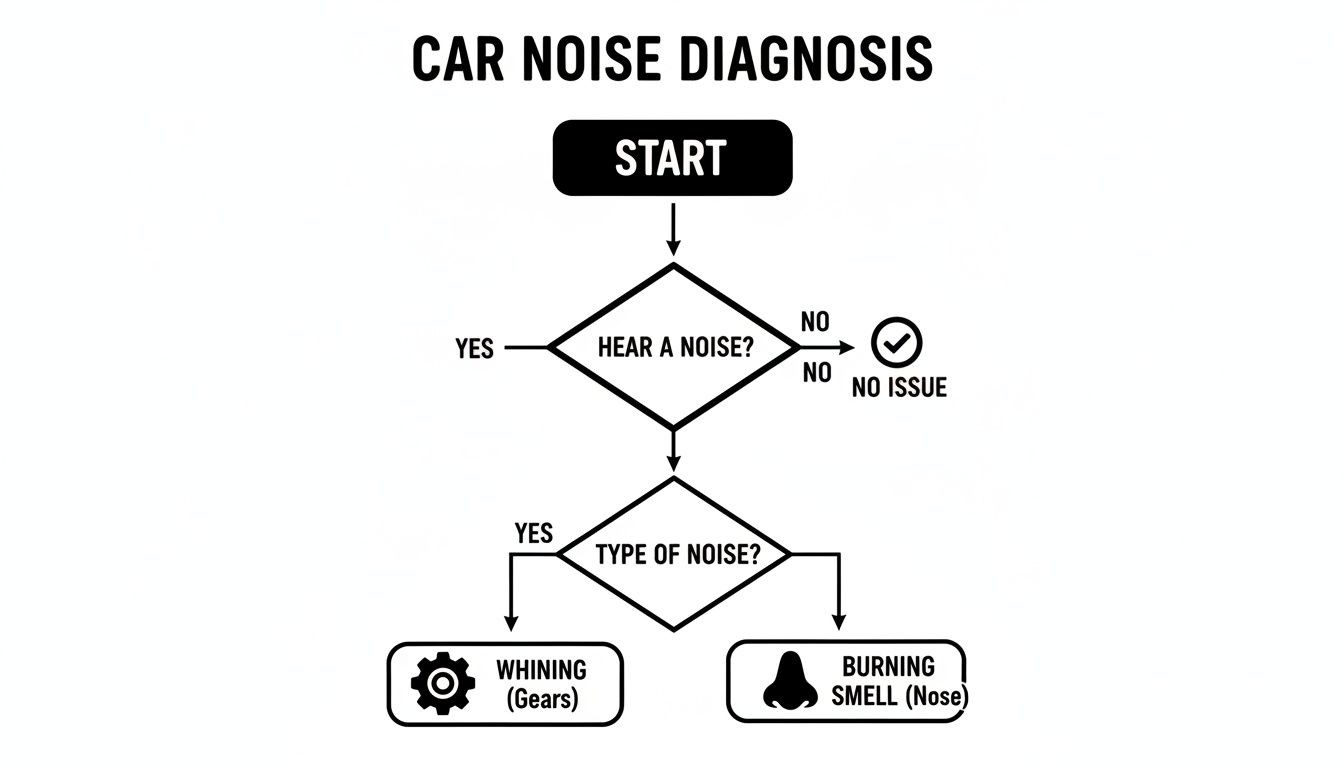
As the visual shows, a distinct whining often points to mechanical issues like bearings, while a burning smell suggests an electrical short or a slipping belt. Getting a proper diagnosis is the most important part of any repair, which is why a full vehicle check is always smart. You can see what's involved by checking out our car inspection checklist.
The Silent Battery Drain When Your Car Is Off
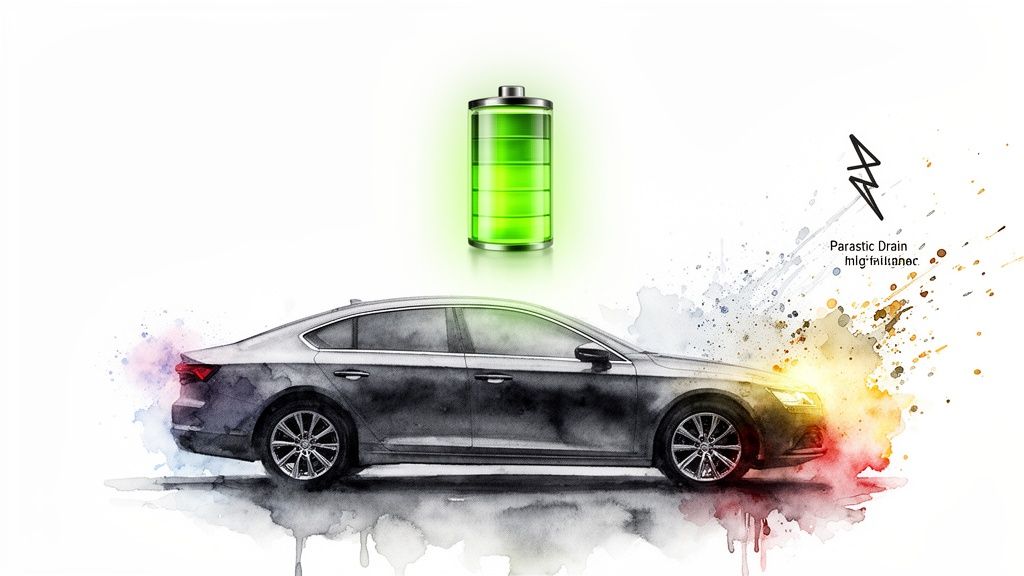
It’s one of the most frustrating things to deal with: you park your car for the night, everything seems fine, and the next morning your battery is completely dead. The first instinct is usually to blame the battery itself, but a failing alternator can be the real culprit, slowly sucking the life out of it while the car is off.
This particular symptom almost always points to an internal failure within the alternator. Inside, there's a part called a diode rectifier. You can think of these diodes as tiny one-way electrical gates. Their job is to convert the AC power the alternator generates into DC power your car needs, and crucially, to stop that power from flowing backward from the battery.
When one of these diodes goes bad, that one-way gate gets stuck open. This creates what mechanics call a parasitic draw—a small but constant electrical leak that siphons your battery's charge, even when the key is in your pocket.
Identifying a Parasitic Draw
Pinpointing a parasitic draw can be tricky because a lot of things can cause one. But if you’ve also noticed other classic alternator symptoms, like dimming lights or a warning on the dash, the alternator moves to the top of the suspect list.
The constant heat cycles under the hood are tough on these components. This is especially true for drivers in Haltom City and Watauga who spend time idling in traffic, which really bakes the electronics. In fact, a 2024 analysis from Endurance Warranty found that a faulty alternator diode is the cause of overnight battery drain in about 30% of cases. That sneaky leak can easily drain a healthy battery by up to 50% overnight. You can read more about the signs of a failing alternator on their website.
Expert Tip: A "key-off draw test" is the professional way to confirm this. A technician measures the electrical draw with everything shut down. A normal reading should be under 50 milliamps (mA). If the meter shows a draw over 100mA, a bad alternator diode is a very likely cause.
If you’ve already replaced your battery once and still find yourself with a dead car in the morning, that’s a huge red flag that the problem isn't the battery. More often than not, the alternator is the hidden villain forcing you to break out the jumper cables. Getting to the root of the issue is key, and our guide to professional battery replacement services can help clarify the difference.
So, You Think Your Alternator Is Bad. What Now?
You’ve gone through the symptoms, maybe even run a few tests, and all signs point to a failing alternator. Now you're facing the big question: what’s the next move? For drivers in Haltom City, figuring this out can save you from a major headache and a surprisingly big bill. It really boils down to a choice between tackling it yourself or calling in the pros.
While some gearheads with a well-stocked garage might feel comfortable swapping an alternator, it’s not always the simple bolt-off, bolt-on job it used to be. Modern engine bays are notoriously cramped, and the electrical systems are more complex than ever. You often need just the right tool and a good bit of know-how to even get to the alternator, let alone replace it correctly.
DIY vs. Professional Diagnosis
Before you even think about ordering parts, the absolute most important step is getting a 100% certain diagnosis. It’s incredibly easy—and common—to mistake a bad alternator for a much simpler (and cheaper) problem.
I’ve seen it countless times here in Haltom City. Someone spends hundreds on a new alternator, installs it, and… nothing. The problem is still there. Why? Because the real culprit was:
- A worn-out serpentine belt that was slipping and couldn't spin the pulley properly.
- A fuzzy, corroded battery terminal that was blocking the flow of electricity.
- A tiny, inexpensive fuse that had blown, breaking the charging circuit.
This is exactly where a professional technician earns their keep. They can run a full charging system test to pinpoint the exact point of failure. If you're curious about what goes into that, our guide on auto diagnostic services walks you through the whole process.
Don't gamble with your car's electrical system. A professional check-up confirms if the alternator is really the problem, saving you from buying a part you don't actually need. That peace of mind is worth the visit to a Haltom City mechanic alone.
Making the Right Call in Haltom City
At the end of the day, it's your car and your call. But I strongly advise against just throwing parts at a problem based on a hunch. A wrong diagnosis is almost always a costly one. For folks around Haltom City, the smartest move is to find a local shop you trust. A quick, accurate inspection from a certified mechanic gives you a clear answer and a reliable fix.
Once you have your current car's charging system sorted out, it might be interesting to look into an Electric Car vs Gas Car Comparison to see how maintenance differs on newer vehicles. For now, though, getting your car dependable again is priority number one. Your car's ability to get you from A to B relies on that alternator, and making sure it's working right will keep you safely on the road in Haltom City, not stuck on the side of it.
If you're in the Haltom City area and your car is showing signs of alternator trouble, don't wait for it to leave you stranded. The certified technicians at Express Lube and Car Care are here to provide a quick, accurate diagnosis and expert repair. Schedule your visit today at https://expresslubehaltom.com.