
It’s a feeling that can catch any driver in Haltom City off guard: one moment you’re cruising along, and the next, your steering wheel feels like it’s stuck in concrete. When your power steering is not working, you're suddenly in a manual-only situation. The car is still steerable, but it’s going to take some serious muscle. The most important thing is to stay calm, grip the wheel tight, and get your car to the side of the road safely.
What To Do When Your Power Steering Fails in Haltom City
That sudden, heart-sinking feeling of a stiff steering wheel is a driver’s nightmare. It’s especially unnerving on busy Haltom City roads like Denton Hwy (US 377) or Loop 820. When your power steering gives out, how you react in those first few seconds is everything. Panic is your worst enemy here; a cool head will get you through it.
The first thing you’ll notice is just how much physical effort it takes to make a turn. Without that hydraulic or electric assist, you're wrestling with the full weight of the front end. It’s a shock, for sure, but remember: you can still steer the car. It just feels like a vehicle from a different era.
Immediate Safety Actions
Your only goal at this point is to get off the road safely. Here’s what you need to do, right now, to get yourself and your vehicle out of harm's way:
- Get a Two-Handed Grip: Grab the steering wheel firmly with both hands. You'll need the leverage.
- Flip on Your Hazards: Let every driver around you know you're in trouble. This is the universal signal for "give me space."
- Slow Down—Gently: Ease your foot off the gas and apply the brakes smoothly. Sudden movements will only make steering harder.
I always tell people to think of it like driving a classic, old-school car with no power assist. You have control, but you have to anticipate your turns, use your strength, and give yourself way more room than you normally would.
This flowchart maps out exactly what to do when you feel that sudden loss of steering assistance.
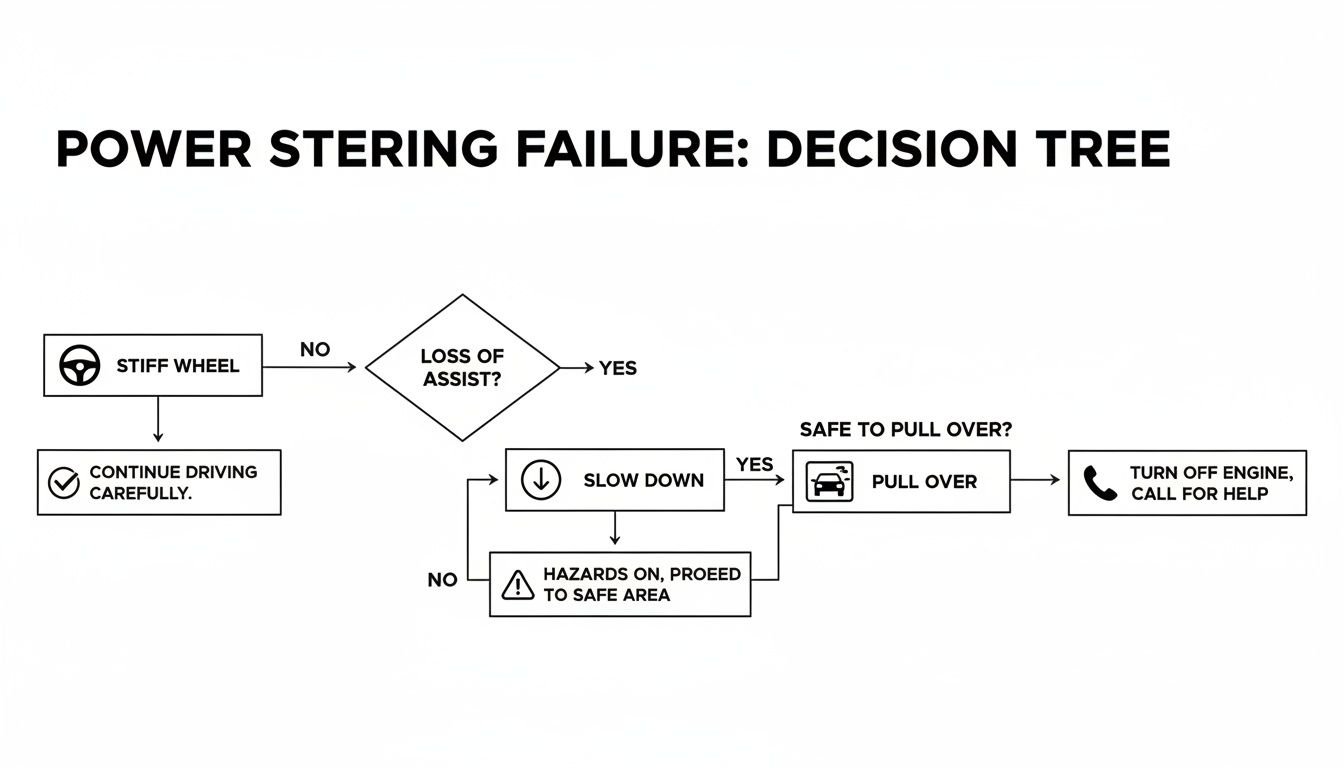
As you can see, the game plan is simple but non-negotiable: recognize the problem, slow down, and pull over as soon as it's safe.
A Quick Look at What Went Wrong
Once you're safely parked, it helps to understand what likely happened under the hood. Most cars today have one of two kinds of power steering.
A hydraulic system uses pressurized fluid, so a failure is often caused by a fluid leak or a snapped belt. If you have an electric power steering (EPS) system, the problem is usually electrical—maybe a blown fuse, a bad sensor, or a problem with the motor itself.
To help you connect the dots, here’s a quick guide to what your car might be telling you.
Initial Symptoms and Potential Causes
| Symptom | Potential Cause (Hydraulic System) | Potential Cause (Electric System) |
|---|---|---|
| Whining or Groaning Noise When Turning | Low power steering fluid, air in the lines, or a failing pump. | N/A (EPS is silent). |
| Stiff Steering, Especially at Low Speeds | Low fluid level, a bad pump, or a clogged hose. | Faulty motor, bad sensor, or electrical connection issue. |
| Sudden, Complete Loss of Assist | A snapped serpentine belt or catastrophic pump failure. | Blown fuse, complete motor failure, or a critical sensor malfunction. |
| Steering Feels "Notchy" or Inconsistent | Worn steering rack or issues with the universal joints. | Failing torque sensor or a problem with the control module. |
No matter which system your car has, the end result is the same: a steering wheel that’s incredibly heavy and hard to turn. Your first move should always be to get to safety, then figure out your next steps for a professional inspection and repair.
Simple DIY Checks You Can Do at Home

Before you start pricing out a new power steering pump, take a deep breath. A lot of the time, the reason your power steering is not working is something you can spot right in your own driveway. For any driver around Haltom City, popping the hood is always the best first move.
The biggest—and most common—culprit is often low or dirty power steering fluid. Thankfully, it's also the easiest thing to check. Let's walk through how to find that reservoir and what to look for.
Inspect the Power Steering Fluid
First things first, you need to locate the power steering fluid reservoir. It's usually a small plastic container, either white or semi-clear, with a black cap. Look for a steering wheel symbol or the words "Power Steering Fluid" right on the cap. If you're having trouble finding it, your owner's manual will show you exactly where it is.
Once you’ve got eyes on it, check the fluid level. You'll see "MIN" and "MAX" lines marked right on the side of the tank. If your fluid is hovering below that "MIN" line, you've almost certainly found a big piece of the puzzle.
But don't stop there—the fluid's condition tells its own story. Good power steering fluid should be clear with a reddish or light amber tint. Anything else is a warning sign.
- Dark or Black Fluid: This means the fluid is old and has broken down. It’s full of gunk and can no longer protect the system's moving parts.
- Milky or Foamy Fluid: See bubbles or a milky-looking consistency? That's a classic sign of air or water contamination. Air in the system is what often causes that awful whining sound you might be hearing.
- Burnt Smell: If the fluid has a nasty, burnt odor, it's getting too hot. This usually happens when the pump is struggling from low fluid levels or a clog somewhere in the lines.
A low fluid level is almost always a sign of a leak. Topping it off might make the wheel easier to turn for a little while, but it’s a temporary bandage. The leak needs to be fixed by a pro to avoid burning out your pump.
If you're pretty sure a leak is the problem, our guide on what causes power steering fluid to leak offers a deeper dive into tracking it down.
Check the Serpentine Belt
If the fluid level and quality look good, your next stop is the serpentine belt. This is the long rubber belt snaking around your engine pulleys, and on most cars, it’s what spins the power steering pump. If that belt is slipping, frayed, or snapped, the pump gets no power.
Make sure the engine is OFF, then take a close look at the belt. You're searching for cracks, splits, missing ribs, or a shiny, glazed surface that indicates it's slipping. Now, give it a firm push with your finger—it should feel tight, with very little flex. A loose belt is notorious for causing that ear-splitting squeal on startup and can lead to intermittent power steering.
Look at the Fuses
Finally, don’t overlook the simplest fix of all: a blown fuse. This is especially true for newer cars with Electric Power Steering (EPS), since the whole system is electronically controlled. Your vehicle has at least one fuse box, sometimes one under the hood and another under the dashboard. The inside of the fuse box lid has a handy diagram.
Scan the diagram to find the fuse labeled for power steering (it might be marked "P/S" or with a steering wheel icon). Pull it out using the little tool provided in the fuse box or a pair of needle-nose pliers. Hold it up to the light—if you see a break in the thin metal wire inside, it's blown. Swapping in a new fuse of the same amperage is a cheap and easy fix that just might solve your entire problem.
Why Hydraulic and Electric Systems Fail Differently
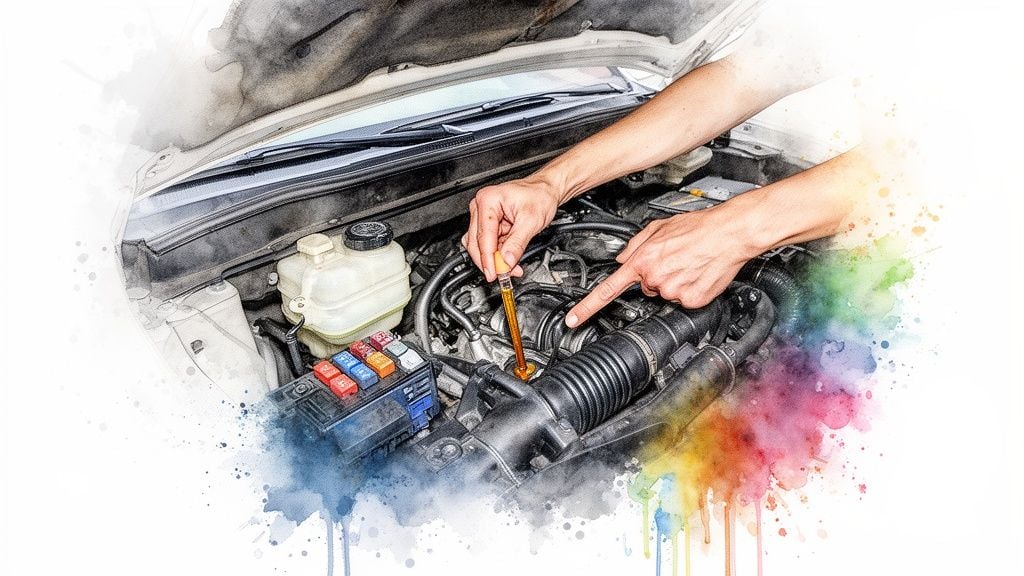
When your power steering is not working, the culprit depends entirely on what kind of system is under your hood. Older cars typically use a hydraulic setup, while newer models have gone electric. They are two completely different beasts, and knowing how they work—and how they break—is the first step in figuring out what’s wrong.
A hydraulic power steering (HPS) system is all about mechanical force. It uses a pump, belts, and high-pressure fluid to make turning the wheel feel effortless. Because it has so many moving parts, when something goes wrong, it's often a physical problem you can see, hear, or feel.
Common Failure Points in Hydraulic Systems
Hydraulic steering is a proven workhorse, but all those components create several potential points of failure. Here in Haltom City, the combination of summer heat and dusty roads can be especially tough on these systems, causing parts to wear out faster.
Pump Failure: The power steering pump is the heart of the whole operation. When it starts to go, it can't build enough pressure, and you’ll feel it immediately—the steering becomes incredibly heavy. A classic giveaway is a loud whining or groaning noise that gets worse when you turn the wheel.
Fluid Leaks: This is by far the most common hydraulic problem we see. Over time, rubber hoses and seals dry out, get brittle, and crack. You'll often spot the evidence as a reddish-brown puddle under the front of your car.
System Clogs: Old, dirty fluid is an enemy to your steering. It breaks down into a nasty sludge that can clog up the tiny passages inside the pump and steering rack. This blockage chokes off fluid flow, resulting in steering that feels stiff, jerky, or unpredictable.
The good news is that most hydraulic issues are fairly straightforward. But if you're hearing a distinct grinding sound, it could point to a more severe mechanical problem brewing. We have a whole guide dedicated to tracking down what causes a grinding noise when turning the steering wheel.
Electric Power Steering Gremlins
Electric power steering (EPS) is a much simpler design from a mechanical standpoint. There's no pump, no fluid, and no belts to worry about. Instead, an electric motor does all the work. While EPS systems are generally more reliable, when they do act up, the problems are usually electrical—and much trickier to diagnose without professional scan tools.
Think of it this way: your EPS is basically a computer assisting your steering. That means a single software glitch or sensor failure can knock the whole system out.
While hydraulic systems show higher failure rates over time, electric steering issues often demand more specialized diagnostics. Industry analysis shows hydraulic failure rates increase significantly as vehicles age, especially when maintenance is skipped. For Texas drivers in dusty areas like Haltom City, contaminants can rapidly accelerate wear on hydraulic components, making regular checks vital.
Here are the usual suspects when an EPS system gives up:
Faulty Sensors: Your EPS system relies on a torque sensor to know how much you're turning the wheel and how much help to provide. If that sensor goes bad, the computer gets confusing signals and often just shuts the system down, triggering a warning light on your dashboard.
Motor Burnout: It’s not common, but the electric motor providing the power assist can burn out. This usually happens suddenly, leading to an immediate and complete loss of power steering.
Connection Problems: Sometimes the problem is as simple as a loose wire or a corroded connector. These electrical "gremlins" can interrupt communication between the EPS control module and the rest of the car, causing the system to fail instantly. This is exactly why a professional diagnostic scan is almost always the first step for an EPS issue.
When to See a Haltom City Mechanic
It’s great to get your hands dirty and try to figure out what’s wrong with your car. But when it comes to power steering, some problems are clear signs to put down the wrench and call in a pro. This isn't just about convenience; a failing steering system is a serious safety hazard. For anyone driving around Haltom City, knowing when to bring your vehicle to Express Lube & Car Care can be the difference between a simple fix and a catastrophic failure on the road.
If you’ve already checked the fluid, belts, and fuses with no luck, it’s time to look for the more serious symptoms. Your car has a way of telling you when it needs a professional's touch.
Red Flags That Scream "See a Mechanic"
Some issues are much deeper than a simple top-off or a new fuse. These signs usually point to a mechanical or electrical problem that needs specialized equipment and a trained eye to diagnose properly.
Loud, Grinding Noises: A little whine is one thing, often just low fluid. But a harsh, metallic grinding noise when you turn the wheel? That’s a major red flag. It often signals serious damage inside the pump or steering rack, and continuing to drive is asking for a total system failure.
Leaks That Just Won't Quit: If you top off your power steering fluid and the steering gets heavy again in a few days, you've got a persistent leak. Just adding more fluid is like putting a band-aid on a major wound—it lets the pump run dry over and over, causing expensive, permanent damage.
That Unmistakable Burning Smell: A sharp, burnt odor from under the hood is a tell-tale sign that your power steering pump is overheating. This is a critical warning; the pump is likely on its last legs and about to seize up completely.
The Warning Light Won't Turn Off: When that power steering light on your dash stays lit, your car's computer has logged a fault. This is especially common with modern Electric Power Steering (EPS), which will often shut down the assist function entirely until a technician clears the code and fixes the root cause.
Honestly, ignoring these symptoms is a huge gamble. A stiff steering wheel in a parking lot is a workout, but a sudden loss of steering assist on the highway is terrifying. Getting a professional inspection gives you more than just a repair; it gives you peace of mind.
Why You Can't "Just Eyeball" Modern Steering Repairs
Diagnosing today’s power steering, especially the newer Electric Power Steering (EPS) systems, has gone way beyond a quick visual check. These systems are woven into the very fabric of your car's onboard computer network.
When your power steering is not working on a newer vehicle, the first thing a real mechanic does is plug in a professional-grade diagnostic scanner. This tool talks directly to the car's control modules to pull specific fault codes—codes that might point to a failing torque sensor, a dead motor, or a simple wiring short. Your standard home toolkit just doesn't have that capability.
Without the right diagnostic gear, you're essentially flying blind, guessing which expensive part to replace first. It's a surefire way to waste time and money. For a deeper dive into how pros get to the root of an issue, our guide on how to diagnose vehicle problems breaks it down further. It's always the smarter, and safer, choice to trust these complex systems to an expert.
To make it even clearer, let’s break down which tasks are generally safe for a DIY approach and which ones really need a professional mechanic.
DIY vs Professional Repair Tasks
This table can help you decide whether to grab your tools or your phone.
| Task | DIY Feasible? | When to Call a Pro |
|---|---|---|
| Checking Fluid Level | Yes | If the level is consistently low, indicating a leak. |
| Topping Off Fluid | Yes | If the problem returns quickly or requires frequent top-offs. |
| Inspecting the Belt | Yes (visually) | If the belt is frayed, glazed, cracked, or needs replacement. |
| Checking Fuses | Yes | If a new fuse blows immediately, signaling an electrical short. |
| Replacing the Pump | No | This requires draining the system, bleeding air, and precise installation. |
| Repairing the Steering Rack | No | This is a major, complex job requiring specialized tools and alignment afterward. |
| Diagnosing EPS Faults | No | Requires advanced OBD2 scanners to read specific manufacturer fault codes. |
| Flushing the System | Maybe | If you're not comfortable, a pro can ensure all old fluid and debris are removed. |
Ultimately, while simple checks are a great first step, anything involving replacing major components or diagnosing electrical faults is best left to those with the right training and tools. Your safety depends on it.
Preventative Maintenance and Modern Early Warnings
When your power steering is not working, it’s a problem you need to fix right away. But honestly, the best repair is the one you never have to make in the first place. Getting ahead of problems instead of just reacting to them is how you avoid that sudden, muscle-building struggle to turn your wheel on Haltom City roads.
Regular maintenance is your best friend here. I'm not just talking about topping off fluids—I mean preventative services that keep your power steering system healthy from the inside. For older hydraulic systems, that means staying on top of fluid flushes and belt inspections.
Proactive Care for Your Steering System
Over time, power steering fluid just gets old and worn out. It loses its ability to lubricate parts and keep things cool. Worse, it picks up tiny bits of gunk from aging seals and metal components, turning into a nasty sludge that can gum up the pump and steering rack.
A power steering fluid flush isn't a top-off. It’s a full-system cleanse, where we purge every drop of that old, contaminated fluid and refill it with fresh, clean fluid. Think of it like an oil change, but for your steering.
At the same time, a quick look at the serpentine belt for cracks, a shiny glaze, or looseness can prevent it from snapping unexpectedly. A snapped belt means an instant loss of steering assist. These simple checks are a huge part of keeping your car reliable. You can find more tips like these in our complete checklist for car maintenance to keep your entire vehicle in good shape.
How Modern Cars Warn You of Trouble
Newer cars, especially those with Electric Power Steering (EPS), are a lot smarter. They’re packed with sensors that act as an early warning system, often flagging an issue long before you notice anything wrong with the steering.
These systems are constantly monitoring things like torque sensors, wiring, and the electric motor itself. When a warning light pops up on your dash, it’s your car’s way of saying, "Hey, something isn't quite right. You should get this looked at before it turns into a real problem."
This kind of tech is quickly becoming the new normal. The market for Power Steering Failure Early Warning Alerts hit USD 1.42 billion in 2024 and is expected to jump to USD 4.21 billion by 2033. Why the huge growth? Because drivers want advanced safety features, and a single bad sensor can knock out an entire EPS unit, leading to repairs that are 20-50% more expensive than old-school hydraulic fixes. For drivers here in Haltom City, these alerts are a critical heads-up.
When that light comes on, it logs a specific fault code that only a professional scanner can read correctly. If your own checks come up empty, a technician can use advanced diagnostic technology in auto repair shops to find the exact electrical gremlin. Here at Express Lube & Car Care, our techs use these tools every day to read the warnings and make precise repairs, keeping your drive safe and predictable.
Your Trusted Haltom City Steering Repair Partner

When your power steering is not working, you need more than a guess—you need a local Haltom City auto shop you can actually trust. For anyone driving around Haltom City, Watauga, and North Richland Hills, suddenly wrestling with your steering wheel is a serious safety risk. At Express Lube & Car Care, we handle these exact problems every single day.
We know that bringing your car to our shop at 6211 Denton Hwy means you’re putting your safety in our hands. That’s a responsibility we take to heart. Our certified technicians have seen it all, and they combine that deep expertise with honest, straightforward communication.
Why Haltom City Drivers Choose Us
Choosing the right mechanic is a big deal. When you're trying to find a dependable shop, checking out their online reputation and understanding the importance of Google reviews for local businesses can tell you a lot about who you can trust. Our reputation is everything to us, built one quality repair at a time.
Here’s what makes us different:
- Real-World Experience: Our technicians are certified and have the hands-on experience to correctly diagnose both old-school hydraulic and newer electric power steering systems. We get it right the first time.
- No Guesswork: We use advanced diagnostic tools to pinpoint the exact fault codes your car is sending. This means we fix the actual problem instead of just throwing parts at it.
- Honest Service, Period: We’ll show you what’s wrong with your vehicle, walk you through your options in plain English, and give you a clear estimate before we pick up a single tool.
Modern cars are unbelievably complex, and the steering systems are no exception. You really need a team that gets both the mechanical and the electrical side of things to ensure a safe, lasting repair.
This is especially true as more electric systems hit the streets. Think about the massive recall of 380,000 Tesla vehicles in the U.S. in early 2025 because of a power steering assist failure. It was a huge wake-up call, showing that even the newest cars are vulnerable to electrical faults. For drivers around Haltom City, it’s a stark reminder to never ignore those dashboard warning lights.
Our technicians use sophisticated diagnostic equipment to catch these kinds of electric power steering sensor and wiring issues early on, preventing a dangerous breakdown on a busy highway near Keller or North Richland Hills. A proper inspection can save you from a massive repair bill and, more importantly, keep your family safe.
Don't let a small steering issue turn into a full-blown crisis. For complete peace of mind, let the local experts at Express Lube & Car Care give your vehicle a professional inspection. Schedule your appointment at https://expresslubehaltom.com and get back on the road with confidence.