
That maddening rattle when you accelerate is often something simple, like a loose heat shield on your exhaust. But sometimes, it's a red flag for a bigger problem brewing in your engine or transmission. Think of that metallic buzzing or vibration as your car's way of telling you it needs a look, especially for those of us navigating the roads around Haltom City.
Pinpointing That Acceleration Rattle in Haltom City
Hearing a strange noise from your car is always a little nerve-wracking, but figuring out where it's coming from is the first step to fixing it. The specific sound you hear when you hit the gas is a huge clue for any Haltom City mechanic. It happens because acceleration puts everything—the engine, exhaust, and drivetrain—under more stress, causing any loose or worn-out parts to vibrate and make themselves known.
For drivers in Haltom City, Keller, and the surrounding areas, that noise usually points to a few common culprits. Let’s walk through the most frequent offenders so you have a better idea of what might be going on under the hood of your vehicle on our local roads.
Common Sources of Rattling Noises
To get started, let's look at the usual suspects. The problem could be as simple as a loose bolt, or it could be a heads-up for a more serious mechanical issue that needs attention right here in Haltom City.
- Loose Exhaust Heat Shield: This is, without a doubt, the number one cause. These thin metal plates rust over time, or the bolts holding them in place simply work their way loose from driving on Haltom City streets. The result? A high-pitched, tinny rattle that really sings when you're on the gas.
- Worn Engine or Transmission Mounts: These are basically heavy-duty rubber shocks that hold your engine and transmission in place and absorb vibrations. When they wear out, the whole powertrain can shift under load, creating a heavy thud or a deep, guttural rattle.
- Failing Catalytic Converter: Inside your catalytic converter is a fragile honeycomb structure. If it starts to break apart, those loose ceramic bits will get tossed around inside the metal canister. It literally sounds like you're shaking a box of rocks.
This decision tree gives a great visual for how a technician starts to diagnose the problem: is the noise coming from the exhaust, or is it something else?
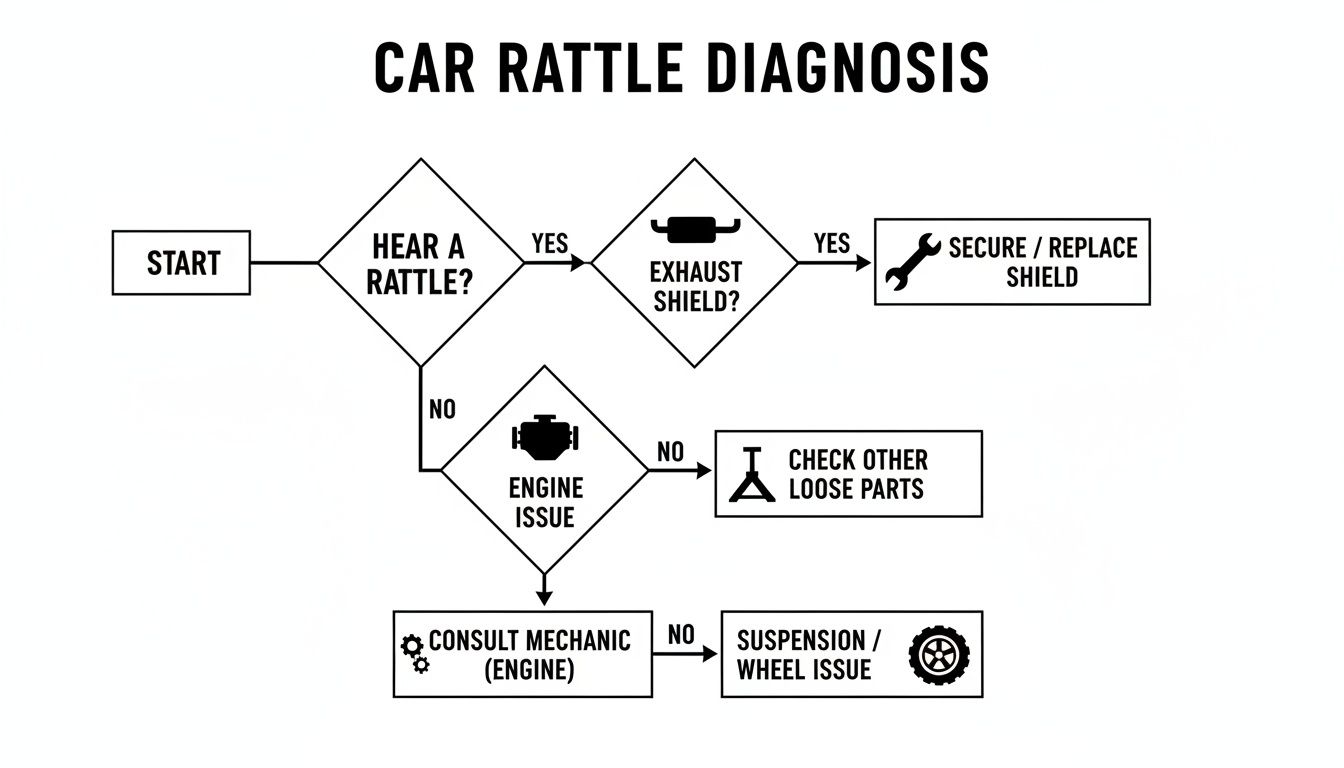
As the flowchart shows, just figuring out the general area of the sound is a massive first step. In fact, real-world service data shows that failing heat shields are responsible for around 40-50% of all rattling complaints for cars over five years old. If you want to learn more, you can find a lot of information online about common car noises and their causes.
To make it even clearer, here's a quick breakdown of the most common issues, what they sound like, and what you can expect.
Common Causes of Rattling Noises During Acceleration
| Potential Cause | Typical Sound | Urgency Level | Estimated Repair Cost |
|---|---|---|---|
| Loose Heat Shield | High-pitched, metallic, tinny rattle | Low | $50 – $250 |
| Catalytic Converter | Like a box of rocks being shaken | High | $500 – $2,500+ |
| Engine/Trans Mounts | Deep clunking or heavy vibration | Medium | $200 – $800+ |
| Suspension Parts | Clunking or popping, often over bumps | Medium-High | $150 – $1,000+ |
| Foreign Object | Inconsistent buzzing or rattling | Low | $0 – $100 |
This table should give you a good starting point for understanding what might be going on. While some of these are quick fixes, others, like a bad catalytic converter, can impact your car's performance and need to be addressed right away.
Checking Your Exhaust System and Heat Shields
If you're hearing a rattle every time you step on the gas, the first place I always tell people in Haltom City to check is the exhaust system. It's a long, complex series of pipes, converters, and mufflers that gets scorching hot and is constantly vibrating. It's really the number one cause of those irritating rattling sounds.
Think about it: this whole system is bolted to the underside of your car. After thousands of miles on Haltom City roads, dealing with everything from temperature swings to potholes, the brackets and hangers holding it all together can start to weaken. Vibration, rust, and the occasional smack from road debris are all it takes for something to come loose and start banging around.
The Notorious Heat Shield
More often than not, the specific culprit is a pesky little part called a heat shield. These are just thin sheets of metal that sit between the hot exhaust pipes and the floor of your car, protecting everything from the extreme heat.
Because they're so thin and exposed, they're the first thing to cause trouble. Here’s why they get so noisy:
- Rust and Corrosion: They're constantly getting hit with water and road salt, which can eat away at the shield itself or the small bolts holding it in place.
- Vibration Damage: The engine's constant vibration can eventually crack the thin metal or work the mounting bolts loose over time.
- Road Debris: A single bad Haltom City pothole or piece of kicked-up debris can be enough to bend a heat shield out of shape, causing it to vibrate against the exhaust pipe.
Key Takeaway: A loose heat shield is the classic cause of that high-pitched, tinny rattle that seems to get worse the faster you go. While it’s not an emergency, you don't want to ignore it—it could eventually fall off and become a hazard on the road for other Haltom City drivers.
How to Perform a Safe Visual Check
You can often find the problem yourself with a quick look, but please, put safety first. Only do this when your car has been off for a few hours and the exhaust is completely cool.
- Find a Safe, Level Surface: Park on flat ground. If you need to lift the car, use proper jack stands. Never get under a car that's only held up by a jack.
- Visually Inspect the Exhaust: Get a good look at the entire exhaust pipe, from the front of the car all the way to the tailpipe.
- Gently Tap Components: Use a rubber mallet or even the handle of a screwdriver to gently tap on the heat shields, the catalytic converter, and the muffler. A part that's secure will make a dull thud. If you hear a metallic rattle, you’ve probably found your culprit.
- Look for Loose Parts: Check all the rubber hangers and metal brackets. Are any of them broken, rusted out, or hanging loose?
This "tap test" is a great way to diagnose the problem, but a real fix usually takes more than a DIY patch. You might be tempted to just clamp it down, but for a solid, long-term repair, it’s best to see a pro. For a better understanding of how these parts function, you can learn more about your car’s muffler system and its job.
Here at Express Lube & Car Care in Haltom City, we have the right tools and experience to properly re-secure or replace the faulty part and get rid of that rattle for good.
When The Rattle Comes from Under the Hood
If the rattling sound seems to be coming directly from the engine bay instead of underneath the car, it's time to listen closely. While exhaust rattles are annoying, noises from under the hood can point to problems with the core components that keep your car moving. A rattle when accelerating from this area often signals a more urgent issue for any Haltom City driver.
Think of your engine and transmission as being held in place by heavy-duty rubber and metal brackets. These are your engine and transmission mounts, and their whole job is to soak up the massive vibrations your powertrain creates. Over the years, these mounts can dry out, crack, and eventually break. When that happens, the entire engine or transmission can lurch under the force of acceleration, causing a heavy thud or a deep, unsettling rattle you can often feel in your seat.
Listening to Your Engine's Health
Besides the mounts, other noises can give you a window into your engine's internal condition. Certain rattles are early warnings of problems with oil circulation or the mechanical timing that keeps everything in sync. Catching these sounds early is one of the best ways for Haltom City residents to head off a major engine failure.
Here are a couple of engine-specific rattles that should put you on high alert:
- Low Engine Oil Rattle: You might hear this as a rapid tapping sound, almost like a sewing machine, that speeds up as you press the gas. It's often called a "lifter tick," and it means there isn't enough oil pressure to keep vital parts in the top of the engine lubricated, leading to metal-on-metal contact.
- Timing Chain Rattle: A failing timing chain tensioner can let the chain go slack. This creates a very distinct, gravelly rattle—especially when you first start the car or accelerate—as the loose chain slaps against its protective cover.
Key Takeaway: Any rattle that changes in speed or pitch directly with your engine's RPM is a huge red flag for an internal engine problem. Ignoring these sounds can quickly turn a manageable repair into catastrophic and incredibly expensive engine damage.
Professional Diagnosis in Haltom City
Unlike a loose heat shield you might spot yourself, diagnosing these under-the-hood noises takes a trained ear and the right equipment. Our ASE-certified technicians in Haltom City don’t just guess. We use tools like electronic stethoscopes to zero in on exactly which component is making the noise, which saves time and ensures we fix the right thing the first time.
If you even suspect your rattle is coming from the engine, don't wait for it to get worse. Knowing how serious these sounds can be is the difference between a minor repair and a full engine replacement. To learn about other noises, check out our guide on what to do if you notice your engine rattling at idle. Taking action now protects both your vehicle and your wallet.
Digging Deeper: Drivetrain and Suspension Noises
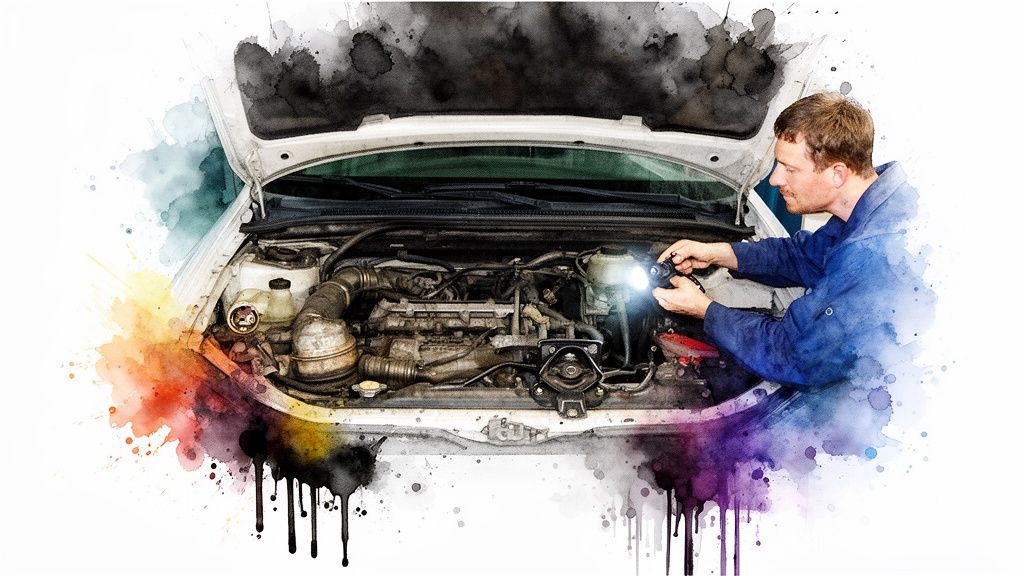
Sometimes, that rattle when you accelerate is more than just a simple buzz from a loose bracket. It can feel like a deep, high-frequency vibration running right through the car's frame. If you've ruled out the exhaust system and the engine bay, it’s time to start looking at the parts that actually put your engine's power to the pavement: the drivetrain and suspension.
For families in Haltom City who rely on their vehicles every day, being able to recognize these specific sounds is key to staying safe. These components are constantly under incredible stress, handling both the engine’s power and every bump in the road. When they start wearing out, the noises they make are clear warnings that a critical part of your car needs attention.
Is It a Failing CV Joint?
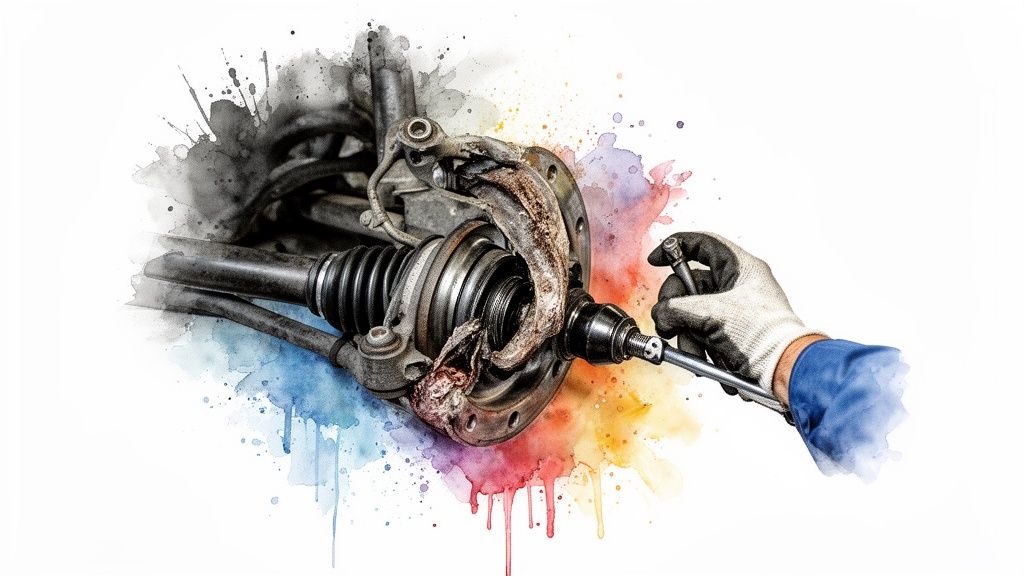
One of the most common culprits for drivetrain noise is a bad Constant Velocity (CV) joint. You can think of a CV joint as your car’s ankle—it lets the axle flex and pivot while still spinning the wheels, which is absolutely essential for turning.
When a CV joint starts to go, it usually makes a very distinct clicking or rattling noise. You’ll hear it most when you’re accelerating and turning at the same time, like when you’re pulling out of a parking space or making a sharp turn at a Haltom City intersection.
What About Worn Suspension Parts?
Your car's suspension is all about giving you a smooth and controlled ride. It’s a whole system of struts, ball joints, control arms, and bushings working together to soak up bumps and keep your tires glued to the road. Naturally, after thousands of miles of movement and impacts on Haltom City roads, these parts wear down.
Worn suspension components can cause all sorts of rattling, clunking, or popping sounds. You'll often notice the sound most when the car's weight shifts, like when you step on the gas or drive over uneven pavement. If you hit a pothole and hear a rattle that sticks around as you get back up to speed, that's a huge clue pointing toward a suspension problem.
A nagging rattle that gets louder as you accelerate could be a sign of worn-out suspension parts or failing wheel bearings. According to NHTSA data, these issues affect roughly 30% of vehicles with more than 75,000 miles on the clock.
Putting off these repairs isn't just about ignoring a noise; it’s a major safety risk. Worn drivetrain or suspension parts can lead to terrible handling, rapid tire wear, and even a complete loss of control. A bad ball joint, for instance, could separate entirely, causing you to lose steering. It’s also helpful to learn how related parts fail—our guide on the signs of wheel bearing failure can show you how to distinguish between different troubling noises.
Because these components are so critical to your safety, any rattle that changes when you turn or hit bumps needs to be checked out immediately by a professional. Here at Express Lube & Car Care, our technicians can get your car on a lift, perform a thorough inspection, and make sure your vehicle is safe to drive on Haltom City roads.
Your Local Haltom City Diagnosis and Repair Solution
Now that you've got a better handle on what could be causing that rattle when accelerating, the next step is finding someone you can trust to figure it out and fix it right. For drivers here in Haltom City, Keller, and the neighboring areas, Express Lube & Car Care on Denton Hwy is where folks turn for straight answers and repairs that last. We're a local Haltom City shop, and we pride ourselves on getting our neighbors back on the road safely.
When you show up with a rattling noise, we don't just start guessing. We have a methodical process to hunt down the real source of the problem. Our team of ASE-certified technicians knows that every noise tells a story, and it's our job to listen to what your car is trying to tell us.
Our Diagnostic Approach to Rattles
Our whole approach is built on being thorough and precise. We know a quick glance underneath the car just won't cut it. To properly track down a rattle, we run through a multi-point inspection that covers all the usual suspects we've talked about.
Here's a peek at what that looks like for our Haltom City customers:
- A Complete Vehicle Lift Inspection: First, we get your car up on a lift. This gives us a clear, up-close view of the entire undercarriage, from the exhaust system and heat shields to every last suspension and drivetrain component. We're looking for anything loose, damaged, or rusted out.
- A Professional Road Test: One of our techs will actually get in the car and drive with you. We want to experience the rattle exactly how you do—at the same speed, under the same kind of acceleration. Hearing the sound firsthand is often the most important clue we can get.
- Using Modern Diagnostic Tools: If the noise seems to be coming from the engine bay, we don't just guess. We use modern tools like electronic stethoscopes to zero in on specific parts, so we know we’re fixing the right thing.
Transparency You Can Trust in Haltom City
We're big believers that trust is earned through honesty. Once we’ve pinpointed the source of that rattle, we’ll take the time to show you exactly what we found. You'll get a simple, straightforward explanation of the problem and a detailed estimate breaking down the costs for parts and labor. We never start any work until you understand the situation and give us the green light.
At Express Lube & Car Care, our goal is simple: to give our Haltom City neighbors a solid diagnosis and a dependable repair that solves the problem the first time around. We put our expertise to work on your car's specific issue so you can drive away with peace of mind.
Finding the right shop makes all the difference. When you're looking for a local expert, it helps to understand the world of automotive repair solutions and what sets a great shop apart. To learn more about our process, our deep dive into auto diagnostic services explains the specific tools and techniques we use to keep Haltom City drivers safe.
Common Questions About Car Rattles
Figuring out that your car is rattling when you accelerate is the easy part. The hard part is knowing what to do next. We get it. That's why we've put together answers to the most common questions our technicians in Haltom City hear every day.
This isn't just about understanding the noise; it's about giving you the confidence to take the right next step. Let's clear up the confusion around safety, costs, and common causes for Haltom City drivers.
Is It Safe to Drive My Car if It Rattles When I Accelerate?
Honestly, it depends entirely on what’s causing the rattle, and that's the problem—you can't know for sure just by listening.
A loose heat shield, for instance, is more of an annoyance than a danger. It’s loud and irritating, but it's unlikely to cause a major issue, though it could eventually fall off and become a hazard on Haltom City roads.
On the other hand, if that rattle is coming from a worn-out CV joint, a failing engine mount, or a loose suspension part, you've got a serious safety issue on your hands. Those parts are critical for controlling your vehicle. An internal engine rattle is the worst-case scenario, often signaling that major, catastrophic failure isn't far behind.
The Safest Bet: Because you can’t diagnose a sound with 100% certainty from the driver's seat, the only responsible move is to get it inspected by a professional. Don't gamble with your safety—it’s just not worth the risk.
How Much Does It Cost to Fix a Rattle When Accelerating?
This is the million-dollar question, and the answer can range from a cheap fix to a major repair bill. It all comes down to the root cause.
Something simple, like tightening a few bolts or re-securing a rattling heat shield, might only set you back $100 to $250.
But if the problem is more complex, the cost goes up. Replacing a catalytic converter can run anywhere from $1,200 to over $2,500, depending on your car. Engine mounts or suspension work usually land somewhere in the middle, typically from $400 to $1,000+.
Here at Express Lube & Car Care in Haltom City, we promise no guesswork. We always start with a complete diagnosis and give you a clear, itemized estimate before a single wrench is turned.
Can Low Oil Cause My Car to Rattle?
Yes, absolutely. Low engine oil is a classic cause of a rattling or ticking noise that gets faster as you press the gas.
When oil levels are too low, there isn't enough pressure to properly lubricate critical engine parts like the hydraulic lifters. They start to clatter, and that's the sound you're hearing. Think of it as your engine's cry for help.
This isn't just a noise; it's a serious warning that your engine is starving for lubrication, which can lead to rapid, expensive, and irreversible damage. If the rattle seems to be coming from the engine, check your dipstick immediately. But even if it's low, a professional diagnosis is crucial to make sure a failing oil pump isn't the real villain.
Don't let a mysterious rattle ruin your peace of mind or put you at risk. The ASE-certified team at Express Lube and Car Care in Haltom City has the right tools and the hands-on experience to find that noise and fix it right the first time.