
Picture this: you're driving down Denton Hwy in Haltom City, and your car suddenly hesitates or jolts when it shifts gears. That little hiccup? It’s often the first warning sign of a transmission fluid issue. For drivers in Haltom City and the surrounding areas, learning where your transmission fluid is located is one of the most important skills you can have to prevent a small problem from becoming a massive repair bill.
Why Finding Your Transmission Fluid Is A Non-Negotiable Car Check in Haltom City
Your car's transmission fluid is its lifeblood. It's not just a simple lubricant; this fluid is a multitasking powerhouse that cools, cleans, and provides the hydraulic pressure your transmission needs to shift gears smoothly. Putting off checking it is, frankly, one of the most expensive mistakes you can make as a car owner in Haltom City.
It's no exaggeration. A staggering number of transmission failures could have been avoided with this simple check. Industry data shows that issues related to fluid cause over 80% of all transmission failures, which often end in repair bills that stretch into the thousands. You can discover more insights about these transmission fluid trends and see why maintenance is so critical.
The Role of Transmission Fluid in Vehicle Health
Think of transmission fluid as being like engine oil, but with an even more demanding job. It's constantly working to keep your car reliable on Haltom City roads.
- Lubrication: It coats hundreds of intricate moving parts—from tiny gears to clutch plates—to slash friction and prevent them from grinding themselves down.
- Cooling: Transmissions create a ton of heat, especially in our Haltom City stop-and-go traffic. The fluid is what carries that heat away, preventing your transmission from overheating.
- Hydraulic Power: For automatic transmissions, this fluid is the hydraulic muscle, creating the precise pressure needed to engage and disengage gears without you feeling a thing.
Just looking at the fluid can tell you a story. Healthy fluid is usually bright red and almost transparent. If yours is low, looks dark and muddy, or has a burnt smell, your transmission is crying out for help.
For many Haltom City drivers, the transmission feels like a mysterious "black box." But checking its fluid is one of the most straightforward and empowering things you can do to protect your investment and keep yourself safe on the road.
Understanding the benefits of a transmission fluid change is the next logical step. As the fluid breaks down over time, it can't protect those vital components anymore. This leads to sluggish performance and, if ignored, total transmission failure. By simply knowing where to look and what you’re looking for, you take back control of your car’s health and can save yourself from the stress of a breakdown.
How to Find the Transmission Fluid Dipstick in Most Cars
For the majority of automatic cars you'll see around Haltom City, checking the transmission fluid starts with finding the dipstick. This is one of those fundamental maintenance checks that can save you a world of hurt down the road, and doing it right is key.
Before you even think about popping the hood, though, you have to prep the car.
First, the engine and transmission need to be at their normal operating temperature. A quick 5-10 minute drive around your Haltom City neighborhood should do the trick. This step is non-negotiable because transmission fluid expands as it heats up. Checking it cold will give you a false low reading every time.
Once it's warm, find a perfectly level spot to park. If you're on a slope, even a slight one, the fluid will slosh to one side of the transmission pan and throw off your measurement.
Locating the Dipstick Under the Hood
Alright, with the engine warm, the car parked on flat ground, and the parking brake on, leave the engine running. Now you can pop the hood and start the hunt. The transmission dipstick is usually a bit more reclusive than its engine oil counterpart.
- Front-Wheel Drive (FWD) Vehicles: In most FWD cars, the transmission is mounted sideways (transversely). You'll typically find the dipstick on either side of the engine, often tucked away.
- Rear-Wheel Drive (RWD) Vehicles: For RWD cars and trucks, the dipstick is usually farther back in the engine bay, closer to the firewall that separates the engine from the passenger cabin.
The handle is almost always a bright, distinct color to make it stand out. Look for a red, pink, orange, or yellow handle. Sometimes it's even labeled with "TRANS" or a little gear symbol.
A Pro Tip: If you’re having trouble, grab a flashlight. It’s amazing how a little focused light can reveal a dipstick handle hiding behind a tangle of hoses or wires. This is a common challenge for Haltom City DIY mechanics.
Getting an Accurate Fluid Reading
Once you’ve got it, the process is simple but needs to be done carefully. Pull the dipstick all the way out and wipe it completely clean with a lint-free cloth or paper towel. You don't want any lint or debris getting into your transmission—that's just asking for trouble.
Now, push the dipstick all the way back in, then pull it out again. Hold it horizontally to keep the fluid from running and get a true reading. You’ll see markings on the end, usually with a "HOT" and "COLD" range indicated by a crosshatch pattern. The fluid level should fall squarely within the "HOT" marks. If it's low, you might have a leak or just need a top-off. This simple check is a crucial part of any good car inspection checklist.
With more automatic vehicles on the road than ever, knowing how to do this is incredibly valuable. In fact, the global transmission fluid market was valued at USD 15.67 billion and is expected to hit USD 19.70 billion by 2029, driven almost entirely by the dominance of automatic transmissions.
This flowchart really illustrates the crossroads you're at when you first feel that tell-tale hesitation or slip.
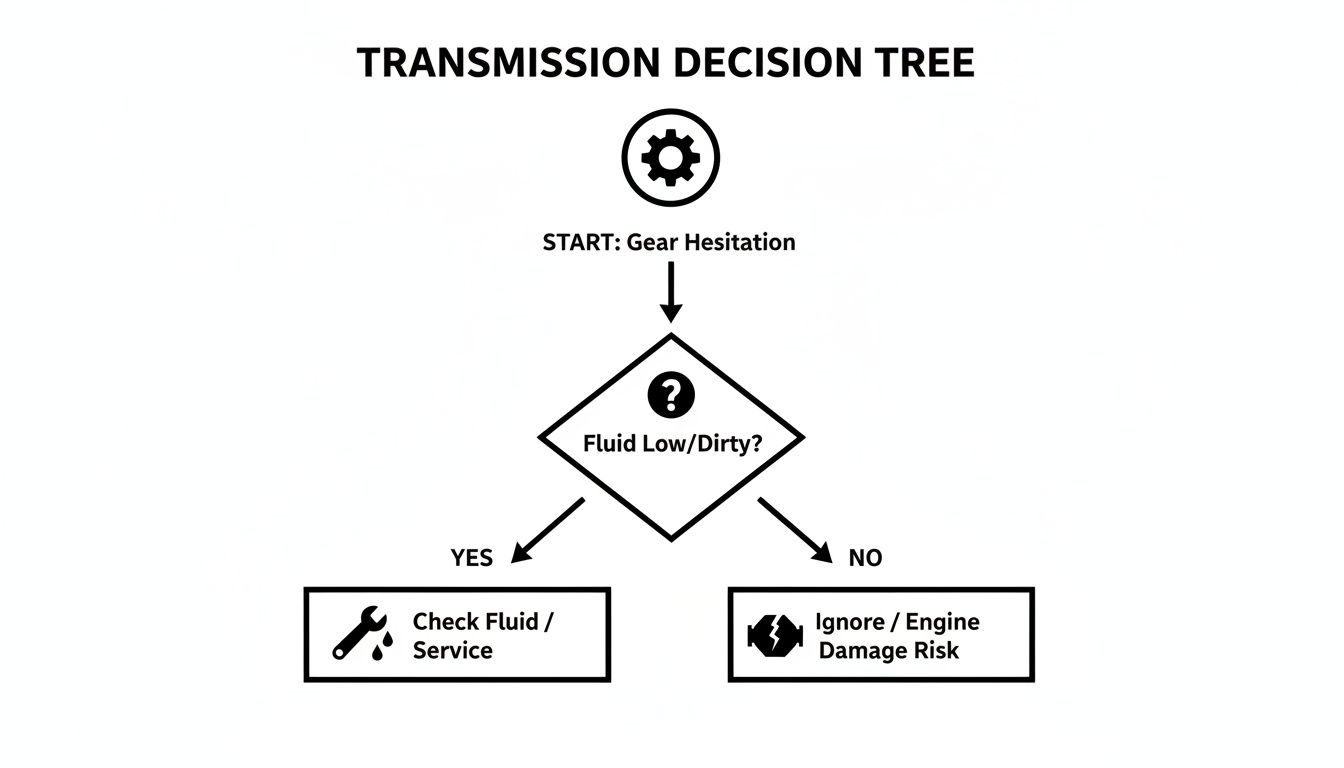
As you can see, ignoring the symptoms can put you on a path to major damage, whereas taking a minute to check the fluid is the first step toward keeping your car healthy and on the road in Haltom City.
What If Your Car Has No Transmission Dipstick?
Popped the hood and can't find that familiar transmission dipstick anywhere? Don't worry, you're not going crazy. A lot of modern cars, including many you see cruising around Haltom City and North Richland Hills, now come with a sealed transmission. This isn't a defect—it's a deliberate design choice by automakers.
The thinking behind it was to create a closed system. This protects the sensitive transmission fluid from outside contaminants and, frankly, prevents owners from accidentally pouring in the wrong type of fluid. That's a simple mistake that can cause thousands in damage. These systems use advanced synthetic fluids designed to last for tens of thousands of miles, so the idea is that you shouldn't need to check it regularly yourself.
Finding the Check and Fill Plug
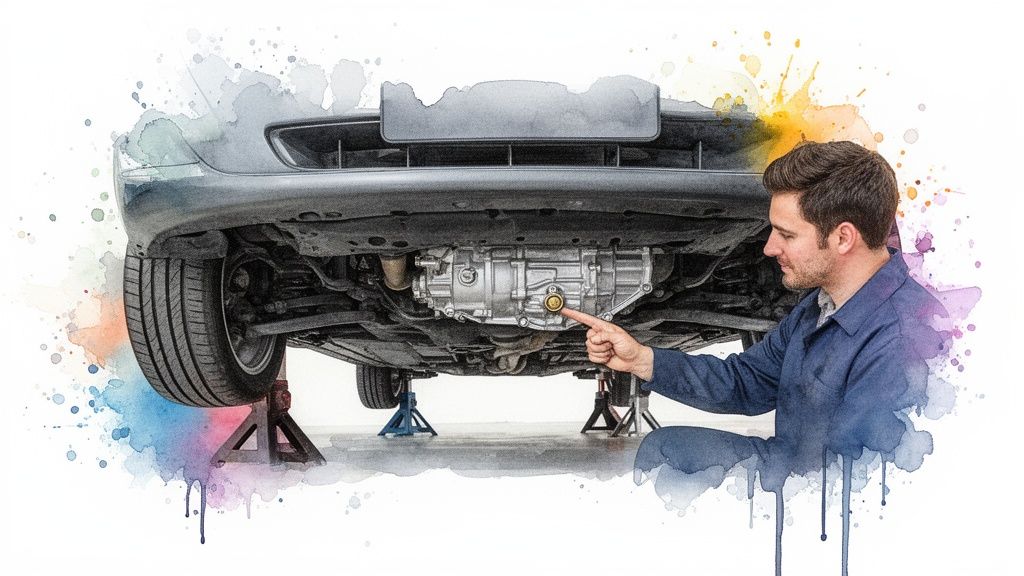
So, if there's no dipstick, how in the world do you check the fluid? The secret is a specific plug on the transmission housing. Finding the transmission fluid location on a sealed unit means getting underneath the car. And I mean safely—with the vehicle securely up on jack stands, never just a floor jack.
Once you’re safely under there, you're looking for two different plugs on the transmission case.
- The Fill Plug: This one is usually positioned higher up on the side of the transmission.
- The Drain Plug: You'll find this one at the very bottom of the transmission pan.
The check itself is done by removing the fill plug while the engine is running and the transmission is at a very specific temperature. If a tiny stream of fluid dribbles out, the level is perfect. If nothing comes out, it needs fluid. It sounds simple on paper, but this is where things get tricky.
Key Takeaway: "Sealed" doesn't mean the transmission never needs service. It just means the process is more involved and requires the right tools and knowledge. Assuming everything is fine just because you can't easily check it is a gamble you don't want to lose here in Haltom City.
Why This Is a Job for the Pros in Haltom City
Checking the fluid in a sealed transmission isn't really a driveway DIY job. The whole procedure hinges on temperature. If the fluid is even a few degrees too hot or too cold, you'll get a false reading. We use professional diagnostic scan tools to see the transmission fluid temperature in real-time, which is the only way to get it right.
On top of that, you can't just pour fluid in. It requires a special pump to get the fluid back into the fill port against gravity. Overfilling or underfilling, even by a small amount, can cause shifting problems, overheating, and serious internal wear.
Given the precision required, this is one of those jobs best left to technicians who do it every day. The team here at Express Lube & Car Care in Haltom City has the equipment and the hands-on experience to service these sealed units correctly. You can learn more about our professional fluid exchange services and see why getting it done right matters. It’s not worth risking a multi-thousand-dollar transmission replacement to save a little money on a proper fluid check.
Reading the Signs: What Your Transmission Fluid Is Telling You
Finding the transmission fluid is the first part of the puzzle. Understanding what you're seeing is where the real work begins. Think of the fluid's color, smell, and consistency as a complete health report for your transmission—it tells you everything you need to know about what's happening inside.
Healthy automatic transmission fluid (ATF) is pretty easy to recognize. You're looking for a bright, translucent red or pinkish color. It should be nearly odorless, though some might say it has a faintly sweet smell. When you see this, you know the fluid is fresh, clean, and doing its job lubricating parts and keeping things cool.
If your fluid doesn't look like that, your transmission is trying to tell you something important.
Decoding Unhealthy Transmission Fluid
When you pull that dipstick out and wipe it on a clean cloth, take a good, hard look. The story it tells could save you from a costly breakdown on a busy Haltom City road.
Keep an eye out for these red flags:
- Dark Brown or Black Color: This is a classic sign of old, oxidized fluid. Over time and with heat, the fluid breaks down and loses its ability to protect the transmission's delicate internal parts.
- Burnt Smell: A sharp, acrid burning smell is a serious warning that your transmission is overheating. This almost always goes hand-in-hand with a dark color and points to excessive friction and potential damage.
- Cloudy or Milky Appearance: This is a big one. It means water or coolant has gotten into your transmission fluid, likely from a bad seal or a failed cooler. This contamination can cause catastrophic transmission failure in a hurry.
Another critical thing to look for is the presence of tiny metal shavings or glittery flecks in the fluid. This is physical proof that internal gears or clutches are grinding against each other and wearing away. Catching this early can be the difference between a manageable repair and a full-on transmission replacement.
Don't just dismiss a change in your fluid's appearance. It's the most direct feedback your transmission can give you. A dark color or burnt smell is a call to action, not just an observation.
For busy pros and fleet managers in Haltom City, a quick fluid check means less downtime and can save a lot of money down the road. Don't wait until you smell something burning or feel the gears slipping. Drop by our shop at 6211 Denton Hwy for transparent, reliable service that keeps your vehicles on the road. You can get more information on the importance of fluid checks for commercial and consumer vehicles and how they impact the bottom line.
Topping Off Versus a Full Service
So, what if the fluid is just a little low but still looks clean and red? In that case, adding a small amount of the correct type of fluid is usually fine. But you have to ask yourself why it's low. Low fluid almost always means you have a leak somewhere. You can learn more about what causes transmission fluid to leak in our detailed guide on the topic.
A simple top-off is really just a band-aid. If your fluid is already dark, smells burnt, or has debris in it, pouring in new fluid won't solve the real issue. At that point, your best bet is to get a professional fluid flush and inspection right here in Haltom City to stop any further damage in its tracks.
Checking Fluid in a Manual Transmission
If you're still rowing your own gears with a manual transmission, you know the feeling of control it gives you. But when it comes to maintenance guides, it can feel like you've been left behind. Don't worry, checking the fluid in your manual is just as important as it is for an automatic, and it's key to keeping that gearbox shifting smoothly for years to come.
First things first, let's bust a common myth. Manual transmissions do not use Automatic Transmission Fluid (ATF). They require a much thicker lubricant, usually called gear oil. It’s a completely different animal, designed to stick to the gears under intense pressure. Using ATF in a manual gearbox is a recipe for disaster.
Finding the Fill and Drain Plugs
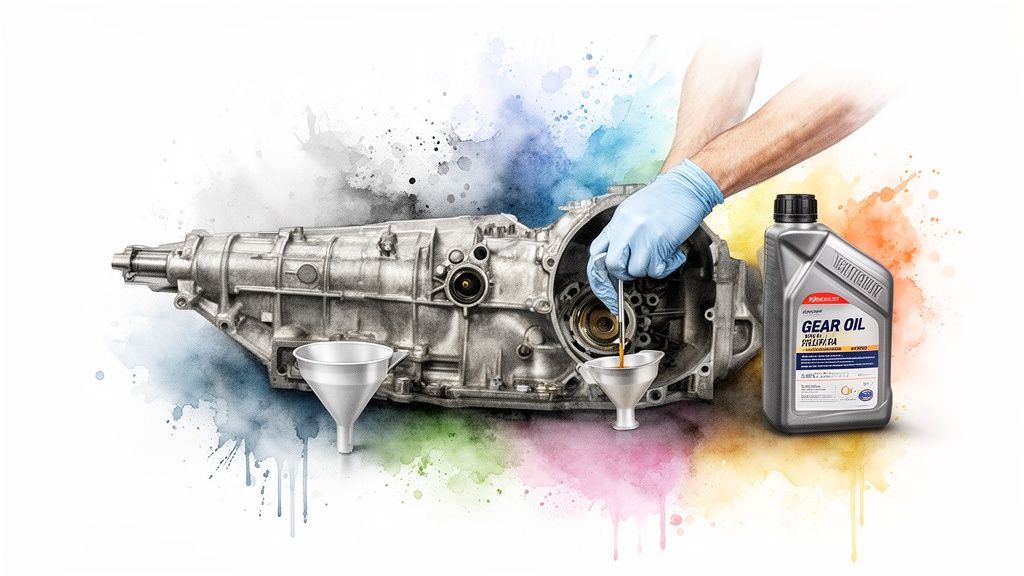
Forget looking for a dipstick under the hood. For a manual transmission, you'll need to get underneath the car. The transmission fluid location is on the side of the transmission case itself, in the form of two plugs.
This is a job that requires proper safety. You absolutely must use jack stands; never, ever trust a car jack alone to hold the vehicle's weight while you're under it.
Once you're safely underneath, scan the side of the transmission housing. You're looking for two prominent bolts or plugs.
- The Fill Plug: This is your target. It's almost always located about halfway up the side of the transmission case.
- The Drain Plug: This one sits at the lowest point of the case. Leave it alone unless you're doing a full fluid change.
Safety First: The car must be on a completely level surface. If it's tilted even slightly, you'll get a false reading and could spill fluid everywhere. It’s also a serious safety hazard. This is crucial for anyone working on their car in their Haltom City garage.
The Old-School Check
Checking the level is surprisingly low-tech. With the car parked and the engine cool, grab a wrench that fits the fill plug and slowly loosen it. Have a rag handy, as a little fluid might trickle out, which is actually a good sign.
Here’s the classic rule of thumb: the gear oil should be level with the bottom of the fill plug hole. The easiest way to check? Just stick your pinky finger into the hole.
If you immediately get a little oil on the tip of your finger, you're golden. If you have to angle your finger down to find the fluid level, it’s low and needs topping off. A zip tie or a bent paperclip also works well for this.
Make sure you use the exact gear oil specified in your owner’s manual. The viscosity matters immensely, and the wrong fluid can cause grinding, difficult shifting, and serious wear. While this is a doable DIY task, a little uncertainty can lead to a big repair bill. If you're not 100% confident, the pros at Express Lube & Car Care in Haltom City are ready to lend a hand. We'll make sure it's done right.
Your Go-To Transmission Experts in Haltom City
So, you've learned the what, where, and why behind checking your transmission fluid. Now you've got a choice to make. Doing it yourself can be a great way to get to know your car, but there's a lot to be said for the peace of mind that comes from having an expert eye take a look.
At Express Lube & Car Care, we've built our reputation on being the trusted transmission service team for our neighbors right here in Haltom City. Our certified technicians have seen it all and know exactly what to look for, ensuring the job is done right every time.
We believe in using only premium fluids and giving you honest, straightforward advice. Whether you just need a quick top-off or a complete transmission flush, we'll tell you what your car actually needs. This kind of professional care is more critical than ever. The U.S. transmission fluid market is projected to grow at a CAGR of 3.8% from 2025 to 2035, driven by the millions of cars on the road in places just like ours. You can see the full transmission fluid market analysis on mordorintelligence.com for more details.
Finding the transmission fluid dipstick is a great first step, but having a professional confirm the fluid's condition is the best way to catch small issues before they become expensive repairs.
We're conveniently located at 6211 Denton Hwy in Haltom City. Swing by and let us take the guesswork out of your transmission maintenance. We're here to help you keep your vehicle running smoothly for years to come.
Common Questions About Transmission Fluid in Haltom City
We get asked about transmission fluid all the time here at the shop. It's one of those maintenance items people know is important, but the details can be a little fuzzy. Let's clear up a few of the most common questions we hear from drivers around Haltom City.
How Often Should I Check My Transmission Fluid?
A great habit to get into is checking your transmission fluid every other oil change. For most drivers, that works out to be around every 6,000 to 10,000 miles. This simple check can catch small problems before they become massive headaches.
Now, if you put your vehicle through its paces—maybe you tow a boat out to Lake Worth on the weekends or deal with the stop-and-go grind on Denton Hwy in Haltom City—it’s smart to check it more frequently. And if you ever feel your gears slipping or spot a reddish puddle in your driveway, don't wait. Get it looked at right away.
Can I Just Top Off Low Transmission Fluid?
You can, but it's usually not a good idea. Think of it this way: your transmission is a sealed system. If the fluid is low, it means there's a leak somewhere.
Adding more fluid is just a temporary band-aid for a bigger problem that needs a real fix. Finding and repairing that leak is the only way to prevent serious, and seriously expensive, transmission damage. Plus, pouring in the wrong type of fluid can be a catastrophic mistake.
A professional diagnosis is always the safest bet. Here in Haltom City, we can pinpoint the leak, fix it properly, and make sure your transmission gets the exact fluid it needs. It's a small step that can save you from a massive repair bill later on.
Is Automatic Transmission Fluid Different From Gear Oil?
Yes, they are worlds apart! Using the wrong one is a surefire way to wreck your transmission, so it's critical to know the difference.
- Automatic Transmission Fluid (ATF): This is a highly engineered hydraulic fluid. It’s thin and packed with specific detergents and friction modifiers designed for the complex valve bodies and clutches in an automatic transmission.
- Gear Oil (Manual Transmission Fluid): This is a much heavier, thicker lubricant. Its main job is to coat and protect the rugged, simple gears in a manual gearbox from extreme pressure.
Our technicians in Haltom City are meticulous about using the precise fluid your manufacturer specifies. It’s a key part of protecting your vehicle’s performance and ensuring it lasts.
When in doubt, let a professional take a look. For an expert inspection and service you can trust, stop by Express Lube and Car Care in Haltom City. You can learn more about our full range of services at https://expresslubehaltom.com.