
When you press the brake pedal in Haltom City, you're counting on a whole system of parts to work together perfectly to bring your car to a safe, smooth stop. A complete brake service isn't just about swapping out one part; it's a comprehensive check-up of that entire system. We're talking about inspecting brake pads, rotors, calipers, and the brake fluid to make sure everything is in top shape for reliable stopping power on local roads like Denton Hwy or I-820.
Your Guide to a Complete Brake Service in Haltom City
So, you've noticed a strange squeal when you're pulling up to a stoplight in Haltom City, or maybe the steering wheel shudders a bit when you brake. These are common signs that have local drivers asking, "what exactly does a brake service include?"
Think of it less like a simple part replacement and more like a detailed safety procedure. Our goal is to bring your car's most important safety feature back to its factory-fresh performance, giving you total peace of mind every time you get behind the wheel in Haltom City and the surrounding Tarrant County area.
A proper brake service is the bedrock of vehicle safety. At a local Haltom City shop like ours, the process always starts with a careful look at all the key players in your braking system—the pads, rotors, calipers, drums, brake fluid, and all the hoses connecting them. For those interested in the nitty-gritty, you can dive deeper into the brake system market and its components through industry research.
What Is Inspected and Serviced?
A professional brake service is a methodical process, not a guessing game. It's a systematic review of several interconnected parts that all have to work in harmony. Our technicians go through each component one by one to find the real source of the problem for our Haltom City customers.
Here’s a breakdown of what any Haltom City driver can expect when they come in:
- Initial Consultation and Test Drive: It all starts with a conversation. We listen to what you're hearing and feeling. That high-pitched squeal or that grinding noise tells us a lot. A quick test drive around Haltom City helps us experience the issue firsthand.
- Thorough Component Inspection: With your car on a lift, we get a good look at everything. This is where we break out the tools to measure the thickness of your brake pads and rotors and scan for any signs of fluid leaks from the brake lines or calipers.
- Clear Recommendations: We believe in showing, not just telling. We'll walk you through what we found, pointing out the worn parts and explaining exactly what needs to be done. You’ll get a clear, easy-to-understand estimate before we even think about picking up a wrench.
Being proactive with your brakes isn't just about safety—it also saves you money in the long run. Catching a small issue early can prevent it from turning into a major, expensive repair. It's a smart investment in your car and, more importantly, your family's safety here in Haltom City.
To make this even clearer, here's a simple table that breaks down the main components of a typical brake service, what we do with them, and why each step is so crucial for Haltom City drivers.
Brake Service at a Glance
| Service Component | What We Do | Why It's Important |
|---|---|---|
| Brake Pads/Shoes | Measure thickness and check for uneven wear. | These create the friction needed to stop your car. Worn pads can't stop you effectively. |
| Rotors/Drums | Inspect for warping, cracks, and measure thickness. | This is the surface the pads press against. A smooth, true surface is vital for smooth braking. |
| Calipers | Check for fluid leaks and ensure pistons move freely. | Calipers squeeze the pads against the rotors. If they're stuck, your brakes can drag or fail. |
| Brake Fluid | Test for moisture/copper content and check the fluid level. | Hydraulic fluid is what transfers the force from your foot to the brakes. Old fluid can boil and fail. |
| Brake Lines/Hoses | Visually inspect for cracks, rust, or leaks. | These carry the fluid to the wheels. A leak means a complete loss of braking power. |
Ultimately, this table gives you a snapshot of how each part plays a critical role. A failure in one area can compromise the entire system, which is why a complete inspection is always the best approach for every Haltom City vehicle we see.
Understanding Your Braking System's Core Parts
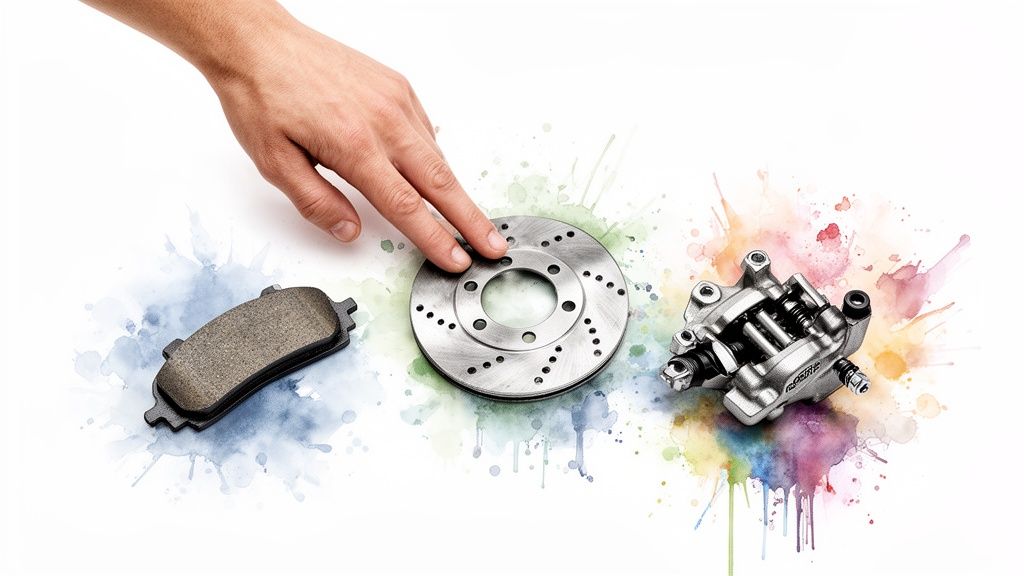
To really get what a brake service is all about, you need to know the main players working together to get your car to stop. It’s actually a lot like the handbrakes on a bicycle, just way more powerful. The core idea is the same: you apply friction to a spinning wheel, and that slows you down.
Every part has a very specific job. When one starts to go, it throws the whole system out of whack and can put your safety at risk. Let's pull back the curtain on the essential components our technicians inspect and service for Haltom City drivers every single day.
Brake Pads: The Friction Creators
Your brake pads are the real workhorses of the braking system. These are the components that physically press against the spinning rotor, creating the friction that stops your car. Just like the little rubber blocks on a bike brake, they're designed to wear down with use—that's their job.
Brake pads come in a few different materials, and each has its own pros and cons. The right choice often comes down to your driving habits, whether you're cruising down Denton Hwy or dealing with constant stop-and-go traffic around Haltom City.
- Organic Pads: These are known for being quiet and are great for typical daily driving, though they can wear out a bit quicker.
- Semi-Metallic Pads: If you want durability and good performance in the heat, these are a solid choice, especially for more spirited driving.
- Ceramic Pads: This is the premium option. They’re incredibly quiet, produce very little of that ugly brake dust, and last a long time.
At Express Lube & Car Care in Haltom City, a thorough pad assessment is step one. We'll help you pick from organic, semi-metallic, or ceramic pads based on what your vehicle actually needs. Many of our customers love the ceramic options, which can last up to 70,000 miles and cut down on brake dust by about 40%.
Rotors: The Spinning Surface
So if the pads create the friction, the brake rotors (or discs) are the surface they press against. These are heavy metal discs bolted to your wheel hub, and they spin right along with your wheels. For your brakes to feel smooth and strong, the surface of these rotors has to be perfectly flat.
Over thousands of miles, all that heat and pressure can cause rotors to warp, get grooves cut into them, or develop hard spots. If you've ever felt a vibration or pulse in your brake pedal, a warped rotor is the most likely culprit. Depending on the condition, we might be able to resurface them to make them smooth again, but if they're too thin or damaged, a full replacement is the only safe option.
A common question we get from Haltom City drivers is whether to resurface or replace rotors. If the rotor's thickness is still well within safety specifications, resurfacing can be a great, cost-effective option. However, safety is always our priority, and we will always recommend replacement for rotors that are too worn or damaged.
Calipers: The Squeezing Power
The last piece of this puzzle is the brake caliper. Let's go back to that bicycle analogy. The caliper is the mechanical "hand" that does the squeezing, clamping the brake pads onto the rotor. When you step on the brake pedal, hydraulic fluid shoots into the caliper, pushing a piston that forces the pads to make contact.
It's critical that calipers can apply and release that pressure flawlessly. A "stuck" caliper is a common problem where it doesn't release properly, causing the pads to constantly drag on the rotor. This leads to rapid wear, overheating, and can really do a number on your fuel economy. You can dive deeper into the different brake setups in our guide on the types of car brakes.
The Hidden Heroes: Brake Fluid and Hardware
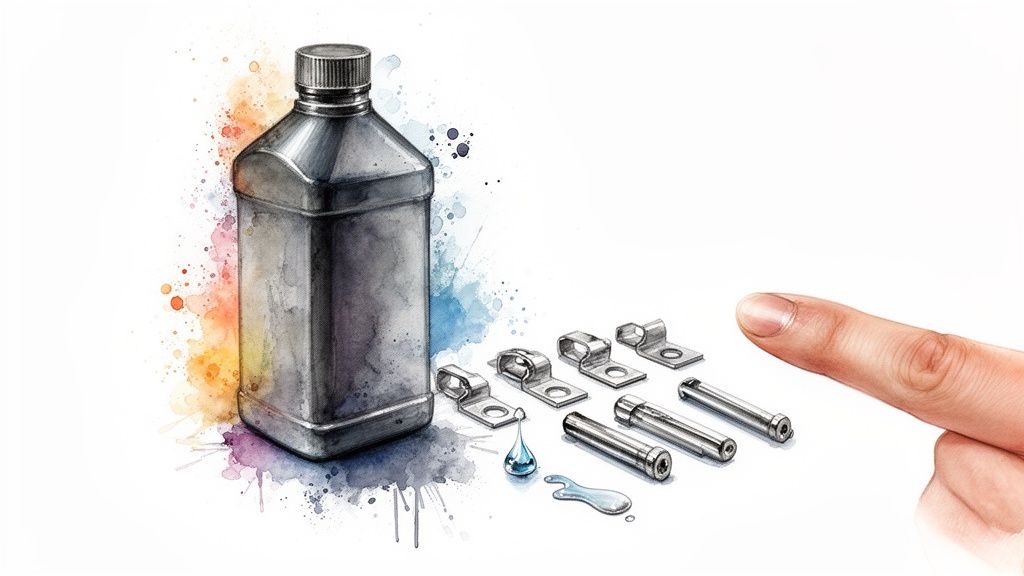
Everyone talks about brake pads and rotors, and for good reason. But a truly great brake job goes deeper. The real unsung heroes of your braking system are the fluid and the small bits of hardware that work behind the scenes. Without them, even brand-new pads and rotors won't do their job right.
That’s why a complete, professional brake service always includes a careful look at these supporting players. For our customers here in Haltom City, we make it clear that skipping over these "hidden heroes" is a non-starter. They're every bit as crucial to your safety as the big parts.
Why Brake Fluid is Your System's Lifeblood
Think of brake fluid as the messenger that carries the command from your foot to the wheels. When you push the brake pedal, you’re not physically squeezing the brakes. You're actually pressurizing this special fluid, which then travels through the brake lines and tells the calipers to clamp down with incredible force.
But brake fluid has a weakness: it loves to absorb water. Over time, it pulls moisture right out of the air, and that’s a big problem. Water lowers the fluid's boiling point, and when the fluid boils from the heat of braking, it creates air bubbles in the lines.
When air gets into your brake lines, you get that dreaded "spongy" or soft pedal feel. Air compresses, but fluid doesn't. That means the force from your foot gets wasted squishing air instead of being fully transferred to the brakes, which can dangerously increase your stopping distance.
A brake fluid flush is a critical maintenance item for any vehicle in Haltom City. We don’t just top off the old stuff. We completely exchange the old, contaminated fluid for fresh, high-quality fluid that meets your vehicle’s exact needs. This single step restores that firm, confident pedal feel and keeps your brakes working at their best.
The Importance of Brake Hardware
Beyond the fluid, you have an entire kit of small but mighty parts known as brake hardware. These are all the little clips, pins, shims, and springs that hold your brake pads in just the right spot. They may not look like much, but they have a massive impact on how your brakes feel and sound.
Worn-out, rusty, or tired hardware can create a real headache for Haltom City drivers. Here’s what we see all the time:
- Noise and Vibration: Old clips and shims lose their springiness, letting the brake pads vibrate. That vibration is exactly what causes most of that annoying squealing and grinding.
- Uneven Pad Wear: If guide pins aren't lubricated or clips are bent out of shape, the pads can't slide freely. They end up wearing down unevenly, which kills the life of your pads and can even score the rotors.
- Poor Performance: Sticking hardware can cause the brakes to drag instead of fully releasing. This absolutely tanks your gas mileage and builds up a ton of excess heat, which is the enemy of good braking.
That’s why with every brake job, we replace all this little hardware. It’s the only way to ensure the new pads move exactly as they should—smoothly and quietly. This kind of attention to detail is what makes the difference between a simple parts swap and a professional, long-lasting brake service.
Recognizing the Warning Signs Your Brakes Need Help
Your car has its own way of talking to you, and when it comes to safety, it pays to listen. Brakes, in particular, give off plenty of signals when they need attention. Catching these early can mean the difference between a quick, affordable fix and a much bigger, more expensive problem down the line. For drivers here in Haltom City, learning these signals makes you the first and best line of defense for your vehicle.
Most brake warnings fall into three camps: what you hear, what you feel, and what you see. Tuning into these clues—some subtle, some not-so-subtle—is the key to staying safe on the road in Haltom City.
What Your Ears Are Telling You
Often, the first sign of brake trouble is a sound you just can’t ignore. These noises are very specific, and they usually point to a particular part that needs a look. Before you reach for the volume knob, listen for these tell-tale sounds.
- High-Pitched Squealing: This is the classic "I need new brakes" sound. It comes from a tiny metal tab built right into your brake pads. Think of it as an audible wear-and-tear alarm, letting you know the pads are getting thin and it's time to get them checked.
- Harsh Grinding or Growling: This sound is much more serious. It means the brake pads are likely worn down completely. You’re hearing metal grinding on metal—specifically, the brake caliper scraping against the rotor. This causes damage fast and needs to be addressed immediately.
What Your Foot and Steering Wheel Feel
Your brakes also communicate physically, sending signals right through the pedal and steering wheel. These feelings give you a direct sense of what's happening with the system's health. You can also check out our detailed breakdown of common brake problem symptoms.
Here are a few feelings you shouldn't ignore:
- Vibrations or Pulsing in the Pedal: If your brake pedal shudders or pulses under your foot, you’re likely dealing with warped brake rotors. When the rotor surface isn't perfectly flat, the brake pads grab unevenly, creating that vibration.
- Spongy or Soft Pedal: Does the pedal feel mushy or sink closer to the floor than it used to? That’s a red flag for an issue in the hydraulic system, like air in the lines or a brake fluid leak.
- Car Pulling to One Side: If your car veers left or right when you hit the brakes, it's often a sign of uneven braking force. This could be caused by a stuck caliper or a bad brake hose on one side.
It's important to remember that modern vehicles are complex. Service today often includes scanning the On-Board Diagnostics (OBD-II) system for electronic brake faults, especially with features like electronic stability control, which studies show can reduce skids by 35%. In Texas, mandated annual safety checks catch about 15% more brake issues early, underscoring the value of regular inspections for Haltom City drivers. To learn more, discover insights about high-performance brake systems on datainsightsmarket.com.
What Your Eyes Can See
Finally, some warnings are impossible to miss because they light up right in front of you. Your car's dashboard is designed to get your attention when a critical system has a problem.
The most direct signal is the brake warning light. This light can pop on for a few reasons, from something as simple as low brake fluid to a more complex problem with the Anti-lock Braking System (ABS). Whatever the cause, a lit brake light is your car's way of saying, "Get me to a mechanic, now."
What to Expect During Your Haltom City Brake Service Appointment
Bringing your car in for brake work can feel a little intimidating, but knowing what’s going to happen ahead of time makes all the difference. We believe you should never be in the dark about your own vehicle, so we’ve laid out our entire process. From the second you pull into our Haltom City shop to when you get back on the road, you'll know exactly what's going on.
Our approach is built to be straightforward, efficient, and incredibly thorough. We combine years of hands-on experience with the right tools to make sure your car's most critical safety system is in top-notch condition. This step-by-step method means no surprises, just a clear path to getting your brakes fixed right in Haltom City.
The Initial Consultation and Inspection
It all starts with a simple chat. We'll listen to you describe what you've been noticing—is it a squeal when you stop, a weird vibration, or a pedal that feels mushy? Your firsthand account gives our technicians a head start on what to look for.
From there, we get your car up on the lift for our comprehensive digital vehicle inspection. This is way more than a quick glance. Our certified technicians get down to the details:
- They'll measure the exact thickness of your brake pads and rotors with precision calipers.
- They’ll inspect the brake calipers to ensure they're moving freely and not leaking.
- They’ll carefully examine the brake lines and hoses for any cracks, rust, or weak spots.
- They’ll also test your brake fluid to check its level and see if it's been contaminated.
Service Recommendation and Repair
Once we have the full picture, we don’t just hand you a bill with a bunch of jargon. We'll sit down with you and walk you through what we found, often using photos from the inspection to show you precisely what’s going on. You’ll get a clear, itemized estimate that plainly explains what needs to be done and why.
After you give us the green light, our technicians get to work. We only use premium, high-quality parts that meet or exceed what your car's manufacturer recommends. This isn't just about fixing the problem; it's about making sure the repair lasts. For a deeper dive into what we offer, take a look at our page on brake pad services.
Transparency is the foundation of trust. We want you to feel completely comfortable with the service you're receiving. That’s why we take the time to answer all your questions, explain the repairs in plain English, and get your explicit consent before any work begins. Your understanding and peace of mind are our top priorities at our Haltom City location.
Quality Check and Final Test Drive
The job isn’t done just because the new parts are on. A senior technician performs a final quality check, making sure every bolt is torqued to the exact specs and all contact points are properly lubricated to prevent any future noises.
The last step is the one that really counts: the post-service test drive. We take your car out for a spin to confirm everything is perfect. We’re looking for a firm pedal, silent operation, and strong, reliable stopping power. Only when we're 100% satisfied do we call you to say your car is ready, getting you back on the roads of Haltom City safely.
This graphic shows the key sensory warnings—what you hear, feel, and see—that tell you it's time for a brake check.
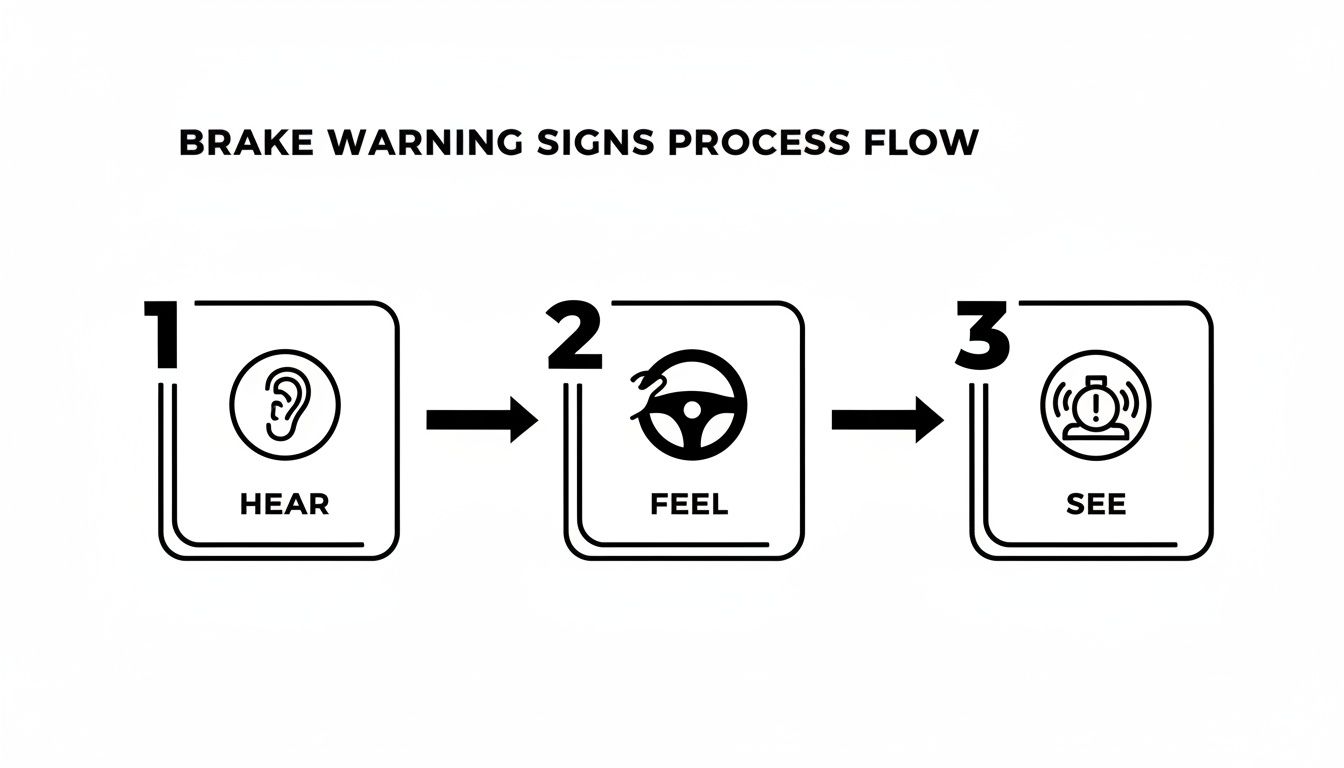
Each icon represents a direct signal from your vehicle. Paying attention to these signs is your first and best line of defense.
Common Brake Service Questions from Haltom City Drivers
When it comes to car care, brakes seem to spark the most questions. Over the years, we've heard just about everything from drivers right here in Haltom City, and we've put together some straight answers to help you feel more in control.
Our goal isn't just to fix your car; it's to give you the clear, honest information you need to make the right calls for your vehicle's safety in and around Haltom City.
How Often Do My Brakes Need to Be Checked?
This is, without a doubt, the question we hear most often in Haltom City. The short answer? A good rule of thumb is to have your brakes professionally inspected at least once a year or every 12,000 miles—whichever comes first. Think of it as an annual check-up to catch problems before they become dangerous.
But that's just a baseline. Your real-world driving habits matter a lot. If you're constantly in stop-and-go traffic on Denton Hwy, regularly tow a boat to the lake, or just have a bit of a lead foot, your brakes are getting a much tougher workout. In those cases, they'll need more frequent attention.
The best strategy is to balance that general guideline with your car's owner's manual. Your vehicle's manufacturer provides the most accurate specs, and our Haltom City technicians always use that information to create a service schedule that truly fits you and your car.
Should I Resurface or Replace My Rotors?
So your rotors are worn. Now what? You've got two main paths: resurfacing them or replacing them outright. The right choice really boils down to the rotor's current condition and, most importantly, its thickness.
Resurfacing: Think of this like sanding a piece of wood. We machine a paper-thin layer off the rotor's surface to make it perfectly smooth again. It’s a fantastic, budget-friendly option for rotors with minor issues like light grooves or slight warping, as long as there's enough metal left to meet safety standards.
Replacement: This is the only safe option if your rotors are too thin to be machined down any further. The same goes for rotors with deep gouges, severe warping (that tell-tale steering wheel shake), or any cracks. A thin rotor can't handle heat, and that can lead to brake failure. Safety comes first, always.
We'll always measure your rotors with a micrometer and show you the exact readings, so you can see for yourself why we're recommending one option over the other here at our Haltom City shop.
Why Did My Brake Warning Light Turn On?
That little red or yellow light on the dash is enough to make anyone's heart skip a beat, especially when it's the one for your brakes. This isn't just a friendly suggestion from your car; it's a direct warning that something in the system needs immediate attention.
So, what could it be? Sometimes it's simple, like low brake fluid, which often points to a leak somewhere. It could also signal a problem with the Anti-lock Braking System (ABS), a drop in hydraulic pressure, or even just that you forgot to fully release the parking brake.
Because the cause can range from a minor fix to a critical failure, the only safe move is to get it diagnosed by a professional in Haltom City. Don't put it off. You can learn more in our detailed guide on what to do when your brake light comes on. Driving with that light on is a risk you never want to take.
When it comes to the safety of you and your family, having a mechanic you can trust makes all the difference. At Express Lube and Car Care, we’re here to give Haltom City drivers expert brake service you can count on. Schedule your appointment today and get back on the road with total peace of mind. https://expresslubehaltom.com