

A typical engine mount replacement runs from around $200 for a single rubber mount on a compact car to $1,500 or more for hydraulic or multi-mount jobs on larger SUVs and minivans, according to RepairPal’s estimator. Parts rarely drive that range. Labor does, since most jobs require supporting or lifting the engine to reach the mount. If you’re hearing clunking or feeling a shudder at idle, don’t panic. Get a proper diagnosis before assuming the worst.
TL;DR:
- Replacing multiple mounts or hydraulic units can significantly increase costs due to more complex access and labor hours needed.
- Labor costs are the primary driver of total expenses, often exceeding the price of parts, especially if engine supports or components need removal.
- Cost estimates vary widely depending on vehicle size, with compact cars typically costing $200–$500 and large SUVs or minivans exceeding $1,500.
- A typical job on a common sedan involves one to three hours of labor, but tight engine bays and seized bolts can extend this time.
- Getting a detailed, written quote that includes parts, labor, and potential extra charges helps prevent surprises and ensures accurate price comparisons.
Table of Contents
- How Much Does Engine Mount Replacement Cost?
- Parts vs. Labor: Where the Money Actually Goes
- What Engine Mount Replacement Costs by Vehicle Type
- What Actually Changes Your Quote
- Symptoms That Mean It’s Time to Act
- Should You Attempt Engine Mount Replacement Yourself?
- Getting an Accurate Quote Without Surprises
- Why Trust This Cost Guide
- How Express Lube & Car Care Handles Engine Mount Diagnosis and Repair
- A Note on Cost vs. Longevity
- Sources
- FAQ
How Much Does Engine Mount Replacement Cost?
Here’s the short version: a single mount job on a common sedan often lands between $200 and $500 once parts and labor are combined. Multiply that when a shop needs to replace more than one mount, or when the vehicle uses hydraulic or active mounts instead of basic rubber and steel units.
Parts alone tend to be the smaller slice of the bill. AutoZone lists basic rubber and steel mounts starting around $10 and running up to about $150, while hydraulic or active mounts commonly start above $50 and can reach the $200 range per mount. Labor is where the real cost of engine mount replacement shows up.
- Basic mount, easy access: often the fastest and cheapest job
- Hydraulic or active mount: higher parts cost, often more labor too
- Multiple mounts replaced at once: cost scales with each additional mount, though labor overlap can offset some of it
Cars notes that lifting the engine and removing components to reach a mount can push total motor mount replacement cost past $1,000 on certain vehicles, even when the part itself costs under $100.
Parts vs. Labor: Where the Money Actually Goes
Parts for a single mount usually fall somewhere between $10 and $250, depending on whether it’s a basic rubber piece or a hydraulic unit, and whether you go OEM or aftermarket. That’s the easy part of the estimate. Labor is where things get complicated, and it’s usually the bigger number on the invoice.
Reaching a mount often means supporting the engine with a jack or hoist, disconnecting brackets, and sometimes removing intake components, wiring harnesses, or exhaust parts just to get a wrench in position. Shops typically bill labor by the hour, and mount jobs commonly run anywhere from one to three hours per mount depending on access. That’s before anything goes wrong.
- Rusted or seized bolts can add significant time, especially on older vehicles in humid or salt-exposed regions
- Removing accessories like the alternator, A/C lines, or exhaust brackets adds labor even though those parts aren’t being replaced
- Reassembly and post-repair checks (torque specs, vibration test at idle) add to the clock
Cars.com’s reporting on labor complexity backs this up: engine lifting and component removal are consistently cited as the main reason motor mount jobs cost more than their parts price suggests.
Pro Tip: Ask the shop for a labor-hours estimate up front, not just a total price. If a quote seems unusually low, it may not include the disassembly work your specific engine layout requires.
What Engine Mount Replacement Costs by Vehicle Type
Vehicle size and engine layout change the math considerably. A compact sedan with a simple, accessible mount setup sits at the low end. A large SUV, minivan, or AWD vehicle with a tight engine bay and multiple mount points sits at the high end, sometimes by a wide margin.
| Vehicle Class | Typical Total Cost Range | Why |
|---|---|---|
| Compact/economy car | $200–$500 | Simple mount design, easier access |
| Midsize sedan/crossover | $200–$500 | More components around the mount |
| Compact SUV | $200–$500 | Tighter engine bay, added labor |
| Large SUV/minivan | $1,500 or more | Multiple mounts, hydraulic units, harder access |
| Pickup truck (larger engine) | $200 to $1,500 or more | Engine weight and size increase labor |
RepairPal’s model-based estimator shows this kind of spread clearly across specific vehicles like the Ford Explorer, Honda CR-V, Toyota Camry, and Chevrolet Silverado. AWD drivetrains and transmission mounts tied into the same job push costs higher still, because there’s more hardware to remove and reinstall correctly.
When you call for a quote, give the shop your exact year, make, model, and engine code. Two versions of the same model can have different mount configurations, and that detail changes the estimate more than people expect.

What Actually Changes Your Quote
Shops build a final number around a few core variables, and knowing them helps you read a quote instead of just reacting to the total.
- Mount type: rubber and steel are cheaper parts than hydraulic or active mounts, which use fluid-filled chambers to dampen vibration
- Number of mounts replaced: most engines use two to four mounts, and shops often recommend replacing them together when one shows heavy wear
- Engine accessibility: transverse engines in tight bays typically take longer than engines with more open access
- Labor rate: hourly rates vary by shop and region, and that alone can shift a quote by hundreds of dollars
- Hidden add-ons: new gaskets, exhaust hardware, replacement bolts, or coolant lines disturbed during the job frequently show up on the final invoice
- OEM vs. aftermarket parts: OEM usually costs more but may carry a stronger fit guarantee from the manufacturer
Replacing engine mounts without fixing an underlying oil leak nearby is a common mistake; following safe steps and ceramic protection helps prevent oil and grime from breaking down rubber mounts prematurely. Oil and grime break down rubber faster, so a fresh mount sitting in the same leak often fails again within a year or two.
Symptoms That Mean It’s Time to Act
A worn engine mount rarely fails without warning. The signs build gradually, then suddenly feel urgent.
- A noticeable vibration or shudder at idle that wasn’t there before
- A clunk or thud when accelerating, shifting into gear, or hitting a bump
- Visible engine movement when you look under the hood while someone revs the engine
- Increased noise or vibration transmitted into the cabin, especially at stoplights
Driving on a badly failed mount risks secondary damage. An engine that shifts too far can stress exhaust connections, pull on hoses, or chafe wiring harnesses, and that turns a mount job into a bigger repair bill. A short trip to a nearby shop is usually fine if the movement is mild, but heavy clunking or visible engine shift on acceleration is a sign to stop driving and arrange a tow instead. Not every worn mount needs immediate replacement, though. Car Talk points out that subtle wear doesn’t always mean imminent failure, which is exactly why a second opinion matters when the diagnosis feels marginal.
Should You Attempt Engine Mount Replacement Yourself?
DIY parts-only costs can look tempting on paper, often landing well under $200 for a basic rubber mount kit. But the labor you’d be doing yourself is exactly where the risk lives, not just the savings.
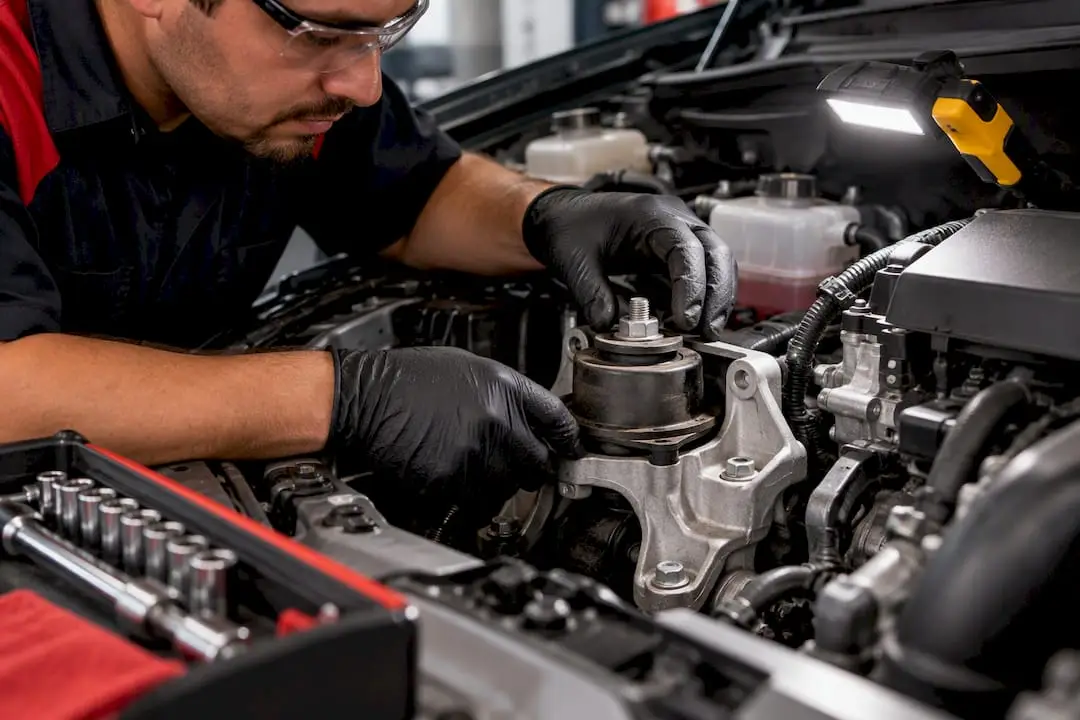
Supporting an engine incorrectly during the swap can cause it to shift, drop, or crush a hose or wiring harness you didn’t account for. Getting mount bolts to the correct torque spec matters too. Under torqued bolts loosen over time, and over torqued ones can crack a mount or bracket.
A professional job should include:
- Proper engine support with a jack or hoist rated for the vehicle’s weight
- Inspection of surrounding hoses, wiring, and exhaust components before and after the swap
- Replacement of any worn mounting hardware, not just the rubber or hydraulic mount itself
- A post-repair check for vibration at idle and under load before the vehicle leaves the shop
Pro Tip: If a shop suggests replacing only one mount while others show similar wear, ask why. Mixing new and old mounts can create uneven stress that shortens the life of the new part.
Getting an Accurate Quote Without Surprises
A little preparation before you call gets you a quote you can actually compare between shops.
- Give the shop your exact year, make, model, and engine code, plus which mount you suspect (front, rear, side, or transmission mount)
- Ask for the parts and labor split separately, not just a bundled total
- Confirm whether the quote uses OEM or aftermarket parts, since that changes both price and fit
- Ask the shop’s hourly labor rate and their estimated hours for your specific vehicle
- Ask about warranty coverage on both the part and the labor, plus whether taxes, shop fees, or towing are included in the number you’re given
Getting these answers up front is the single best way to avoid a bill that’s larger than the estimate you walked in with.
Why Trust This Cost Guide
Express Lube & Car Care’s technicians are ASE-certified and our shop carries RepairPal certification, which means our diagnostic and pricing practices are held to a standard drivers can check independently. Every inspection comes with a digital report and photos, so you see exactly what a technician found before any work begins, not after.
That transparency matters most on a job like engine mount replacement, where labor complexity drives most of the variance in price. If a diagnosis feels uncertain, or a quote surprises you, asking for a second opinion is a reasonable step, not an insult to the shop that gave it.
How Express Lube & Car Care Handles Engine Mount Diagnosis and Repair
Some repair shops offer same-day, no-appointment service for engine concerns like mount wear, vibration, and clunking. That means less time spent worrying and more time getting a real answer.

Bring in your vehicle and we’ll run a full inspection with photo documentation, so you see exactly which mounts are worn and why. You’ll get a clear parts-versus-labor breakdown before any work starts, not a vague number after the fact. Our engine repair and replacement service covers mount diagnosis alongside the surrounding components that often complicate these jobs, like exhaust brackets and coolant lines. If cost is a concern, flexible financing options can help spread out a larger repair.
Ready to get a real number instead of a guess? Schedule your engine inspection at Express Lube & Car Care in Haltom City and find out exactly what your vehicle needs.
A Note on Cost vs. Longevity
Replacing an engine mount is rarely just about the noise going away. Consider your mileage, how long you plan to keep the vehicle, and whether ignoring it risks secondary damage to exhaust or wiring down the line. A transparent quote, and a second opinion when the diagnosis feels marginal, protects both your budget and your engine.
— Express Lube & Car Care
Sources
- Engine Mount Replacement Cost Estimate
- Why Are Motor Mounts So Expensive to Replace?
- Motor Mount Replacement Cost
- Motor Mounts: To Replace or Not to Replace?
FAQ
Is It Worth Fixing Engine Mounts?
Yes, in most cases. A failed mount lets the engine shift under torque, which can stress exhaust connections, hoses, and wiring over time, turning a moderate repair into a larger one if it’s ignored.
Can I Drive With a Bad Engine Mount?
You can drive short distances if the symptoms are mild, like slight vibration at idle. Heavy clunking or visible engine movement on acceleration means you should stop driving and get the vehicle towed or inspected right away.
What Are the Symptoms of Worn Engine Mounts?
The most common signs are vibration at idle, a clunk or thud when accelerating or shifting gears, and visible engine movement under the hood during a rev test. Cabin noise and vibration at stoplights often increase as wear progresses.
How Much Does It Cost to Replace 4 Engine Mounts?
Replacing all four mounts on the same vehicle typically costs more than a single mount job, but shops often gain some labor efficiency by doing them together since the engine is already supported. Total cost depends heavily on vehicle size and mount type, ranging from several hundred dollars on a compact car to well over $1,000 on larger SUVs, based on RepairPal’s model estimates.
How Long Does Engine Mount Replacement Take?
Most single-mount jobs take one to three hours of labor, while multi-mount jobs on vehicles with tight engine bays can take longer. Ask your shop for a specific time estimate based on your exact vehicle.