
Expect to pay in the low thousands for a catalytic converter replacement, with costs varying widely depending on your vehicle, choice of OEM or aftermarket parts, and local labor rates. The RepairPal estimator provides a typical example range around $2,300 to $2,470 for general context. The breakdown below walks through exactly where that money goes.
TL;DR:
- The average cost for catalytic converter replacement ranges from $2,300 to $2,470, but prices can exceed $2,500 for luxury or high-flow converter systems.
- The parts price is largely influenced by precious metal content, with OEM parts being the most expensive, and installation complexity varies based on vehicle type and converter configuration.
- Costs increase significantly for vehicles with multiple converters, older corrosion-prone exhaust systems, or those in regions with strict emissions regulations, such as CARB states.
- Delaying replacement risks engine damage, higher repair bills, emissions test failures, and legal issues if driving without a functioning converter after theft.
- Proper diagnosis with a clear quote that includes parts, labor, taxes, and disposal fees is essential for a fair estimate, with immediate service recommended if symptoms like rattling or odor appear.
Table of Contents
- Catalytic Converter Replacement Cost by Vehicle and Part Type
- Parts vs. Labor: Reading Your Catalytic Converter Repair Cost Estimate
- What Changes Your Cat Converter Cost
- Signs Your Catalytic Converter Needs Replacing
- Repair Alternatives That Can Lower the Cost
- Emissions Rules and Certified Replacement Parts
- How Express Lube & Car Care Handles Catalytic Converter Diagnostics
- What Delaying Replacement Actually Costs You
- A Shop’s Honest Take on Catalytic Converter Quotes
- Book a Catalytic Converter Diagnostic With Express Lube & Car Care
- Sources
- FAQ
Catalytic Converter Replacement Cost by Vehicle and Part Type
The spread in catalytic converter prices comes down to what kind of vehicle you drive and what kind of part goes under it. A compact economy car with a single converter often lands on the lower end, while a midsize SUV or truck with dual converters climbs toward the middle and top of the range. Luxury and performance vehicles, especially those with multiple high-flow converters or complex exhaust routing, can push well past $2,500.
Part type matters just as much as vehicle size:
- Direct-fit converters are engineered for a specific make and model and install with minimal modification, usually costing more than universal units but saving labor time.
- Universal converters are cheaper up front but often need welding or custom fitting, which adds labor hours.
- Remanufactured converters cost less than new OEM units and can be a reasonable middle ground when sourced from a reputable supplier.
- OEM converters carry the highest price tag but guarantee a proper fit and emissions compliance for your exact vehicle.
Shops sometimes quote a wide range up front because they haven’t confirmed which converter configuration your car needs. A mid-range estimate usually assumes a direct-fit or reman part with standard labor, not the cheapest universal option or the priciest OEM part.
Parts vs. Labor: Reading Your Catalytic Converter Repair Cost Estimate
A catalytic converter repair cost estimate typically breaks into four line items, and knowing what each one covers helps you spot a fair quote from an inflated one.
- Parts cost. This is driven largely by the precious metals inside the converter, platinum, palladium, and rhodium, which fluctuate in market price and explain why identical-looking converters can cost very differently. AAA’s repair guidance notes that converter complexity and metal content are the biggest swing factors in parts pricing.
- Labor cost. Straightforward bolt-on replacements might take one to two hours, but converters mounted deep in the exhaust system, or ones welded in place, can push labor time and cost higher.
- Diagnostic and related fees. Expect a diagnostic charge if you haven’t already had the code read, plus potential O2 sensor replacement, a disposal fee for the old converter, and applicable taxes.
Pro Tip: Always ask whether your quote includes taxes and disposal fees. RepairPal’s estimator explicitly separates parts and labor and flags exclusions like these, and a written estimate should do the same.
What Changes Your Cat Converter Cost
Your specific vehicle and situation can push the price up or down from the average.
- Engine size and converter count. V6 and V8 engines often run dual converters, doubling parts cost and adding labor for exhaust access on both sides.
- Rust and seized bolts. Older vehicles, especially those that see winter road salt, often have corroded exhaust hardware that needs cutting or extra shop time to remove safely.
- Emissions region rules. Vehicles registered in CARB-regulated areas typically require CARB-certified replacement converters, which cost more than standard federal parts but keep you compliant.
- Theft replacement. If your converter was stolen, you’re paying for a full replacement rather than a repair, and insurance involvement can extend the timeline.
Pro Tip: If your car sits low or has an aftermarket exhaust, mention it when booking. Converter placement changes access time and can shift your quote by an hour or more of labor.
Signs Your Catalytic Converter Needs Replacing
A failing catalytic converter usually announces itself before it fails completely. Watch for a rattling noise from underneath the car (often loose ceramic honeycomb inside), reduced acceleration or a sluggish feeling under load, a sulfur or rotten-egg smell from the exhaust, and a check engine light with codes like P0420 or P0430, which point to catalyst efficiency below threshold.
Before you authorize replacement, a proper diagnosis should include:
- Reading the stored OBD-II code to confirm which converter bank is affected.
- A visual and physical inspection for rattling, physical damage, or exhaust leaks.
- Backpressure or temperature checks across the converter when the code alone doesn’t confirm the failure.
Ask the shop which code triggered the recommendation, what part number they’re quoting, whether the part carries a warranty, and whether related O2 sensors need replacement at the same time. A shop that can’t answer those questions clearly is worth a second opinion.
Repair Alternatives That Can Lower the Cost
Replacement isn’t always the only option, though it’s the most reliable one for a genuinely damaged converter.
- Cleaning additives can sometimes help with mild clogging from carbon buildup, but they won’t fix a physically broken or melted converter.
- Used or remanufactured converters cost less than new OEM units, though used parts carry more risk since you can’t verify internal wear, and any replacement still needs to meet emissions certification for your region.
- Insurance claims for theft generally require a police report before the insurer will process the claim, so file one immediately and contact your insurer with the case number as soon as possible.
Emissions Rules and Certified Replacement Parts
Federal law treats catalytic converter removal without a proper replacement as tampering, and it’s illegal under the Clean Air Act, though replacing a failed unit with an approved part to restore proper function is allowed.
The EPA’s own guidance states that replacement after-treatment systems need a reasonable basis for not increasing emissions, and that labeling, certification, or emissions testing documentation supports compliance.
- Ask your shop for the CARB Executive Order number or EPA certification label on any replacement part.
- Keep your paperwork and part documentation in case of a future emissions inspection or Texas emissions test.
- Uncertified parts can trigger inspection failures, penalties under the EPA’s tampering policy, or a voided warranty.
How Express Lube & Car Care Handles Catalytic Converter Diagnostics
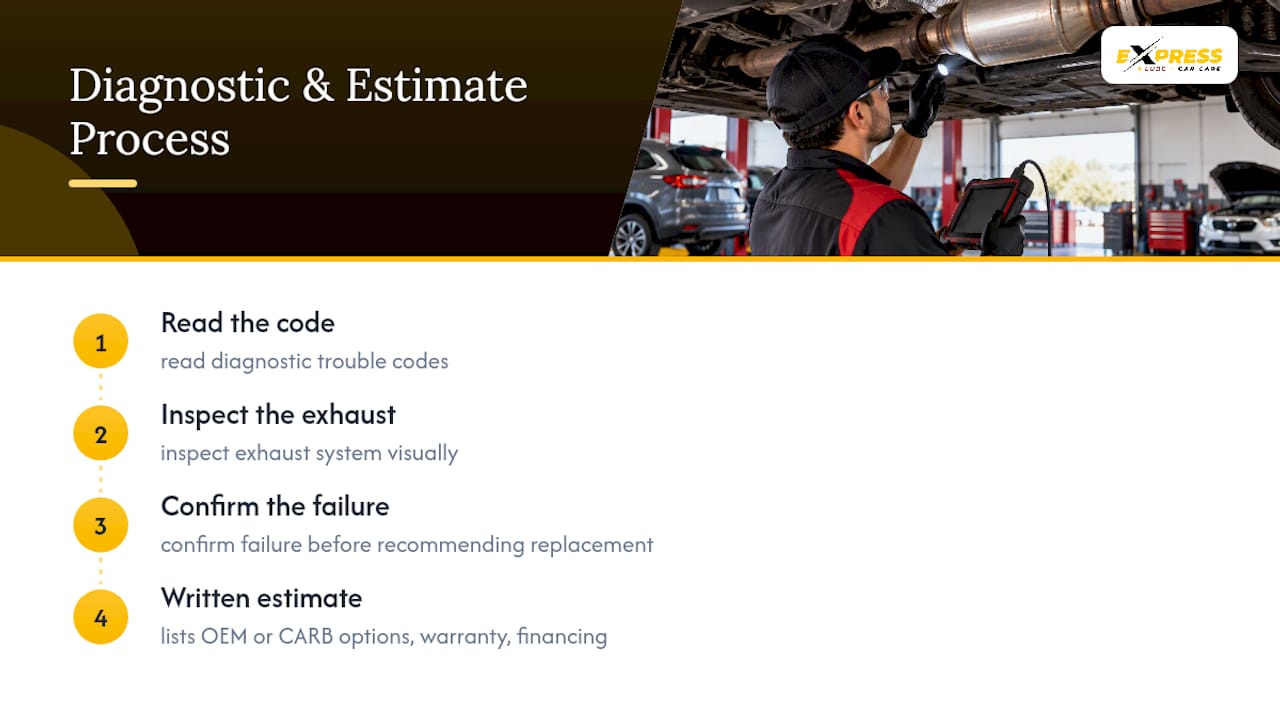
Our ASE-certified technicians and RepairPal certification back every catalytic converter diagnosis with a repeatable process: read the code, inspect the exhaust, and confirm the failure before recommending replacement. You’ll see the findings yourself through a photo-backed digital vehicle inspection, and your written estimate lists OEM or CARB-certified options when your vehicle requires them, along with warranty and financing details.
What Delaying Replacement Actually Costs You
Putting off a catalytic converter repair rarely saves money in the long run, and it often makes the eventual bill bigger. A partially clogged converter forces your engine to work harder against increased exhaust backpressure, which can degrade fuel economy and, over time, stress the engine and exhaust system components around it. What starts as a $1,500 converter job can turn into a converter plus damaged O2 sensors, a stressed exhaust manifold, or even engine performance issues if the clog is severe enough to affect combustion.
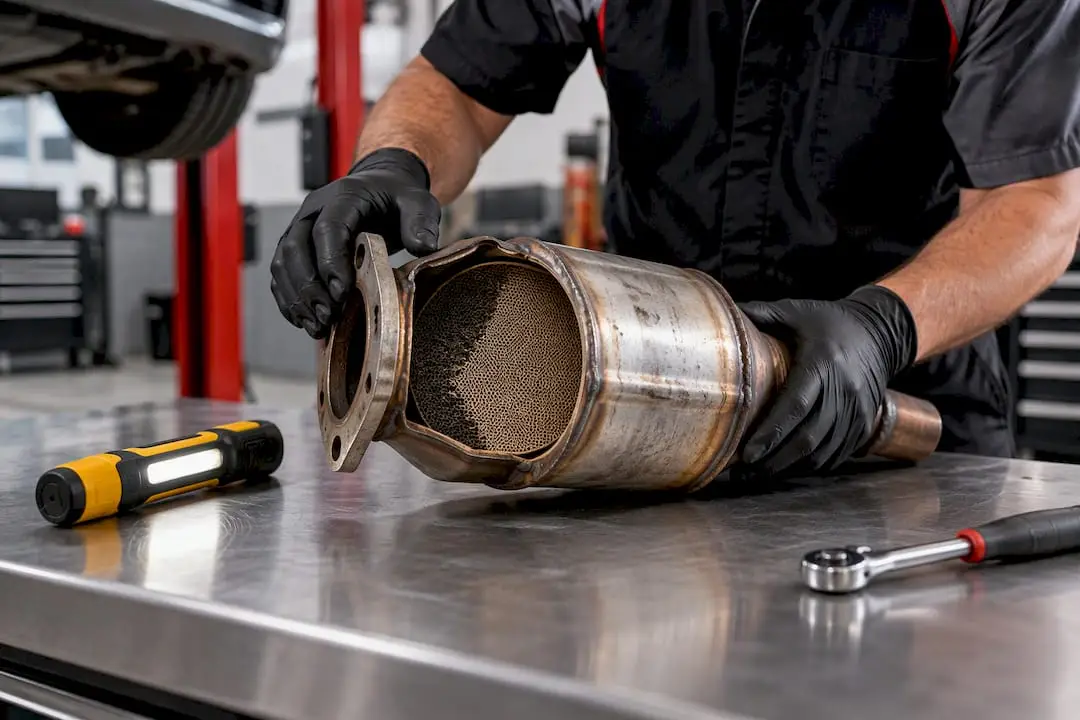
There’s also a compliance angle. Many states require passing emissions inspections to renew vehicle registration, and a check engine light tied to a P0420 code will fail that test. Driving on an expired registration or with a known emissions failure can lead to fines, and in regions with strict enforcement, repeated failures can complicate renewal until the underlying problem is fixed. That’s on top of the inspection fee you’ll pay again once the converter’s replaced and the car needs retesting.
If the original failure traces back to a stolen converter, delay carries a different risk. Thieves often target vehicles that sit for long stretches without repair, and driving without a converter at all is both illegal and loud enough to draw attention you don’t want. Filing your police report and getting the replacement scheduled quickly protects both your wallet and your insurance claim window, since insurers generally expect prompt reporting rather than a delayed one.
The practical takeaway: a rattling noise, a sulfur smell, or a P0420 code are all signals worth addressing within days, not months. The cost of the fix rarely shrinks by waiting, and the list of things it can drag down with it, sensors, fuel economy, registration status, only grows.
A Shop’s Honest Take on Catalytic Converter Quotes
Quotes vary because part source and labor method vary, not because shops are guessing. A second estimate makes sense if something feels rushed; immediate service makes sense once you have the code, the part number, and a written estimate in hand.
— Express Lube & Car Care
Book a Catalytic Converter Diagnostic With Express Lube & Car Care
If you’re hearing that rattle or staring down a check engine light, the fastest way to a real number is a proper diagnostic, not a guess based on online estimator ranges. Express Lube & Car Care runs every catalytic converter case through ASE-certified technicians and backs the diagnosis with a photo-backed digital inspection, so you see exactly what’s failing before you approve anything.
No appointment is required, and most diagnostics turn around the same day, so you’re not stuck waiting on a rental car while your exhaust system sits half-diagnosed. If your converter issue traces back to worn O2 sensors or exhaust damage, our team will walk you through those exhaust and muffler repair options alongside the converter itself, with OEM or CARB-certified parts quoted clearly when your region requires them. Financing is available if the repair timing catches you off guard.
Bring any estimate you’ve already received, and ask the shop to show you the part number and warranty terms in writing. Ready to get a real diagnosis instead of another guess? Schedule your diagnostic with Express Lube & Car Care today.
Sources
These are the primary references used to build the estimates and legal guidance above:
- Catalytic Converter Replacement Cost — RepairPal estimator
- EPA Tampering Policy — Enforcement policy on vehicle and engine tampering
- Catalyticconvertertheft
FAQ
Is It Worth Replacing a Catalytic Converter?
Yes, in almost every case, since driving without a functioning converter is illegal and typically causes a failed emissions test and a check engine light that won’t clear. Replacement also protects your engine from the added strain of a clogged exhaust system.
How Can I Cheaply Fix a Catalytic Converter Without Replacing It?
A fuel-system or catalytic-converter cleaning additive can sometimes help with mild carbon buildup, but it won’t repair a physically broken, melted, or rattling converter. If a code like P0420 persists after cleaning, the converter likely needs full replacement rather than a temporary fix.
What Is the Cheapest Way to Fix a Catalytic Converter?
A remanufactured or direct-fit converter generally costs less than a new OEM unit while still meeting emissions requirements, making it the most budget-friendly legitimate option. Universal converters are cheaper on the part itself, but added welding labor can offset those savings.
What Are Signs of a Bad Catalytic Converter?
Common signs include a rattling noise from underneath the car, a sulfur or rotten-egg smell from the exhaust, sluggish acceleration, and a check engine light with codes like P0420. A diagnostic scan and inspection confirm whether the converter itself is the cause before you approve replacement.
How Much Does Express Lube & Car Care Charge for a Catalytic Converter Diagnostic?
Current diagnostic and repair pricing is available on the Express Lube & Car Care services page, since costs depend on your vehicle and the parts required. A written, code-backed estimate from our ASE-certified technicians gives you an exact number before any work begins.