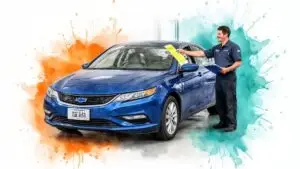

OEM parts are made by, or for, your vehicle’s manufacturer and match what the car had when it left the factory. Aftermarket parts are new replacement parts made by other companies. Neither is automatically better. OEM gives you predictable fit and simpler choices, while aftermarket usually costs less and offers more options, with quality that depends heavily on the brand and the part.
The right answer depends on what is being replaced, how old your vehicle is, who is paying, and how long you plan to keep it. This guide walks through each of those so you can have a clear conversation with whoever is writing your estimate. We wrote it at Express Lube & Car Care, at 6211 Denton Hwy, Haltom City, TX 76148, where drivers from Haltom City, Watauga, North Richland Hills, Fort Worth and Keller bring us everything from oil changes to engine and transmission work.
TL;DR
- OEM parts match the original factory parts. They tend to cost more and are easier to select.
- Aftermarket parts come from third-party makers. They are usually cheaper and widely available, but quality ranges from budget to better than original.
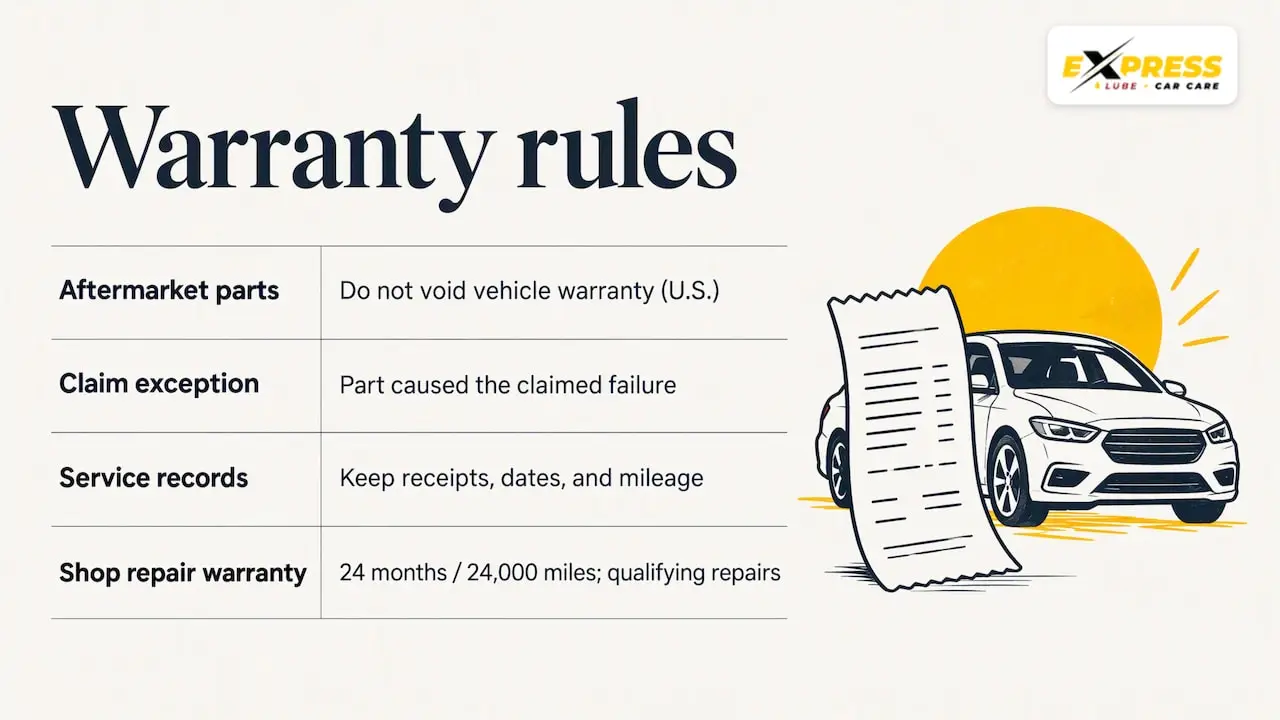
- Using an aftermarket part does not automatically void your new-vehicle warranty under federal law. The part has to be the cause of the failure.
- OEM often makes more sense for collision repairs, vehicles still under warranty, and parts where exact fit matters. Aftermarket often suits older vehicles and tighter budgets.
- Ask your shop what brand and grade is on the estimate, and why it was chosen, before you approve the work.
Table of Contents
- What is the difference between OEM and aftermarket parts?
- Are aftermarket parts as good as OEM parts?
- How do the two compare on price, selection and warranty?
- Will aftermarket parts void my vehicle warranty?
- When does OEM make more sense?
- When can aftermarket parts be a good choice?
- Which parts matter most? A system-by-system look
- Does counterfeit risk apply to both?
- A note on Texas inspections and parts
- Our perspective: ask for the reason behind the part
- Questions to ask before approving a repair
- Get an honest estimate in Haltom City
- FAQ
- Schedule your repair
- Sources
What is the difference between OEM and aftermarket parts?
OEM stands for original equipment manufacturer. According to Edmunds, OEM parts are made by the vehicle’s manufacturer and match the parts the vehicle came with, while aftermarket parts are not sourced from the automaker.
Two details trip people up:
- Aftermarket does not mean used. Progressive notes that aftermarket parts are new replacement parts built by a company other than the vehicle’s original manufacturer, not parts pulled from another car.
- OEM does not always mean the car brand’s name is on the box. A part can be made by a supplier for the automaker. What makes it OEM is that it is the same part the factory used.
A practical example: a brake rotor for a Ford F-150 from a Ford parts counter is OEM. A rotor from a different company, designed to fit that same truck, is aftermarket. Both bolt on. What differs is the metal, the machining tolerances, the coating, and the price.
Are aftermarket parts as good as OEM parts?
Sometimes, yes. Sometimes no. That is the honest answer, and anyone who says aftermarket is always worse, or always equal, is simplifying.
Here is what the evidence shows:
- Edmunds says OEM parts generally give predictable fit and are easier to choose, because they are designed for your specific vehicle, while aftermarket quality varies substantially by brand and part.
- Some aftermarket parts are made by the same suppliers that build OEM parts, and Edmunds reports they may equal or exceed OEM quality.
- J.D. Power points out that aftermarket makers often reverse-engineer OEM parts to find their strengths and weaknesses, which is how some improved designs happen.
- In crash testing, the Insurance Institute for Highway Safety found a 2008 Dodge Ram 1500 with a CAPA-certified aftermarket bumper performed nearly identically to one with the Dodge bumper in 40 mph frontal offset tests, and both earned good ratings. That is one test of one part, not a rule for every part, but it shows certified aftermarket parts can hold up.
The flip side is real too. Budget aftermarket parts can cut corners on materials or fit. A part that needs a little persuasion to line up can add labor time, and labor is where the savings sometimes disappear.
In short: a reputable aftermarket brand can be a smart choice, and a no-name part with a bargain price can be a gamble. The brand and the part type matter more than the label “OEM” or “aftermarket.”
How do the two compare on price, selection and warranty?
| Factor | OEM | Aftermarket |
|---|---|---|
| Price | Usually higher | Usually lower, though not always |
| Selection | One option for your vehicle, easy to pick | Many brands and grades, more to sort through |
| Fit | Designed to match your vehicle | Varies by brand and part |
| Where to buy | Mostly dealerships and authorized retailers | A wider range of sellers |
| Quality | Consistent | Ranges from budget to better than original |
On availability, J.D. Power says OEM parts are mostly found at dealerships or authorized retailers, while aftermarket parts are sold in more places. It also explains that OEM parts cost more partly because they are built for specific makes and models and dealerships add markups.
Edmunds adds that OEM parts usually come with a one-year warranty, and that independent shops increasingly choose aftermarket parts for better availability and lower cost, which helps keep maintenance affordable.
We are not going to quote you a percentage savings, because it changes by part, brand and vehicle. If you want a real number, ask for the estimate with both options priced side by side.

Will aftermarket parts void my vehicle warranty?
In the United States, generally not. Under the Magnuson-Moss Warranty Act, as MotorTrend explains, using aftermarket parts does not void a vehicle’s warranty unless the aftermarket part itself is shown to have caused the failure being claimed. A manufacturer cannot deny a claim just because non-OEM parts were installed elsewhere on the car.
A practical example: if you put an aftermarket battery in your SUV and later the transmission fails under factory warranty, the battery has nothing to do with it. The claim should not be denied for that reason. If the aftermarket battery’s failure damaged the charging system, that is a different conversation.
Keep your service records either way. Receipts that show what was installed, when, and at what mileage make any warranty discussion much easier.
A separate point, and one we want to be clear about: the repair warranty on work done at our shop is its own thing. We offer a 24-month/24,000-mile warranty on qualifying repairs only, not on every service or part, so ask us what applies to your specific job.
When does OEM make more sense?
OEM tends to be the better call in these situations:
- Collision and body repairs. Edmunds recommends OEM where body-panel fit and crumple zones matter. Gaps, alignment and crash performance depend on exact geometry.
- A vehicle still under factory warranty. NerdWallet says OEM may make more sense for a vehicle under warranty, or when compatibility and longer life matter most.
- Complex electronics and sensors. Modern vehicles have modules, sensors and cameras that expect specific signals. A part that is close but not identical can trigger warning lights or odd behavior.
- European vehicles with tight tolerances. Many of them are sensitive to part specification, so we pay close attention to the exact part number.
- Parts you want to install once. If a repair involves a lot of labor, such as a timing belt or clutch, the part cost is small next to the cost of doing the job twice.
When can aftermarket parts be a good choice?
Aftermarket parts are often a sensible fit when:
- The vehicle is older and you want a reliable repair without paying for a premium part you may not keep long enough to benefit from.
- The part is a wear item such as brake pads, wipers, filters, belts or batteries, where several well-known brands have long track records.
- Budget is tight or the repair is urgent. NerdWallet notes aftermarket parts may suit tight budgets or quick repairs.
- Your insurer specifies them. Progressive explains insurers may specify aftermarket parts because they generally cost less and can restore the vehicle to its pre-loss condition. If you want OEM instead, you may have to pay the price difference unless your policy covers OEM parts. Check your policy before a claim, not after.
- You use the vehicle hard. Some performance-oriented aftermarket parts are built to a higher standard than stock. That can matter for towing trucks or delivery vehicles, as long as the part is matched to how you actually drive.
For drivers with a rideshare or delivery vehicle, or a small fleet, cost per mile matters. A quality aftermarket part with a good track record can keep a vehicle on the road at a lower repair bill. Our fleet maintenance and repair service covers this kind of planning.
Which parts matter most? A system-by-system look
The OEM-versus-aftermarket question plays out differently depending on which system is being repaired. Here is how we think through the common ones.
Brakes
Brake pads, rotors and hardware come in many grades. Quality matters because braking in Haltom City means plenty of stop-and-go traffic on Denton Highway and the merge points near I-820 and 377. A bargain pad that fades or squeals is a poor trade. Whether you pick OEM or a reputable aftermarket brand, the pads and rotors should be a matched set and installed correctly. See our brake repair and pad replacement page for what the work involves.
Engine, check engine light and diagnostics
Sensors are the part type where exact specification matters most. An oxygen sensor or mass airflow sensor that reads slightly differently from the original can cause drivability problems or bring the light back on. Before any part is replaced, the problem should be diagnosed. A code points you toward a system, not automatically to a part, which is why we stress check engine light diagnostics before parts get ordered. Replacing a part on a guess is how drivers pay for the wrong thing twice.
Transmission and drivetrain
Fluids, filters, mounts, axles and CV joints are all available in both forms. For internal transmission components, the specification is demanding, and we look closely at what is being installed and why. Our transmission and drivetrain repair page covers the services we offer.
Steering and suspension
Shocks, struts, control arms and tie rod ends have a wide quality spread. Texas roads are tough on suspension, especially on construction-heavy stretches. For trucks and SUVs that tow or haul, heavier-duty aftermarket options may suit the job better than stock. For a daily commuter sedan, OEM-equivalent parts usually feel right.
Battery, alternator and starter
Batteries are a good example of the “it depends on the brand” rule. North Texas summer heat is hard on them, so a quality battery with a solid warranty matters more than the OEM label. With alternators and starters, remanufactured and new units both exist, so ask which one is on the estimate.
Electrical and lighting
Simple items like bulbs and fuses are low risk in either form. Modules, wiring harness repairs and anything tied to the vehicle’s computer calls for more care, and often OEM-matched parts.
Cooling system, A/C and heating
Radiators, water pumps, hoses and thermostats work hard in a Texas summer, and the cooling system has little margin for error when traffic crawls in 100-degree weather. A poorly fitted or low-grade water pump or thermostat is not a place to save a few dollars. The same goes for A/C compressors and condensers. We recommend a proper diagnosis first, because a weak A/C is often a leak or a failed component, not a part that needs wholesale replacement.
Exhaust
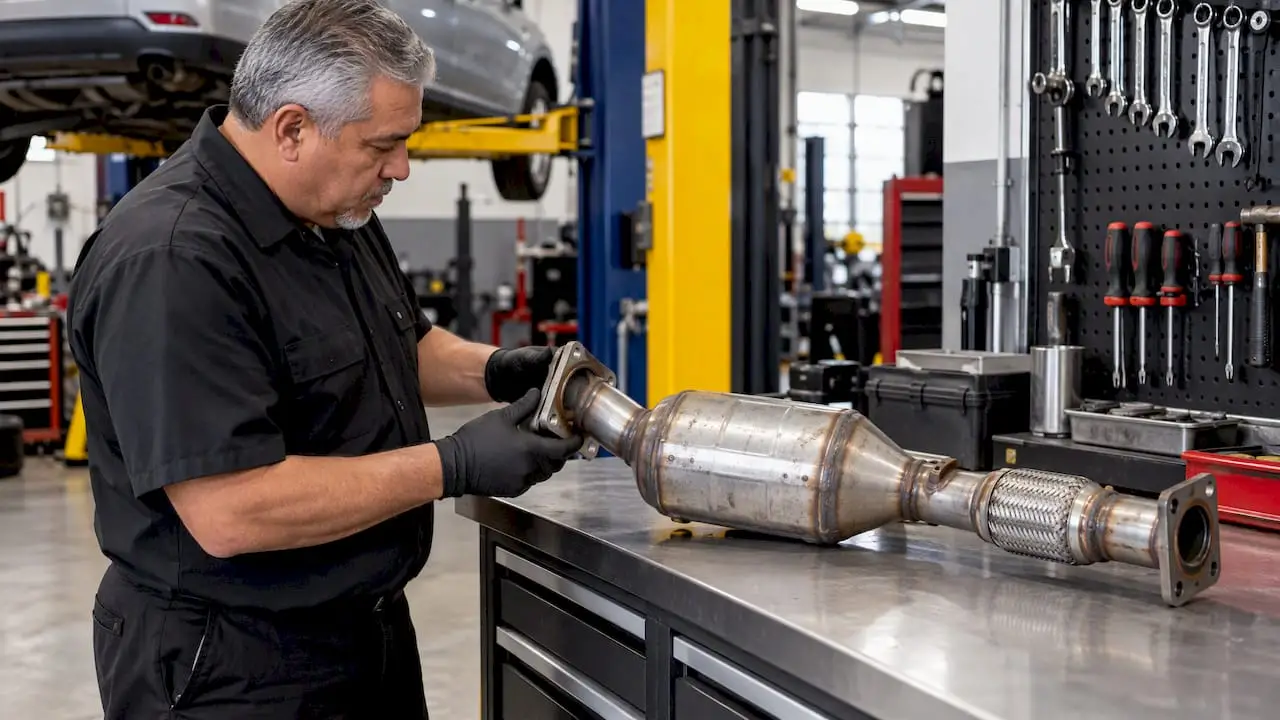
Mufflers, catalytic converters and pipes are heavily aftermarket territory. Fit and material quality vary, and emissions-related parts have their own rules, so confirm the part is legal for your vehicle before buying. If you drive a performance or European model and are curious about sound and tuning differences, this breakdown of OEM versus aftermarket exhaust systems is a helpful starting point.
Does counterfeit risk apply to both?
Yes. Official consumer guidance from the UK government notes that fake parts can turn up in both OEM and aftermarket markets, which is why buying from a reputable source matters. That guidance is from the UK, but the lesson carries over: a price far below everyone else’s, no brand markings, or sloppy packaging are reasons to walk away. Buying through your repair shop’s established suppliers is a simple way to avoid it.
A note on Texas inspections and parts
The rules for Texas inspections changed recently, and they affect parts choices on some vehicles. According to the Texas DMV, House Bill 3297 ended the safety inspection requirement for non-commercial vehicles starting January 1, 2025. The same notice says emissions inspections are still required before registration in 17 counties, and Tarrant County is one of them. Qualifying commercial vehicles remain subject to the applicable safety inspection rules.
If your vehicle is in Tarrant County, emissions-related parts such as catalytic converters, oxygen sensors and evaporative system components should be correct for your vehicle. Our Texas emissions and commercial inspections page has more on what we handle. Because rules can change, confirm current requirements with the state before you register.
Our perspective: ask for the reason behind the part
We do not think the answer is “always OEM” or “always aftermarket.” We think the right answer is the one you understand before you approve it.
Our approach is built around diagnosis first, then a clear recommendation. We perform digital vehicle inspections with photos and technician recommendations, so you can see what the technician saw. When a repair needs a part, you should be able to ask what is on the estimate, why it was chosen, and what the alternatives are. A shop that cannot answer that clearly is a shop to question.
Our ASE-certified technicians work on many makes, and our RepairPal certification reflects how we handle estimates and customer service. For a daily commuter, a reliable mid-grade part and a fair price often wins. For a truck that tows, or a European vehicle with tight tolerances, the specification gets more attention.
If you would like a second look at an estimate you already have, our guide on how to verify auto repair estimates is a good place to start.
— Express Lube & Car Care
Questions to ask before approving a repair
Use this short checklist at any shop, ours included:
- Is the part OEM, OEM-equivalent, or aftermarket, and what is the brand?
- What does the part itself carry for a warranty, and what does the shop’s labor warranty cover?
- What is the price difference between the options, in writing?
- Was the problem diagnosed, or is this a guess?
- Does my insurer or my factory warranty have any requirement I should know about?
If an estimate leaves you feeling pushed, our article on avoiding car repair upsell tactics explains what to watch for.
Get an honest estimate in Haltom City
We handle routine maintenance and complex mechanical repairs, from oil changes and brakes to engine, transmission, electrical, cooling and A/C work. See everything we offer on our services page. You can drive in without an appointment, and a digital inspection with photos shows you what is going on before you decide.
Eligible repairs may qualify for third-party financing through Snap Finance, subject to provider approval and applicable terms. Read more on our auto repair financing page. We do not offer in-house payment plans, and approval is not guaranteed.
FAQ
Is OEM always better than aftermarket?
No. OEM offers consistent quality and predictable fit, but a reputable aftermarket brand can match or beat it on some parts, and sometimes costs less. The weak spot is budget aftermarket parts, where materials and fit can vary. Choose based on the specific part, not the label.
Do aftermarket parts void my car’s warranty?
Not automatically. Under the Magnuson-Moss Warranty Act, a manufacturer generally cannot deny a claim just because aftermarket parts were used. It can deny coverage if the aftermarket part itself caused the failure. Keep your service records so you can show what was installed and when.
Why are OEM parts more expensive?
They are designed for specific makes and models, and dealerships often add markups, according to J.D. Power. Aftermarket parts can fit multiple vehicles and are sold through more channels, which tends to bring prices down. The gap varies by part, so ask for both prices on your estimate.
Should I use OEM parts after an accident?
Often yes for structural and body parts, because fit and crash performance matter. Edmunds recommends OEM for collision repairs where panel fit and crumple zones are a concern. Check your insurance policy first, since insurers may specify aftermarket parts and you may owe the difference if you request OEM.
Can I ask my mechanic which type of part they are using?
Yes, and you should. A good shop will tell you the brand, the grade, and why it recommends it. At our shop, you are welcome to ask before approving any work, or call us at (817) 281-3300.
Schedule your repair
If you have an estimate that mentions OEM or aftermarket parts and want to talk it through, call us at (817) 281-3300 or request an appointment online. We are at 6211 Denton Hwy, Haltom City, TX 76148.
Sources
- Aftermarket Versus Manufacturer Car Parts, Edmunds
- Aftermarket vs Manufacturer Car Parts, J.D. Power
- Aftermarket Parts & Insurance, Progressive
- IIHS-HLDI media release on aftermarket bumpers
- What Does OEM Mean?, MotorTrend
- OEM vs. Aftermarket Parts, NerdWallet
- Consumer guidance on fake parts, GOV.UK
- Texas vehicle inspection changes, Texas DMV