

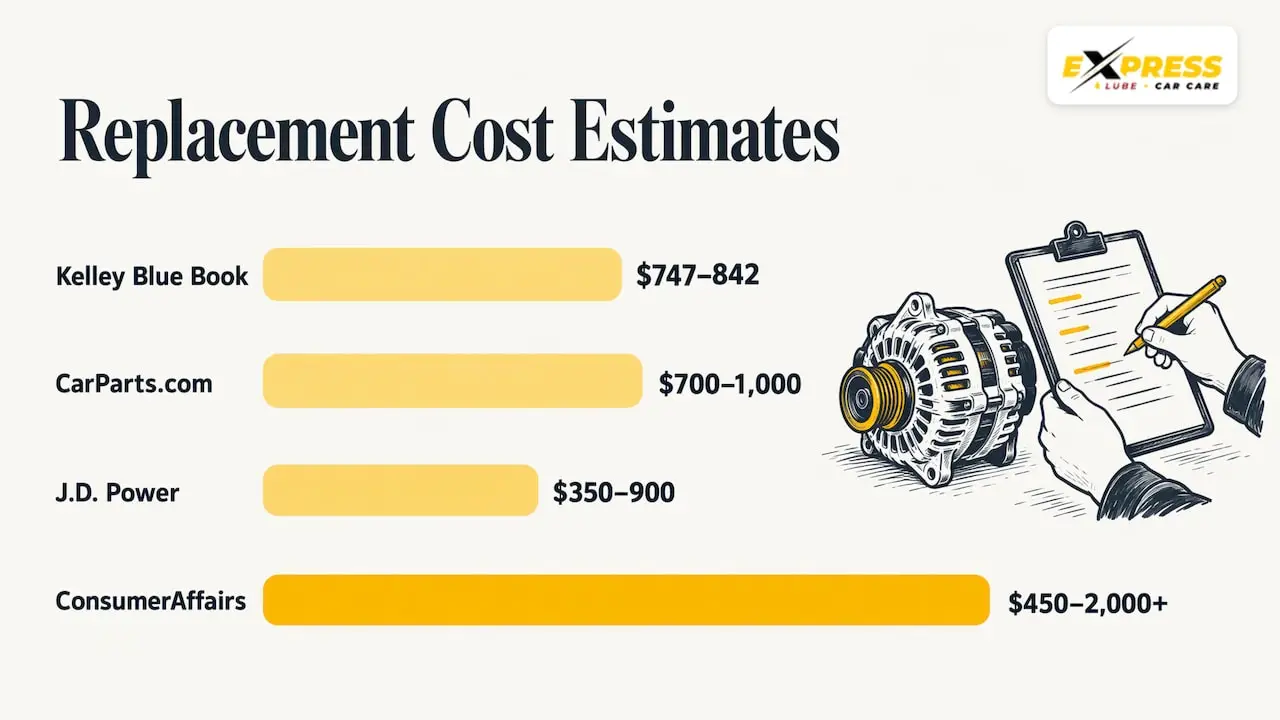
Most drivers pay somewhere between $450 and $1,000 to replace an alternator, and many mainstream cars land near the middle of that range. Kelley Blue Book puts the average at $747 to $842, while CarParts.com reports $700 to $1,000 installed for most mainstream vehicles. Your exact number depends on the part you choose, how buried the alternator is in your engine bay, and the shop’s labor rate. Below, we break down each piece so you can read an estimate with confidence.
TL;DR
- Expect roughly $700 to $1,000 installed on most mainstream cars and trucks. Luxury, high-output, and some start-stop systems can run past $1,500.
- Labor is usually 1 to 2 hours on easy-access engines and more when the alternator sits behind other components.
- The part is the biggest swing: new OEM, new aftermarket, and remanufactured units are priced very differently.
- A failing alternator can leave you stranded within a short drive, so get it diagnosed before it takes the battery down with it.
- Ask for a written estimate that lists parts, labor, and anything else the job touches, such as the belt.
Table of Contents
- How much does alternator replacement cost?
- What makes up the bill: parts and labor
- Why does the cost change from one vehicle to another?
- Add-ons your estimate may include
- Can an alternator be repaired instead of replaced?
- How do you know it’s the alternator?
- Summer heat and stop-and-go driving
- Perspective: why we diagnose before we replace
- Getting an alternator quote in Haltom City
- Is it worth fixing the alternator on an older car?
- FAQ
- Sources
How much does alternator replacement cost?
Here is how the published national figures compare. They differ because each source weights vehicles, parts, and labor rates differently.
| Source | Reported cost to replace an alternator |
|---|---|
| Kelley Blue Book | $747 to $842 average |
| CarParts.com | $700 to $1,000 installed on most mainstream vehicles |
| J.D. Power | $350 to $900 average total |
| ConsumerAffairs | $450 to $2,000 or more, depending on the vehicle |
A gap that wide is normal. A compact sedan with an easy-to-reach alternator sits at the low end. A luxury SUV with a high-output or coded alternator sits at the top. If you want a single planning number for a typical daily driver, think in the high hundreds, then adjust for your vehicle using the factors below.
We don’t publish a fixed price for alternator replacement, because the honest number depends on your vehicle and the part. After a diagnosis, you get a specific quote before any repair work starts.
What makes up the bill: parts and labor
An alternator job has two main pieces. The part is usually the larger share, and labor is more modest.
Parts
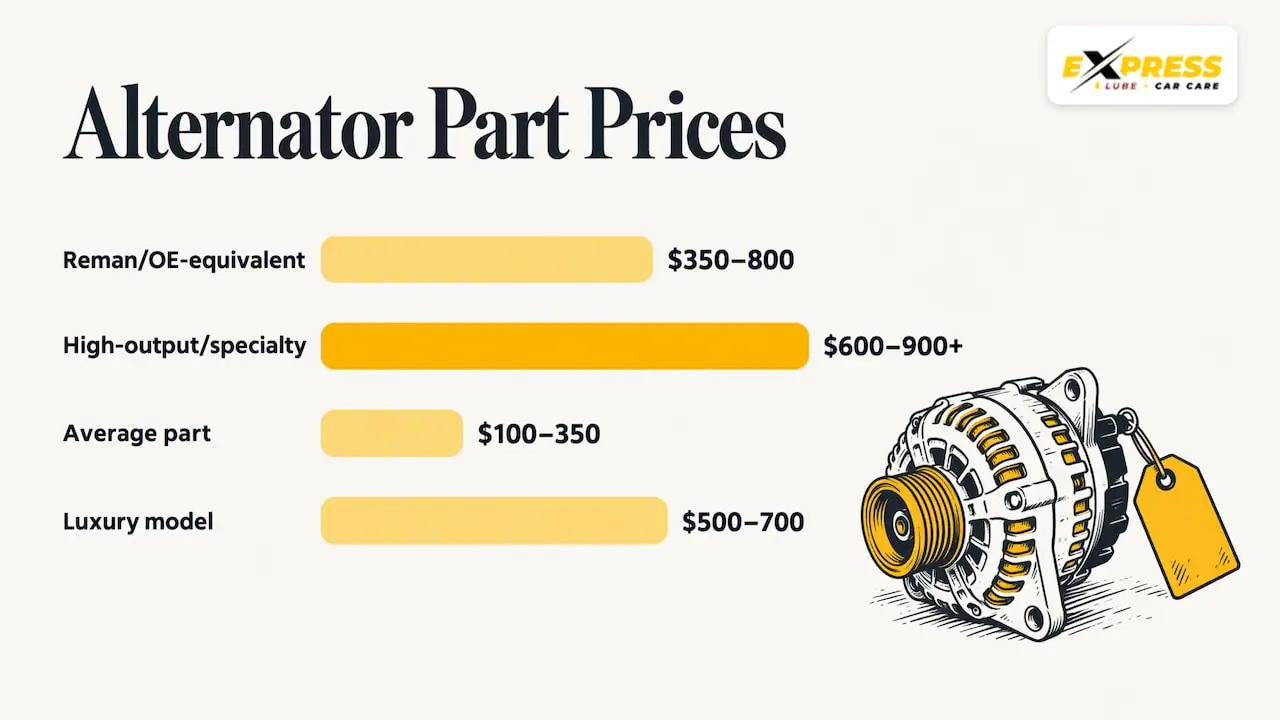
CarParts.com says that for conventional 12-volt systems, quality remanufactured or OE-equivalent units typically price at $350 to $800 before labor on mainstream vehicles. High-output or specialty units often run $600 to $900 or more for the part alone. J.D. Power reports $100 to $350 for the part on average, and $500 to $700 for luxury models.
The three common part types:
- New OEM: Built to the automaker’s specification. Usually the highest price.
- New aftermarket: Made by a third-party manufacturer to fit your vehicle. Usually costs less than OEM.
- Remanufactured: A used alternator, rebuilt with new wear components and tested. Often the best balance of price and reliability for daily drivers.
If you want a deeper look at that choice, our guide on OEM vs aftermarket parts walks through how to decide.
Remanufactured parts deserve a closer look because quality varies. A good rebuild replaces the wear items, such as bearings and brushes, then tests the unit under load. Reading about how remanufactured alternators are rebuilt and tested helps you know what a warranty on a rebuilt part should actually cover.
Many parts also carry a refundable core charge. That means you pay a deposit that comes back when the old alternator is returned, so check how the estimate shows it.
Labor
CarParts.com lists typical labor at $180 to $270 for the job, and ConsumerAffairs quotes a mechanic describing one and a half to two hours of labor at $200 to $300. That lines up with what most shops see: a typical job takes one to two hours.
The time depends on access. On many four-cylinder cars, the alternator sits at the front of the engine and comes out fairly quickly. On some V6 trucks, minivans, and European models, the alternator sits low or behind other components, so the technician has to remove parts to reach it. Same part, more hours.
Why does the cost change from one vehicle to another?
Four things move the price more than anything else.
- Output and design. Stock alternators often span about 60 to 120 amps, and vehicles with heavy electrical loads may need higher-output units of 130 amps or more, priced at a premium. Smart-charging and start-stop systems add cost, and some may need to be programmed to the vehicle after installation.
- Access. Hours of labor follow how many parts sit in the way.
- Part choice. OEM, aftermarket, or remanufactured.
- Brand. European luxury models cost more for parts and for labor. ConsumerAffairs cites a 2024 BMW X3 example in the $2,700 to $3,000 range, which shows how far the top end can climb.
What about trucks and SUVs?
Around Haltom City, a lot of drivers run half-ton pickups and three-row SUVs. Trucks often have larger electrical loads from towing packages, auxiliary lights, and upfitted equipment, and some light-duty diesel setups carry more than one alternator. That can push a quote above a compact car’s, so tell the shop what you’ve added to the vehicle.
Add-ons your estimate may include
A good estimate is honest about what the job touches. Common line items:
- Serpentine belt. CarParts.com notes that replacing the belt while the alternator is off costs roughly $70 to $200 installed. Because the belt is already loose, doing both at once avoids paying for the same labor twice.
- Tensioner or idler pulley. Worth inspecting any time the belt comes off.
- Battery. If repeated deep discharges have damaged it, a new battery may be needed. Our auto electrical and lighting repair service covers battery, alternator, and starter testing.
- Diagnostic time. Confirming the alternator is the real culprit before replacing it.
The Federal Trade Commission advises that you ask how a shop prices its work, and consider a second opinion on expensive or complicated repairs. Both are reasonable for any repair estimate.
Can an alternator be repaired instead of replaced?
Sometimes. CarParts.com says conventional 12-volt units can occasionally be repaired more affordably, but most modern smart or 48-volt systems are replaced rather than rebuilt. Whether repair makes sense depends on the vehicle, the age of the unit, and what actually failed.
A practical example: your battery light comes on and the belt is slipping. After testing, the technician finds the alternator is fine and the belt is worn. You pay for a belt, not an alternator. That’s one reason professional diagnosis comes first.
How do you know it’s the alternator?
Symptoms include dimming headlights, a battery warning light, flickering dash lights, a whining or grinding noise from the engine bay, and a car that starts after a jump but won’t stay running. A weak battery can mimic some of these, and a bad connection or belt can too, which is why we test the charging system before recommending parts. Our guide to telling if your alternator is bad lists the signs in detail.
If you’re deciding whether to keep driving, treat it seriously. A failed alternator means the car runs off the battery alone. One shop guide describes about 20 to 30 minutes in the best case, and modern vehicles with more electronics may stall sooner. If you notice the warning light, turn off nonessential loads like the stereo and A/C, and head straight to a shop or safe stop rather than running errands. Stalling in the middle lane of Denton Highway at rush hour is a situation worth avoiding.

Summer heat and stop-and-go driving
North Texas summers put real demands on a charging system. The A/C runs hard, the blower is on high, and in stop-and-go traffic the engine idles at lower speeds, when an alternator produces less output. Add headlights, a phone charger, and a heavy-duty audio system, and a weak alternator gets exposed. Heat is also hard on batteries, so a battery that struggles in August may actually be pointing at a charging problem. We see that pairing often enough that we test both together.
Perspective: why we diagnose before we replace
We see drivers come in sure that they need an alternator because the battery light came on or the car wouldn’t start. Sometimes they’re right. Sometimes the battery is the problem, or a corroded cable, or a worn belt.
That’s why we test the battery, the charging output, and the belt before recommending anything. A replacement based on a guess can cost you twice: once for the wrong part, and again when the real problem shows up.
Our technicians are ASE-certified, and we use digital vehicle inspections with photos, so you can see what we see and what we recommend. We would rather explain the repair clearly and give you a straight quote than rush you into a part you may not need.
Eligible repairs may qualify for a 24-month/24,000-mile warranty, and we’ll tell you up front whether your repair qualifies.
Express Lube & Car Care
Getting an alternator quote in Haltom City
We’re at 6211 Denton Hwy, Haltom City, TX 76148, and we serve drivers from Haltom City, Watauga, North Richland Hills, Fort Worth, and Keller. You don’t need an appointment for most service, so if your battery light is on or your car is struggling to start, you can come in and we’ll start with a diagnosis. Our auto electrical and lighting repair service covers charging-system testing and replacement, and our full list of services shows what else we handle if the problem turns out to be somewhere else.
Here is how to get the most accurate quote from any shop:
- Give your year, make, model, and engine size.
- Describe the symptoms and when they started.
- Ask for a written estimate with parts, labor, and any extras listed separately.
- Ask which part type is quoted and what warranty comes with it.
- Ask to be contacted before the work goes beyond the quoted amount.
After a diagnosis, your quote reflects your exact vehicle. Eligible repairs may qualify for third-party financing through Snap Finance, subject to provider approval and applicable terms. You can read the details on our auto repair financing page. Our 24-month/24,000-mile warranty applies only to qualifying repairs, and we’ll confirm whether yours qualifies when we write the estimate.

Visit the Express Lube & Car Care website to see our services, or call us at (817) 281-3300.
Is it worth fixing the alternator on an older car?
Usually, yes, if the rest of the car is sound. The alternator is one of the less expensive major repairs, and without it the car doesn’t run. If the car has other expensive problems on the horizon, ask the technician to list everything the inspection found, ranked by urgency, so you can plan. Photo-based inspection reports make this easier because you can see each item.
Compare that with other repairs we cover. If you’ve also been quoted for a starter, the two often go hand in hand on older batteries and charging systems, and handling them in the same visit can save duplicate diagnostic effort.
FAQ
How much is alternator labor?
Most jobs take one to two hours, and national sources report labor in the range of about $180 to $300 on typical vehicles. Alternators that are buried behind other parts take longer and cost more. Your written estimate should show labor on its own line.
Is fixing an alternator a big job?
On many cars it’s a moderate job, usually one to two hours at a shop, but it depends on access. Some engines need other parts removed first. It also involves the belt and electrical connections, so most drivers leave it to a technician.
Can I drive with a bad alternator?
Only for a short distance. The car runs on battery power alone, which can drain in a matter of minutes, and the engine may stall. Turn off nonessential electrical loads and get to a shop or safe place right away.
Are Texas vehicle inspections affecting my alternator repair?
Not directly. Since January 1, 2025, non-commercial vehicles no longer need a state safety inspection. Vehicles registered in emissions counties, which includes Tarrant County, still need emissions testing, and qualifying commercial vehicles remain subject to applicable safety inspection rules. A warning light on the dash can matter at emissions time, so it’s worth having it checked.
Sources
- Kelley Blue Book: Alternator Replacement Costs
- CarParts.com: How Much Does It Cost to Replace an Alternator?
- J.D. Power: How Much Does It Cost To Replace An Alternator?
- ConsumerAffairs: Cost of an alternator replacement
- FTC Consumer Advice: Auto Repair Basics
- Texas DPS: Vehicle Safety Inspection Program Changes
- Old Ox Tire: How Long Can You Drive With a Bad Alternator?
- Rebuild Masters: Remanufactured Alternators
When you’re ready, schedule your alternator diagnosis online or call (817) 281-3300, and we’ll test your charging system and give you a clear written quote.