
That glowing check engine light on your dashboard can be a real headache. Often, the culprit is a small but mighty part called an oxygen sensor. For drivers in Haltom City, understanding the downstream oxygen sensor location is key, as we're specifically looking for the one that sits after the catalytic converter. Think of it as the final quality-control inspector for your exhaust system.
Its position is key—this allows it to keep a close eye on how well your catalytic converter is cleaning up the exhaust, a crucial function for passing state inspections here in Texas.
What This Sensor Actually Does for Your Car

It helps to think of your exhaust system as a two-act play. In Act One, the engine burns fuel, and the upstream O2 sensor fine-tunes the air-fuel mixture for peak performance. In Act Two, those hot exhaust gases rush through the catalytic converter, which scrubs out the worst of the pollutants.
The downstream oxygen sensor, also called Sensor 2, is the critic watching Act Two. Its entire job is to measure the amount of oxygen left in the exhaust after the catalytic converter has done its work. This feedback tells your car’s computer whether the converter is actually succeeding at its job.
Why This Sensor Matters for Haltom City Drivers
Here in Haltom City, a healthy downstream sensor is non-negotiable for passing state emissions tests and keeping your fuel economy in check on roads like I-820 and Denton Highway. If this little sensor goes bad, your car's computer has no way of knowing if the converter is pulling its weight. This confusion almost always triggers that dreaded check engine light.
Speaking of which, a faulty O2 sensor is one of the most common reasons you'll see that light. It's often the root cause of a P0420 trouble code, which signals that your catalytic converter isn't as efficient as it should be. In fact, failing oxygen sensors are behind roughly 25% of all check engine light alerts, a common issue we see in repair shops across Haltom City. You can dive deeper into what causes an engine light to come on in our other guide.
Upstream vs. Downstream O2 Sensors Explained
To find the downstream oxygen sensor, you first need to understand its relationship with its counterpart, the upstream sensor. Think of them as a two-part quality control team for your car's exhaust system. They work together, but each has a very specific job that's critical for your engine's performance and keeping emissions in check here in Haltom City.
The upstream oxygen sensor, which you'll also see referred to as Sensor 1, is the first one in line. It’s located in the exhaust manifold or header pipe, before the catalytic converter, where it gets a direct sample of the raw, untreated exhaust gases fresh from the engine.
This sensor is all about real-time feedback. It constantly samples the exhaust to check the air-fuel ratio, sending lightning-fast signals to your car’s computer. Based on this information, the computer makes tiny adjustments to the fuel injectors to keep the mixture just right. A healthy upstream sensor's voltage reading will jump up and down rapidly as it works.
The Downstream Sensor’s Critical Role
Now, for the downstream oxygen sensor, also known as Sensor 2. This sensor is the final inspector, and you’ll always find it positioned after the catalytic converter. Its purpose isn't to adjust the fuel mixture but to act as a watchdog, making sure the catalytic converter is actually doing its job.
It confirms whether the converter is successfully cleaning up harmful pollutants. A good downstream sensor should show a relatively slow, steady voltage reading. This stability proves the catalytic converter is working efficiently. If its readings start bouncing around wildly like the upstream sensor's, that’s a big red flag, often pointing to a failing catalytic converter. If you're dealing with tricky symptoms, knowing how to diagnose common vehicle problems can be a huge help for any Haltom City driver.
Key Takeaway: The upstream sensor (Sensor 1) fine-tunes the engine's air-fuel ratio, while the downstream sensor (Sensor 2) confirms the catalytic converter's performance. Their different readings tell a complete story about your vehicle's health.
To make it even clearer, here’s a quick breakdown of what makes each sensor unique.
Upstream (Sensor 1) vs. Downstream (Sensor 2) O2 Sensors
This table provides a quick comparison of the key functions and characteristics of the two primary oxygen sensors in your vehicle's exhaust system.
| Characteristic | Upstream Oxygen Sensor (Sensor 1) | Downstream Oxygen Sensor (Sensor 2) |
|---|---|---|
| Location | Before the catalytic converter | After the catalytic converter |
| Primary Job | Measures air-fuel ratio from the engine | Monitors catalytic converter efficiency |
| Signal to ECU | Tells the computer to adjust fuel trim | Confirms the converter is working |
| Voltage Reading | Fluctuates rapidly (0.1V – 0.9V) | Stays relatively stable (around 0.45V) |
| Common DTCs | P0130-P0135, P0150-P0155 | P0136-P0141, P0156-P0161, P0420 |
Seeing them side-by-side really highlights their different but equally important roles. One is a micromanager for the engine, and the other is a pass/fail inspector for the emissions system. Both are essential for a smooth-running, environmentally-friendly vehicle in Haltom City and beyond.
Finding the Downstream Oxygen Sensor on Your Car
Alright, let's get under the car. Finding the right downstream oxygen sensor is actually pretty easy once you know what you’re looking for. The key is to follow the exhaust pipe, and your main landmark is the catalytic converter.
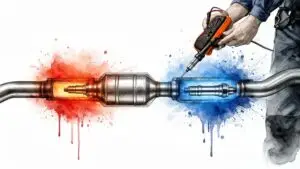
First, make sure your vehicle is safely lifted and secured. Start at the engine and trace the exhaust pipe as it runs toward the back of the car. Somewhere along that pipe, you'll find a larger, somewhat bulky box or canister—that's the catalytic converter. The downstream O2 sensor is the small, spark-plug-like part screwed into the pipe just after the converter, closer to the muffler.
Think of it this way: the upstream sensor is the manager, the converter is the worker, and the downstream sensor is the quality control inspector checking the final product.

This diagram shows exactly where the downstream sensor sits in the system—it's the last checkpoint before the exhaust heads out the tailpipe, giving it the perfect vantage point to monitor the catalytic converter's performance.
Understanding Banks and Sensor Numbers
Now, if you're driving something with a V6 or V8 engine, things get a little more involved. These engines are split into two halves, or "banks," and each bank has its own exhaust manifold and catalytic converter. That means you've got more than just two O2 sensors to deal with.
Here’s how mechanics and diagnostic tools in Haltom City label them:
- Bank 1 is always the side of the engine with cylinder #1. If you're not sure which side that is, a quick peek at your owner's manual will tell you.
- Bank 2 is simply the other side of the engine.
- Sensor 1 always refers to the upstream sensor (the one before the catalytic converter).
- Sensor 2 always refers to the downstream sensor (the one after the catalytic converter).
So, if your code reader throws a "Bank 1, Sensor 2" error, you know you're looking for the downstream sensor on the same side as cylinder #1. This system keeps things organized and points you to the exact part that needs attention. It’s the same kind of logic used for finding other components, like when you need to check your transmission fluid location and what to check.
Pro Tip: If you have a standard inline-4 cylinder engine, life is simpler. You only have one bank. In this case, the downstream sensor is just called "Sensor 2," making it a breeze to identify on most common cars in the Haltom City area.
How to Identify the Correct Sensor
So you’ve crawled under your car, followed the exhaust pipe, and found the catalytic converter. Now you’re staring at two very similar-looking sensors, and you need to figure out which one is the downstream sensor you’re after. Getting this right is everything, and thankfully, there are a few visual clues to help you out.

First, take a good look at the wiring. Automakers often use different wire colors and connector shapes for upstream versus downstream sensors. It's a simple, practical way they help prevent technicians (and you!) from plugging the wrong one in.
The length of the wire harness is another dead giveaway. Because the downstream sensor sits further away from the engine, its wiring has to be longer than the upstream sensor’s. This is often the quickest and easiest way to tell them apart at a glance.
Confirming with Markings and Connectors
For an extra layer of certainty, get a little closer and look for markings on the sensor's body. Most will have a part number and sometimes the manufacturer's name stamped right on them. You can easily plug this number into an online parts search or check it against your vehicle’s service manual to confirm you've got the right one.
The electrical connector is your final checkpoint. These plugs are usually keyed, meaning they have a unique shape that only allows them to fit into the correct socket. It's a simple but effective design to make a mix-up nearly impossible.
Important Tip: Before you even head to the store, snap a clear picture of the old sensor, paying special attention to the part number and the connector. This little step can save you the headache of buying the wrong part and making a second trip.
Paying attention to these details is what makes the difference between a smooth DIY job and a day full of frustration. For drivers around Haltom City, knowing what to look for builds the confidence to get the job done right.
Common Symptoms of a Failing Downstream Sensor
Long before that dreaded check engine light flicks on, a bad downstream oxygen sensor usually gives you a few hints that something's wrong. If you're driving around Haltom City, knowing what to look for will keep your car running smoothly and save you from bigger repair bills.
The first thing you'll probably notice is at the gas pump. Is your fuel economy slowly getting worse? A faulty downstream sensor can throw off the delicate balance of your engine's performance, forcing you to fill up more often. It's a subtle sign, but your wallet will definitely feel it over time.
Telltale Signs to Watch For
Another dead giveaway is failing your local emissions test in Haltom City. The downstream sensor's whole purpose is to make sure your catalytic converter is doing its job cleaning up the exhaust. If that sensor is on the fritz, your car has no way of confirming it's running clean, which often means an instant fail.
You might also catch a whiff of rotten eggs or sulfur coming from your exhaust. This isn't just an unpleasant smell—it's a serious warning sign.
Key Insight: That foul odor is a classic symptom of a failing catalytic converter. Because the downstream sensor is the only thing monitoring the converter, a bad sensor can let the converter's health degrade in secret until the smell is too strong to ignore.
Keep an eye (and nose) out for these common red flags:
- Check Engine Light: This is the most obvious sign, often with codes like P0136 or the infamous P0420 ("Catalyst System Efficiency Below Threshold").
- Worsening Gas Mileage: Those extra trips to the gas station start adding up.
- Failed Emissions Test: A clear signal that the emissions monitoring system has a blind spot.
- Rotten Egg Smell: This points to unburned fuel hitting a struggling catalytic converter.
Across the U.S., diagnostic codes related to downstream sensor problems, like P0135 through P0420, are behind a surprising 18% of all emissions-related repairs. A certified mechanic in Haltom City will plug in an OBD scanner to watch the sensor's voltage in real-time. A lazy or flat signal is a surefire sign that the sensor is the culprit. You can dig deeper into the data with this automotive oxygen sensor market report. Spotting the problem early is the best way to keep your car healthy and performing its best.
When to Get Professional Help in Haltom City
Knowing where to find the downstream oxygen sensor is a fantastic first step, but the real key is getting the diagnosis right. The sensor's job is to report information, and sometimes, it's just the messenger telling you about a bigger problem.
This is where turning to a professional mechanic in Haltom City can save you a lot of time and frustration.
A great example is the infamous P0420 trouble code. It often points the finger at the catalytic converter's efficiency, not necessarily the sensor itself. If you replace the sensor without confirming the root cause, you'll likely see that check engine light pop right back on—a classic case of treating the symptom instead of the disease.
Why Expert Diagnosis Matters in Haltom City
A seasoned Haltom City technician does more than just pull a trouble code from your car's computer. They plug in advanced scan tools to look at the live data stream coming directly from the sensor.
They're watching its voltage patterns in real-time. Is it switching like it should? Is it stuck high or low? This detailed analysis reveals whether the sensor has failed or if it’s accurately reporting a problem somewhere else, like a failing catalytic converter or an exhaust leak. That’s a level of insight your average code reader just can't offer.
For tricky issues or if you'd rather leave it to the experts, the best move is to consult with the pros at local Haltom City auto repair shops and dealerships.
For drivers here in Haltom City, this means getting a fix you can trust. You’ll know your vehicle is running safely, efficiently, and cleanly. Instead of playing a guessing game with parts, you get peace of mind knowing the right problem was fixed.
If you think your car has an O2 sensor issue and want a definitive answer, you can schedule a diagnostic appointment and have our certified team take a look.
Your O2 Sensor Questions, Answered
Working on cars can definitely stir up a lot of questions. For our customers here in Haltom City, getting the straight scoop on parts like oxygen sensors helps them make smarter choices for their vehicles. Here are some of the most common questions we get at the shop, along with some clear, no-nonsense answers.
How Much Will a New Downstream Oxygen Sensor Cost Me in Haltom City?
This really depends on your car’s make and model, but we can give you a solid ballpark for the Haltom City area. The sensor itself usually runs between $50 and $150.
When you bring it to a shop like ours for a professional replacement, the total cost—including the diagnosis, labor, and clearing the check engine light—typically lands somewhere between $150 and $300. Paying a pro ensures the right downstream oxygen sensor location is serviced and the job is done correctly from the start.
Can I Just Keep Driving with a Bad Downstream Oxygen Sensor?
Technically, your car will still run, but it’s a really bad idea, especially in Haltom City. When the downstream sensor fails, your car's computer has no way to confirm the catalytic converter is actually doing its job. This will absolutely cause you to fail a Texas state emissions test.
Worse yet, it can hide a brewing catalytic converter failure, which is a much, much more expensive problem to fix. You’ll also notice your gas mileage slowly getting worse over time.
Think of a bad downstream sensor as a broken smoke detector for your emissions system. You won't know there’s a major fire (a failing catalytic converter) until it's too late, potentially turning a simple sensor replacement into a four-figure repair bill.
Will Replacing the Downstream Sensor Get Rid of a P0420 Code?
Maybe, but it's far from a sure thing. The P0420 code ("Catalyst System Efficiency Below Threshold") is the classic sign of a failing catalytic converter.
While a faulty sensor can sometimes trigger this code, it's critical to get a real diagnosis from a Haltom City mechanic first. A good technician can look at the live data coming from the sensor to see if it's the one that's malfunctioning or if it's just accurately reporting that the converter has a problem. This simple step can save you from spending money on a part you didn't need.
For a professional diagnosis and reliable O2 sensor service in Haltom City, trust the certified technicians at Express Lube and Car Care. We use advanced tools to pinpoint the exact issue and get you back on the road safely. Visit us at https://www.expresslubehaltom.com to learn more or schedule your appointment.