
When you’re facing another sweltering Haltom City summer, the last thing you want is to be stranded on the side of I-820 with steam pouring from under your hood. At Express Lube, we’ve seen it happen countless times. This is why getting your coolant mixture right isn't just a suggestion—it's one of the most important things you can do for your engine. It's not about the rare Texas freeze; it’s about preventing a catastrophic boil-over when the pavement on Haltom Road is hot enough to cook on.
More Than Just "Antifreeze": Why The Mix Matters in Haltom City
A proper antifreeze and water mix acts as your engine's year-round thermal regulator. Getting this blend right is your primary defense against preventable, and often expensive, engine damage. It's the key to keeping your car reliable on our demanding Haltom City roads.
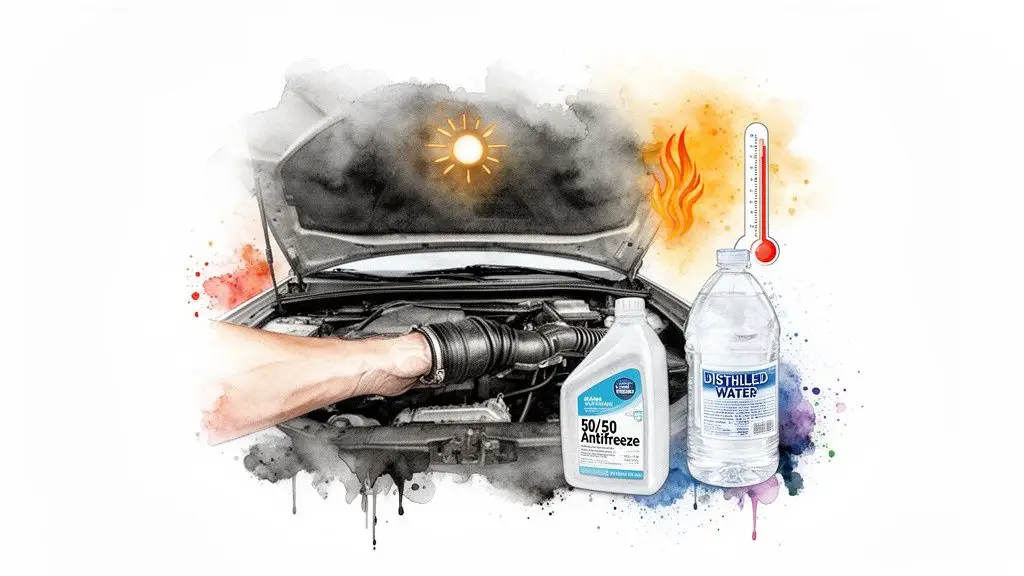
One of the biggest mistakes we see from local drivers is topping off their radiator with just water. Water boils at 212°F, a temperature your engine can easily blow past during a Texas heatwave. Once it boils, it’s not cooling anything, and you risk seriously warping or cracking expensive engine parts—a repair no Haltom City resident wants.
Getting The Ratio Right
So, what's the secret sauce? For most vehicles in Haltom City, the magic number is a 50/50 mixture of antifreeze and distilled water. This simple-sounding combination completely transforms the fluid's behavior, giving your engine what it needs to survive.
A proper 50/50 mix does three critical jobs:
- Raises the boiling point well above what plain water can handle, preventing your engine from overheating on the hottest Haltom City days.
- Lowers the freezing point to protect the engine block from cracking during an unexpected cold snap.
- Introduces crucial corrosion inhibitors that safeguard the radiator, water pump, and other metal components from rust and scale.
Believe it or not, an improper coolant mix is linked to over 40% of all cooling system failures we see at our Haltom City shop each year. Those failures aren't cheap, often resulting in repairs that average $1,200—an expense that is completely avoidable with a few minutes of preventative maintenance.
The importance of antifreeze is no secret. The global market for it is expected to grow significantly, driven by the critical role it plays in protecting modern engines. If you want to get a better feel for the system at the heart of all this, take a look at our guide explaining how car radiators work. Understanding how it all fits together makes it clear why that coolant mix is so vital for keeping your car happy on the road. For more details, you can find information on this trend in the full research about the antifreeze market.
Selecting The Right Antifreeze And Water For Your Car
Before you even think about mixing anything, let's get the ingredients right. One of the most common—and costly—mistakes we see from Haltom City drivers is people grabbing the first jug of coolant they find. Not all antifreeze is created equal, and using the wrong one can cause serious damage to your engine.
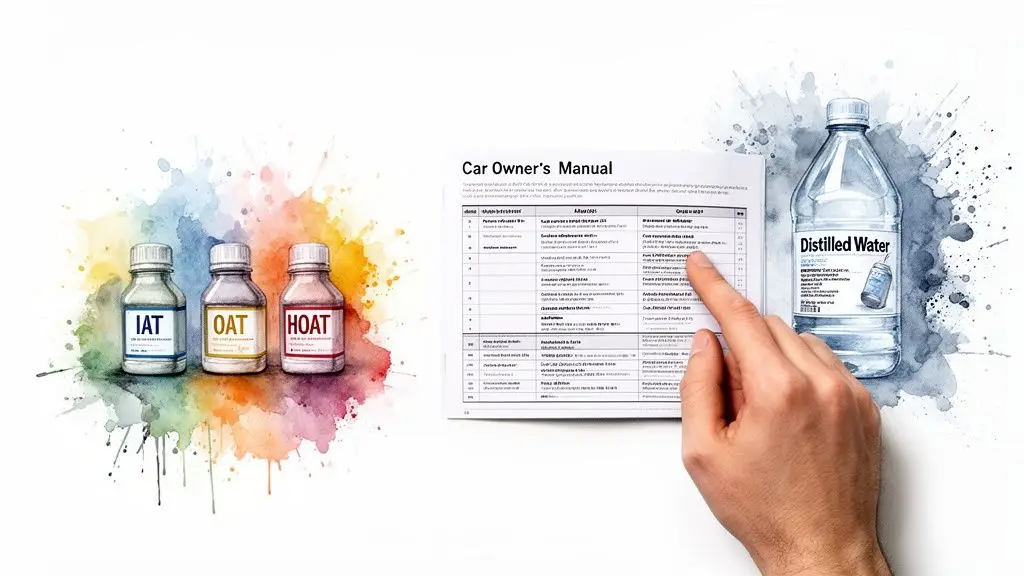
Your best friend in this process is your vehicle’s owner's manual. Seriously, don't skip this step. It will tell you the exact antifreeze chemistry your car needs, which will likely be IAT, OAT, or HOAT. These aren't just fancy acronyms; they represent different technologies for preventing corrosion, and they absolutely cannot be mixed. If you mix them, you risk creating a thick sludge that will clog your radiator and cooling passages.
The Water You Use Matters More Than You Think
Now, let's talk about the water. It’s just as crucial as the antifreeze itself. It might be tempting to just use your garden hose and fill a jug with tap water, but that's a shortcut you really can't afford, especially for drivers here in Haltom City.
Why? Tap water is full of minerals like calcium and magnesium. Over time, these minerals build up inside your engine’s cooling system, creating scale deposits.
Think of this mineral buildup like plaque in an artery. It chokes off the flow of coolant, forcing your engine to work harder and run hotter. Eventually, this leads to overheating, corrosion, and expensive repairs that were completely avoidable for our Haltom City customers.
The solution is incredibly simple: always use distilled water. It's been purified to remove all those pesky minerals, giving you a clean, effective mix that protects your engine from the inside out.
Tap Water Vs Distilled Water For Your Coolant Mix
To really drive the point home, let's break down the long-term impact of using tap water versus distilled water for your antifreeze mix. This table clearly shows why making the smarter choice for your engine is a no-brainer for any Haltom City driver.
| Feature | Tap Water | Distilled Water |
|---|---|---|
| Mineral Content | High (calcium, magnesium, etc.) | None |
| Scale Buildup | High risk of deposits clogging passages | No risk of mineral deposits |
| Corrosion Risk | Increased risk due to mineral reactions | Minimizes corrosion, protects metals |
| Heat Transfer | Becomes less efficient over time | Maintains optimal efficiency |
| Long-Term Cost | Can lead to expensive repairs | Protects your investment, saves money |
The bottom line is that distilled water ensures your coolant does its job without introducing any harmful side effects. It’s a small detail that makes a huge difference in your vehicle’s health and longevity.
Most coolants used across the globe are ethylene-based, and they must be diluted with demineralized water to prevent that scale buildup, which can cut coolant flow by as much as 40%. In a hot climate like ours in Haltom City—where we see temperatures soar past 95°F for over 60 days a year—a proper 50/50 mix is your best defense against overheating, a problem that affects a staggering one in five vehicles annually. For a deeper dive into these statistics, you can check out the full global antifreeze and coolant market report.
Taking the time to choose the right components is the foundation of a coolant service that will actually protect your engine for years to come.
How to Mix and Add Your Coolant the Right Way
Alright, you've got your bottle of concentrated antifreeze and some pure distilled water. Let's get them mixed and into your car. But before we even think about touching the hood, we need to talk about safety.
The single most important rule is to always work on a completely cool engine. I can't stress this enough. A hot cooling system is pressurized, and if you open that cap, it can spray scalding-hot fluid everywhere. We're talking serious burns. Just let the car sit for a few hours until the engine is cold to the touch.
Once you're sure it's cool, grab a pair of safety glasses and some gloves. Antifreeze is nasty stuff—it's toxic and you really don't want it splashing in your eyes or soaking into your skin.
Creating the Perfect 50/50 Blend
The biggest mistake we see Haltom City drivers make is trying to eyeball the mixture by pouring antifreeze and water directly into the reservoir. That’s a recipe for an unbalanced system. To get the job done right, you need a separate, clean container.
Here’s how to mix a perfect batch for your car here in Haltom City:
- Nail the Ratio: Use a measuring cup to pour equal amounts of your concentrated antifreeze and distilled water into the container. If your car’s cooling system holds about a gallon, for example, you’d simply mix half a gallon of antifreeze with half a gallon of distilled water.
- Stir It Up: Give the solution a good, gentle stir until it's completely blended. This step is crucial for making sure you have consistent protection across the entire engine.
Don't ever rush the mixing. An uneven blend can cause big problems. You might get "hot spots" where there's too much water and not enough boil-over protection, or "cold spots" where pure antifreeze isn't transferring heat properly. A solid 50/50 mix is the only way to get dependable, year-round performance in Haltom City.
With your coolant properly mixed, it's time to get it into the vehicle. Pop the hood and find the coolant reservoir. It’s that translucent plastic tank, usually near the radiator, with "Min" and "Max" or "Full" lines marked on the side.
Adding the Coolant Without the Mess
Go ahead and remove the reservoir cap—again, only on a cold engine! Now, grab a funnel and stick it in the opening. Using a funnel will save you from making a mess. Spilled antifreeze is a serious hazard for pets and wildlife in our Haltom City neighborhoods, so it’s best to avoid spills altogether.
Slowly pour your new coolant mixture through the funnel, keeping a close eye on the level markings. You want to stop right when the fluid reaches the 'Full' or 'Max' line. Don't be tempted to top it off any further; the fluid needs room to expand as your engine warms up.
Once you’re at the 'Max' line, pull the funnel out and screw the reservoir cap back on securely. You're all set! This straightforward process ensures your engine has the protection it needs. If you have any doubts about whether your new antifreeze can be mixed with what's already in your system, it's worth taking a moment to learn more about mixing coolants in our detailed guide—it could save you from a very expensive mistake.
Don't Guess—Test Your Coolant Mix for True Peace of Mind
You've carefully mixed your antifreeze and water, aiming for that perfect 50/50 ratio. But how do you know for sure that you've nailed it? When it comes to protecting your engine from Haltom City's extreme temperatures, "close enough" isn't good enough.
This is where a simple, affordable tool comes in handy: the coolant tester, also known as a hydrometer. It takes all the guesswork out of the equation.
Using one is a breeze. Just dip the tester into your coolant mix, draw up a small sample, and read the gauge. It will tell you the precise freezing and boiling points of your mixture, confirming your engine is protected whether you're facing a Texas heatwave or a surprise winter freeze.
This image breaks down the core process of getting your mix right.
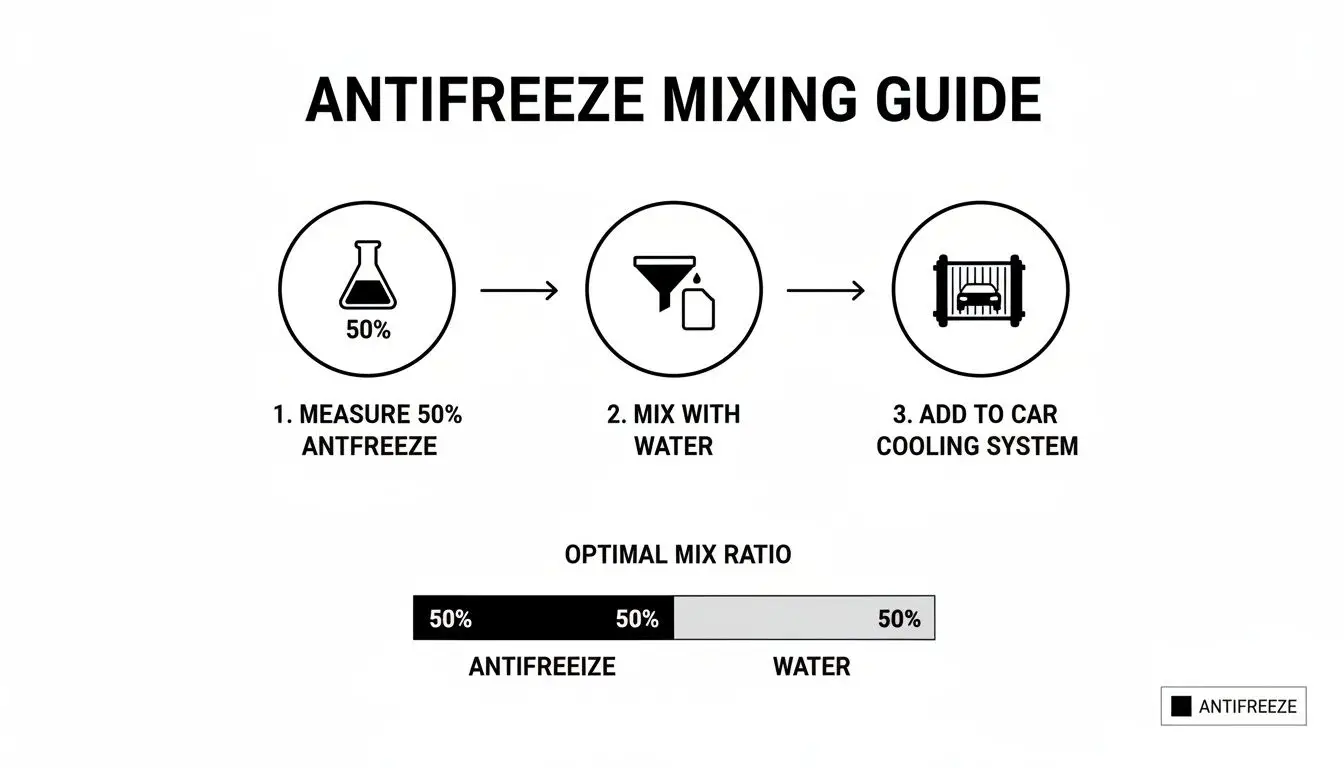
The key is to be precise. Measure your ratio, blend it well in a separate container, and then add it to your car’s reservoir.
Adjusting the Mix: Getting the Ratio Right
While a 50/50 blend is the gold standard for our climate here in Haltom City, different environments sometimes call for a different approach. For instance, folks in brutally cold climates might use a 60/40 mix (60% antifreeze to 40% water) to get freeze protection down to a staggering -62°F.
This table gives you a quick look at how different ratios affect protection levels.
Antifreeze To Water Ratio Protection Levels
| Antifreeze/Water Ratio | Freezing Point Protection | Boil-Over Protection |
|---|---|---|
| 50/50 | -34°F (-37°C) | 265°F (129°C) |
| 60/40 | -62°F (-52°C) | 270°F (132°C) |
| 70/30 | -84°F (-64°C) | 276°F (136°C) |
As you can see, more antifreeze provides better freeze protection. But there's a catch.
A higher concentration of antifreeze actually makes the coolant less effective at transferring heat. For drivers in Haltom City, moving away from the 50/50 mix could make your car more likely to overheat during our hot summers. It's best to stick with the balanced ratio for optimal year-round performance.
If you test your coolant and find the concentration is off, or if you keep having to top it off, you might be dealing with a bigger problem. Our guide on how to find a coolant leak can walk you through the steps to diagnose the issue before it turns into a costly repair.
When It's Time to Call in the Pros in Haltom City
Knowing how to top off your antifreeze is a great skill for any Haltom City car owner. But just as important is knowing when a simple top-off isn't enough and it's time to let a professional take over. Sometimes, your cooling system needs more than just a little extra fluid—it needs a complete reset.
Look for a few tell-tale signs. Is your coolant dark, sludgy, or rusty-colored? Do you see little bits of debris floating around in the reservoir? Those are clear warnings that the additives in your antifreeze have broken down, leaving your engine vulnerable to corrosion and damage.
Other dead giveaways include your engine running hot more often than it should or simply blowing past the service interval recommended in your owner's manual. These aren't issues you want to ignore.
What Makes a Professional Flush Different?
You might be wondering why you can't just drain the radiator yourself. The reality is, a simple "drain and fill" in your driveway leaves a surprising amount of old, contaminated coolant behind in the engine block, heater core, and hoses.
At our Haltom City shop, we perform a full system flush. We hook up specialized equipment that pushes out all of the old, worn-out fluid. It’s a process that ensures every last drop of the bad stuff is gone before we refill it with a fresh, perfectly mixed solution.
For busy professionals and fleet managers in Haltom City, a proper 50/50 antifreeze and water mix is critical. It helps prevent a share of the $500 million lost annually in the U.S. to overheating-related tows. Our certified techs use advanced diagnostics to verify your mix, offering fast flushes that can cut repair bills by 35% through preventive care, keeping your vehicle reliable on Texas highways.
We also handle the safe and responsible disposal of the old coolant, which is toxic and can't just be poured down the drain. If you've noticed puddles under your car, our guide on what to do if your antifreeze is leaking offers some extra pointers.
When you want the peace of mind that comes with knowing the job was done right, our team in Haltom City is here to help keep your vehicle running cool and reliably.
Common Questions About Mixing Antifreeze And Water
Over the years at our Haltom City shop, we’ve heard just about every question there is about coolant. Getting the antifreeze mix with water just right can seem complicated, but it's usually simpler than you think. Let's tackle a couple of the big ones we hear all the time from our Haltom City customers.
Can I Just Add Pure Antifreeze Without Water?
This is a common misconception, but the answer is a firm no. It seems logical that 100% antifreeze would offer 100% protection, but it's actually the opposite. Pure antifreeze has a higher freezing point and is much less efficient at transferring heat than a proper 50/50 blend.
Think of water as the key that unlocks the antifreeze's protective properties. Without it, your engine is more vulnerable to both freezing solid in the winter and boiling over in the summer. You always have to mix it.
What Happens If I Mix Different Colors Of Antifreeze?
Speaking of mistakes, mixing different coolant colors is something you want to avoid at all costs. Different colors often mean different chemistries (like OAT and HOAT), and they do not play well together.
When these incompatible formulas combine, they can react and create a thick, gunky sludge. This gel clogs up your radiator and the small passages in your cooling system, which is a fast track to serious engine overheating. Your best bet is to always use the specific type your owner's manual recommends.
A good rule of thumb is to check your coolant level twice a year—once before the Haltom City summer heat arrives and again before winter. If you're constantly topping it off, you probably have a leak that needs a professional look.
As for a full system flush, you should stick to your vehicle's service schedule, which is typically every 30,000 to 50,000 miles. We can easily take care of that for you during your next visit.
When you need professional radiator service or a complete coolant flush, you can trust the certified technicians at Express Lube and Car Care. We're conveniently located in Haltom City and will make sure your vehicle gets the perfect mix for total protection. Schedule your visit today.