
So, you’ve just flushed your coolant or replaced a part like the radiator or a hose. You’re not done yet. The next, and arguably most crucial, step is bleeding the cooling system. This just means you’re getting all the trapped air out so only pure coolant can flow through your engine.
Why Bleeding Your Cooling System Matters in Haltom City
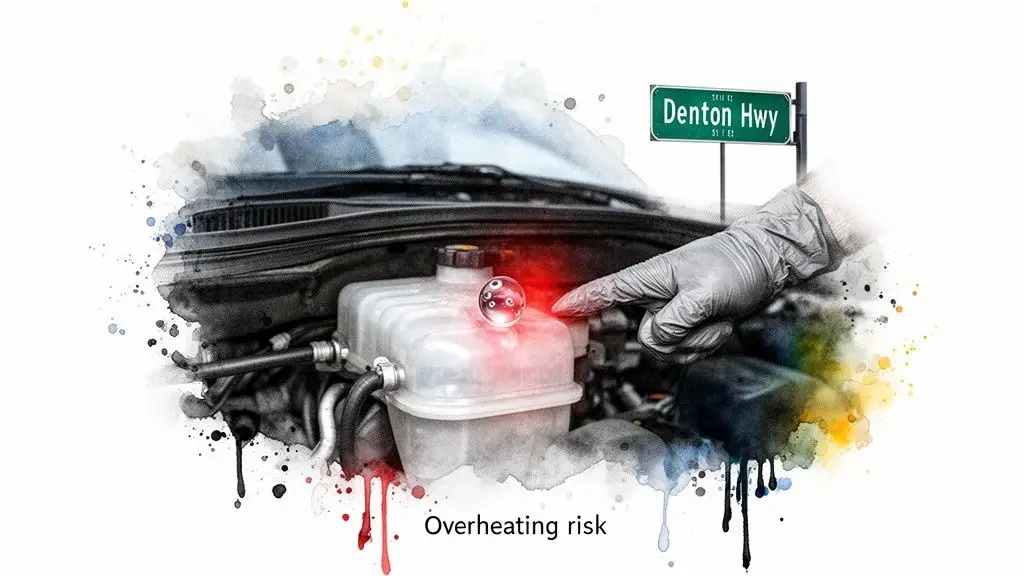
Living in Haltom City, we all know the Texas heat can be brutal. That intense heat puts a massive strain on your vehicle’s engine. If you have air trapped in your cooling system, you’re setting yourself up for trouble. These air pockets are like silent saboteurs, creating dangerous hotspots that can lead to a sudden breakdown on busy local roads like Denton Hwy.
Think of it this way: air pockets act like dams, stopping coolant from circulating where it needs to go. The result is an engine that can’t cool itself down properly. You might see the temperature gauge spike, but by then, you could already be on the fast track to serious and expensive damage, like a warped cylinder head or a blown head gasket, a common repair for Haltom City mechanics.
The Hidden Danger of Air Pockets
Here’s the simple science: air is terrible at absorbing heat compared to coolant. When an air bubble gets stuck in a critical part of the engine, like the passages around the cylinder head, it creates a superheated spot. The scary part? Your dashboard temperature gauge might still read normal while serious internal damage is already starting.
Knowing how to bleed the system is a core part of good preventive maintenance for vehicles. It’s a fundamental step that ensures your engine runs the way it was designed to, especially for Haltom City residents. If you really want to get into the nuts and bolts of it, you should check out our guide on how car radiators work.
A Problem Magnified by Haltom City Heat
Getting all the air out is non-negotiable for any vehicle, but it’s especially vital in a hot climate like Haltom City’s, where summer temps routinely push past 100°F. An improperly bled system with lingering air bubbles can slash your cooling efficiency by up to 15%.
That might not sound like much, but it’s enough to make your engine temperature jump from a normal 210°F to a dangerous 250°F. This is the kind of stress that causes head gasket failure—a problem that we see in 20-30% of major engine repairs right here in the Haltom City area.
Key Takeaway: For anyone driving in Haltom City, knowing how to bleed a cooling system is more than just a weekend DIY task. It’s a critical defense against the strain our local climate puts on our cars. A properly bled system is your best shot at preventing overheating and catastrophic engine failure.
What You’ll Need: Tools and Safety Gear
Alright, before you even think about popping the hood, let’s get our gear in order. Taking a few minutes to gather the right tools will make this job go smoothly and save you from a giant, messy puddle on your garage floor. This is how we approach every cooling system job here in Haltom City—preparation is everything.
First, and this is the most important rule of all: make sure the engine is completely cool to the touch. A hot cooling system is under pressure, and opening that radiator cap can send scorching-hot fluid flying. Seriously, don’t even think about starting until you can comfortably rest your hand on the engine. You’ll also want to be parked on level ground.
The Essential Tools for Bleeding Your Radiator
You don’t need a professional-grade workshop, but a few specific items will make this job much, much easier.
- A No-Spill Funnel Kit: Trust me, this thing is a game-changer. It locks onto your radiator or expansion tank, giving you a high, stable funnel. This not only prevents spills but also uses gravity to help force stubborn air bubbles up and out of the system. It’s the secret to getting it right on the first try, a favorite tool among Haltom City DIYers.
- A Good Floor Jack and Jack Stands: Getting the front of your car elevated helps ensure the radiator cap is the absolute highest point of the cooling system. Air naturally wants to rise, and this just helps it along. And remember, never get under a car that’s only held up by a jack—always secure it with jack stands.
- The Right Kind of Coolant: This is critical. Using the wrong coolant is a fast track to causing corrosion and other expensive damage inside your engine. Check your owner’s manual for the specific type (like OAT, HOAT, or IAT) and color your vehicle requires. If you need to dilute a concentrate, make sure you do it correctly—you can learn more about the proper way of mixing coolant and water in our detailed guide.
Safety First: Always wear safety glasses and a pair of nitrile gloves. Antifreeze is no joke; it’s toxic and can irritate your skin. Keep a drain pan handy to catch any drips and dispose of old coolant properly—it’s extremely harmful to kids, pets, and the local Haltom City environment.
It’s also smart to have a basic set of pliers for spring-loaded hose clamps and a few old rags close by for the inevitable drip or two. Once you have everything laid out, you’re all set to tackle the job with confidence.
A Practical Guide to Bleeding Your Cooling System
Alright, let’s get to the hands-on part. Forget those overly technical service manuals for a minute. Think of this more like having an experienced buddy in your Haltom City garage walking you through the job. The whole point of learning how to bleed a cooling system is simple: get stubborn air out so the right amount of coolant can get in.
The secret weapon here is gravity. By jacking up the front of your car, you’re making the radiator cap the highest point of the whole system. Since air is much lighter than coolant, it naturally wants to rise to the top to escape. It’s a simple bit of physics that makes our job much easier.
Setting Up for a Successful Bleed
Once your car is safely supported on jack stands, it’s time to break out the best tool for this job: a no-spill funnel. We use these in our Haltom City shop for a reason. It creates a perfect, sealed connection to your radiator or expansion tank, which not only prevents a huge mess but also gives you a visual reservoir to watch the air purge out.
With the funnel twisted on securely, you can start pouring in your pre-mixed, vehicle-specific coolant. Don’t go crazy—fill the funnel about one-third of the way up. This creates a supply of fluid for the system to drink from as it burps out the trapped air.
This diagram lays out the absolute essentials you’ll need to have ready before you even start.
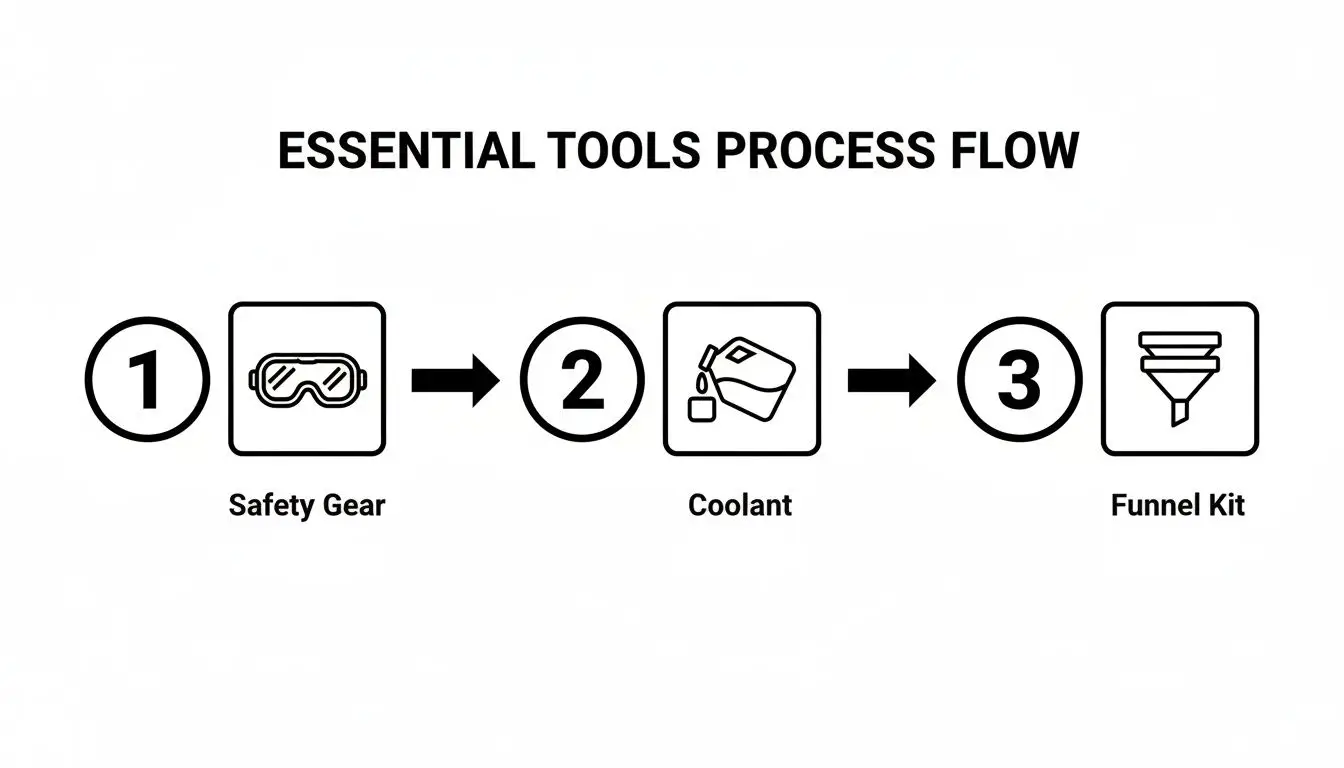
Think of it this way: proper safety gear, the right coolant, and a good funnel kit are the three pillars of a clean, successful bleed.
Bringing the System to Life
Now for the moment of truth. Go ahead and start your engine, leaving the funnel right where it is. Inside the car, crank the heater to its highest temperature setting but turn the fan down to the lowest speed. This simple step opens up the heater core, which is like a mini-radiator behind your dash, ensuring we get coolant flowing through every last passage.
Just let the engine idle. As it gets up to temperature, the thermostat will open, and you’ll start seeing bubbles percolate up into the funnel. That’s exactly what you want to see! It’s proof that air is being forced out and fresh coolant is taking its place.
Insider Tip: To help things along, you can gently squeeze the upper radiator hose. I call this “burping” the system. It helps dislodge any stubborn air pockets that are clinging to the inside of the hoses or engine, pushing them out toward the funnel.
Keep a close eye on the funnel, as the coolant level will drop while air escapes. Be ready to add more fluid to keep it about one-third full. You’ll need to keep this up until you see a steady, bubble-free flow of coolant, which could take a good 15-20 minutes. Patience is key here.
Pro Tips for a Perfect Finish
Want a trick we use in our Haltom City shop to speed things up and get a more thorough bleed? Raise the front end a little higher and, with the heat still on full blast, bring the engine idle up to around 2000 RPM for a couple of minutes. While it’s revving, squeeze both the upper and lower radiator hoses to really force out any last pockets of air.
Folks on automotive forums back this up, confirming this method clears up air-related issues in nearly 90% of cases. It’s the best way to prevent those scary temperature spikes where the gauge goes from normal to hot in a heartbeat. For fleet managers and busy professionals in Haltom City, where vehicle downtime is money lost, a quick stop at Express Lube for a professional bleed using the right tools and OEM-grade parts is a no-brainer. You can even see how the market for professional-grade tools like these is growing over at Future Market Insights.
Once you’ve had a solid, bubble-free flow for a few minutes, you’re on the home stretch. Shut the engine off and let it cool down completely—and I mean completely. Only then should you remove the funnel, top off the radiator one last time if needed, and secure the cap. Your final step is to check the coolant level in the overflow reservoir and fill it to the “cold” line. That’s it. You’ve successfully bled your cooling system.
Advanced Bleeding Techniques for Tricky Vehicles
So, you’ve tried the classic “park on a hill” method, you’ve squeezed the hoses, and you’ve run the engine with the heater on full blast. But you’re still getting those tell-tale signs of an air pocket—gurgling sounds from the dash, or a temperature gauge that won’t stay put. Don’t throw in the towel just yet.
Modern cars, with their tightly packed engine bays and complex hose routes, can be incredibly stubborn. Sometimes, the air just doesn’t want to come out the easy way. When that happens, you need to bring out the more advanced tools and techniques we use in our Haltom City shop.
Locating and Using Bleeder Screws
Many manufacturers know their cooling systems can be tricky, so they provide a secret weapon: a bleeder screw or bleeder valve. These are small, purpose-built escape hatches placed at the highest points in the system where air naturally collects.
Finding them can be a bit of a treasure hunt, but they’re almost always in one of these spots:
- On the thermostat housing, which is a common place for air to get trapped.
- At the highest point of a heater hose, often near the firewall.
- Directly on the top tank of the radiator itself.
The process is simple but effective. With the engine cool and off, crack the screw open just enough to hear a hiss of escaping air. Keep pouring coolant into the radiator or reservoir until a steady stream of fluid, not frothy bubbles, starts to dribble out. As soon as you see solid liquid, tighten the screw. You’ve just successfully purged air from a known problem spot. Understanding how these parts work together is key; our guide on what a thermostat does in a car can give you a better picture.
The Gold Standard: The Vacuum-Fill Method
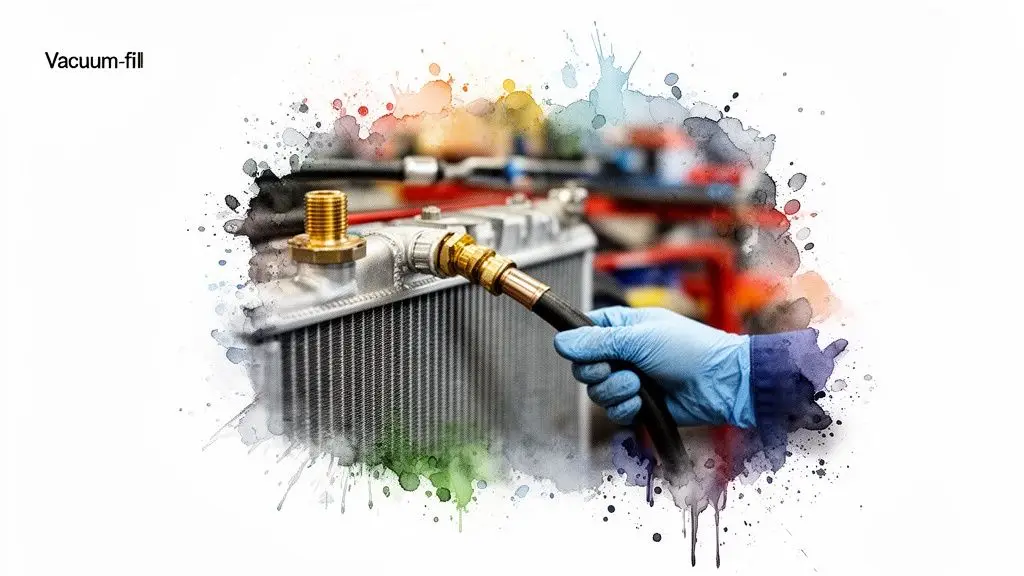
For a guaranteed, 100% perfect bleed, especially on notoriously difficult cars, nothing beats a vacuum-fill tool. This is the method we rely on at Express Lube & Car Care in Haltom City because it completely eliminates the possibility of air pockets. It’s the definitive professional solution.
Instead of trying to push air out with coolant, this tool does the exact opposite: it pulls all the air out first.
The Vacuum-Fill Advantage: This technique uses a specialized tool that connects to the radiator and an air compressor. It creates a strong vacuum within the entire cooling system, collapsing the hoses. By removing all the air before adding coolant, it becomes physically impossible for air pockets to form.
Once the system is holding a vacuum, you simply flip a valve. The vacuum pressure instantly sucks the fresh coolant in from your supply bucket, filling every single passage and crevice of the engine and heater core. There’s no guesswork, no mess, and no chance of a lingering air bubble.
For drivers in Haltom City who can’t afford a comeback due to an overheating engine, this professional-grade service is the only way to ensure the job is done right the first time. It’s how we guarantee your cooling system is completely air-free and ready to handle the Texas heat.
Troubleshooting Common Issues After Bleeding
You’ve spent the afternoon under the hood, followed all the steps, and you’re pretty sure you’ve burped every last bubble out of those hoses. But when you start it up, something’s still off. Maybe the heater is only blowing lukewarm air, or worse, you see that temperature needle creeping back into the red zone.
Don’t throw in the towel just yet. This is a common roadblock, especially for Haltom City DIYers, and the fix is often simpler than you think. Nine times out of ten, these lingering symptoms point to one of two things: a really stubborn air pocket that’s playing hard to get, or the air was just a side effect of a bigger issue.
Let’s walk through what could be going on.
Still Seeing Signs of Overheating
If your temp gauge is bouncing around or the heater is blowing cold, the most likely culprit is still air. Some cooling systems are just notoriously finicky, especially on newer cars with complex hose routing. It can feel like you’re chasing your tail, but it’s a frustratingly common problem in many Haltom City garages.
In fact, after a major job like a radiator replacement, it’s not unusual for stubborn air bubbles to remain in about 40% of cases if the bleeding procedure isn’t perfect. This trapped air can cause engine temps to spike to 210°F or even higher, especially when you’re just idling with the A/C on. Many drivers will notice weak coolant flow at idle that seems to magically fix itself at higher RPMs. You can find more market data on the tools designed to solve this problem over at DataIntelo.com.
Expert Tip for Haltom City Drivers: Before you start tearing things apart again, try one more bleed. This time, find the steepest, safest incline you can park on—a steep Haltom City driveway is perfect. That extra front-end elevation is often all it takes to push that last pesky air bubble out of a high spot like the heater core.
When It’s Not Just Air
So, what happens if you’ve re-bled the system on a hill and the overheating problem just won’t quit? Now it’s time to shift gears and consider that the trapped air was a symptom, not the root cause. You’re moving from a simple bleed job into some real diagnostics.
A few common mechanical failures can perfectly mimic the signs of air in the system. The top suspects are:
- A Stuck Thermostat: If your thermostat is stuck in the closed position, it’s like a roadblock for your coolant. The engine will overheat no matter how well you’ve bled the radiator because the coolant can’t get there to cool off.
- A Failing Water Pump: The water pump is the heart of the system. If its internal impeller is damaged or slipping, it can’t circulate coolant effectively. This often leads to overheating that gets worse at idle and may improve slightly as you drive.
- A Hidden Coolant Leak: Even a tiny, hard-to-find leak can suck air back into the system every time the engine cools down. This creates a vicious cycle where you bleed the air out, only for it to return the next day. If you smell coolant but can’t see a puddle, check out our guide to find a coolant leak in your vehicle.
If you’ve already tried a second bleed on an incline with no luck, it’s a strong signal you’re dealing with a bad part. Pinpointing a failing water pump or a stuck thermostat can be tricky without the right diagnostic tools and experience. At this point, a quick trip to a trusted mechanic in Haltom City is your best bet to save time and prevent more serious engine damage.
When to Visit Your Local Haltom City Auto Experts
Doing your own car maintenance can be a great way to save money and understand your vehicle better. But let’s be honest, sometimes a job fights back. Knowing when to step back and hand the keys to a pro is a skill in itself, especially with a system as vital as your engine’s cooling.
If you’ve gone through all the steps for how to bleed the cooling system and you’re still scratching your head, it’s a good sign that it’s time for a professional opinion. Stubborn symptoms are a dead giveaway. If the heater is still blowing cold, you’re hearing gurgling sounds from the dash, or the temperature gauge is bouncing around, the problem likely goes deeper than a simple air bubble.
Recognizing When You’ve Hit a Wall
Sometimes, the issue isn’t what you’re doing, but what you’re working with. Many newer cars are notoriously difficult to bleed without specialized tools. Or maybe you just don’t have an entire Saturday to spend chasing an elusive airlock. Your time is valuable, after all.
For anyone driving around Haltom City, Watauga, and North Richland Hills, getting your car back on the road safely is what matters most. Rolling the dice on a cooling system problem can turn a minor fix into a major engine meltdown, and nobody wants to be stranded on the side of a Haltom City road on a hot Texas day.
The Pro Advantage: Bringing your car to a certified shop isn’t just about paying for a service; it’s about buying peace of mind. An experienced technician can quickly tell if you’re dealing with a trapped air pocket or a more serious component failure, like a bad thermostat or a failing water pump.
Your Haltom City Experts at Express Lube & Car Care
At Express Lube & Car Care, we know exactly what our Haltom City heat can do to a vehicle’s cooling system. Our ASE-certified technicians have the right equipment to handle even the most frustrating situations, including professional-grade vacuum-fillers. This tool pulls all the air out of the system before we even add the new coolant, making it impossible for air pockets to form.
We make sure the job is done right the first time, using only the high-quality, vehicle-specific fluids and parts your car requires. When you’ve run out of patience or just want the confidence that comes with expert service, come see us.
You can find our shop at 6211 Denton Hwy in Haltom City. We’re here to provide reliable, straightforward auto care you can count on.
Your Cooling System Questions, Answered
Let’s tackle some of the most common questions we hear from Haltom City drivers about their cooling systems. With the kind of heat we get here in Texas, knowing your way around your car’s radiator isn’t just a good idea—it’s essential for avoiding a breakdown on the side of the road.
How Often Should I Bleed My Cooling System?
This is a great question, and the answer is simpler than you might think: you only need to bleed the system when it’s been opened up. It’s not a regular maintenance item like an oil change.
You’ll need to do it after any job that introduces air into the lines. Think of jobs like:
- Swapping out a radiator, hose, or water pump.
- Doing a full coolant flush.
- Replacing a bad thermostat.
Anytime coolant comes out, air can get in. That’s your cue to perform a proper bleed.
The key takeaway is that you only need to worry about how to bleed the cooling system right after it’s been serviced. A healthy, sealed system takes care of itself.
Can I Just Use Any Coolant in My Car?
Absolutely not, and this is a mistake we see all the time from drivers in Haltom City. Pouring the wrong coolant into your car can cause serious, wallet-draining damage. It’s not just about color, either—different coolants have unique chemical formulas designed for the specific metals in your engine.
Always, and I mean always, check your owner’s manual for the exact coolant your vehicle needs. Using the wrong type (or mixing different types) can cause the fluid to turn into a thick, damaging gel, leading to corrosion and clogs that kill your cooling performance.
What if My Car Still Overheats After Bleeding?
If you’ve bled the system properly and the temperature gauge is still climbing, you’re likely looking at a bigger problem than just an air pocket. Persistent overheating is a classic symptom of a failing part.
The most common culprits are a thermostat that’s stuck shut, a worn-out water pump that isn’t circulating coolant, or a radiator that’s clogged internally. At this point, it’s time to stop guessing and have a professional technician in Haltom City find the real issue before it leads to major engine damage.
If you’ve given it your best shot and are still stuck, or you’d just rather have an expert handle it from the start, we’re here to help. The team at Express Lube and Car Care has the right tools and experience to get your cooling system running perfectly. Stop by our Haltom City location for auto care you can count on. Learn more at https://www.expresslubehaltom.com.