
TL;DR: A CV boot is a flexible, rubber-like cover that protects your car’s constant velocity joint by keeping grease inside and dirt, water, and debris out. If it tears, wear can accelerate by up to 500% within 10,000 miles and a cheap $10 to $20 part can turn into a $300 to $800 repair because labor often takes 1 to 3 hours depending on the vehicle, according to Motor Works and Cars.com.
You may be here because your car made a clicking sound backing out of a driveway in Haltom City, or because a mechanic mentioned a “CV boot” and it sounded like one more mystery part under the car.
That’s normal. Most drivers never think about CV boots until one fails.
The good news is that the part’s job is simple once someone explains it in plain English. If you understand what is cv boot, what it protects, and why repair costs seem out of proportion to the part itself, you’ll make better decisions before a small problem turns into an axle replacement.
That Clicking Sound When You Turn Your Car
A common local scenario goes like this. You leave a grocery store parking lot, turn the wheel, and hear a click-click-click from the front end. It may happen in a tight turn, pulling out of a neighborhood, or easing through a drive-thru.
That sound often makes people think of brakes, steering, or a wheel bearing. Sometimes it is one of those. But in many cases, the trail leads back to a worn CV axle, and that damage often starts with a failed CV boot.

Why drivers notice it during turns
Your front axle has joints that let power keep flowing to the wheels while the suspension moves and the wheels turn. Those joints work hard every time you corner, especially in stop-and-go traffic and parking lots around Tarrant County.
If the protective boot splits, grease escapes and contamination gets in. After that, the joint starts wearing faster. The classic clue is noise during turns.
A damaged or worn CV boot is one of the most common maintenance issues found during inspections, and Texas heat exposure and road debris can accelerate deterioration, as noted in the Wikipedia overview of constant-velocity joints.
Why this gets confused with other problems
Front-end noises overlap. A bad hub bearing can hum or growl. Suspension parts can clunk. Tire issues can cause vibration. If you’ve been comparing sounds, this guide on what a hub bearing sound can tell you helps show why one noise can mimic another.
What matters most is this. A CV boot is small, but it protects a much more expensive component.
Your CV Axle’s Bodyguard
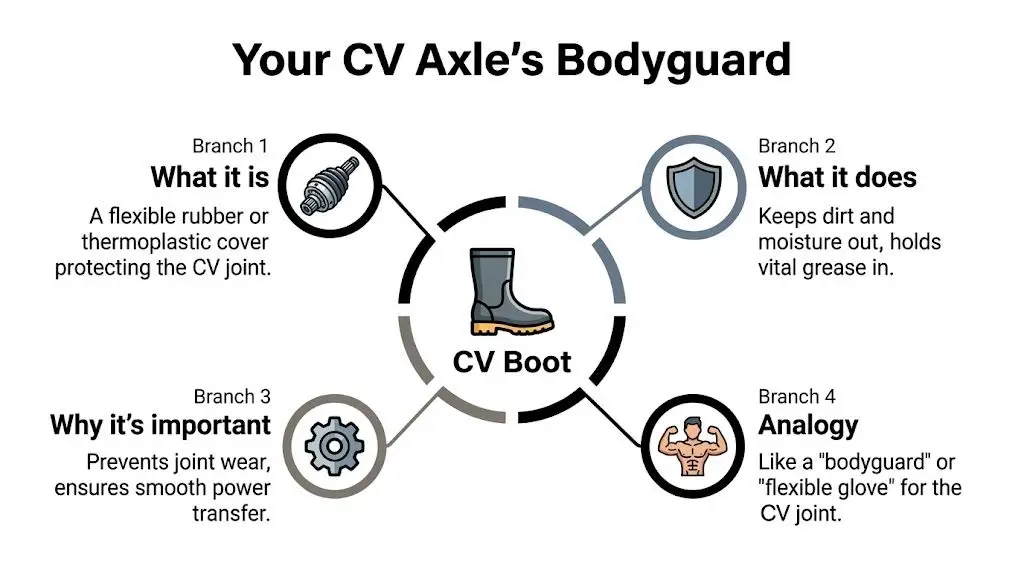
The CV boot is a flexible protective cover wrapped around the CV joint on your drive axle. If the joint is the part that lets power keep flowing while your wheel turns and your suspension moves, the boot is the sealed cover that keeps that joint clean and lubricated.
Around Haltom City, that matters more than many drivers realize. Summer heat, gritty road dust, and everyday stop-and-go driving in Tarrant County all put stress on rubber parts under the car. A small split in the boot can turn a simple repair into a much more expensive axle job.
What the boot does
A CV boot has two basic jobs, and both are simple to understand.
- Keeps grease in: The joint depends on thick grease to reduce friction as it moves through turns and bumps.
- Keeps dirt and moisture out: The inside of the joint needs to stay clean. Once road grit or water gets in, wear speeds up fast.
That is why a torn boot gets attention in the shop. The rubber cover itself is not the expensive part. The problem is what happens to the joint after the seal is lost.
Why the boot looks ribbed and flexible
A CV boot is built with ribs, sometimes called bellows, because it has to bend constantly with the axle. Your suspension moves up and down. Your wheels turn left and right. The boot has to follow all that motion without opening a gap or pulling loose from its clamps.
A good boot looks soft, sealed, and dry on the outside.
If you see cracks, grease splatter, or a boot that looks brittle, the joint may already be in trouble. In some cases, drivers first notice the issue as a shudder or shake under load, which can overlap with other drivetrain problems. If that sounds familiar, our guide on why a car shakes when you accelerate can help you compare symptoms.
Why this small part can lead to a bigger bill
Drivers are often surprised when we explain the repair. They see a torn piece of rubber and expect a minor fix. What they cannot see is the precision joint hiding underneath, spinning near the wheel and relying on that boot every mile.
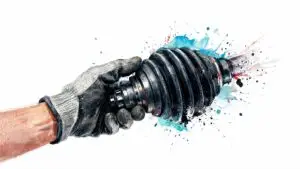
A good comparison is a work glove protecting your hand. Once the glove tears, your hand is the part that gets hurt. The same idea applies here. When the boot fails, the CV joint loses its protection, and repair costs in the Haltom City area can rise quickly if the damage is ignored.
Common Causes of Failure and Symptoms You Can’t Ignore
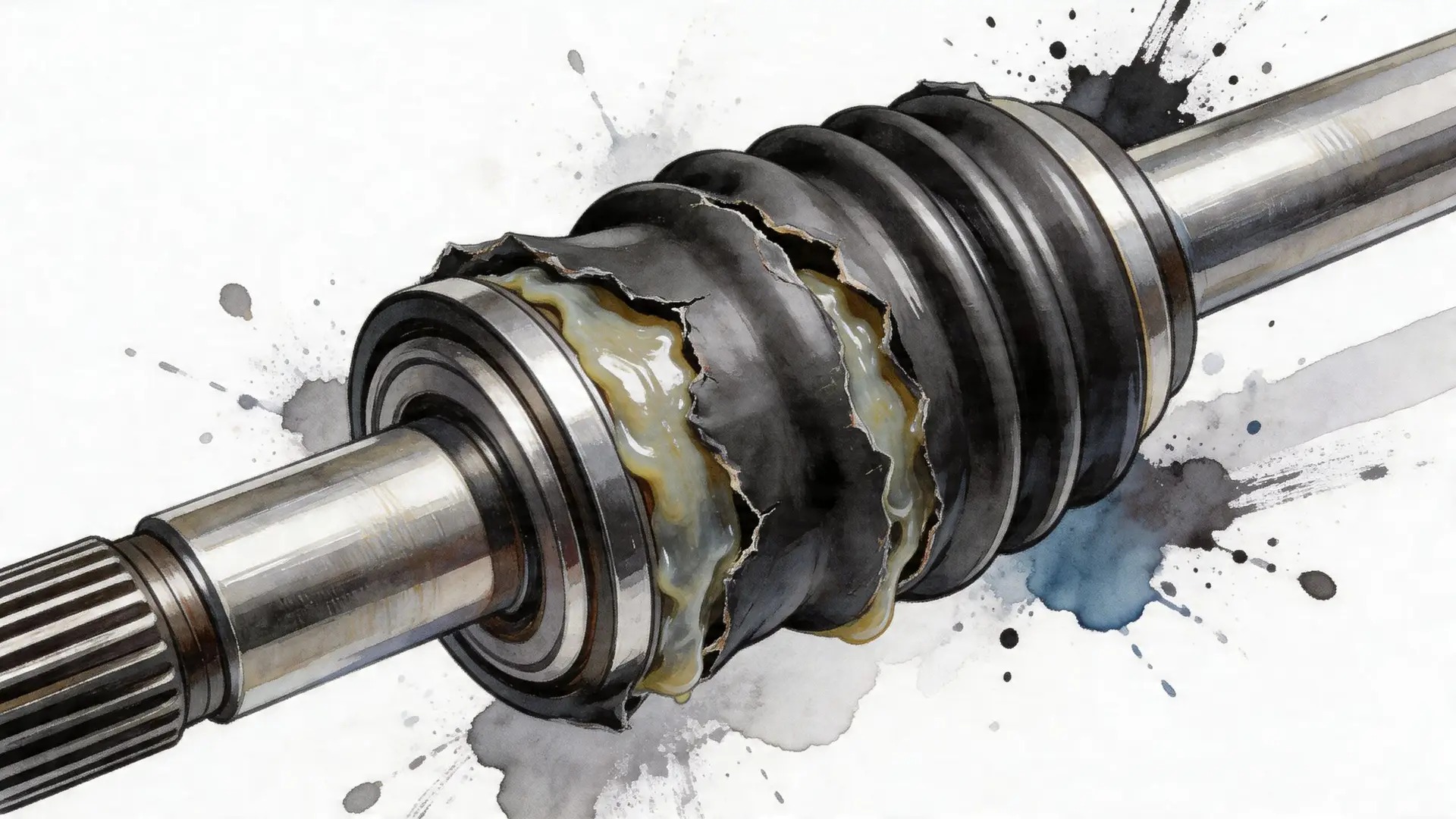
A CV boot usually fails the same way a work glove fails. It spends years bending, heating up, cooling down, and getting hit with dirt and grit until a weak spot opens. Around Haltom City and the rest of Tarrant County, rough pavement, loose debris, summer heat, and stop-and-go driving all add to that wear.
Once the rubber splits, the joint inside loses its grease and starts picking up contamination. That is when a small rubber problem can turn into axle noise, vibration, and a bigger repair bill at the shop.
What usually causes the damage
A few patterns show up again and again in the shop:
Age and repeated flexing
Every turn and every bump makes the boot flex. Over time, the rubber can dry out, weaken, and split along the ribs.Heat exposure
High undercar temperatures and Texas sun can make the material hard and brittle, especially on older vehicles.Road hazards
Rocks, broken pavement, and other debris can nick the boot or tear it outright.Clamp or seal problems
Sometimes the boot itself is not ripped at first. A loose clamp can let grease escape and dirt work its way in.
Warning signs drivers notice first
You do not need to be a mechanic to catch the common symptoms. Most drivers notice one of these before they ever see the boot itself:
Clicking while turning
This is one of the clearest signs the joint has started to wear, especially during slow turns into driveways or parking spaces.Grease splatter near the wheel or suspension
If grease gets thrown outward in a circular pattern, the boot may be torn and spinning that grease out as the axle turns.Vibration during acceleration
A worn CV joint can create a shake that feels worse as speed builds. If that sounds familiar, our guide on why a car shakes when accelerating can help you compare CV axle symptoms with tire, brake, and suspension problems.A clunk or shudder when shifting into drive
This can happen when wear in the joint starts creating extra play.
Why early symptoms matter
Timing makes a big difference here.
If a torn boot is caught early, there are cases where the repair is more manageable because the joint has not been heavily contaminated yet. If the car keeps being driven with grease leaking out and dirt getting in, the joint surfaces wear down fast, and many drivers in the Haltom City area end up needing a full axle assembly instead of a simpler fix.
That is why we tell local drivers not to ignore clicking on turns or grease near the inside of a wheel. Those signs are your warning that the protective seal has already failed, and the longer it sits, the fewer low-cost options you usually have.
If you hear clicking in a turn and see fresh grease nearby, schedule an inspection before that boot problem turns into axle replacement.
A Quick Visual Inspection You Can Do Yourself
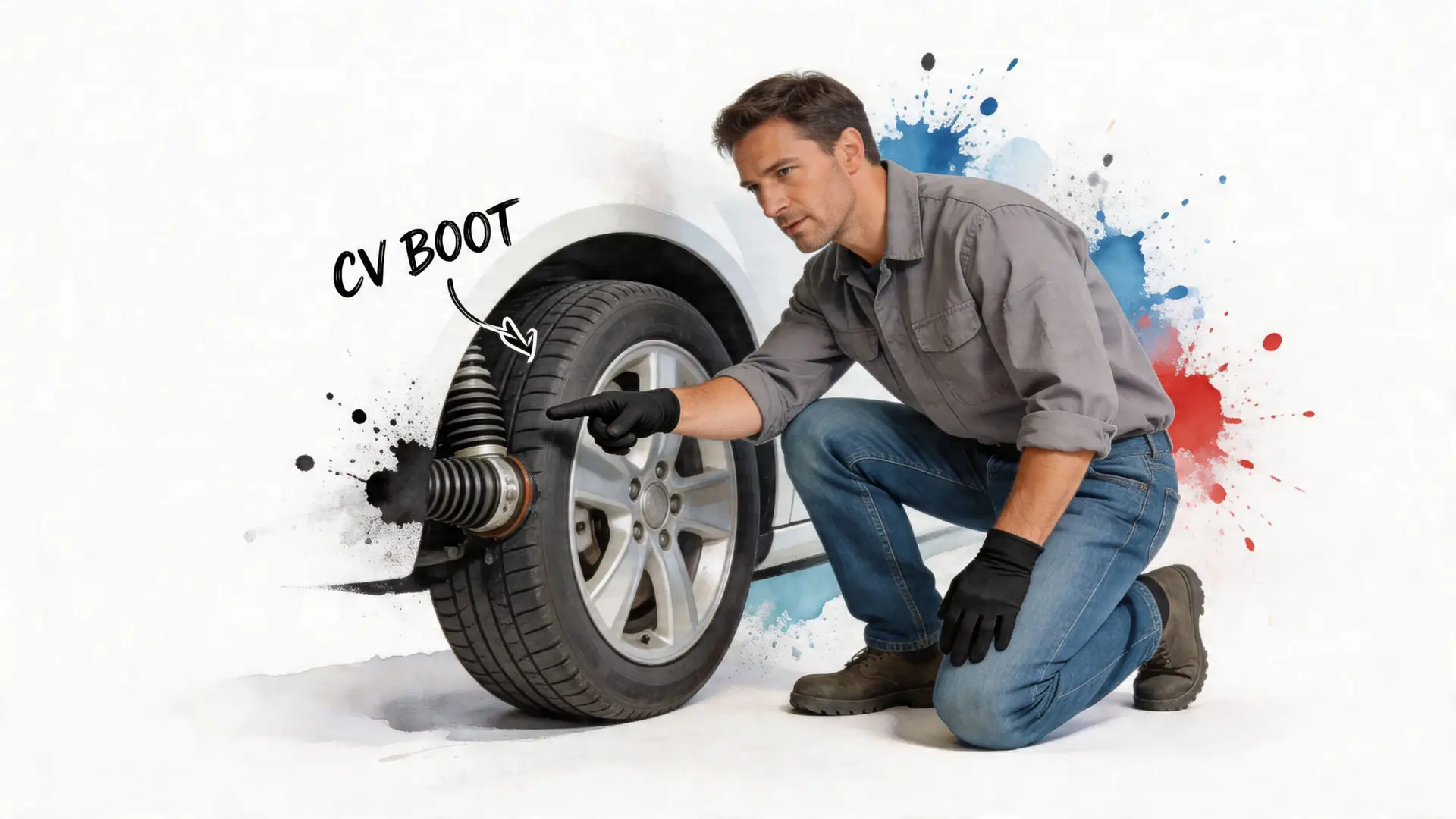
You can do a basic CV boot check at home in just a few minutes. This won’t replace a full inspection, but it can help you spot obvious trouble before it gets worse.
A simple driveway check
Park on a level surface and turn the steering wheel fully to one side. That usually gives you a better view behind the front wheel.
Then use a flashlight and look for the rubber boot around the axle joint.
Here’s what to look for:
An intact boot
The surface should look whole, not split. The ribs should be defined, not torn open.Signs of grease
Fresh or caked greasy dirt around the boot, suspension area, or inner wheel can mean the seal has failed.Cracking or dryness
Tiny cracks matter because they often turn into full tears.
What a trained eye catches better
A quick look is useful, but some problems are subtle. Material condition can be harder to judge than people expect. According to Mevotech DX859 information, premium neoprene compounds offer 25% superior ozone and UV resistance, which matters in Texas heat and sun exposure.
A technician can often tell whether a boot is still sound, getting brittle, or has already started failing at the folds.
If you want a broader check while you’re already looking over the vehicle, this car inspection checklist is a helpful companion.
For a visual walkthrough, this video gives a useful overview of what technicians look for:
Understanding Repair Costs in the Haltom City Area
You hear a click on turns, stop by a shop in Haltom City, and then the estimate is higher than expected. That can feel confusing when the boot itself is just a rubber part.
What you are really paying for is the work around the part.
A CV boot sits in a spot that usually takes time to reach properly. On many vehicles, a technician has to remove the wheel, work around brake and suspension components, and in some cases pull the axle to clean the joint, pack fresh grease, and install the new boot the right way. If grease has already spread around the area, cleanup and inspection add time too.
Why one estimate can look very different from another
Two cars can come in with the same torn boot and leave with very different estimates. Vehicle design matters. So does how long the boot has been torn.
If the boot split recently and the joint is still clean and quiet, the repair may stay limited to the boot service. If dirt and moisture have already gotten into the joint, the job often grows. At that point, the technician may recommend replacing the axle assembly instead of putting a new boot over a worn joint.
Timing is critical at this stage.
That is one reason prices vary around Tarrant County. A small problem caught early usually costs less than a repair that has had weeks or months to wear down the joint. For local drivers who commute through Haltom City, North Richland Hills, Watauga, or Fort Worth traffic every day, that extra mileage can change the repair plan quickly.
CV Boot Replacement Options DIY vs. Professional
| Factor | DIY Repair | Professional Service (Express Lube) |
|---|---|---|
| Part cost | The boot itself is usually not the expensive part | The part is only one piece of the total repair |
| Labor time | Your own time, plus setup, cleanup, and the chance of doing the job twice | A technician handles disassembly, inspection, reassembly, and testing |
| Tools needed | Often more than basic hand tools | Shop equipment and service procedures are already in place |
| Risk of misdiagnosis | Higher if the joint is already damaged | Technician can check whether the boot, joint, or full axle needs attention |
| Mess factor | High. CV grease gets everywhere | Cleanup is part of the service |
| Warranty value | Depends on the parts and your own work | Professional repair usually gives you more protection and less guesswork |
What Haltom City drivers should keep in mind
The smartest move is getting the problem looked at before the joint starts clicking loudly or vibrating under load. That gives you a better chance of keeping the repair smaller.
If you want a clear answer on whether you need a boot repair or a full axle service, you can schedule a CV boot inspection at Express Lube & Car Care. It also helps to stay ahead of drivetrain issues by monitoring your car's overall vehicle health, especially if you rack up a lot of miles around Tarrant County.
Don’t Wait for a Breakdown Visit Express Lube
A torn CV boot isn’t one of those problems that gets better with time. Every trip gives dirt, moisture, and missing grease more opportunity to wear down the joint.
That matters for commuters, parents, and fleet drivers around Haltom City, North Richland Hills, Keller, and Watauga. Losing a CV joint usually doesn’t happen at a convenient time.
Why fast action saves money
According to J.D. Power’s guidance on drive axle boots, replacing a boot early is a minor repair, while waiting for joint failure can multiply the cost by up to 5 times because the entire axle may need replacement.
So if you’ve noticed clicking on turns, grease near the wheel, or a new vibration, don’t put it off. Those clues are your chance to catch the problem before it grows.
A smart habit is monitoring your car's overall vehicle health, especially if you drive daily across Tarrant County and want to stay ahead of drivetrain, tire, and maintenance issues.
If you’re ready to stop guessing and have someone inspect it properly, you can schedule an appointment and get a clear answer before a small boot issue becomes a major axle repair.
Your CV Boot Questions Answered
How long can I safely drive on a torn CV boot
There isn’t one safe universal answer. Some torn boots are caught early, while others have already let in enough contamination to damage the joint. If you hear clicking or feel vibration, treat it as urgent and have it checked soon.
Are all CV boots the same
No. CV boots vary by vehicle and joint design. Inner and outer boots can differ, and the correct fit matters because the boot has to seal properly and flex the right way for that axle setup.
Do all cars have CV joints and boots
Not all cars use the same axle and joint layout. CV joints and boots are especially associated with front-wheel-drive vehicles, and many all-wheel-drive vehicles use them too. Some rear-wheel-drive setups use different driveline designs.
For shops that care about educating customers on auto maintenance, questions like these are worth answering clearly because drivers make better repair decisions when they understand the part, not just the estimate.
If your car is clicking in turns, leaking grease near the axle, or shaking at speed, Express Lube and Car Care can inspect it and tell you whether you need a boot repair, an axle repair, or peace of mind. Their certified team serves Haltom City from 6211 Denton Hwy and helps drivers throughout North Richland Hills, Keller, and Watauga keep small problems from turning into expensive ones.