
That humming or grinding you’ve started hearing on roads like Denton Highway isn’t just road noise. It’s your car trying to tell you something, and often, it’s pointing straight to a failing wheel hub bearing. A bad hub bearing sound usually starts off as a subtle hum or rumble, but if you let it go, it can quickly turn into a loud, metallic grinding that’s impossible to ignore. It’s a pretty common problem we see with cars around Haltom City, and figuring out what’s happening is the first step to getting it fixed right.
What Is That Grinding Noise Coming from My Car?
Think of it like the axle on a good skateboard. For the wheels to spin fast and smooth, the bearings have to be in perfect shape. Your car’s wheel hub bearing does the exact same thing, just on a much bigger scale. This critical part is what lets your wheel spin freely while holding up the entire weight of that corner of your car.
When everything is working as it should, you don’t hear a thing. But when a bearing starts to go bad, that smooth, quiet ride is replaced by a very specific and worrying noise. That hub bearing sound is the sound of trouble—it’s the direct result of too much friction inside the bearing itself. This usually happens for one of a few reasons:
- Loss of Lubrication: The grease packed inside the bearing has either broken down over time or leaked out, leaving metal to grind on metal.
- Contamination: Dirt, road grime, and water can work their way past the bearing’s seals. Once inside, this debris tears up the precision surfaces. This is a common issue for cars in Haltom City due to weather and road conditions.
- General Wear and Tear: Let’s face it, no part lasts forever. After thousands and thousands of miles on Haltom City streets, bearings simply wear out from the constant stress.
Why the Noise Changes with Speed and Turns
One of the biggest giveaways of a bad hub bearing is how the sound changes as you drive. You might only hear a faint hum at a specific speed, maybe around 30-40 mph, that gets louder and growls as you get on the highway.
A classic symptom is the noise getting louder or changing its pitch when you turn. As you steer, you shift the vehicle’s weight, putting more load on the bearings on the outside of the turn. This extra pressure makes a worn-out bearing complain loudly.
For instance, if the bearing on your front right wheel is failing, you’ll probably hear it get much louder when you make a left turn. This is a tell-tale sign we often confirm for drivers from Haltom City and surrounding areas. While that noise can be unnerving, it’s actually a great clue for tracking down the problem. Of course, not every noise is a bearing. If you’re hearing things when you come to a stop, you might want to learn more about why brakes squeak in our related guide.
How to Identify a Bad Hub Bearing Sound
Ever hear a strange, low hum coming from your car and wonder if you’re just imagining it? You’re probably not. A bad hub bearing rarely announces itself with a bang. Instead, it starts subtly, often as a faint rumble you might only catch with the radio off, usually somewhere between 30-40 mph.
But that quiet hum won’t stay quiet for long. As the bearing inside wears down, the sound changes completely. It becomes a loud, rhythmic growling or grinding—a noise that’s directly tied to how fast you’re going. Think of it as a deep, angry roar that gets louder the more you press the accelerator. That’s the sound of metal-on-metal protest, a clear sign that something is wrong inside your wheel assembly.
The Turning Test: A Key Diagnostic Clue
Here’s one of the best ways a driver can start to pinpoint a bad hub bearing, and you can do it from the driver’s seat. The next time you’re driving and hear that noise, pay close attention to what happens when you turn or change lanes.
Imagine you’re cruising down a curve on a local road like I-820 near Haltom City. When you steer, your car’s weight shifts, putting more stress on the wheels on the outside of the turn. If that growling gets much louder when you steer left, the problem is almost certainly on the right side of your vehicle. If it gets worse on a right-hand curve, the bad bearing is likely on the left side. This change in volume is the classic tell-tale sign of a failing hub bearing.
The image below breaks down what you’re hearing, what it means, and what needs to happen next.
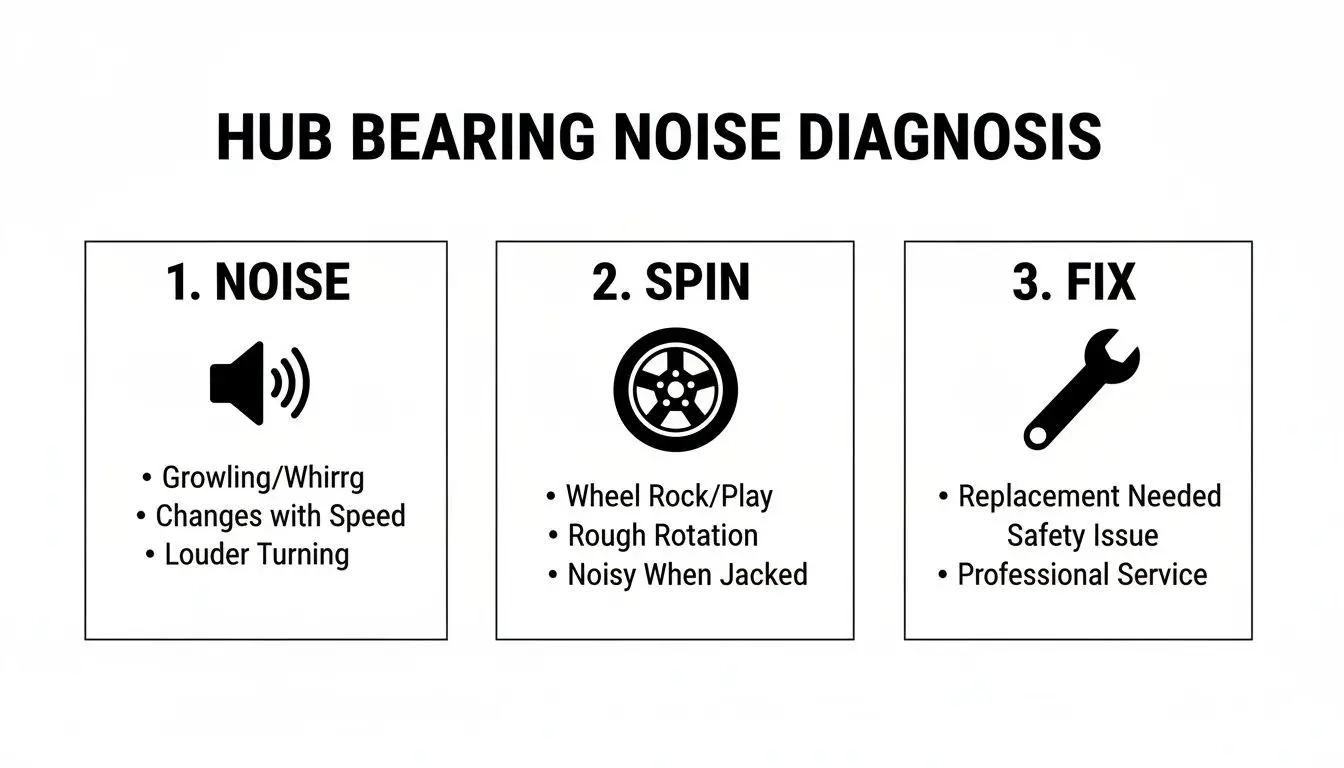
It really is that simple: a growling noise paired with a little bit of wheel looseness (or “play”) points directly to a bearing that’s reached the end of its life.
Car Noise Diagnosis: Hub Bearing vs. Other Common Sounds
Of course, cars make all kinds of noises, and it’s easy to get them mixed up. A bad hub bearing sound can be confused with tire noise or even a failing CV joint, but there are distinct differences if you know what to listen for.
To help you become a better “car whisperer,” we’ve put together a quick guide for Haltom City drivers to tell these common sounds apart.
Car Noise Diagnosis Hub Bearing vs Other Common Sounds
| Noise Source | Sound Description | When It Happens | Likely Culprit |
|---|---|---|---|
| Hub Bearing | Grinding, growling, or humming that gets louder with speed. | Noise changes intensity when turning or changing lanes. | Bad Wheel Bearing |
| Tires | A constant roar or “slapping” sound. | Noise remains consistent during turns. | Worn or Unbalanced Tires |
| CV Joint | A loud clicking or popping sound. | Primarily when making sharp, slow-speed turns. | Bad CV Joint |
Notice the pattern? The key difference is how the noise behaves when you turn. Tire noise is constant, while a bad CV joint is most noticeable in a parking lot, not at highway speeds.
The Bottom Line: If you’re hearing a speed-dependent growl that gets noticeably worse when you steer, a bad hub bearing is the most likely culprit.
Getting familiar with these distinctions helps you have a much more productive conversation with your mechanic. To get an even better handle on the issue, you can read up on the other signs of wheel bearing failure in our detailed article. Remember, this isn’t just a nuisance noise—it’s a safety issue, so figuring it out sooner rather than later is always the right call.
Common Causes of Hub Bearing Failure in Haltom City
So, where does that awful hub bearing sound come from? It rarely just starts overnight. Instead, it’s the final complaint from a component that’s been slowly pushed to its limit by the real-world driving we all do. For those of us navigating the roads in Haltom City, the usual suspects are part of our daily commute.
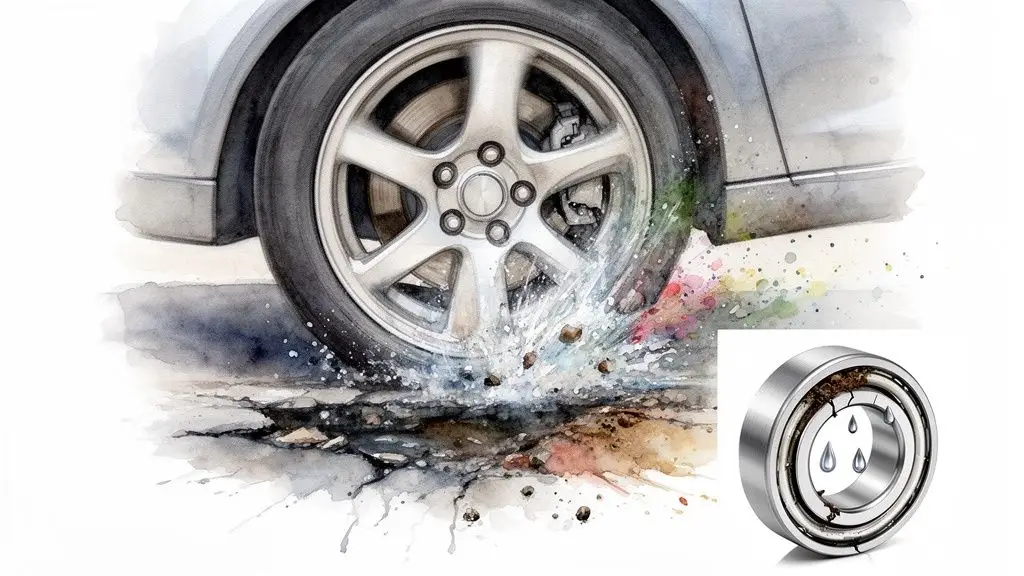
One of the biggest culprits is impact. When you hit a deep pothole or clip a curb in Haltom City, you feel that jarring thud. That same shockwave travels directly to your wheel bearing, slamming the delicate, precision-ground steel parts together. One big hit can do it, but more often, it’s the death-by-a-thousand-cuts from repeated jolts on local roads that leads to that tell-tale grinding noise.
Environmental and Mechanical Stressors
Contamination is another major enemy. Your hub bearings are sealed at the factory to keep a very specific grease in and everything else out. But if that seal gets damaged—from age, heat, or an impact—it’s an open invitation for water, dirt, and road salt to sneak inside. This mixture turns the clean lubricant into a gritty, abrasive sludge that eats the bearing from the inside out.
It’s not just the road’s fault, either. Sometimes our own choices can accelerate wear. Those great-looking oversized wheels and tires you installed? They add weight and change the suspension geometry, putting a lot more leverage and stress on the hub assembly. This extra load can cause a bearing to fail much faster than the factory-sized wheels it was designed for.
And then there’s the simple reality of age and mileage. Just like brake pads or tires, hub bearings are wear-and-tear items. After tens of thousands of miles on Haltom City roads, they’ve done their job, and the constant spinning simply wears them out.
We see this all the time at Express Lube & Car Care on 6211 Denton Hwy in Haltom City. Ignoring these sounds is a safety risk. In fact, research shows that high-speed pothole strikes can cause a type of damage called false brinelling, which can slash bearing life by 30-50%. You can dig into the data in this low-noise wheel hub bearings market research.
The Ripple Effect of Bearing Wear
The key takeaway here is that a worn bearing is often just a standard maintenance issue, not a sign you bought a lemon. But you can’t ignore it. A failing bearing creates vibrations and looseness that can cause other problems, from strange shaking sensations to uneven and premature tire wear.
Here’s a quick recap of what to watch out for:
- Impact Damage: Potholes and curbs on Haltom City roads are the number-one enemy of a happy bearing.
- Contamination: A broken seal lets in water and dirt, which quickly ruins the bearing.
- Excessive Load: Big aftermarket wheels or heavy loads put extra strain on the assembly.
- High Mileage: Like any moving part, they eventually wear out from normal use.
These problems can be tricky to diagnose because they often mimic other issues. For instance, the vibration from a bad bearing can feel a lot like an unbalanced tire. If your car has started shaking, our guide on what causes a car to shake while driving can help you understand the possibilities. Ultimately, an expert inspection at a trusted Haltom City shop is the only way to pinpoint the real cause and prevent a small problem from turning into a big one.
The Dangers of Ignoring a Bad Hub Bearing
That humming or grinding hub bearing sound you’re hearing on your drive through Haltom City is your car’s way of sending up a flare. It’s a clear warning signal about your vehicle’s safety, and ignoring it is a serious gamble. A failing hub bearing compromises your car’s stability and your control behind the wheel, turning a simple drive into an unpredictable risk.
As the bearing wears out, it creates excessive “play” or looseness in your wheel. You’ll feel this as a vague, sloppy sensation in the steering, almost like the car is wandering on its own. This looseness also forces your tires to wear down unevenly and prematurely, costing you money and reducing your traction when you need it most.
From Annoyance to Emergency
Things get even more serious on modern vehicles equipped with an Anti-lock Braking System (ABS). The wheel speed sensor, which is absolutely essential for your ABS and traction control, is often built right into the hub bearing assembly. A wobbly, failing bearing can quickly damage this delicate sensor, causing the ABS or traction control warning light to pop up on your dash and disabling these critical safety features.
Don’t just take our word for it. Automotive industry data reveals that hub-related problems contribute to 10-15% of all wheel-end failures. With the demand for replacement hub assemblies growing by 5-7% each year, it’s a common and significant issue. You can see the full breakdown in these automotive wheel hub aftermarket trends.
The absolute worst-case scenario is catastrophic failure. A hub bearing can completely seize, locking the wheel solid while you’re driving. In the most extreme cases, the wheel can break away from the vehicle entirely, resulting in a complete loss of control.
The Real-World Risks in Haltom City
For anyone in Haltom City who depends on their car for daily commutes on Denton Highway or I-820, putting off this repair simply isn’t an option. The stakes are just too high. Here’s what you’re risking:
- Loss of Steering Control: Your car won’t respond as it should, especially when you need to swerve or react quickly.
- Disabled Safety Systems: A damaged wheel speed sensor can knock out your ABS and traction control, leaving you without them in an emergency.
- Sudden Wheel Lock-Up: A seized bearing can cause the car to pull violently to one side or even spin out.
- Complete Wheel Separation: This is the ultimate failure, where the wheel and tire assembly literally detach from your car on the road.
Getting that initial hub bearing sound checked out isn’t just about fixing a noise. It’s about ensuring the safety of yourself, your family, and everyone else you share the road with in Haltom City.
Your Hub Bearing Repair Options in Haltom City
So, you’ve confirmed that a bad hub bearing is the source of that noise. What’s the fix? For almost every modern car on the road today, the answer is a complete replacement of the hub bearing assembly. Gone are the days of pressing out an old bearing and putting in a new one. Today’s vehicles use sealed, self-contained units that are far safer and more durable.
This means the entire assembly—the hub itself, the internal bearings, and often the ABS wheel speed sensor—is swapped out as a single piece. It’s a design that leaves no room for error, ensuring all the components are brand new and perfectly matched. When it comes to cost here in the Haltom City area, it really depends on the car. Factors like the make, model, and whether it’s front-wheel, rear-wheel, or all-wheel drive will influence the final price. You can generally expect the total for parts and labor to land somewhere between a few hundred dollars and, for some more complex vehicles, over a thousand.
Why Professional Installation is a Must
This isn’t a job for the weekend DIYer. Replacing a hub bearing assembly is a major safety repair, and getting it wrong can have serious consequences. It requires specialized equipment—like hydraulic presses—to seat the new bearing correctly without damaging it. In fact, most part warranties are voided if the hub is installed improperly, as it will almost certainly fail again, and quickly.
That’s why finding a Haltom City shop you can trust is so important. Here at Express Lube & Car Care, our certified technicians have the right tools and the experience to do this job to exact manufacturer specifications. We don’t cut corners. We use premium, high-quality replacement parts that meet or exceed what came on your car from the factory, so you know the repair is built to last.
Choosing a professional isn’t just about fixing a part; it’s about buying peace of mind. A proper installation is your guarantee of safety on the road, restoring your car’s handling and protecting you from a much bigger bill down the line.
A Pro Tip for Saving on Repairs
Here’s a piece of advice we always give our customers in Haltom City: think ahead. Since replacing a hub bearing already requires us to take off the brake caliper and rotor, it’s the absolute best time to inspect your brakes.
If your brake pads are getting thin or your rotors are showing wear, replacing them at the same time is a no-brainer. You’re already paying for the labor to access that area, so you can save a significant amount of money by bundling the work together instead of paying for it all over again in a few months. It’s about being efficient with your time and money.
For our customers in Haltom City, this kind of smart maintenance is key. Catching a noisy bearing early and bundling the repair with a brake job can prevent more expensive problems, sometimes saving you up to 40% compared to a full wheel assembly replacement later on. You can read more about industry trends in the automotive bearings market to see how technology is changing.
Combining these jobs in a single visit is the most practical way to keep your vehicle safe, reliable, and affordable to maintain. To see what other maintenance you could bundle, take a look at our full list of automotive services.
Your Top Questions About Hub Bearing Noises
When you start hearing a strange noise from your wheels, it’s natural to have questions. We hear a lot of the same concerns from drivers in Haltom City, so let’s clear up a few of the most common ones.
Can I Keep Driving with a Bad Hub Bearing?
This is probably the most important question we get, and the short answer is: you really shouldn’t. While your car might feel okay for a very short, slow trip to the shop, continuing to drive on a failing bearing is a serious gamble.
Think of it this way—that bearing is what allows your wheel to spin freely and smoothly. As it fails, it can cause catastrophic damage to the axle and suspension components. The absolute worst-case scenario? The wheel could lock up or even detach from your car while you’re driving. If you suspect a bad bearing, the only safe move is to get it inspected by a trusted Haltom City mechanic right away.
How Long Does It Take to Replace a Hub Bearing?
You’ll be happy to know this isn’t an all-day repair. For a seasoned technician, swapping out a single hub bearing assembly is pretty straightforward. Most of the time, it takes about one to two hours.
At Express Lube & Car Care, our certified team has this down to a science. We work efficiently to get the job done right, minimizing your downtime and getting you back on the road in Haltom City with confidence.
The Bottom Line: A bad hub bearing is a critical safety issue. Taking care of it quickly doesn’t just prevent more expensive repairs down the line—it’s essential for your safety and the safety of everyone else on the road.
Is It Always a Grinding Noise? Or Are There Other Symptoms?
While that grinding or humming noise is the classic sign, a bearing doesn’t always fail so loudly, at least not at first. Sometimes, the initial symptoms are more subtle.
You might feel a slight vibration through the steering wheel that gets worse as you speed up. You may also notice your tires are wearing down unevenly, or the ABS warning light might pop up on your dashboard. That’s because the wheel speed sensor, which is crucial for your anti-lock brakes, is often built right into the hub assembly. Regular vehicle inspections are your best defense for catching these issues before they become a real hazard.
Don’t let a suspicious noise turn into a dangerous breakdown in Haltom City. The team at Express Lube and Car Care has the expertise to diagnose that hub bearing sound and get it fixed right. Schedule your inspection today!