
You’re driving down Denton Highway after a long day, and your car suddenly sounds different. Maybe it’s a deeper rumble when you pull away from a light in Haltom City. Maybe you catch a whiff of exhaust at a stop, or you notice a damp spot under the rear of the vehicle in the driveway the next morning.
Those are the kinds of bad muffler symptoms that shouldn’t get brushed off as “just an older car thing.” A failing muffler can affect noise, fuel economy, drivability, and safety. It can also lead to bigger exhaust repairs if the problem keeps spreading to the pipes, hangers, or nearby components.
Most mufflers last about five to seven years before replacement becomes likely. That’s why this issue shows up so often for drivers who keep a vehicle for the long haul, especially around Haltom City, Keller, Watauga, and North Richland Hills where stop-and-go traffic, heat, moisture, and daily commuting all add wear over time.
The good news is that muffler problems usually give warnings before they become severe. If you know what to listen for, smell for, and look for, you can catch the problem early and make a smart call before the repair gets more expensive.
1. Loud Rumbling or Roaring Noise from Under the Vehicle
This is the symptom most drivers notice first. Your car suddenly sounds louder than normal, especially on acceleration, climbing an overpass, or pulling into traffic on Denton Highway. Instead of the usual controlled exhaust note, you hear a low rumble, a harsh roar, or a sound that makes the whole vehicle seem rougher than it did a few days ago.
That usually means the muffler has lost its ability to dampen sound the way it should. Rust holes, cracked seams, or a separation where the muffler connects to the rest of the exhaust can all cause it. Once that happens, sound escapes before the system can quiet it.
What it usually sounds like
A bad muffler roar isn’t subtle for long. On some vehicles it starts as a deeper-than-normal tone at idle, then gets noticeably louder under load. On others, it shows up all at once after road debris or a hard bump damages the exhaust.
A Haltom City commuter might notice it during the morning rush. A fleet vehicle in Watauga may get flagged during a routine walkaround because the driver hears a sudden change in exhaust note. In North Richland Hills, I’ve seen drivers assume they had an engine problem when the actual issue was the muffler opening up and sending more sound straight out.
Practical rule: If the vehicle gets louder overnight, don’t assume it will “burn off” or go away on its own.
What works is a full exhaust inspection, not just a quick glance at the muffler shell. A technician should check the pipes, clamps, welds, and hangers too. What doesn’t work is waiting until the sound gets unbearable, because by then the extra movement and heat often affect more than one part.
- Note when it happens: Pay attention to whether the noise is worst at startup, idle, acceleration, or highway speed.
- Avoid hard impacts: Curbs, rough lots, and speed bumps can make a weakened exhaust section break farther.
- Ask for a complete exhaust check: Don’t settle for “it’s loud” as the diagnosis. The exact leak point matters.
2. Visible Rust, Corrosion, or Holes in the Muffler
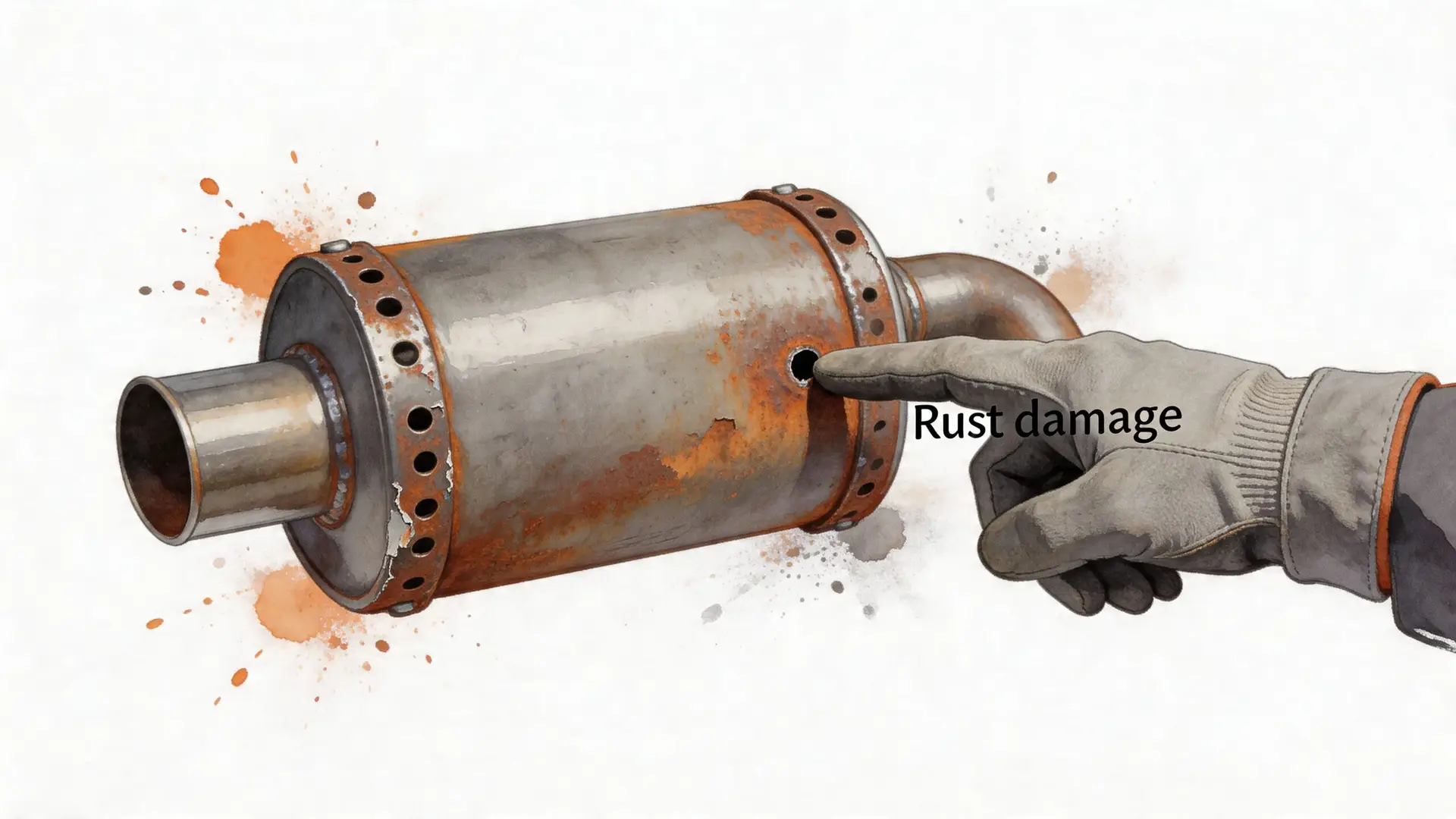
Sometimes the symptom isn’t a sound. It’s what you can see under the vehicle. Surface rust on exhaust parts is common, but heavy corrosion, flaking metal, split seams, and visible holes are different. Those are signs the muffler metal has thinned enough that it can no longer hold exhaust flow and heat properly.
In this area, that damage often sneaks up on drivers. Heat cycles, humidity, moisture trapped in the exhaust, and normal age all work against the muffler over time. Once corrosion gets advanced, patching rarely lasts very long.
What to look for under the car
You don’t need to be a technician to spot obvious warning signs. If you can safely see under the rear of the vehicle, look for rust around seams, dark soot near holes, and areas where the metal looks bubbled, cracked, or paper-thin.
Older vehicles in Keller often show this around the lower half of the muffler body. Multi-vehicle households and fleet units can hide the problem longer because the car still “runs fine,” but the shell keeps weakening until it leaks badly or starts to separate.
A common mistake is trying to buy time with a cheap patch on a badly rusted muffler. If the surrounding metal is already weak, the patch only covers one spot while the rest keeps failing.
- Photograph the damage: A clear photo helps compare progression if the vehicle won’t be repaired the same day.
- Inspect after rough weather: Moisture and grime under the car can speed up corrosion.
- Ask about replacement materials: Rust-resistant options can make sense if you plan to keep the vehicle.
3. Dragging or Hanging Muffler Below Vehicle
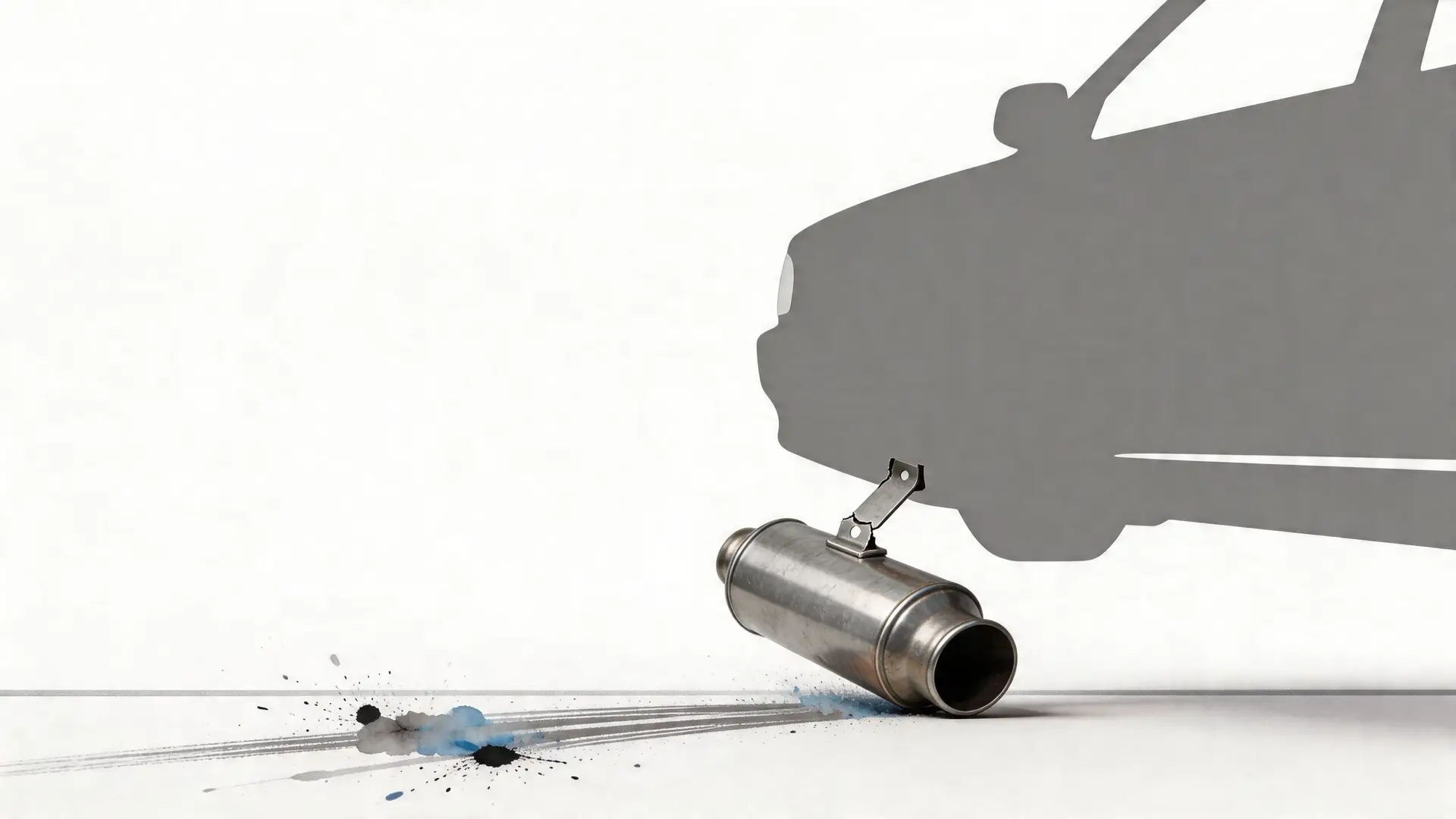
A muffler that’s hanging low or dragging is no longer a “keep an ear on it” problem. It’s an immediate safety issue. Usually the muffler itself hasn’t just failed. The mounting hardware, straps, or hangers have corroded, broken, or pulled loose, and now the exhaust system can drop enough to hit the road.
For delivery drivers and commuters in Haltom City, this often happens at the worst possible time. You back out of the driveway, hear a metal scrape, and realize something underneath is moving when it shouldn’t.
A hanging muffler can catch on pavement, tear away from the pipe, or leave parts in the roadway. It can also damage nearby exhaust sections when the weight shifts.
A quick visual helps show why this needs immediate attention:
Don’t keep driving it normally
Drivers sometimes make the problem worse. They hear scraping, then try to finish errands, hit speed bumps, or take rough side streets. That can turn a hanger repair into a full exhaust section replacement.
If the muffler is dragging, the right move is to limit driving and get it inspected right away. A technician needs to check all mounting points, not just the lowest one. If one hanger failed from corrosion, others may be close behind.
If the muffler is contacting the road, treat it like a same-day repair.
Fleet vehicles in particular need the brackets and supports checked as a set. Reattaching one point without addressing the rest often doesn’t hold up.
Here’s a short look at the kind of problem drivers often hear before they see it:
- Skip speed bumps and steep driveways: They can pull the muffler farther down.
- Ask for hardware inspection: Hangers, straps, clamps, and nearby pipe sections all matter.
- Don’t rely on a temporary tie-up: It may get you moving, but it isn’t a durable repair.
4. Strong Exhaust Odor or Smell of Burning Metal
If you smell exhaust outside the car, that’s a warning. If you smell it inside the cabin, that’s urgent. A bad muffler can let exhaust escape before it exits where it should, and a restricted or damaged exhaust section can also create a hot, acrid smell that some drivers describe as burning metal.
This is one of the bad muffler symptoms that people sometimes second-guess. They’ll say the smell only showed up in traffic, only at idle, or only with the windows down. That inconsistency doesn’t make it harmless. It usually means the leak or restriction changes with airflow, engine load, or where the vehicle is sitting.
Why smell matters
Commuters on Denton Highway often notice this at long lights or in slow traffic, when exhaust can collect around the vehicle more easily. A parent picking up kids in Haltom City may catch the smell in the cabin and assume it came from the car ahead. Sometimes it did. Sometimes it didn’t.
A burning-metal odor can also point to excessive heat in the exhaust system. That heat may come from internal muffler damage, blockage, or a related issue elsewhere in the system. If there’s also fluid underneath the vehicle, it’s smart to rule out unrelated problems such as engine oil leaks that can create their own burning smell.
Roll the windows down, get fresh air, and have the exhaust system checked before you keep using the vehicle normally.
What works here is broad diagnostics. The muffler may be the obvious suspect, but a good shop will also inspect nearby exhaust joints and the catalytic converter area. What doesn’t work is masking the smell with air fresheners and hoping it fades.
- Notice where you smell it: Inside cabin, near the rear of the car, or only at idle.
- Pay attention to heat: A hot-metal smell paired with weak performance needs quick diagnosis.
- Don’t ignore cabin fumes: Exhaust belongs outside the vehicle, not around passengers.
5. Loss of Vehicle Performance or Reduced Fuel Efficiency
Not every muffler problem starts with noise. Some show up at the pump first. If the muffler is clogged, collapsed internally, or otherwise restricting exhaust flow, the engine has to work harder to push gases out. That can leave the vehicle feeling sluggish and can hurt fuel economy at the same time.
A failing muffler can reduce fuel efficiency enough that regular drivers notice they’re stopping for gas more often. One verified benchmark notes that affected vehicles can see fuel economy drop by about 10 to 20 percent when muffler failure disrupts exhaust flow. That’s why performance complaints and mileage complaints often show up together.
What drivers usually notice first
In Haltom City, this often feels like weaker acceleration when merging, less smooth response climbing speed, or an engine that just seems to be working harder than usual. Busy professionals who drive the same route every day usually catch this quickly because they know what their normal fuel stops look like.
If your mileage has changed, it helps to compare it against basic fuel-saving habits too. Sometimes the issue is driving pattern or maintenance. Sometimes the exhaust is the primary cause. This guide on how to increase MPG is a useful reference point if you’re trying to separate normal efficiency loss from a mechanical problem.
Another clue is smoke. A muffler problem doesn’t always cause it directly, but if drivability changes come with black smoke from the exhaust, the vehicle needs inspection sooner rather than later.
What works is tracking the change. Reset a trip meter, note your fill-ups, and write down when the loss started. What doesn’t work is throwing parts at the problem because “it feels down on power.” Exhaust restriction, ignition issues, and fuel delivery problems can overlap in how they feel from the driver’s seat.
- Track fuel stops: A pattern matters more than one bad tank.
- Notice throttle response: Hesitation on takeoff can point to exhaust restriction.
- Get the whole exhaust checked: Muffler condition is part of a larger system.
6. Check Engine Light or Exhaust System Warning Codes
Modern vehicles don’t always wait for your ears to catch the problem. Sometimes the check engine light is the first clue. Muffler trouble can affect exhaust flow enough to trigger sensor-related faults, especially when the rest of the system is already sensitive to changes.
One verified benchmark notes that muffler-related exhaust problems can trigger the check engine light in 45 percent of cases through codes such as P0420. That doesn’t mean every P0420 is a muffler. It does mean the muffler belongs on the inspection list when the light comes on with noise, odor, or performance changes.
The code is a clue, not a conclusion
Drivers sometimes lose time and money. They scan a code, replace the first sensor mentioned online, clear the light, and the problem returns. Oxygen sensors react to what’s happening in the exhaust stream. They don’t always cause the issue.
If you want a quick background on how those sensors are positioned and why they matter, this explanation of the difference between upstream and downstream O2 sensor helps connect the warning light to the larger exhaust system.
For drivers in Watauga and Keller, the practical move is simple. Get the codes read, but don’t stop there. Have the shop match the code to what the vehicle is doing. A noisy exhaust, fuel smell, or rattling under the car gives context a scanner alone can’t provide.
A warning light tells you where to start looking. It doesn’t tell you which part to buy.
What works is code reading plus a physical inspection. What doesn’t work is clearing the light and waiting to see if it comes back while the exhaust issue keeps getting worse.
7. Water Pooling or Excessive Moisture Dripping from Muffler Area
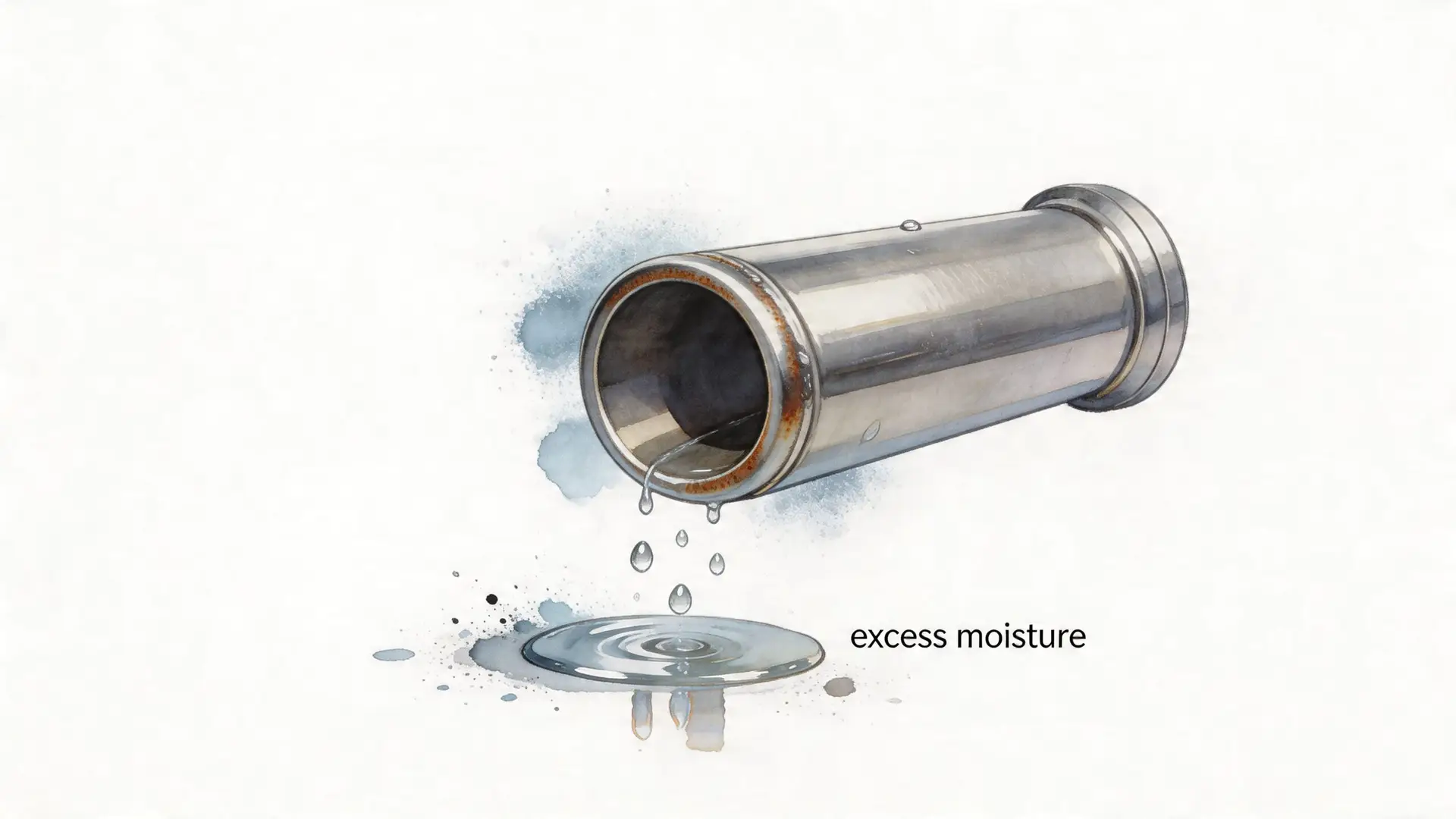
A little condensation from the exhaust can be normal, especially at startup. Excessive moisture from the muffler area is different. If you keep seeing a puddle under the rear of the vehicle, or the dripping seems heavier than it used to be, the muffler may have internal damage or corrosion that’s changing how moisture exits the system.
This symptom gets overlooked because water under a car doesn’t always seem serious. But location matters. Water from the front of the engine bay points you in one direction. Moisture from the muffler area points you somewhere else.
When dripping becomes a warning sign
In Haltom City neighborhoods, I’d pay attention if the puddle is showing up repeatedly in the same rear area and is paired with noise, rust, or a change in smell. That combination matters more than moisture by itself.
Internal baffles can deteriorate and let moisture move through the muffler differently. Rust holes can also let condensation and exhaust residue escape before they should. If the vehicle leaves staining in the parking space or the drip looks excessive after short drives, it’s worth inspecting.
What works is documenting the pattern. Take a photo, note whether it happens on cold starts or after longer trips, and mention any other symptoms with it. What doesn’t work is assuming every rear-of-car drip is harmless condensation for months while corrosion keeps spreading.
- Check the location: Rear-of-vehicle moisture isn’t the same as front-engine leakage.
- Watch for pairing symptoms: Dripping plus odor or noise deserves faster attention.
- Ask for an internal inspection: If the shell looks intact outside, internal damage may still be present.
8. Rattling, Clanking, or Vibration Noises from Under Vehicle
This sound is different from the deep roar of a leaking muffler. Rattling and clanking usually point to something loose. It could be broken internal baffles, worn mounting hardware, or a section of exhaust that shifts when the engine moves or the car hits a bump.
Some drivers feel it through the floorboard or hear it only at certain RPMs. Others notice it when backing out of a driveway, crossing rough pavement, or accelerating from a stoplight.
The noise pattern tells you a lot
A rattle at idle that goes away with more throttle often points to a loose shield or mounting issue. A metallic clank over bumps can mean the exhaust is moving more than it should. A vibration that gets stronger under acceleration may line up with a larger exhaust concern.
One of the more useful related reads for this symptom is rattle when accelerating, because it helps separate muffler-related noise from other under-vehicle or engine-load noises.
Drivers in Keller and Watauga often describe this as “something sounds loose underneath.” That’s usually a good description. The problem is that “loose” can mean inside the muffler or outside it. A visual inspection matters, and so does listening to when the sound appears.
What works is documenting the pattern before the appointment. Note whether it happens cold, warm, under load, over bumps, or only while idling in gear. What doesn’t work is waiting for the rattle to become a scrape, because that’s often the point where a loose exhaust section starts damaging neighboring parts.
If the sound changes with bumps or RPM, mention both. That detail can save time during diagnosis.
8-Point Bad Muffler Symptoms Comparison
| Symptom | 🔄 Implementation complexity | ⚡ Resource requirements | 📊 Expected outcomes | 💡 Ideal use cases | ⭐ Key advantages |
|---|---|---|---|---|---|
| Loud rumbling or roaring noise from under the vehicle | Medium, requires listening + visual check; may need replacement | Technician inspection, possible muffler repair/replacement; moderate time/cost | Significant noise reduction after repair; prevents further exhaust damage | Drivers noticing louder exhaust during acceleration or under load | Easily noticeable → prompts quick service and early detection |
| Visible rust, corrosion, or holes in the muffler | Low to medium, detection is visual; repair usually requires replacement | Visual inspection; likely new muffler (stainless option) and mounting parts; moderate cost | Restored structural integrity and reduced leaks; longer term durability if upgraded | Older or weather-exposed vehicles; annual undercarriage checks | Visually obvious → immediate severity assessment and clear next steps |
| Dragging or hanging muffler below vehicle | High urgency but low diagnostic complexity, safety issue | Immediate inspection/repair or tow; bracket replacement or welding; higher immediate cost | Eliminates road hazard and prevents undercarriage damage; restores safe operation | Vehicles with visible dragging/scraping or sparks at night | Immediate safety justification → prioritized repair |
| Strong exhaust odor or smell of burning metal | Medium–high, may indicate multiple component issues | Full exhaust and catalytic diagnostics, engine scan; specialized tools may be required | Identifies health risks and engine/exhaust faults; prevents further damage | Any cabin or external detection of sulfur/burning odors | Alerts to severe/systemic issues → prompts comprehensive evaluation |
| Loss of vehicle performance or reduced fuel efficiency | Medium, requires diagnostic testing to confirm root cause | Fuel tracking, exhaust diagnostics, possible replacement; moderate diagnostic time | Improved MPG and responsiveness after repair; reduces long-term fuel costs | Fleet managers or drivers tracking MPG declines over time | Fixing yields measurable economic benefits and performance gains |
| Check engine light or exhaust system warning codes | Low detection, medium diagnosis, needs code reading and interpretation | OBD-II scanner and technician analysis; targeted repairs guided by codes | Pinpoints problem source, reduces unnecessary parts replacement | Any vehicle with an illuminated check engine light | Provides specific diagnostic direction → more accurate and efficient repairs |
| Water pooling or excessive moisture dripping from muffler area | Low detection, medium severity assessment, distinguish condensation vs. failure | Visual inspection, borescope if available; likely replacement if baffles failed | Stops corrosion progression; confirms internal damage and need for replacement | Vehicles with puddles or staining under muffler after parking | Visual symptom → clear indicator replacement is needed before wider damage |
| Rattling, clanking, or vibration noises from under vehicle | Medium, requires road test and focused inspection | Audio/visual diagnostics, possible bracket tightening or muffler replacement | Eliminates metallic noises; prevents internal part loss or further damage | Drivers sensing metallic noise or vibration at certain RPMs | Distinctive early warning sign → often repairable if addressed promptly |
Your Next Step for a Quiet, Safe, and Efficient Ride
A healthy muffler does more than keep your car quiet. It helps the whole exhaust system do its job properly, keeps cabin comfort where it should be, and supports the kind of smooth drivability most drivers take for granted until something changes. When bad muffler symptoms start showing up, your vehicle is telling you something has already begun to fail.
Some symptoms are obvious, like loud roaring, scraping, or a hanging muffler. Others are easier to dismiss, like a slight exhaust smell, extra moisture at the rear of the car, or a check engine light that doesn’t seem to affect how the vehicle runs yet. Those quieter warnings still matter. Muffler problems rarely improve on their own, and they often spread into pipes, brackets, and related exhaust components if the vehicle keeps being driven the same way.
For local drivers in Haltom City, daily conditions make early attention even more important. Denton Highway traffic means lots of idling, stop-and-go use, and repeated heat cycles. Add Texas humidity, uneven road surfaces, and normal vehicle age, and it’s easy to see why muffler issues show up in cars that otherwise seem dependable.
The smartest move is to match the symptom to the urgency. If you smell exhaust in the cabin, hear scraping, or see the muffler hanging, get it checked right away. If the problem is more gradual, like worsening fuel economy, a rattle, or visible rust, don’t let it sit for months just because the car still starts and drives. That delay is what turns a manageable repair into a broader exhaust job.
A professional inspection should answer a few simple questions. Is the muffler itself failing, or is the issue farther forward or backward in the exhaust system? Are the hangers, clamps, and pipes still solid? Is a repair realistic, or is replacement the better long-term choice? Good diagnosis saves money because it keeps you from replacing the wrong part first.
If you’ve noticed any of the symptoms on this list, the team at Express Lube & Car Care can help you sort it out quickly and clearly. They’re conveniently located at 6211 Denton Hwy in Haltom City, and they handle the kind of real-world diagnostic work local drivers need, especially when a noise, smell, or warning light doesn’t point to just one obvious cause.
Don’t wait for a loud muffler to become a dragging one, or for a small leak to turn into a larger exhaust repair. A timely inspection gives you a clearer answer, a safer vehicle, and a quieter drive through Haltom City and the surrounding area.
If your car has gotten louder, started rattling, or smells like exhaust, schedule an inspection with Express Lube and Car Care. Their Haltom City team can inspect the muffler, check the full exhaust system, and help you decide on the right repair before the problem gets worse.