
That new rattle on Belknap, the squeal when you back out of the driveway in Haltom City, or the clunk that shows up every time you hit a rough patch on Denton Highway usually isn't random. Cars rarely get louder for no reason. Most noises start as a small warning, then turn into a repair that costs more and takes longer once the damage spreads.
For local drivers, that matters because daily stop-and-go traffic, short trips, rough pavement, and hot Texas weather all put stress on belts, brakes, cooling systems, and suspension parts. If you catch the sound early, you often keep the repair simpler. If you wait, you risk turning a single worn part into a chain reaction.
This guide to common car noises and what they mean is built for real-world driving around Haltom City. The goal isn't to turn you into a full-time diagnostician. It's to help you notice where the sound happens, what it resembles, and how quickly you need to act. A squeal at startup means something different from a grind while braking. A rattle over bumps points you in one direction. A hiss under the hood points you in another.
If you're also sorting out electrical oddities, this guide on why your car alarm keeps going off covers another problem local drivers run into.
1. Squealing Belt Noise
A sharp squeal from the engine bay, especially on a cold morning or right when you accelerate, usually points to the serpentine belt or the belt tensioner. The belt runs several important accessories, so when it slips, hardens, cracks, or loses proper tension, you hear it.
In the shop, one of the first questions is when the sound happens. If it squeals only at startup, the belt may be glazed or stiff. If it comes and goes with steering input or A/C use, the system may be under extra load and exposing a weak belt or tensioner.
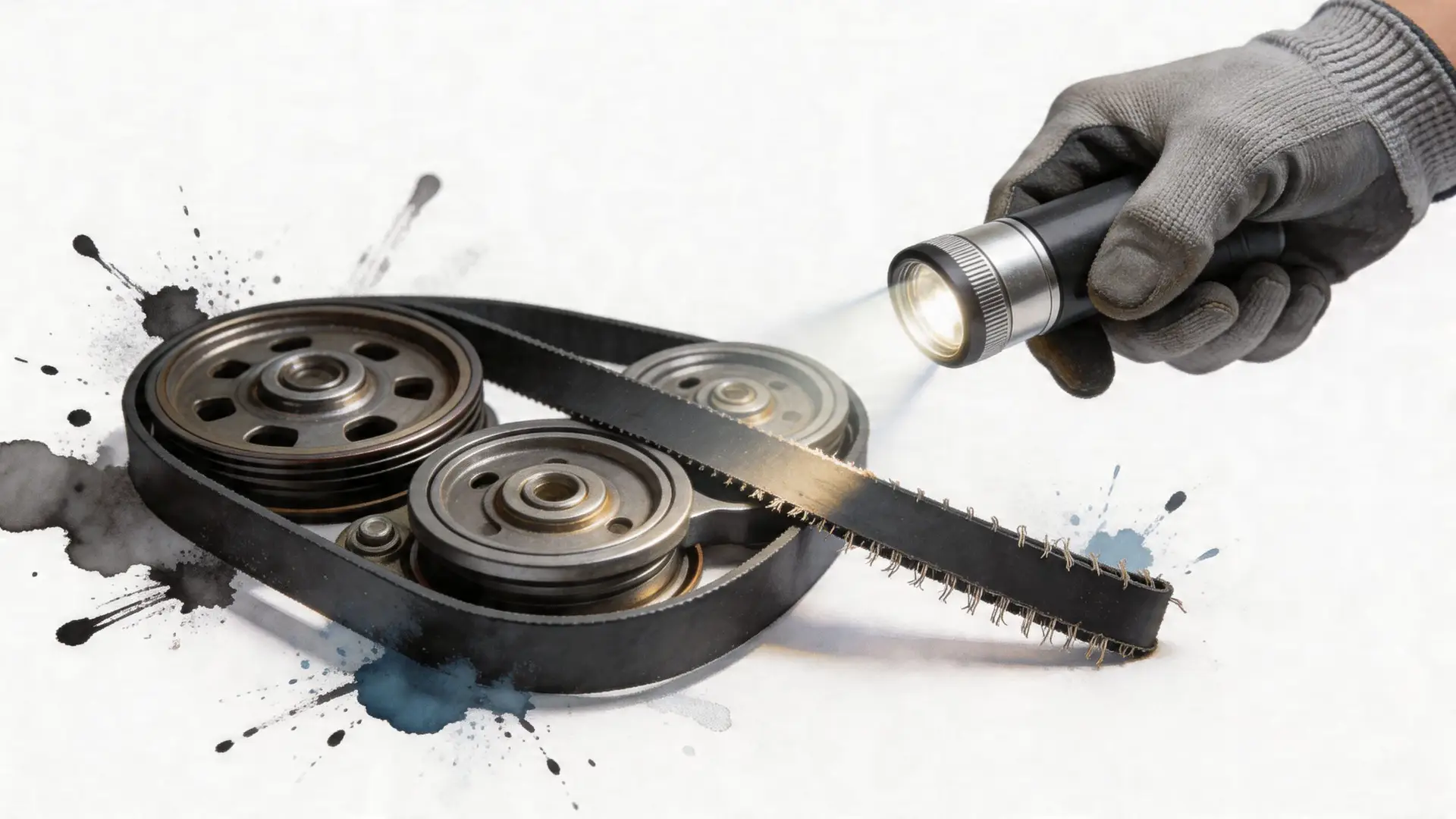
A common example is a commuter sedan that sounds fine once it's warm but squeals every morning in the first few seconds after startup. Another is a work truck that chirps under load with the A/C on. Both can come from belt wear, but the fix isn't always the same. Sometimes the belt is the problem. Sometimes the tensioner pulley or an accessory pulley is no longer tracking smoothly.
What works and what doesn't
Spraying belt dressing on a noisy belt usually doesn't solve the root problem. It may quiet the sound briefly, but it doesn't correct cracking, glazing, weak spring tension, or pulley misalignment. A proper inspection does.
Useful details to tell your technician:
- When it happens: Cold start, acceleration, A/C on, steering turns, or all the time.
- How long it lasts: A quick chirp is different from a constant squeal.
- Recent work: A new alternator, battery, or A/C repair can change belt routing or tension.
If your vehicle is making this sound, it's worth reading more about a car belt making noise.
Practical rule: Belt noise is often a short window to fix something cheaply before you're dealing with a no-charge condition, hard steering, or an overheating issue tied to a belt-driven component.
2. Brake Grinding or Squeaking
Brake noise is one sound you never want to shrug off. A light squeak can be an early warning from the pad wear indicator. A grinding sound is much more serious. In automotive diagnostics, grinding brakes point to metal-on-metal contact between worn pads and rotors, and quick-reference service guides classify that as high urgency. Standard OEM guidance for many sedans and SUVs treats pad thickness below 3 mm as the point where the wear indicator starts contacting the disc and creating the warning sound, as noted in this brake grinding reference.
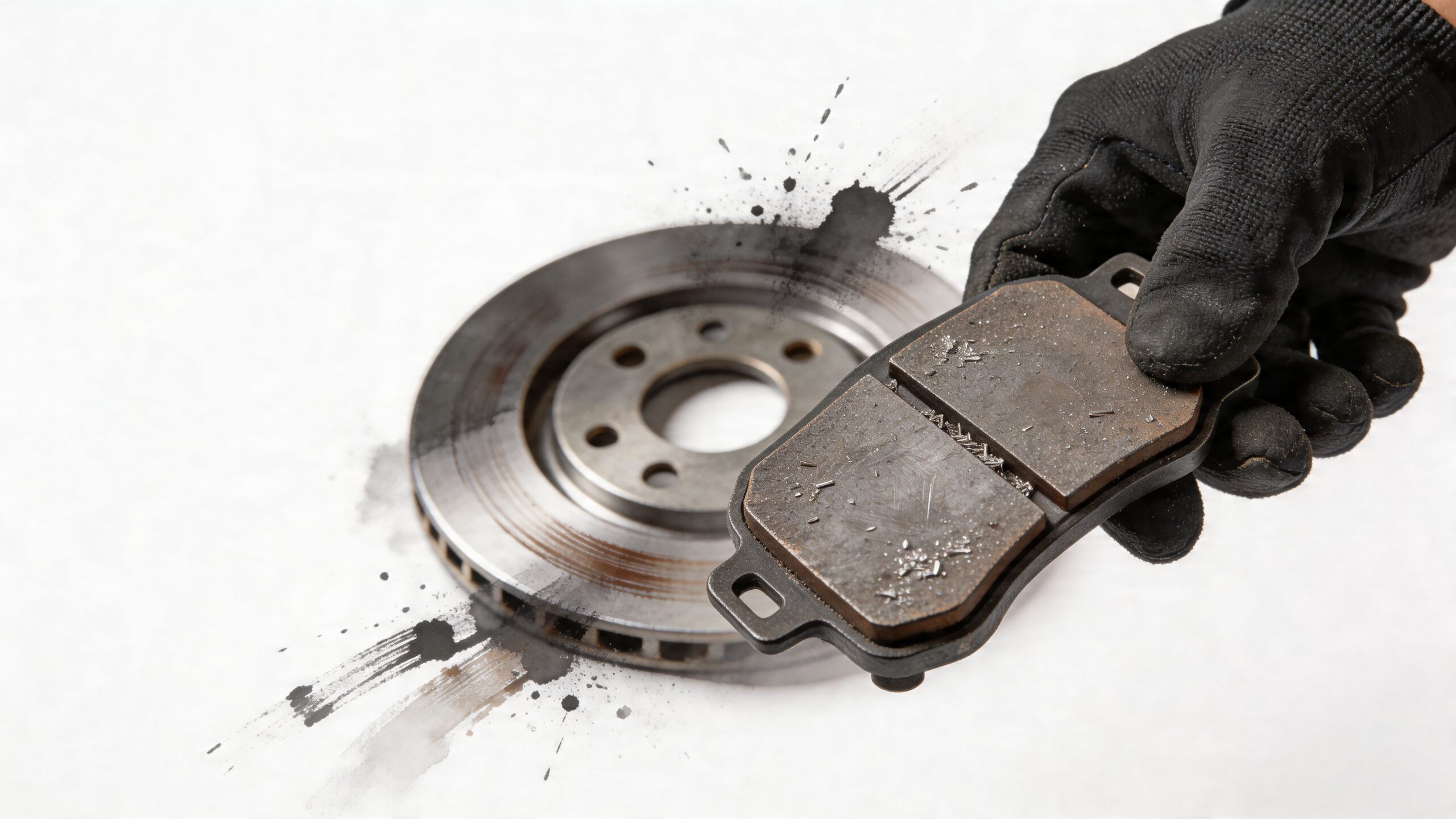
That difference matters. Squeaking often means you still have a chance to replace pads before the rotor gets chewed up. Grinding usually means the pad friction material is gone or nearly gone, and the backing plate is cutting into the rotor.
A Haltom City driver might notice this in two common ways. First, a commuter hears a squeak only when coming to a stop at neighborhood speeds. Second, a delivery vehicle starts making a harsh grind every time the brake pedal is applied. The second vehicle shouldn't stay in service.
What the sound usually tells us
Brake squeak doesn't always mean total failure. Dust, pad material, rotor condition, and moisture can all influence noise. But repeat squeaking during normal braking is enough reason to inspect the system.
Grinding is different. It's a stop-and-address-it-now symptom.
For more detail on the early warning side of the problem, this explanation of why brakes squeak is useful.
Later in the process, a visual inspection and road test tell the story much faster than guessing from the driver's seat.
If the noise changes the moment you touch the brake pedal, treat the brake system as the first suspect until proven otherwise.
3. Clicking or Knocking From Engine
A metallic clicking, pinging, or knocking sound from the engine under load usually gets more serious attention than owners expect. If it shows up during acceleration, climbing a hill, or pulling away from a stop, it can point to pre-detonation, also called engine knock.
This happens when combustion doesn't occur the way the engine expects. Instead of a controlled burn, the fuel mixture ignites irregularly and creates the sharp knock you hear. Common causes include incorrect fuel grade, carbon buildup, ignition timing problems, and sensor issues. A faulty knock sensor can also keep the computer from correcting the problem properly.
A real-world example is the driver who switches to a lower octane fuel than the manufacturer recommends and starts hearing pinging under throttle. Another is a higher-mileage engine that sounds fine at idle but knocks when merging onto the highway. The sound may be intermittent, but the risk isn't.
What drivers can notice before the inspection
Listen for patterns instead of trying to name the exact failure. Does the knock happen:
- Under load: During hills, passing, or strong acceleration
- When hot: After the engine is fully warmed up
- With a full tank from a new station: Fuel quality can change how the engine behaves
- Alongside a warning light: That helps narrow down sensor and timing issues
Don't confuse engine knock with a loose heat shield or a small rattle at idle. The location and trigger matter. A true combustion knock often follows throttle input.
If your car has a lighter rattle when sitting still, this guide on engine rattling at idle can help you compare symptoms.
A quick fix in this situation usually doesn't exist. Fuel additives sometimes help in limited cases, but they don't replace diagnosis. If the engine is knocking regularly, the smart move is to inspect it before internal damage starts.
4. Grinding or Clunking When Starting
If the noise only happens when you turn the key or press the start button, focus on the starting system first. A grinding or clunking sound during startup often points to a worn starter motor, a damaged starter drive gear, weak electrical delivery, or trouble with the flywheel engagement.
This noise has a very specific timing. You hear it at the moment the engine is being cranked, not while driving down the road. That's a useful distinction because it separates starter issues from belt noise, suspension noise, or transmission-related sounds.
A typical example is an older pickup that starts fine most days but occasionally makes a harsh grind before the engine catches. Another is a compact car that gives one heavy clunk and then hesitates before cranking. Sometimes the problem is inside the starter. Sometimes low battery voltage keeps the starter from engaging cleanly.
Start with the basics, then test the system
Before replacing parts, test the battery and cable condition. A weak battery can create misleading symptoms. Corrosion at the terminals can do the same thing. But if the battery checks out and the noise remains, the starter and its engagement with the flywheel need attention.
Watch for these clues:
- Single clunk, no crank: Electrical supply or starter solenoid problem
- Grinding while cranking: Starter gear isn't meshing correctly
- Intermittent no-start with noise: Early-stage starter failure
- Repeated clicking: Often points to voltage or connection issues first
If you're comparing symptoms, this article on bad solenoid symptoms is a good reference.
Shop advice: Startup noises rarely heal themselves. If the starter is beginning to fail, the next step is often getting stranded in a parking lot at the worst time.
5. Clunking or Rattling Suspension
A clunk over bumps tells you something underneath the vehicle has developed play. In most cases, that points to worn shocks, tired struts, loose sway bar links, deteriorated bushings, or other suspension hardware that no longer holds things tight.
This is one of the easiest sounds for drivers to describe and one of the easiest to misidentify. People often say, "It sounds like something's loose under there." That's a good starting point, but the road condition matters. If it only happens over speed bumps, potholes, driveway entries, or uneven pavement, suspension is high on the list.
One SUV may clunk from the front end every time it crosses railroad tracks. A small crossover may rattle from the rear on rough neighborhood streets. A pickup can feel fine at speed but knock over low-speed dips. Those are different patterns, and they help narrow down whether the issue is with links, mounts, struts, or bushings.
Why self-diagnosis gets tricky
Drivers often struggle to separate rattling, buzzing, clunking, and knocking. Background guidance on car-noise descriptions notes that most content lists sounds generically without helping non-experts match what they're hearing to a likely source, and anecdotal trends cited there say many drivers have trouble deciding whether a sound is rattling or buzzing, as discussed in this car noise descriptions guide.
For suspension sounds, the best clue is repeatability. If you can make the noise happen over the same bump, at the same steering angle, or with the same amount of body roll, that helps the shop duplicate it.
What usually helps most:
- Note the location: Front left, front right, rear, or "sounds centered underneath"
- Name the trigger: Bumps, braking, turning, reversing, or driveway transitions
- Don't wait too long: Suspension noise tends to spread wear into nearby parts
Replacing shocks or struts in pairs is usually the better repair. Replacing one side only can leave the vehicle feeling uneven, especially in braking and cornering.
6. Hissing or Steaming From Engine
A hiss under the hood deserves quick attention. If you also see steam, smell hot coolant, or notice the temperature climbing, stop driving as soon as it's safe. This usually points to a coolant leak, an overheating condition, or pressure escaping from the cooling system.
Cooling systems fail in a few common ways. A radiator can leak, a hose can split, a water pump can fail, or a thermostat can stop coolant from circulating properly. In each case, the sound is your warning that hot pressurized coolant or vapor is escaping where it shouldn't.
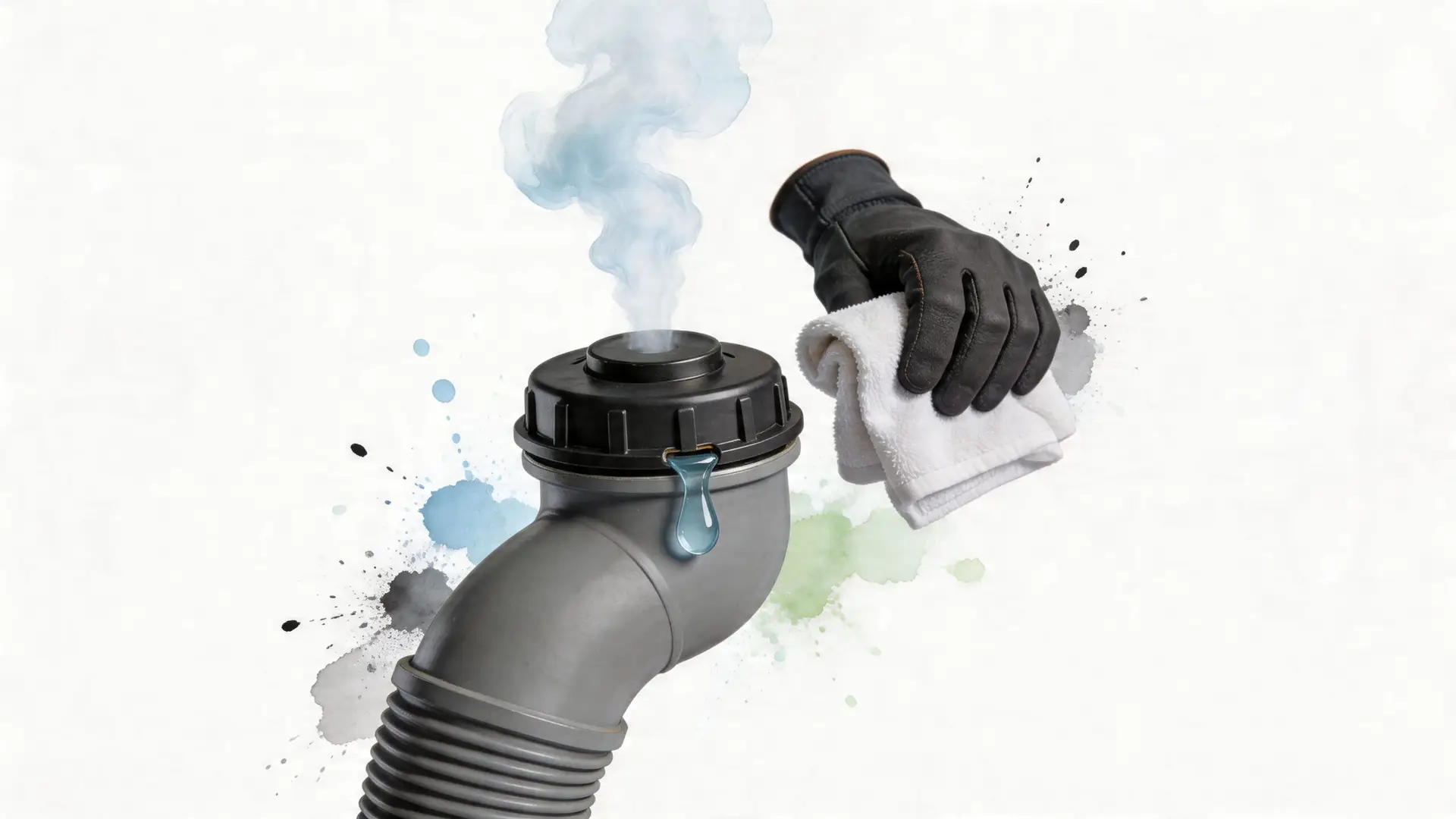
Around Haltom City, this often shows up after a short errand when the driver parks and hears a sharp hiss from the engine bay. In worse cases, steam appears at a stoplight or after highway driving on a hot day. Once steam is visible, the conversation shifts from convenience to preventing engine damage.
What to do right away
Do not open a hot radiator cap. Let the engine cool fully before checking anything. Opening the system while it's still hot can cause serious burns.
Use this sequence instead:
- Pull over safely: Shut the engine off if the gauge is rising or steam is visible.
- Let it cool: Give the system time before looking under the hood.
- Check for obvious leaks later: Wet spots, coolant residue, or a low reservoir level can help the diagnosis.
- Arrange service promptly: A small coolant loss can become a major overheating event fast.
A hiss with steam is not a "see if it makes it home" noise. It is a "shut it down before the engine gets hurt" noise.
7. Grinding or Scraping Noises When Turning
A grinding or scraping noise in a turn usually means something in the front end needs attention. Around Haltom City, drivers often notice it first pulling into a driveway, easing through a parking lot, or making a tight turn onto Denton Highway. The usual suspects are CV joints, wheel bearings, brake dust shields rubbing, or steering and suspension parts that have developed play.
The sound itself matters. A steady clicking on a tight turn often points to an outer CV joint. A rough scrape that changes as the wheel angle changes can suggest shield contact, bearing trouble, or another rotating part touching where it should not. Drivers do not need to diagnose the exact part at home, but they should notice when the noise happens and what makes it worse.
One simple check can help. In an empty, quiet lot, turn the wheel fully left and creep forward. Then do the same to the right. If the noise is stronger in one direction, that gives a shop a better starting point and can shorten diagnostic time.
Don't confuse turning noise with normal system sounds
In our shop, we have seen some Haltom City drivers mistake normal hybrid or EV operating sounds for a mechanical problem, especially on newer vehicles that make more motor and regenerative braking noise than older gas models. That said, a true scraping or grinding sound during a turn still deserves a proper inspection.
The trade-off is simple. If the issue is light shield contact or a minor issue, the fix may be straightforward. If a CV boot has torn, grease has likely already escaped and road grit has gotten in. At that point, joint wear speeds up, and the repair usually gets more expensive the longer it is left alone.
Pay attention to steering feel, too. If the wheel feels rough, loose, or like it wants to bind, stop guessing and get it checked. That combination points to a problem that can affect control, not just noise.
Helpful notes to give the technician at Express Lube & Car Care on Denton Hwy:
- Type of turn: Tight parking-lot turn or normal corner
- Left or right: One side often gets louder under load
- Under power or coasting: Some parts make noise only while accelerating
- Steering feel: Vibration, looseness, or resistance in the wheel
8. Rattling or Banging From Exhaust
A metal rattle from underneath the car often turns out to be exhaust-related. Loose heat shields, aging muffler hangers, damaged pipes, or hardware around the catalytic converter can all create a sound that seems worse over bumps or when you accelerate from a stop.
This noise can fool people because it travels through the floor pan. Drivers think it's in the trunk, the suspension, or even inside the cabin. But when the pitch is metallic and the sound comes from under the middle or rear of the vehicle, exhaust parts move high on the list.
A common example is a small car with a heat shield that vibrates only at certain RPM. Another is an older vehicle with a muffler that has started to hang lower than it should. The driver hears a bang over bumps because the exhaust assembly is shifting on worn mounts.
Why you shouldn't put this off
Exhaust issues often start as an annoyance, but they can progress. A loose shield may be simple. A dragging pipe or separated hanger can become a road hazard. Exhaust leaks can also change the way the vehicle sounds and smells.
What usually works best is a proper undercar inspection rather than guessing from the driveway. Tapping on parts while the car is cold can sometimes reveal a loose shield, but many problems only show up when the system is hot and vibrating under load.
Useful clues to give the shop:
- Noise location: Middle, rear, or one side of the car
- Trigger: Idle, acceleration, bumps, or startup
- Recent impact: Curb strike, road debris, or rough pavement
- Sound type: Tinny rattle, heavy bang, or scraping underneath
If the sound suddenly gets louder and the vehicle seems much noisier overall, don't assume it's harmless. Exhaust failures tend to get worse, not better.
8 Common Car Noises and Their Likely Causes
If your car starts making a new noise on Denton Highway, Highway 121, or even pulling out of the driveway in Haltom City, the sound usually points you toward the system that needs attention. This table gives you the short version. What the noise often means, how involved the repair usually is, and how quickly it should be checked.
| Issue | Repair Difficulty | Cost and Time | Likely Result | Common Situations | Practical Advice |
|---|---|---|---|---|---|
| Squealing Belt Noise. Worn serpentine belt or weak tensioner | Low to Medium | Moderate cost, often a quick repair | Restores quiet accessory operation and lowers the chance of belt failure | Squeal on cold starts, during acceleration, or when accessories are on | Check it during routine service. A glazed belt or weak tensioner rarely gets quieter on its own. |
| Brake Grinding or Squeaking. Worn pads, rotor damage, or brake hardware issues | Low to Medium | Pads may be straightforward. Rotors or calipers raise the cost. | Improves braking performance and stops metal to metal wear | Noise while braking, reduced stopping confidence, vibration, or pull | Treat grinding as urgent. In the shop, I usually find the bill stays smaller when drivers come in at the squeak stage instead of the grind stage. |
| Clicking or Knocking From Engine. Detonation, valvetrain wear, or internal engine trouble | High | Diagnostic time first. Repair cost depends on the cause. | Helps prevent heavier engine damage | Knocking under load, uphill, during acceleration, or with a warning light | Do not guess with fuel additives and hope. The right fix depends on whether the sound is spark knock, top end noise, or something deeper. |
| Grinding or Clunking When Starting. Starter, flywheel, battery, or connection problem | Low to Medium | Usually manageable if caught early | Restores dependable starts and helps avoid a no start situation | Grinding only during startup, repeated click then crank, or intermittent starting trouble | Have the battery and cables tested before replacing parts. A weak electrical supply can mimic a starter problem. |
| Clunking or Rattling Suspension. Worn struts, sway bar links, bushings, or mounts | Medium to High | Moderate to higher cost. Alignment may be needed after repair. | Improves ride control, tire wear, and stability | Clunks over bumps, rattles on rough streets, loose feel in turns | Haltom City roads can expose worn front end parts quickly. Suspension noise is often a safety and tire wear issue, not just a comfort issue. |
| Hissing or Steaming From Engine. Coolant leak, overheating, or pressure loss | Medium to High | Cost ranges widely. Timing matters more than price here. | Helps prevent severe overheating damage | Steam from under the hood, rising temp gauge, coolant smell, or visible leak | Shut it down and let it cool. Driving overheated for even a short stretch can turn a hose repair into major engine work. |
| Grinding or Scraping Noises When Turning. CV joint, wheel bearing, brake backing plate, or steering issue | Medium | Moderate cost. Delay can make it more expensive. | Restores safer turning and can prevent axle or bearing failure | Noise on tight turns, parking lot maneuvers, or when the wheel is fully turned | If the sound changes with steering angle, get it checked soon. Front wheel drive vehicles commonly point to CV joint problems here. |
| Rattling or Banging From Exhaust. Loose heat shield, hanger, muffler, or damaged exhaust section | Low to Medium | Often affordable if caught early | Reduces noise and stops parts from dragging or breaking loose | Rattle at certain RPM, bang over bumps, or noise under the middle or rear of the car | An undercar inspection usually settles this fast. At Express Lube & Car Care on Denton Hwy, this is the kind of noise we can often pinpoint once the vehicle is on the lift and the exhaust is checked cold and under load. |
Your Next Step for a Quieter, Safer Ride in Haltom City
Most strange vehicle sounds fall into one of two categories. They're either an early warning, or they're the sound of damage already happening. The hard part for most drivers isn't hearing the noise. It's deciding whether they can wait, whether they can keep driving, and whether they're describing it correctly.
That's where a local shop helps. You don't need to walk in with the exact failed part named. You just need to tell the technician what you heard, when it happens, whether it changes with braking, turning, acceleration, bumps, or startup, and whether the sound has gotten worse. Those details save time and keep the diagnosis focused.
For common car noises and what they mean, there are a few practical rules worth remembering. Brake grinding is urgent. Steam or hissing from the engine is urgent. Startup grinding can leave you stranded without much warning. Engine knock deserves attention before it turns expensive. Suspension and exhaust noises may not always stop the car today, but they rarely stay cheap if you ignore them.
At Express Lube & Car Care, the approach is straightforward. Listen to the symptom, inspect the system that's most likely involved, confirm the cause, then recommend the repair that resolves the issue. That matters because guessing wastes money. Replacing parts based on a vague noise description alone is how people end up paying for work that didn't solve the problem.
For Haltom City drivers, convenience matters too. If you're balancing work, school pickup, deliveries, or fleet use, downtime matters almost as much as the repair itself. Fast, accurate diagnosis is what keeps a strange squeal from turning into a missed day, and what keeps a warning noise from becoming a tow-in.
If your car has started making a sound that wasn't there last week, trust that change. New noise, louder noise, or a noise tied to a specific action usually means the vehicle is asking for attention. Bringing it in early gives you more options.
Express Lube & Car Care serves drivers right here at 6211 Denton Hwy with practical diagnostics, clear communication, and repair recommendations you can understand. If something sounds off, let a technician hear it before the problem grows.
If your vehicle is squealing, grinding, hissing, rattling, or clunking, don't wait for the sound to make the decision for you. Schedule an inspection with Express Lube and Car Care in Haltom City and get a clear answer from a local team that knows how to track down the problem and fix it right.