
You walk out of a store in Haltom City, glance back at your car, and spot a bright puddle under the front end. Your stomach drops a little. You wonder if it’s safe to drive home, whether it’s “just water,” or if you’re one traffic light away from an overheated engine on Denton Highway.
That reaction makes sense. A car coolant leak can go from small nuisance to major engine trouble fast, especially in North Texas where summer heat puts extra strain on every hose, seal, and plastic tank under the hood. The good news is that coolant leaks usually leave clues. If you know what to look for, you can catch the problem early and avoid the kind of repair that ruins your week.
That Puddle Under Your Car A Driver’s First Sign of Trouble
A lot of drivers first notice a coolant problem in the same simple way. They back out of a parking spot in Haltom City, Keller, or North Richland Hills and see a green, orange, or pink puddle on the pavement. Sometimes it’s just a few drops. Sometimes it’s enough to make you think, “I probably shouldn’t ignore this.”
That’s the right instinct.
Coolant is one of those fluids people often confuse with water from the A/C system, power steering fluid, or even oil. If you’re not sure what color you found under the car, it helps to compare it with other leak types. This guide on brown fluid leaking from a car can help rule out some common lookalikes.
Why this puddle matters
A coolant leak means the engine may not have enough fluid to carry heat away. If the level keeps dropping, the engine can run hotter than it should. In North Texas traffic, where cars spend plenty of time idling at lights and crawling in construction zones, that’s not a risk you want to gamble on.
Sometimes the leak is minor, like an aging hose or a weak clamp. Other times it points to a bigger issue deeper in the cooling system. The puddle itself doesn’t tell the whole story, but it does tell you one important thing.
Don’t treat coolant on the ground like a harmless drip. It’s the cooling system asking for attention.
What to do first
Before you panic, do three things:
- Notice the location: Is the puddle near the front center, passenger side, or farther back?
- Check the color: Coolant is often bright and easy to spot compared with darker fluids.
- Watch the temperature gauge: If it’s climbing higher than normal, the problem may already be getting worse.
A coolant leak is serious, but it isn’t mysterious once you know how the system works.
What Is Car Coolant and Why It Matters for Your Engine
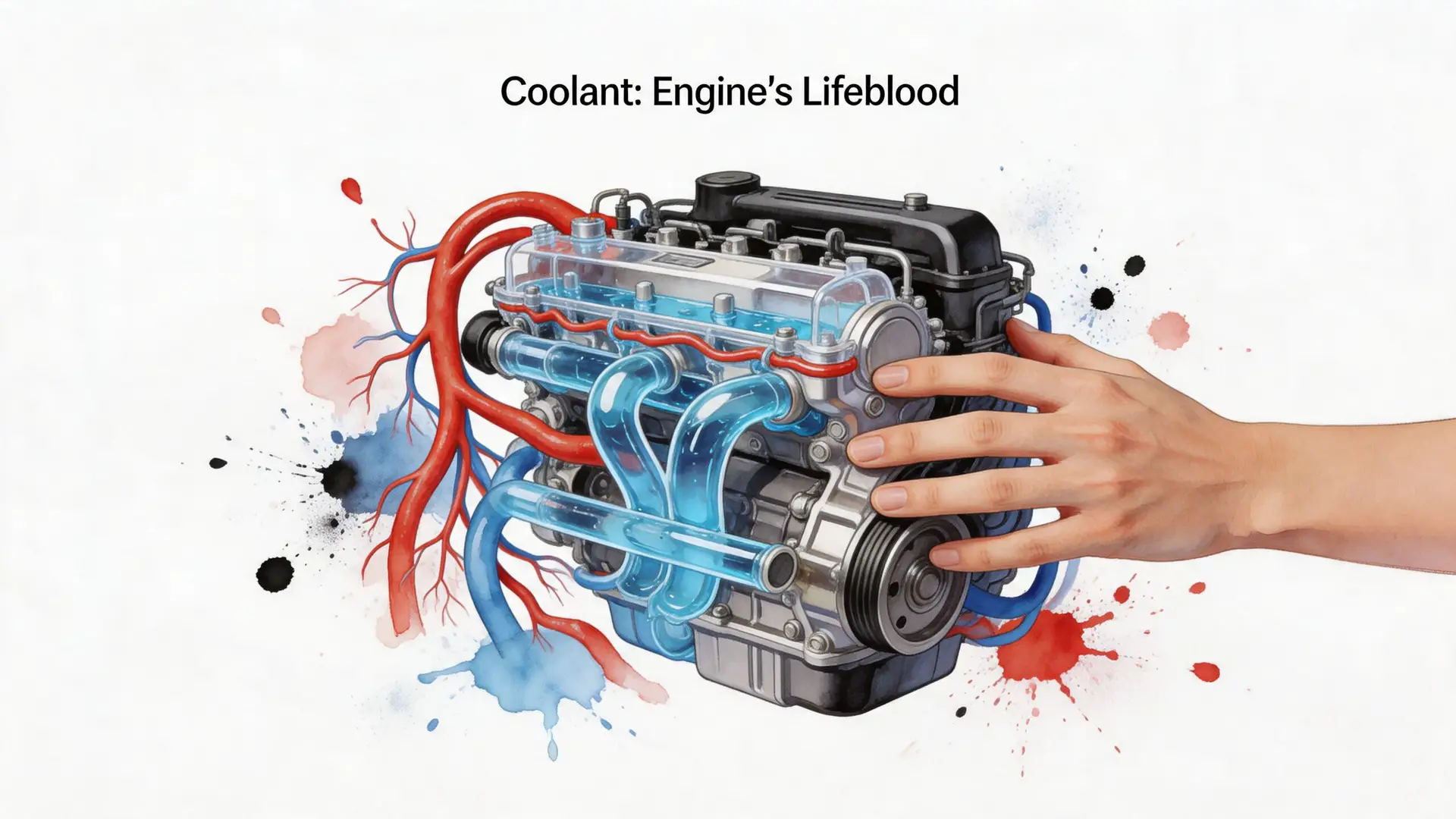
Your cooling system works a lot like your body’s circulatory system. The engine is the part creating heat, the radiator acts like a heat exchanger, and coolant is the fluid moving through passages and hoses to carry that heat away. If that fluid leaks out, the system can’t do its job.
That’s why coolant matters so much. It doesn’t just keep a car from overheating in August. It also helps prevent freezing in cold weather and protects metal parts inside the system from corrosion year-round.
Coolant is more than antifreeze
A lot of people use “coolant” and “antifreeze” like they mean exactly the same thing. In everyday conversation, that’s common. In practice, what’s in your vehicle is a specific coolant formula designed for your engine and cooling system materials.
You’ll usually see coolant in colors like green, orange, or pink. The color can hint at the type, but color alone isn’t a safe way to choose what belongs in your car. Different vehicles call for different formulas, and mixing the wrong types can create more problems than it solves.
If you want a simple breakdown of how heat moves through the system, this overview of how car radiators work is a good companion read.
The parts that usually age out first
The most common wear items are the rubber pieces. Rubber hoses and seals in a vehicle’s cooling system typically last 4 to 10 years before wearing out due to constant exposure to heat, pressure, and vibration, according to Car.co.uk’s coolant leak guide. That same source notes that routine inspections are critical, and a coolant level drop after 30,000 to 60,000 miles can signal a developing leak.
In plain language, hoses don’t fail because you did something wrong. They age. They harden, soften in the wrong places, crack, or lose their ability to seal tightly.
Why North Texas drivers should pay attention
Heat speeds up wear. So does stop-and-go driving, long commutes, and regular pressure changes as the engine heats up and cools down. That’s why a car that seems “fine yesterday” can show a leak today.
Here’s the practical takeaway:
- Coolant protects against overheating
- Coolant also fights corrosion
- The wrong coolant can cause compatibility problems
- Old hoses and seals are common leak points
- Small losses today can become breakdowns later
If coolant is the engine’s lifeblood, a leak is blood loss. Maybe slow. Maybe sudden. Either way, the system needs to stay sealed to keep the engine healthy.
The Telltale Signs of a Developing Coolant Leak
A coolant leak doesn’t always announce itself with a big puddle. A lot of leaks start with subtle clues that drivers shrug off for days or weeks. If you know the pattern, you can catch the issue sooner.
What you can see
Start with your eyes. Look under the car after it’s been parked. Then look under the hood, especially around hose connections, the radiator area, and the coolant reservoir.
Common visual signs include:
- Colored drips or spots: Coolant often leaves green, orange, or pink fluid under the car.
- Crusty residue: Dried coolant can leave a chalky or crusty trail near a fitting or seam.
- Low reservoir level: The coolant in the overflow bottle should sit between the MIN and MAX marks when checked properly.
- Steam from under the hood: That can mean coolant is leaking onto a hot surface and burning off.
If you see white smoke from the exhaust along with coolant loss, that can point to an internal problem rather than an external drip.
What you can smell
Coolant has a distinct sweet smell. If you notice that odor after parking, while idling, or through the vents with the heater or A/C on, pay attention. Drivers often describe it as syrupy or chemical-sweet.
That smell matters because a leak doesn’t always hit the ground. Sometimes coolant seeps onto a hot engine part and burns away before it forms a puddle.
Practical rule: If you smell sweet coolant and can’t find a puddle, don’t assume the problem disappeared. It may be evaporating before you can see it.
What the dashboard may be telling you
Your car may warn you before the engine gets dangerously hot. The most obvious sign is the temperature gauge creeping higher than normal. Some cars also trigger a low coolant warning light.
Watch for this combination:
- Gauge running warmer than usual
- Heater performance changing
- Low coolant warning
- Intermittent steam or smell after shutdown
That cluster usually means the system isn’t staying full and pressurized.
How to check safely
Only inspect coolant levels when the engine is cool. Never remove a radiator cap on a hot engine. Pressure inside the cooling system can release scalding fluid.
When the engine is cool, check the reservoir:
- Look at the side of the bottle: Most tanks are translucent enough to see the level.
- Find the MIN and MAX lines: The level should be in that range.
- Watch the trend over time: A small drop that keeps repeating is more important than one isolated reading.
A developing car coolant leak is often a pattern, not a single event. Smell, temperature, residue, and fluid level usually tell the story together.
Common Causes of Coolant Leaks in North Texas Vehicles
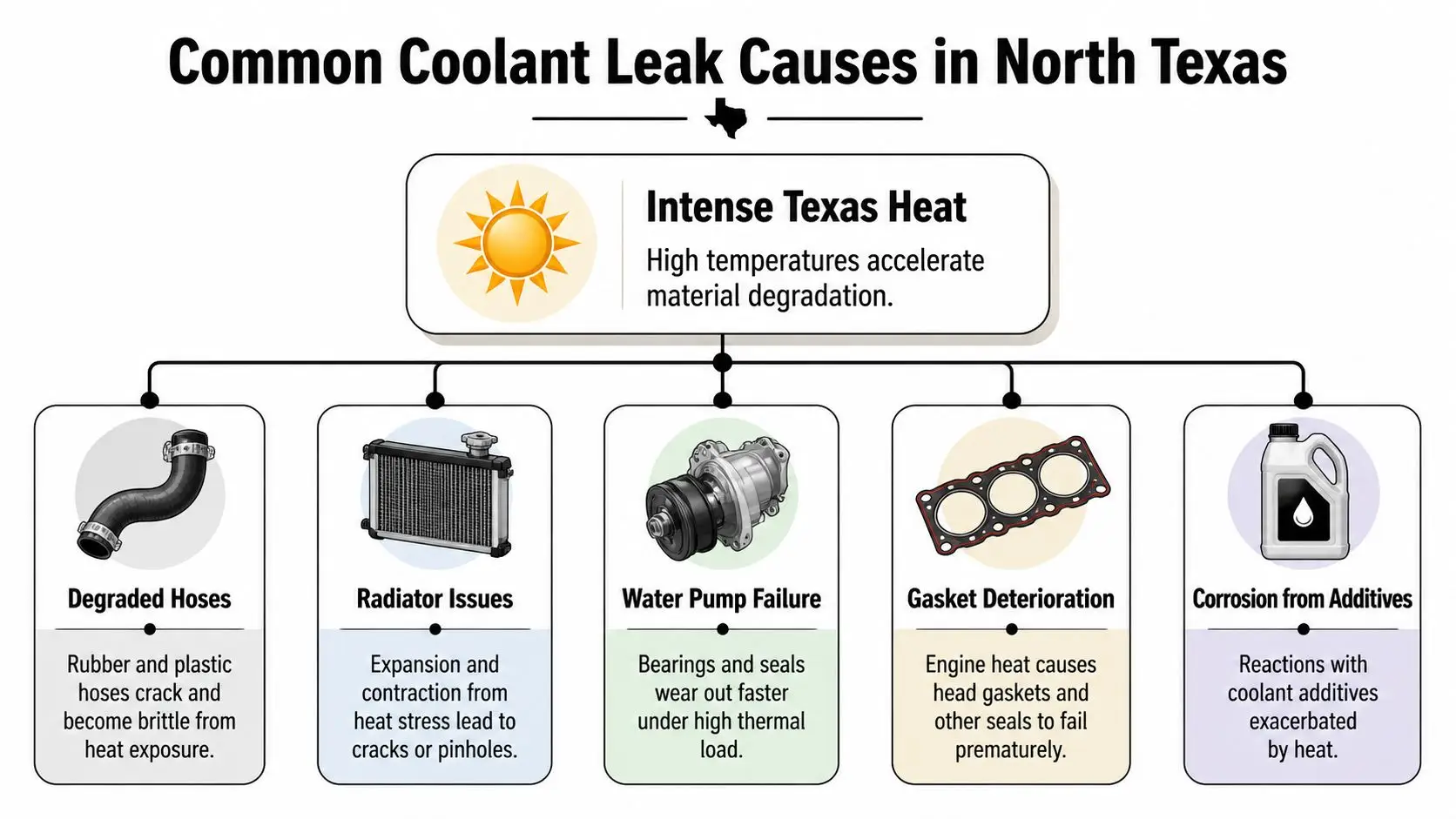
A cooling system in Haltom City has a tougher job than one in a milder climate. Summer heat, long idling on Loop 820 or I-35W, and sudden temperature swings between seasons keep parts expanding and contracting. That repeated stress is hard on rubber, plastic, and seals, so a weak spot often shows up here sooner than drivers expect.
Aging hoses and weakened seals
Hoses are the cooling system’s blood vessels. They carry hot coolant away from the engine and bring cooler fluid back around for another pass. After years of heat and pressure, the rubber can harden, soften in spots, or split near the ends.
That is why hose leaks often start small. You might see moisture around a clamp, a crusty trail near a fitting, or a swollen section that opens up only after the engine reaches operating temperature. If you want a better sense of timing, these warning signs that a radiator hose may need replacement are especially relevant in North Texas, where summer heat speeds up rubber wear.
Seals and O-rings age the same way. They shrink, flatten, and lose their grip, which lets coolant sneak past connections that used to stay dry.
A radiator cap that can’t hold pressure
The radiator cap is small, but it controls system pressure. Pressure matters because coolant needs it to stay in liquid form at high engine temperatures. If the cap spring weakens or the seal wears out, coolant can escape into the overflow area or boil sooner than it should.
The Family Handyman guide to coolant leaks notes that a bad radiator cap is one of the common places coolant can escape from a cooling system. That fits what local drivers see in North Texas. A marginal cap may seem fine on a short winter errand, then act up during a July stoplight backup with the A/C running full blast.
Cracked radiator or damaged reservoir
Radiators and coolant reservoirs deal with constant temperature change. Hot on the drive home. Cooler after shutdown. Hot again the next morning. Plastic tanks and seams can eventually form small cracks, especially on older vehicles.
These leaks can be frustrating because they are not always steady. A radiator seam may seep only when pressure rises. A reservoir may split near the hose neck and leak only after the coolant warms up and expands.
If the puddle seems to come and go, this is one of the first places a technician in Haltom City will inspect.
Water pump seepage
The water pump is the cooling system’s circulation pump. If it starts leaking, coolant usually shows up near the front of the engine, often around the belt area or below the pump. Many pumps also have a small weep hole that lets coolant escape when the internal seal is failing.
That leak matters for two reasons. You are losing coolant, and the part responsible for moving coolant may also be wearing out. In North Texas traffic, where engines spend plenty of time idling in extreme heat, poor circulation can push temperatures up fast.
Intake manifold or gasket leaks on some engines
Some vehicles are known for coolant leaks around the intake manifold or related gaskets. On those engines, coolant passes through parts of the intake area, and a failing gasket can let it seep externally or internally.
This type of problem can fool drivers because the leak may collect in hidden spots on the engine before it reaches the ground. You may only notice a dropping reservoir level or dried residue in places that are hard to see without a flashlight.
Head gasket failure
This is the serious one. The head gasket seals the engine block and cylinder head so coolant, oil, and combustion gases stay in their proper lanes. When that seal fails, coolant may leak inside the engine, enter a cylinder, or mix with oil.
The AAA guide to overheating and coolant problems explains that internal cooling-system failures can lead to overheating and major engine damage if the car is kept in service. For drivers in North Texas, that risk is higher during hot-weather driving because the cooling system already has less room for error.
If coolant keeps disappearing with no obvious drip under the car, an internal leak moves higher on the suspect list.
Which causes are minor and which are urgent
Here’s a quick way to sort the common causes by risk:
| Problem | Usually starts as | Risk level |
|---|---|---|
| Hose or clamp issue | Small external leak | Moderate |
| Radiator cap failure | Pressure loss or overflow | Moderate |
| Reservoir or radiator crack | Intermittent or steady leak | Moderate to high |
| Water pump leak | Drip plus weak circulation | High |
| Intake manifold or gasket leak | Hidden external or internal loss | High |
| Head gasket failure | Internal coolant loss | Very high |
North Texas heat does not create every coolant leak. It exposes the weak part faster. That is why a small issue in spring can turn into an overheating problem by the first stretch of triple-digit weather.
Safe DIY Diagnostics You Can Perform at Home
You can do a lot of useful checking in your driveway without taking anything apart. The goal isn’t to become your own full-time mechanic. The goal is to gather clues safely so you know whether the car coolant leak looks minor, hidden, or urgent.
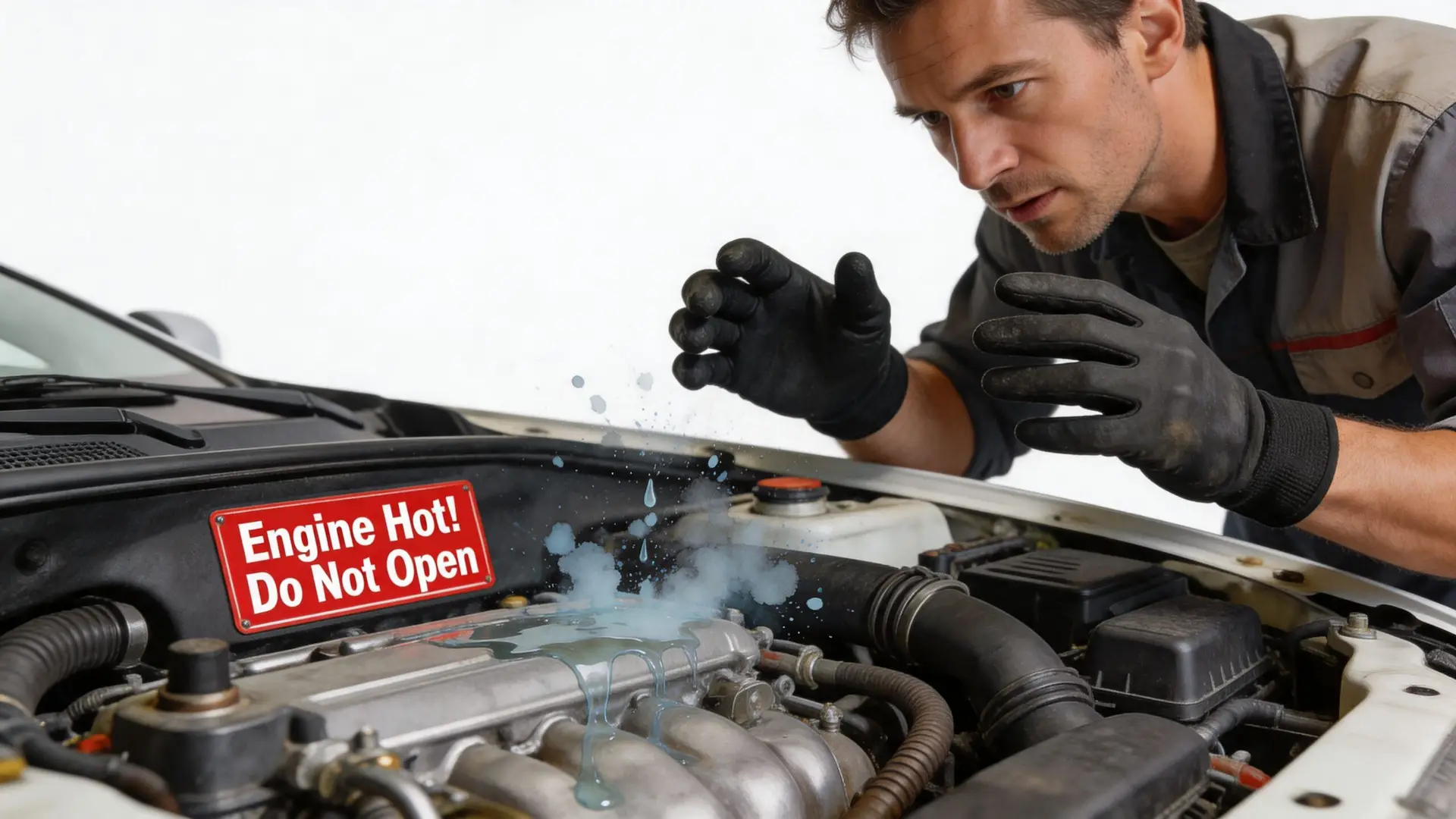
Safety comes first
Never remove the radiator cap when the engine is hot. Coolant systems operate under pressure, and hot coolant can spray out hard enough to burn you badly.
If you want to understand one common failure point before you inspect, this article on how to test a radiator cap gives helpful background.
Let the engine cool completely before you touch the cooling system. Warm isn’t cool enough.
A simple driveway inspection
Start with a flashlight and patience. You’re looking for signs, not trying to diagnose every part in one pass.
Check these areas:
- Upper and lower hoses: Feel for cracking, stiffness, soft spots, or bulges.
- Hose connections: Look for wetness, stains, or crusty residue around clamps.
- Radiator seams and tanks: Scan for damp corners or dried coolant marks.
- Coolant reservoir: Inspect the bottle and cap area for hairline cracks or residue.
- Under the water pump area: Look for fresh drips or buildup.
A leak often leaves a trail. Coolant dries into residue that points back toward the source.
Use the cardboard test
A plain piece of cardboard can tell you a lot. Park on level ground overnight and slide cardboard under the front of the vehicle. The next morning, look for fresh drips.
This helps in two ways. First, it confirms whether the leak is active. Second, the drip location can help narrow down whether it’s closer to the radiator, hose area, or engine side of the bay.
Monitor the reservoir over several days
A single reading can mislead you. A trend is more useful.
Try this:
- Check when the engine is cold
- Note the level relative to MIN and MAX
- Drive normally for a few days
- Recheck under the same cold conditions
- Look for repeated loss, not just one fluctuation
That pattern can help a technician later, especially if the leak is intermittent.
Don’t miss angle-related leaks
Some leaks only show up when the vehicle sits a certain way. That’s one of the more confusing coolant issues because drivers can swear the car leaks at work but not at home, or only leaks nose-down on a slope.
According to the Miata forum thread discussing position-dependent coolant leaks, leaks that appear only on hills or inclines can come from expansion tank cracks or hoses that shift under gravity. The same source also notes that in some modern vehicles with self-bleeding systems, an apparent drop in coolant may come from air pockets purging from the system rather than a physical leak.
That’s a useful distinction. If you only see signs after parking on an incline, tell the shop exactly that. It may change how they test the vehicle.
A short visual demo can help you spot what residue and seepage usually look like in real life:
What DIY can and can’t confirm
DIY inspection can help you answer these questions:
- Is fluid being lost
- Does the leak happen cold, hot, or only after driving
- Is it coming from one side of the engine bay
- Does parking angle affect it
DIY inspection usually can’t confirm hidden internal leaks, pressure-test the system accurately, or rule out combustion gases in the coolant. That’s where professional tools matter.
Immediate Steps to Prevent Engine Damage
A coolant leak becomes dangerous when heat starts building faster than the system can carry it away. In Haltom City traffic, especially on a hot North Texas afternoon with the A/C running, that can happen sooner than drivers expect.
The first job is simple. Protect the engine before you worry about getting the car home.
When you can move the car and when you shouldn’t
If the coolant is only slightly low, the temperature gauge stays normal, and you do not see steam or active dripping, you may be able to drive a very short distance to a safer spot or repair shop. Keep the trip brief. Watch the gauge the whole time, and turn the heater on full hot if the temperature starts creeping up. It is uncomfortable, but it can pull some heat away from the engine for a short time.
Pull over and shut the engine off as soon as it is safe if you notice any of these signs:
- The temperature gauge is rising above normal
- Steam is coming from under the hood
- You smell a strong sweet coolant odor while driving
- The reservoir is empty or nearly empty
- The engine starts misfiring, shaking, or losing power
Those are warning signs, not suggestions.
If the engine is overheating, every extra minute of run time can warp metal parts, damage the head gasket, or leave you stranded somewhere between Haltom City and Fort Worth. A tow is often the cheaper decision. For work trucks or commercial vehicles, fast help like on-site truck and fleet maintenance can also reduce downtime.
A tow bill is usually cheaper than engine work.
Topping off as a temporary measure
Adding coolant can buy you enough time to reach safety. It does not fix the leak.
Only add coolant after the engine has cooled down. Opening a hot cooling system is like taking the cap off a pressure cooker. Hot coolant can spray out and cause serious burns. If you know the correct coolant type for your vehicle, use that. If you are unsure, check the owner’s manual or the label on the reservoir cap before adding anything.
Pour slowly into the proper reservoir, then watch how the car behaves afterward. If the level drops again quickly, the leak is active enough that the car should not be driven any farther than necessary.
What about stop-leak products
Stop-leak products are emergency tools, not dependable repairs. They can sometimes slow a tiny seep long enough to help a stranded driver get off the road, but they also create new problems.
Use caution for a few reasons:
- They can hide the source without repairing the failed part
- They may leave residue in the cooling system
- They can make shop diagnosis harder later
- They usually do little for larger leaks or internal engine problems
A pinhole seep is one thing. A split hose, cracked radiator tank, failing water pump, or head gasket issue is another.
The safest mindset
Treat coolant loss with the same urgency as low oil pressure. Check the level only when the engine is cool, watch the temperature gauge closely, and do not give the problem a few more days to "see what happens." Heat is what turns a manageable coolant repair into engine damage.
Professional Repair Options and Typical Costs
A coolant leak repair usually starts the same way a good doctor starts with symptoms. The shop has to find the true source, not just the place where the fluid finally dripped to the ground. Coolant can run along hoses, brackets, and the bottom of the engine, so the puddle you notice in a Haltom City driveway may be several inches, or even a couple feet, away from the failed part.
That matters for cost.
A radiator cap that no longer holds pressure is a small fix. A water pump tucked behind other components takes more labor. A head gasket problem can move the job into major engine repair territory. In North Texas, where summer heat and long idle times in traffic put extra strain on the cooling system, shops also pay close attention to parts that get brittle from repeated heat cycles.
How a shop usually confirms the leak
A reliable diagnosis is more than a quick flashlight check in the parking lot. Technicians often pressure-test the cooling system to recreate the conditions where the leak shows up. For slow leaks, UV dye may be added so the coolant trail is easier to trace.
They also look at the whole system as a loop, much like checking the entire circulatory system instead of only looking at one vein. If one part failed because of age or pressure problems, another weak part may not be far behind.
A technician will commonly inspect:
- Radiator cap and system pressure retention
- Upper and lower radiator hoses
- Hose clamps and plastic fittings
- Coolant reservoir and its seams
- Radiator tanks and core areas
- Water pump weep hole and shaft area
- Thermostat housing and nearby gaskets
- Signs of internal leakage, such as contaminated oil or exhaust-related symptoms
For companies running work trucks, service vans, or delivery vehicles, outside resources on on-site truck and fleet maintenance can help put repair timing and downtime into business terms.
What repairs usually cost
Most coolant leak repairs fall into three buckets. Small external leaks are usually the least expensive. Mid-level repairs involve parts like a radiator, reservoir, or water pump. Internal engine leaks are the costly ones because labor rises fast.
For head gasket work, cost estimates from ConsumerAffairs' guide to head gasket replacement costs show that repairs commonly land in the $1,500 to $3,000 range, with some vehicles going higher depending on engine design and damage.
For everything else, price depends on access, part quality, and how much coolant system teardown is required. On many North Texas vehicles, a simple hose near the top of the engine is a very different job from a water pump buried behind engine mounts or timing components.
Estimated Coolant Leak Repair Costs in the DFW Area 2026
| Repair Service | Estimated Cost Range | Typical Time Required |
|---|---|---|
| Radiator cap replacement | Lower-cost repair, varies by vehicle and cap type | Usually short |
| Hose or clamp replacement | Lower to moderate, depends on hose location and parts access | Often same day |
| Coolant reservoir replacement | Moderate, depending on part design and accessibility | Often same day |
| Radiator replacement | Moderate to high, varies with vehicle size and cooling package | Often half day to full day |
| Water pump replacement | Moderate to high, especially if buried behind other components | Often half day or more |
| Head gasket repair | $1,500 to $3,000 for many V6 and V8 applications | Extended repair time |
Questions to ask before you approve the repair
If you want to feel confident at the counter, ask the shop to show you the leak source and explain how they confirmed it. Good shops in Haltom City, Keller, Watauga, and nearby parts of Tarrant County should be able to answer plainly.
Use questions like these:
- Where is the leak coming from
- Did you pressure-test the system
- Is this only an external leak, or do you suspect an internal engine issue
- Which parts are being replaced, and which ones are being reused
- Will you refill, bleed, and recheck the system after the repair
Those questions help you separate a careful diagnosis from guesswork. A proper repair is not just installing a new part. It also means confirming the cooling system holds pressure and circulates coolant the way it should before the car goes back into North Texas heat.
Your Trusted Haltom City Partner for Radiator and Engine Care
A coolant leak can feel intimidating because the symptoms range from a harmless-looking puddle to a real overheating emergency. But the pattern is usually clear once someone checks the system properly. Hoses age. Caps weaken. Radiators crack. Pumps seep. Internal leaks leave their own warning signs.
For drivers in Haltom City, Keller, Watauga, and North Richland Hills, the local climate makes cooling system maintenance more important, not less. Hot pavement, long idling stretches, and packed afternoon traffic put pressure on every part of the system. Catching a small issue early is the best way to avoid a much larger repair later.
Why local drivers benefit from certified diagnostics
A cooling system problem isn’t just about replacing a part. It’s about confirming the actual source, making the correct repair, and verifying that the system holds pressure afterward. That’s where certified technicians and proper diagnostic equipment earn their keep.
For commercial drivers and fleet managers, preventive maintenance matters even more. Broader fleet planning resources on how to boost truck uptime and cut costs can be useful when you’re building a maintenance routine that keeps vehicles on the road instead of in the shop.
A nearby option when you need help
If you’re in this part of Tarrant County and your coolant level keeps dropping, your temperature gauge is creeping up, or you’ve found that unmistakable puddle under the car, getting it inspected sooner is the smart move. A local shop that handles radiator maintenance and engine diagnostics every day will know how North Texas heat changes the way these problems show up.
That’s especially valuable with intermittent leaks, pressure-related issues, and hidden failures that don’t show themselves during a quick glance in the driveway. Whether you drive a commuter sedan, a family SUV, or a work truck, the goal is the same. Find the leak, fix the cause, and protect the engine.
If you need a local shop, Express Lube & Car Care is conveniently located at 6211 Denton Hwy, Haltom City, TX.
If you’ve noticed a puddle, a sweet smell, rising engine temperature, or a coolant reservoir that won’t stay full, schedule an inspection with Express Lube and Car Care. Their certified team can diagnose cooling system problems, explain the repair clearly, and help you protect your engine before a small leak turns into a major breakdown.