
You’re driving down Denton Highway, maybe heading home through Haltom City after work, and a low humming starts to creep in under the radio. At first it sounds like rough pavement or tire noise. Then it gets louder. You change lanes, the sound shifts a little, and now you’re wondering if it’s safe to keep driving or if you’re about to get stuck on the side of I-820.
That concern is valid. A lot of drivers first notice bad wheel bearings as a faint hum, a rumble, or a noise that changes when the vehicle leans in a turn. It’s a common problem, and it usually starts small. The good news is that wheel bearing issues often give warning signs before they become serious.
If your car has started making a noise you can’t place, it helps to learn how those sounds fit into the bigger picture. A good overview of related sounds is this guide to common car noises and what they mean. Wheel bearing noise has its own pattern, and once you know what to listen for, it’s easier to separate it from tire roar, brake squeal, or a loose heat shield.
That Humming Noise on Your Drive Through Haltom City
Around Haltom City, this problem often shows up in the most ordinary way. A driver notices a soft humming on a dry day, then the next week it becomes a rougher growl after hitting a few patched roads or standing water near the curb lane. The vehicle still moves, still stops, and still feels mostly normal, which is why many people put it off.
That’s the tricky part. A failing wheel bearing doesn’t always announce itself with a dramatic breakdown. It often starts with a noise that seems easy to ignore.
What that sound usually feels like
The classic bearing complaint is a steady hum or rumble that rises with speed. It may get louder in one turn and quieter in the opposite turn. Drivers sometimes describe it as road noise that suddenly seems too loud for the road they’re on.
In local driving, the sound often stands out most on smoother stretches where tire noise drops off and the bearing noise has nowhere to hide. If you’ve driven the same route for months and your car suddenly sounds different, trust that instinct.
Bad wheel bearings rarely get better on their own. They usually get noisier, hotter, and looser.
Why local roads make it easier to notice
Haltom City drivers deal with a mix of patched pavement, potholes, curbside water, and short trips that don’t always give problems time to show up consistently. That creates two common patterns:
- Noise after a bump: You hit a pothole and notice a new hum soon after.
- Noise after rain: Moisture works past a weak seal, and the sound becomes more obvious over time.
- Noise only at certain speeds: The bearing is wearing, but not yet at the point where every drive sounds bad.
A wheel bearing problem is still a maintenance issue, not a mystery. The key is catching it while it’s just a noisy part, not after it starts affecting brakes, tires, or the hub.
What Wheel Bearings Do and Why They Fail
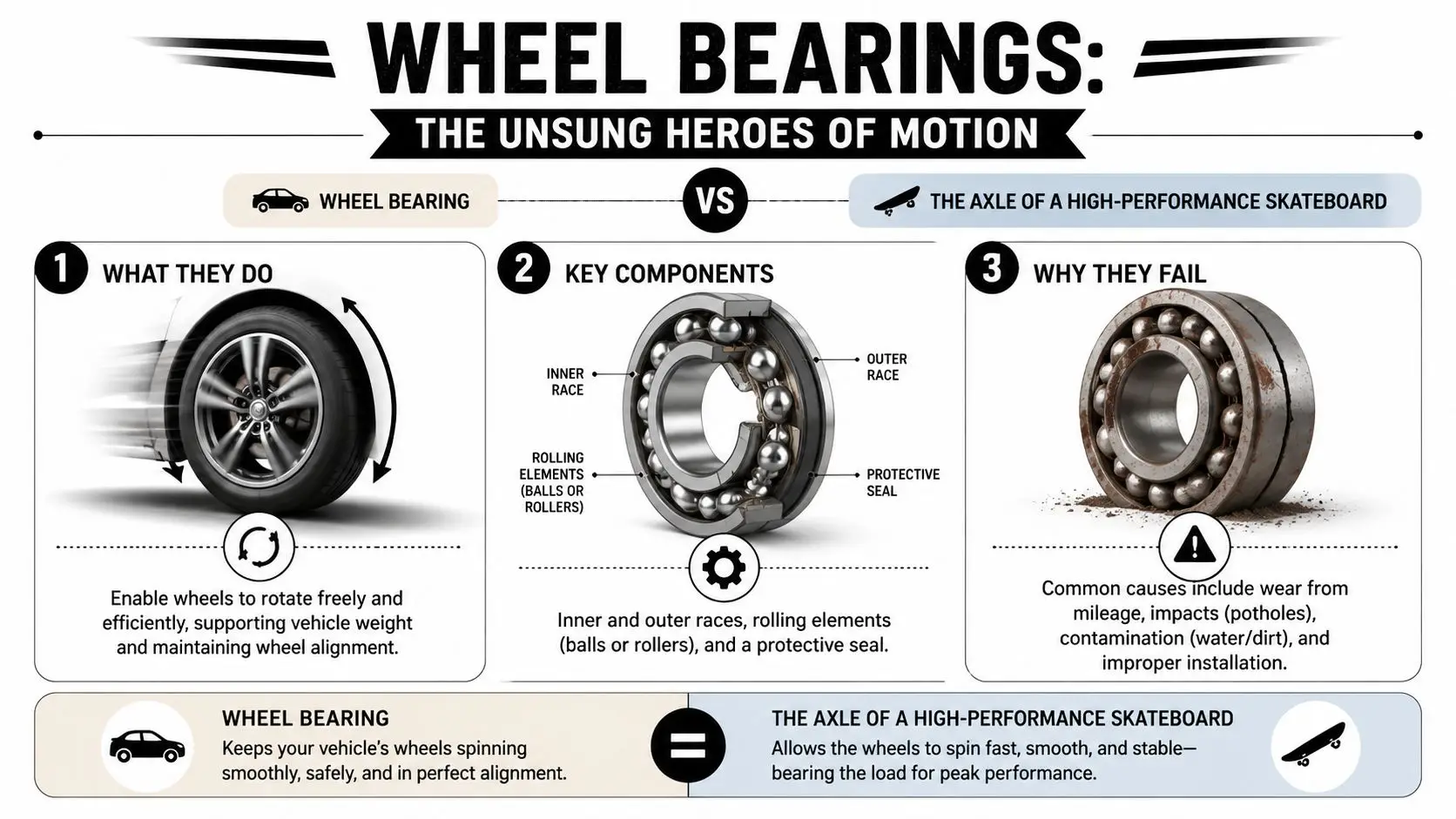
Wheel bearings are the parts that let each wheel spin freely while still carrying the weight of the vehicle. They sit in the hub and have to do two jobs at once. They reduce friction, and they keep the wheel running true under braking, cornering, and rough pavement.
That second job matters more than many drivers realize.
A healthy bearing keeps the wheel stable on the spindle or within the hub assembly. When the bearing wears, that stability starts to fade. The wheel can develop roughness, extra heat, and slight looseness. At first, that may only show up as noise. Left alone long enough, it can start affecting tire wear, brake feel, and hub condition.
The work they do on Haltom City roads
Around Haltom City, bearings have a harder life than the mileage number alone suggests. Potholes shock the hub. Patchwork pavement loads and unloads the bearing over and over. Standing water along the curb can work past an aging seal, especially on the passenger side.
Short local trips can make diagnosis trickier too. A bearing may only hum at certain speeds or after the hub has warmed up, so the problem feels inconsistent even when the wear is real.
Most late-model cars and crossovers use sealed hub assemblies. Once the grease breaks down or contamination gets inside, the usual repair is replacement of the hub unit. Older or heavier-duty setups may use serviceable bearings that can be cleaned, inspected, adjusted, and repacked, but only if they are still in good condition and the surfaces are not damaged.
Why bearings fail in the real world
The most common failure pattern is simple. The seal weakens, moisture or grit gets in, grease loses its protective film, and the bearing surfaces start to pit and wear.
Common causes include:
- Water intrusion: Rain, puddles, and gutter water can get past a compromised seal.
- Impact damage: A hard pothole hit or curb strike can shock the bearing and hub.
- Age and mileage: Grease and seals do not last forever.
- Improper service on adjustable bearings: Too tight builds heat. Too loose allows movement that beats the bearing up.
- Related hardware problems: A loose axle nut or improperly torqued components can shorten bearing life.
That last point gets missed online all the time. In the shop, one of the easier mistakes to make is assuming every wheel-area noise or wobble is a bad bearing. Loose lug nuts can create clunking, vibration, and wheel movement that sounds serious and feels similar from the driver’s seat. The difference is that loose lug nuts are a wheel retention problem first, while a bad bearing is a support and rotation problem inside the hub. Both need attention right away, but they are not the same failure.
If you want a clearer comparison of the noise side of the diagnosis, this guide to hub bearing sound and how it differs from other wheel noise helps separate bearing trouble from tire or hub-related sounds.
Why shops often catch them during other work
A lot of bad bearings are found during brake service, tire work, or suspension inspections. That makes sense. With the vehicle in the air and the wheel off, it is easier to feel roughness, check for play, inspect the hub, and rule out simpler problems like loose lug nuts or uneven tire wear.
That is also why early diagnosis saves money. Catching a noisy bearing before it overheats or loosens excessively can help prevent extra damage to the hub, sensor area, tire, or brake components.
For serviceable bearings, maintenance intervals depend on the vehicle and use, but the rule is straightforward. They need periodic cleaning, fresh grease, and correct adjustment according to trade guidance for that bearing design. Sealed units trade that maintenance for simplicity. They are clean and dependable until wear or contamination catches up with them, then the fix is replacement rather than repacking.
Recognizing the Symptoms of Bad Wheel Bearings
A lot of Haltom City drivers first notice a wheel bearing on a normal commute. The car starts with a faint hum on a rough stretch of road, then the sound sticks around even after the pavement smooths out. That pattern matters, especially here in North Texas where potholes, broken pavement, and standing water can speed up bearing wear.
The noises that matter
The classic symptom is a humming, growling, or rumbling sound that rises with road speed. Early on, it may sound a lot like aggressive tire tread. As wear gets worse, the noise usually turns rougher and more mechanical.
Pay attention to what happens in a gentle turn. A bad bearing often changes pitch or gets louder as the vehicle’s weight shifts from one side to the other. If you want a clearer comparison, this guide on what hub bearing sound usually does on the road helps separate bearing noise from tire noise and other rotating sounds.
One local point that gets missed in a lot of online articles is the loose lug nut mix-up. Loose lug nuts can also create noise, vibration, and a wheel that feels unsettled. From the driver’s seat, the two problems can feel close enough to fool people. The difference is that bearing noise usually follows vehicle speed and load changes in turns, while a loose wheel often brings a sharper wobble or clunk, especially after recent tire or brake work.
What you may feel from the driver’s seat
Noise gets attention first, but feel matters too.
A worn bearing can send a vibration through the steering wheel, floor, or seat. Some vehicles develop a slight wander at highway speed. In more advanced cases, the car may feel less planted because the hub is no longer holding the wheel as precisely as it should.
Those symptoms overlap with tire balance problems, brake issues, and suspension wear. That is why a good diagnosis matters. Replacing a bearing that is not bad does not fix a loose wheel, and tightening lug nuts does not cure a failing hub bearing.
Heat and smell are real warning signs
A failing bearing creates friction. Friction creates heat.
After a drive, one wheel area may give off a hot metallic smell or seem noticeably warmer than the others. That does not prove the bearing is bad by itself, because dragging brakes can do the same thing, but it is a strong clue that one corner of the vehicle needs inspection.
The usual chain is simple:
- Moisture or debris gets past the seal
- Grease breaks down or escapes
- Internal friction increases
- Heat builds inside the hub
- Wear speeds up
- Noise, looseness, and damage get worse
That sequence is common on vehicles that see wet roads, rough pavement, or repeated pothole hits around Haltom City.
Play at the wheel
Excessive play is another common sign, but it has to be interpreted correctly. A wheel that moves when checked by hand may have a bad bearing, but it can also point to loose lug nuts, suspension wear, or steering component problems.
That overlap is why I never treat wheel play as a one-answer test. The source of the movement matters. If the looseness is in the hub, the bearing becomes a strong suspect. If the wheel was not clamped properly to begin with, the fix is completely different and much more urgent.
Other signs drivers notice
Bearing problems can also show up as:
- Uneven tire wear
- An ABS warning light if hub movement affects the sensor reading
- A rougher feel during braking
- A wheel that seems less stable than the others
By the time the noise turns into a grinding growl, the bearing has usually been worn for a while. Catching the earlier hum or rumble gives you a better chance of fixing the problem before it starts taking other parts with it.
Simple At-Home Checks Before You Call a Mechanic
A lot of people jack up the car, grab the tire, feel movement, and immediately assume the bearing is bad. That’s where many DIY checks go sideways.
Before you blame the bearing, start with the simplest thing that can mimic the exact same symptom.
Check lug nut torque first
Loose wheel lug nuts can cause wheel play and noise that feel almost identical to a failing bearing. Verified guidance on this specific issue notes that home misdiagnosis rates can reach 20-30%, and the first step is to torque lug nuts to the manufacturer’s specification, often around 80-100 ft-lbs for most cars, before checking for bearing play in a DIY inspection, as summarized from this wheel bearing diagnostic video.
That one step can keep you from chasing the wrong repair.
If your vehicle recently had tire work, brake work, or a roadside wheel change, this matters even more. A loose wheel can sound bad fast.
Safe checks you can do at home
Use common sense here. Work on level ground, use proper support, and don’t put yourself under a vehicle that isn’t safely secured. If you’re not set up for that, skip the home test and book an inspection.
If you are set up safely, this general process helps:
Confirm lug nuts are properly torqued
Do this first, not last.Raise one wheel safely
The tire needs to spin and move freely for a meaningful check.Try the 12 and 6 o’clock shake
Hold the tire at the top and bottom, then rock it in and out. Movement here can point toward a bearing issue, though other parts can also contribute.Try the 9 and 3 o’clock shake
Hold the tire at the sides and repeat. Movement at this angle can point to steering or suspension issues, not just the bearing.Spin the wheel by hand
Listen and feel. A rough, gritty, or growling rotation is suspicious.
For broader help sorting out what a symptom may mean before you commit to a repair, this guide on how to diagnose vehicle problems is a useful starting point.
What works and what doesn’t
A quick driveway check can help, but it has limits. It works best for spotting obvious looseness or roughness. It does not reliably tell you the whole story.
What doesn’t work well is assuming every bit of wheel movement means the same thing. The movement could come from:
- Loose lug nuts
- A worn bearing
- Suspension wear
- Steering component play
That’s why the order matters. Start with the simple, high-consequence possibility first.
A visual walkthrough can help if you want to see the difference in motion and technique before trying anything yourself:
A good DIY check narrows the problem. It doesn’t replace a full diagnosis when the symptom affects safety.
When to stop and make the call
If the wheel has obvious looseness, if the noise is getting worse quickly, or if you notice heat, grinding, or brake warning behavior, that’s the point to stop experimenting. Bearings live too close to the brake and hub system to treat casually.
The Professional Inspection and Replacement Process
A proper wheel bearing diagnosis goes beyond shaking a tire and listening for a hum. In the shop, the goal is to identify the exact source of the noise, confirm whether the bearing is at fault, and inspect what else may have been affected while the vehicle was driven that way.
What a real inspection looks like
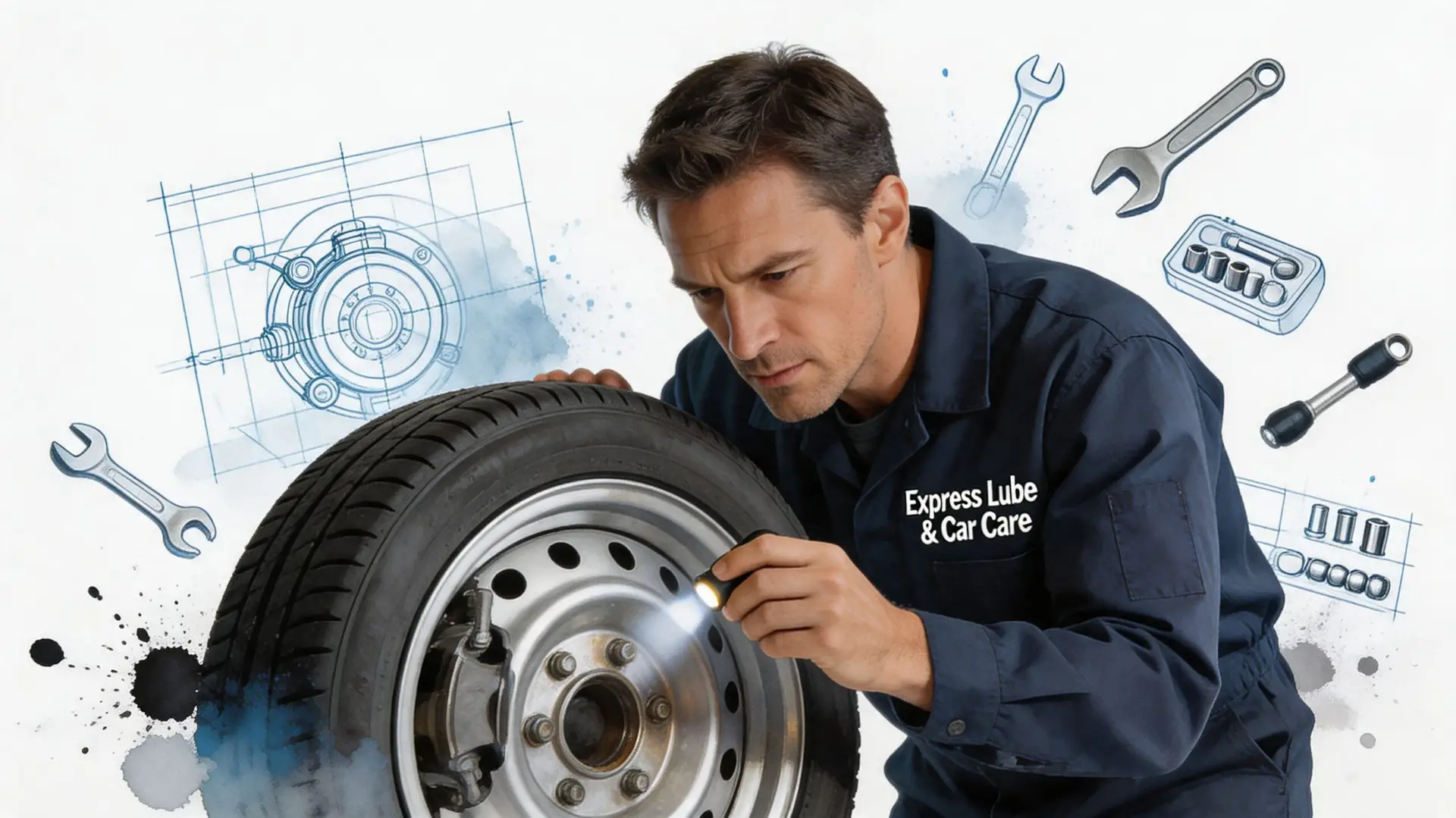
A technician usually starts with a road test and a lift inspection. On the road, the point is to reproduce the noise under load, during lane changes, and at different speeds. On the lift, the point is to isolate play, roughness, heat signs, and any nearby damage.
The tools matter. Chassis ears help narrow down rotating noise. A technician may also compare wheel rotation by hand, check hub roughness, inspect seals and surrounding hardware, and measure movement more precisely than a driveway check allows.
One detail many drivers appreciate is transparency. Good shops explain what they found and why they’re recommending replacement. That clarity matters because bearing noise can overlap with tire noise, brake drag, and suspension concerns.
DIY checks versus shop diagnosis
| Check / Symptom | DIY At-Home Method | Express Lube Professional Method |
|---|---|---|
| Humming while driving | Listen during a normal drive | Controlled road test to load each side and isolate the noise source |
| Wheel play | Shake tire by hand at 12 and 6 or 9 and 3 | Inspect on a lift, verify looseness, and check related steering and suspension parts |
| Rough rotation | Spin wheel by hand | Compare wheel rotation, hub feel, and surrounding component condition with shop tools |
| Heat at one corner | Limited by safety and access | Evaluate temperature differences after driving and inspect for friction-related damage |
| Root cause | Educated guess | Confirm whether it’s the bearing, lug torque issue, brake drag, tire noise, or another fault |
What replacement involves
Once the bearing is confirmed, the repair depends on the vehicle design. Many modern cars use a hub assembly, which means the bearing and hub come out as a unit. Other vehicles use a press-in bearing that requires more disassembly and precision work.
A proper replacement usually includes these steps:
Remove the wheel and brake components
That creates access and also lets the technician inspect for rotor, caliper, or ABS-related effects.Remove the old hub or bearing
On some vehicles this is straightforward. On others, corrosion and tight clearances make it labor-intensive.Install the new OEM-spec or premium-quality part
Fit and quality matter here. Cheap parts often create repeat noise, poor ABS behavior, or short service life.Torque fasteners to spec
Bearings and hubs don’t tolerate guesswork well. Correct torque protects the new part and the surrounding components.Road test after repair
The confirmation step is as important as the install. The original noise should be gone, and the vehicle should feel settled.
The real value in professional bearing work isn’t just installing the part. It’s making sure the diagnosis was right and the new part is mounted exactly as it should be.
Why part quality and process matter
Wheel bearings aren’t a place to cut corners. A poor-quality hub or a rushed installation can create the same symptom all over again. Precision matters because the bearing supports the wheel, affects the brake system, and can trigger ABS issues if anything is off.
That’s also why many shops invest in visibility and education, not just wrench time. If you’re curious how modern repair businesses explain complex repairs to local drivers, examples of AI TV ads for mechanics show how shops are using video to make technical service easier to understand before a customer ever walks in.
Understanding Costs Time and Warranty in Haltom City
The two questions drivers usually ask first are simple. How long will this take, and what will it cost me? The honest answer is that it depends on the vehicle and the bearing design.
Some vehicles use a straightforward bolt-in hub assembly. Others require pressing the bearing in and out of the knuckle, which adds labor and complexity. Front and rear setups also vary, and corrosion can change the difficulty of the job in North Texas vehicles that have seen plenty of weather and road grime.
What changes the price
Wheel bearing replacement isn’t one flat repair across every car. The variables include:
- Vehicle make and model: Some designs are easy to access. Some are not.
- Front or rear location: The labor path may be very different.
- Hub assembly versus press-in bearing: Hub assemblies are often simpler to replace, but parts pricing varies.
- Related damage: A noisy bearing may also have affected the hub, rotor area, or ABS components.
That’s why the best estimate starts with inspection, not guessing. A proper quote should tell you exactly what part is being replaced and whether anything else needs attention now versus later.
How long the job usually takes
Repair time also depends on design and condition. A clean, accessible hub assembly job moves much faster than a seized press-in bearing on a vehicle that has seen years of service. Busy drivers in Haltom City usually care less about the exact wrench time than about whether the shop communicates clearly and keeps downtime under control.
For local drivers weighing where to go, this overview of Haltom City auto repair is a good reminder of what to look for in a shop. Clear estimates, realistic timelines, and a process that doesn’t leave you guessing matter just as much as the part itself.
What a good warranty conversation sounds like
Warranty matters because wheel bearings are safety-related parts. A good shop should explain:
- What parts warranty applies
- What labor warranty applies
- What conditions affect coverage
- What to do if the noise returns
A vague “you’re covered” isn’t enough. You want the terms in plain language.
Ask for the warranty details before the work starts, not after the keys are back in your hand.
That isn’t about being difficult. It’s about knowing whether the shop stands behind the part quality and the installation process. Good shops won’t be bothered by that question.
Frequently Asked Wheel Bearing Questions
Is it safe to drive with bad wheel bearings
If a bearing is starting to fail, short trips can turn into a bigger repair faster than many drivers expect. A light hum today can become looseness, heat, and rough wheel movement if the bearing keeps wearing.
I tell Haltom City drivers to treat it like a wheel-end problem until proven otherwise. If the noise is getting worse, the steering feels different, or you notice play at the wheel, have it checked soon. The same advice applies if you recently hit a pothole or drove through standing water.
Should wheel bearings be replaced in pairs
Usually, no.
Wheel bearings are replaced based on condition, not as an automatic pair. If one side is noisy and the other side is quiet, tight, and passes inspection, replacing only the failed side is a reasonable repair.
There is a trade-off. Some owners choose both sides at higher mileage to avoid coming back later. Others would rather fix the bad side now and keep costs down. Either approach can be right if the decision follows a real inspection.
Can bad wheel bearings sound like tire noise
Yes, and this is one of the most common mix-ups.
Cupped or unevenly worn tires can make a steady road hum that sounds a lot like a bearing. The difference is usually in how the sound behaves. Bearing noise often changes as vehicle load shifts in a turn. Tire noise tends to stay tied more closely to road speed and tread condition.
That is why a good shop does more than listen on a test drive. Tire pattern, wheel play, and hub roughness all need to be checked before anyone calls the bearing bad.
Can loose lug nuts really mimic a bearing problem
Yes. More often than people think.
Loose lug nuts can cause clunking, vibration, wheel movement, and noise that feels a lot like a failing bearing. Around Haltom City, this comes up after recent tire work more than many online guides admit. A vehicle comes in with a humming or wobbling complaint, and the first thing to verify is simple. Lug torque.
That basic check matters because the fix is completely different. One problem needs immediate tightening and inspection for wheel or stud damage. The other may need a hub or pressed bearing replacement.
Do potholes and water make wheel bearings fail faster
They can.
Potholes hit the bearing and hub with a sharp shock load. Water works against the seals that protect the grease inside. In North Texas, that combination is hard on wheel-end parts, especially for drivers who see rough pavement, broken edges near intersections, and rainy curb lanes.
The tricky part is timing. A bearing may not start growling the same day as the impact. It can show up days or weeks later, which is one reason the cause gets missed.
How do aftermarket wheels affect wheel bearings
Heavier wheels, lower-profile tires, and aggressive offsets can put more load on the bearing than the factory setup did. That does not mean every custom wheel setup causes trouble. It does mean the margin for wear gets smaller, especially on trucks and SUVs that already see rough roads.
If your vehicle has aftermarket wheels and develops a hum, mention that at check-in. It helps the technician judge whether the bearing, tire, or wheel setup is contributing to the problem.
Will one bad bearing affect other parts
It can.
A worn bearing lets the wheel run less true, and that can show up in tire wear, brake feel, and stress on nearby suspension parts. Catching it early usually keeps the repair smaller and the diagnosis cleaner.
What should I tell the shop when I bring it in
Give the shop the pattern, not just the word "noise." The best details are:
- When you hear it: low speed, highway speed, while turning, or during braking
- Where you feel it: steering wheel, seat, floor, or one corner of the vehicle
- What happened before it started: pothole hit, recent tire service, brake work, or heavy rain
- Whether the wheel was recently removed: rotation, flat repair, brake job, or new tires
- Whether any warning lights came on: especially ABS or traction-related lights
Those details help sort out bad bearings from tire noise, brake problems, or loose lug hardware without wasting time.
If your vehicle is humming, grinding, or feeling loose on Haltom City roads, schedule an inspection with Express Lube and Car Care. Their certified technicians can pinpoint whether you’re dealing with bad wheel bearings, loose lug hardware, or another wheel-end issue, then walk you through the repair clearly.