

An express oil change is defined as a focused service that drains old engine oil, replaces the oil filter, and refills with fresh oil, designed for speed with minimal wait time. A full service oil change covers all of that plus a comprehensive vehicle inspection, fluid checks, and component reviews that catch problems before they become expensive repairs. Knowing the difference between these two oil change types is not just useful trivia. It directly affects how much you spend, how long you wait, and how well your car holds up over time. This guide gives you a clear, practical comparison so you can make the right call every time.
What does an express oil change include?
An express oil change covers three core steps: removing the old engine oil, swapping in a new oil filter, and refilling with the correct grade of fresh oil. That is the complete service at its most basic. Some express lube service providers add minor checks like tire pressure, windshield washer fluid, and a visual look at wiper blades, but these extras vary by location and are not guaranteed.
The appeal is straightforward. A quick oil change at a no-appointment shop typically takes 15 to 30 minutes, which means you can fit it into a lunch break or a Saturday errand run without rearranging your day. For a car that is running fine, has no warning lights, and received a full inspection within the last few months, this level of service is entirely appropriate.
Here is when an express oil change makes sense for your situation:
- Your vehicle is within its normal oil change interval and the oil life monitor shows no urgency
- No warning lights are active on your dashboard
- The car drives, brakes, and handles without any noticeable issues
- You had a thorough multi-point inspection within the past three to six months
- You are on a tight schedule and need to get back on the road quickly
Pro Tip: Before you pull into any express lube service bay, check your owner’s manual for the correct oil viscosity. Using the wrong grade, even in a fast service, can reduce engine protection over time.
The cost advantage is real too. Express oil changes typically run lower than full service appointments because the labor time is shorter and no additional inspections are billed. For routine maintenance on a healthy, well-maintained vehicle, that savings adds up across a year of driving.
What does a full service oil change actually cover?
A full service oil change includes the same oil and filter replacement as an express visit, but it does not stop there. Full service covers brake fluid, transmission fluid, and coolant level checks, along with inspections of air filters, cabin filters, belts, hoses, spark plugs, battery health, and tire rotation. Kelley Blue Book describes this scope as responding to inspections and diagnostics that find wear items a basic oil change simply misses.
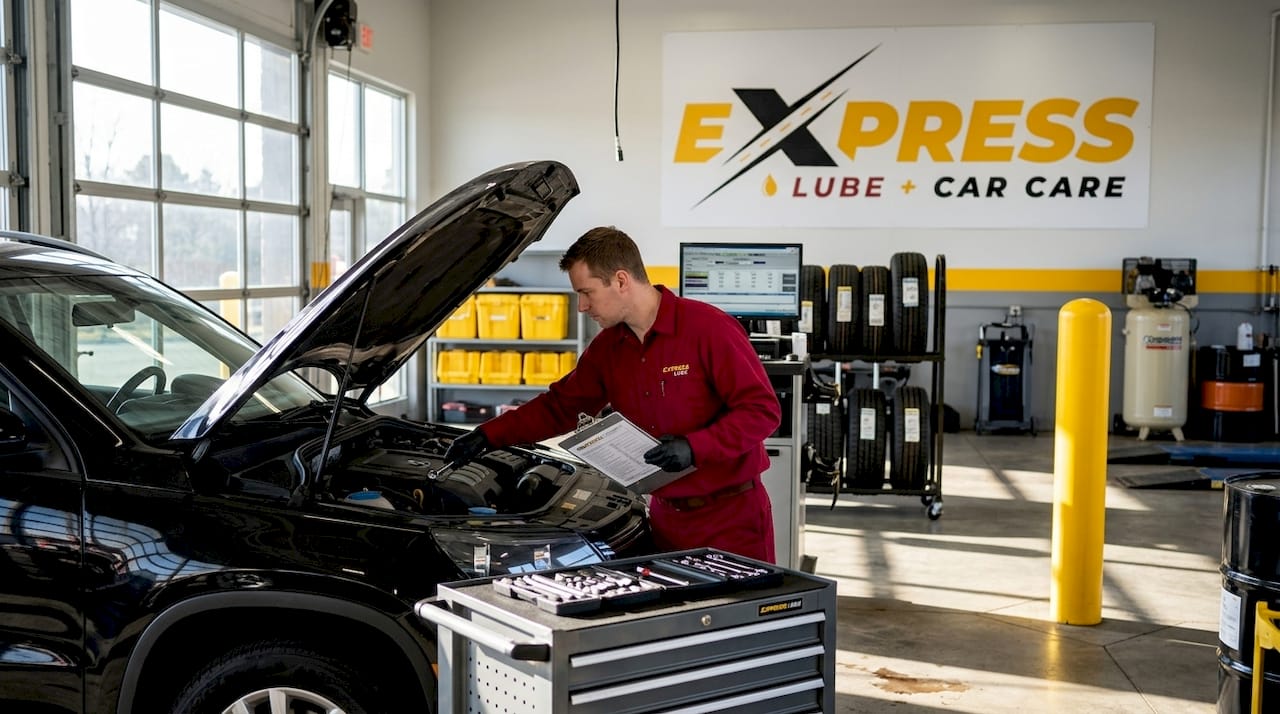
That distinction matters because a car can feel perfectly normal to drive while quietly developing a problem. Worn serpentine belts, low brake fluid, or a battery approaching the end of its life rarely announce themselves with obvious symptoms until something fails. A full vehicle service appointment is designed to catch those issues early, when the fix is still inexpensive.
Here is what a full service inspection typically includes:
| Service Component | What Gets Checked |
|---|---|
| Engine oil and filter | Drain, replace filter, refill with correct grade |
| Fluid levels | Brake, transmission, coolant, power steering |
| Air and cabin filters | Inspect for clogging or contamination |
| Belts and hoses | Check for cracks, fraying, or wear |
| Battery | Test voltage and terminal condition |
| Tires | Rotation, pressure check, tread depth visual |
| Brakes | Pad thickness and rotor condition visual |
| Spark plugs | Inspect for fouling or wear at mileage intervals |
Full service is the right choice when your vehicle has crossed 12,000 to 15,000 miles since the last comprehensive inspection, when a seasonal change is coming, when you recently purchased a used car with an unknown maintenance history, or when something about the way the car drives feels off. The extra time in the shop, usually 45 minutes to an hour and a half, is a reasonable trade for the peace of mind that nothing critical is being overlooked.
How do express and full service compare in cost, time, and vehicle impact?
The practical differences between these two oil change types come down to three factors: time, cost, and what you risk by choosing one over the other at the wrong moment.
| Factor | Express Oil Change | Full Service |
|---|---|---|
| Typical duration | 15 to 30 minutes | 45 to 90 minutes |
| Relative cost | Lower | Higher |
| Inspection depth | Minimal or none | Multi-point, comprehensive |
| Best for | Routine intervals, healthy cars | High mileage, symptoms, seasonal prep |
| Diagnostic value | Limited | Catches hidden wear items |
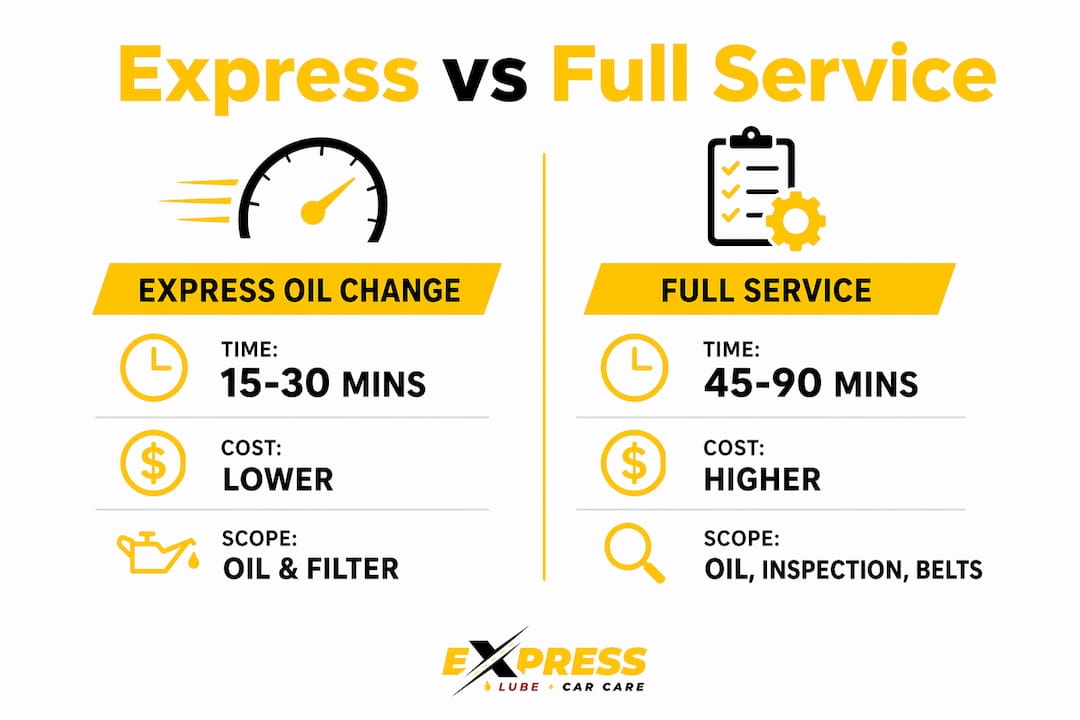
Quick-lube visits optimize speed and efficiency, while full-service shops typically include thorough inspections with the vehicle raised on a lift. That lift access is significant. A technician who can see the underside of your car will spot brake wear, leaking seals, or suspension issues that are invisible from a standing position.
The long-term financial math also favors periodic full service appointments. Catching a cracked belt before it snaps costs far less than a roadside tow and emergency repair. Identifying low brake fluid before it causes brake fade is far cheaper than replacing rotors and calipers. Relying exclusively on quick oil changes, even done on schedule, means you are maintaining the oil but not monitoring the rest of the vehicle.
Pro Tip: Use your car maintenance schedule as a planning tool, not just a reminder. Map out which visits will be express and which will be full service based on mileage milestones, and you will never overpay or underservice your car.
Vehicle age and mileage shift this calculation further. A three-year-old car with 25,000 miles on mostly highway driving can reasonably alternate between express visits and periodic full service. A ten-year-old vehicle with 110,000 miles and an inconsistent service history needs full service more frequently because the cumulative wear on belts, hoses, and fluids is much harder to predict.
When should you choose express vs. full service?
Choosing the right service is less about preference and more about reading your vehicle’s actual condition and maintenance history. Express oil change suffices between full inspections when the vehicle is symptom-free and maintained within intervals, but full service is the safer choice outside routine timing or when any symptoms exist.
Use this sequence to decide before your next service appointment:
- Check your oil life monitor. Many modern vehicles, including those with GM’s Oil Life System and Ford’s Intelligent Oil-Life Monitor, calculate remaining oil life based on driving conditions rather than fixed mileage. If the monitor is below 15%, schedule service soon regardless of type.
- Review your last full inspection date. If it has been more than six months or 6,000 miles since a technician performed a multi-point inspection, a full service appointment is overdue.
- Assess your mileage since the last comprehensive service. The 12,000 to 15,000 mile threshold is a reliable trigger for scheduling full service, even if individual oil changes have been done on time in between.
- Listen and feel while driving. Vibrations, pulling to one side, unusual sounds, or a spongy brake pedal are signals that a quick oil change is not enough. Book a full service appointment and describe the symptom clearly to the technician.
- Consider the season. Pre-winter and pre-summer are the two most important times for a full vehicle service, since temperature extremes stress batteries, coolant systems, and tires more than moderate weather does.
- Account for your car’s history. A used vehicle without documented service records should receive a full service inspection before you rely on it for regular driving, regardless of how well it seems to run.
Some drivers assume that oil life monitors replace the need for broader inspection cadence. They do not. The monitor tracks oil condition, not belt wear or brake fluid degradation. Following the monitor without scheduling periodic full inspections means you are maintaining one system while ignoring the rest. A car inspection checklist can help you track what has been reviewed and what is coming due.
Key takeaways
The most effective maintenance strategy combines timely express oil changes for routine intervals with scheduled full service appointments at mileage milestones, seasonal transitions, and any time symptoms appear.
| Point | Details |
|---|---|
| Express oil change scope | Covers oil drain, filter replacement, and refill with limited extras at some shops. |
| Full service scope | Adds fluid checks, belt and hose inspection, battery test, tire rotation, and more. |
| Cost and time tradeoff | Express saves time and money short-term; full service prevents costly repairs long-term. |
| Mileage trigger for full service | Schedule full service at 12,000 to 15,000 miles or when symptoms appear. |
| Oil life monitors have limits | They track oil condition only, not the broader vehicle health that full service covers. |
Our take on choosing the right service
At Express Lube & Car Care, we see a consistent pattern among drivers who come in frustrated: they have been getting their oil changed on time, every time, but something still went wrong. A belt snapped. Brakes faded. A battery died in a parking lot. The oil was fine. Everything else had been quietly wearing out between visits.
The honest truth is that the label “full service” can be misleading. Not every shop that advertises it performs the same depth of inspection. We have seen vehicles come in after a so-called full service elsewhere with brake pads worn to metal and coolant that had not been checked in years. The service name matters less than what the technician actually does with the car on the lift.
What we recommend to every driver is this: treat express oil changes as your routine maintenance tool and full service as your periodic health check. The best maintenance strategy aligns service scope with recent inspection history, vehicle condition, and manufacturer guidance rather than assuming express equals shallow or full service equals thorough. Ask your technician directly what the inspection covers before you approve the work. A good shop will tell you exactly what they checked, what they found, and what they recommend. That conversation is where real vehicle care happens.
— Express Lube & Car Care
Fast, reliable service from Express Lube & Car Care
Express Lube & Car Care serves drivers in the DFW area with no-appointment-required oil changes, full vehicle inspections, and complete automotive repairs, all performed by ASE-certified technicians. Whether you need a 20-minute quick oil change between meetings or a thorough seasonal service before winter, the team is equipped to handle both without making you wait longer than necessary.
Transparent pricing means you know what you are paying before any work begins, and RepairPal certification backs every repair with verified quality standards. If your vehicle needs more than an oil change, the engine diagnostics and repair service covers everything from warning light diagnosis to full mechanical repair. Stop in at your convenience or book ahead. Your car will thank you for it.
FAQ
What is the difference between an express and full service oil change?
An express oil change covers oil drain, filter replacement, and refill, typically completed in 15 to 30 minutes. A full service adds multi-point inspections of fluids, belts, brakes, battery, and tires, taking 45 to 90 minutes.
How often should I get a full service oil change?
Full service is recommended every 12,000 to 15,000 miles, at seasonal transitions, or any time your vehicle shows symptoms like unusual sounds, warning lights, or handling changes.
Is a quick oil change enough for my car?
A quick oil change is enough when your car is symptom-free, within its normal oil interval, and has received a full inspection within the past few months. Outside those conditions, a more thorough service is the safer choice.
Do oil life monitors tell me when to get full service?
No. Oil life monitors track oil condition only and do not account for belt wear, brake fluid levels, or battery health. Use them to time oil changes, but schedule full service inspections separately based on mileage and vehicle condition.
Can I trust express lube services for routine maintenance?
Yes, for routine oil changes on a well-maintained vehicle, express lube service is reliable and efficient. The key is pairing those visits with periodic full service appointments so nothing critical gets missed between quick stops.