

Yes, an alternator can fail without the battery light ever coming on. When it happens, the cause is often the warning circuit itself (a bulb, fuse, wire or relay) or a fault that only shows up under load, so the quiet signs matter more than the light. Dimming or pulsing headlights, a slow crank, a hot battery, and electronics that act up on their own are all reasons to get the charging system tested before it strands you. At Express Lube & Car Care, 6211 Denton Hwy in Haltom City, we test the whole charging system and show you what we find, so you are not guessing between an alternator, a battery and a bad connection.
TL;DR
- A missing battery light does not mean the alternator is fine. The light can be out of order, or the fault can come and go.
- Watch for headlights that change brightness with engine speed, slow starts, bulbs that burn out early, and odd behavior from windows, radio or gauges.
- A healthy system reads about 13.5 volts at idle and over 14 volts with the engine revved, and not above 15. Anything outside that range needs a professional look.
- Alternator, battery, belt and wiring faults look alike from the driver’s seat, so diagnosis comes before parts.
- If the car is losing power, reduce the electrical load, keep the engine running until you reach a safe place, and call for help rather than pushing on.
Table of Contents
- Why the battery light can stay off when the alternator is failing
- What does a failing alternator feel like without a light?
- Is it the alternator, the battery, or something else?
- How a shop actually tests the charging system
- Intermittent electrical problems: where to look first
- Is it safe to keep driving?
- What it costs, and why diagnosis saves money
- Why drivers bring charging problems to us
- Get the charging system checked
- FAQ
- Sources
Why the battery light can stay off when the alternator is failing
The battery or charging light is not a direct readout of alternator health. It is a lamp in a small circuit that turns on when the system sees a charging problem. If that circuit has its own fault, the lamp stays dark while the alternator struggles.
A service manual for alternators lists the usual reasons for a missing light: a blown warning bulb, a poor alternator ground connection or broken wire, or a relay problem (KTR alternator service manual, 2024). DENSO’s May 2026 technical tip makes a related point: if the charging lamp does not light with the ignition on and the engine off, the fault is usually in the control circuit, such as fuses, the bulb, wiring connections or the regulator, rather than the alternator itself (DENSO TechTip).
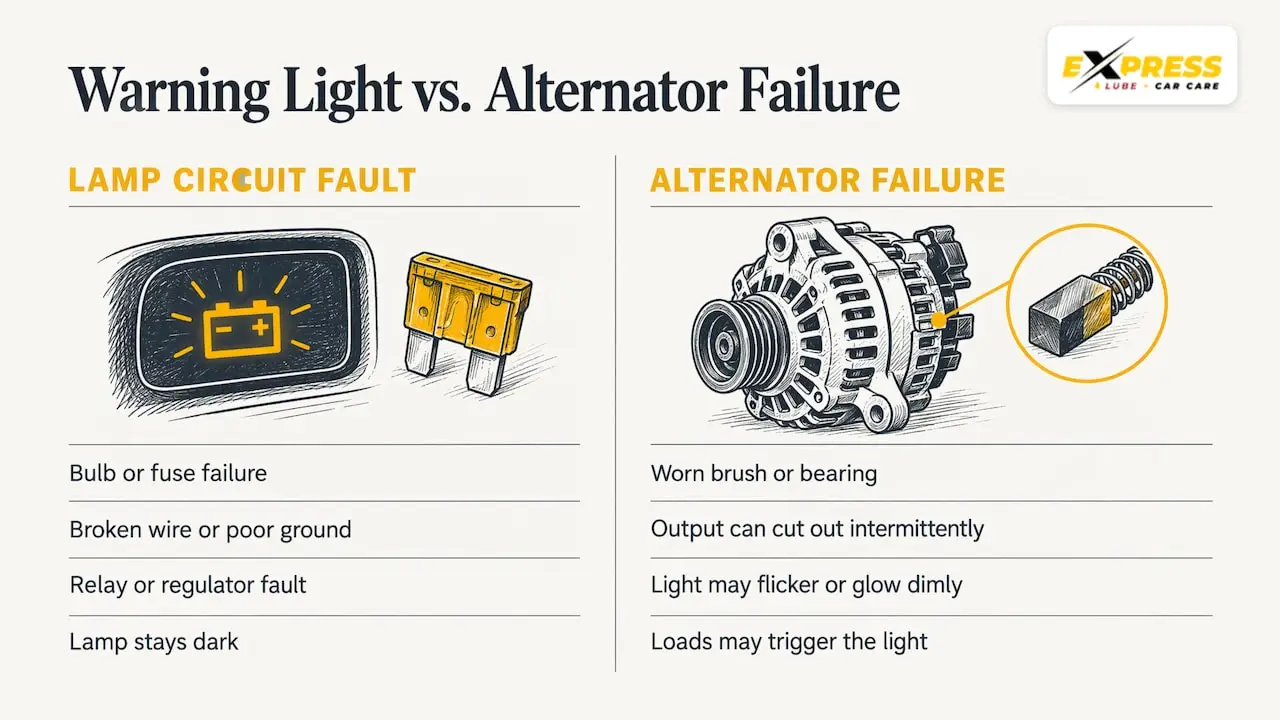
There is a second reason. Some failures are intermittent. A worn brush or bearing can make the alternator drop out for a moment and recover, and the light may flicker, glow dimly, or only appear when you add loads like the A/C and wipers (Haynes Manuals). A flicker you never noticed on a bright Texas afternoon still counts.
A practical test you can do in your driveway: turn the key to the on position without starting the engine. The charging light should glow briefly. If it never does, the warning circuit is not doing its job, and you should not count on it to warn you later.
What does a failing alternator feel like without a light?
The alternator powers everything once the engine is running and recharges the battery. When output drops, the car pulls from the battery until the battery runs down. The signs show up in a rough order, and you can learn to read them.
Lights that follow the engine
Headlights that get brighter as you rev and dimmer at a stoplight are a classic sign. HELLA lists headlamp brightness that changes with engine speed, along with bulbs burning out faster than normal, among alternator-fault symptoms (HELLA). Sitting in stop-and-go traffic on Denton Highway with the A/C on high is the exact situation where this shows: low idle speed, high electrical demand.
Hard starting and a hot battery
An undercharged battery cranks slowly or clicks. HELLA also notes a battery that runs hot from overload as a possible sign. If you have had the battery replaced and the same slow start returns within weeks, the charging system deserves the next look.
Comfort features fading first
Haynes describes electrical systems failing in a sequence: comfort features such as heated seats go first, and headlights go last. So a seat heater that quits, a weak blower fan, or power windows that crawl may be the earliest hint, long before anything feels like an emergency.
Electronics acting strange
Radio static, a flickering dash, a infotainment screen that reboots, or gauges that wander can all come from unstable voltage. This is also why intermittent electrical complaints are so frustrating: the symptom moves around, and the cause may be the alternator, the battery, a ground strap or a corroded terminal.
Noise and smell
Whining or grinding that rises with engine speed can point to worn bearings. A burning smell can mean a slipping belt or an overheating alternator. Treat both as a reason to book a visit soon, not next month.
Is it the alternator, the battery, or something else?
This is the hard part, and it is why guessing is expensive. Haynes explains that when an alternator fails the battery takes over, and its slow decline gets mixed up with the alternator’s, so the two are hard to separate by feel (Haynes Manuals). Our guide on alternator vs. battery symptoms walks through the differences in everyday terms.
Here is how the common causes compare.
| Possible cause | What you might notice | What a shop checks |
|---|---|---|
| Worn brushes or bearings | Output that cuts in and out, whining noise | Charging output under load, noise at the pulley |
| Failed diodes in the rectifier | Weak charging, a battery that drains overnight | Output and AC ripple |
| Slipping or misaligned belt | Squeal, dim lights at idle | Belt condition, tension, pulley alignment |
| Loose or corroded connections | Symptoms that come and go | Voltage drop across cables and grounds |
| Weak battery | Slow crank after sitting | Resting voltage and voltage under load |
| Regulator or control circuit fault | Overcharging or no charging, no light | Voltage at idle and at higher RPM |
DENSO says intermittent charging faults are frequently traced to incorrect belt tension, poor grounding or loose battery connections, and that internal faults like diodes, stator windings or regulators should be suspected only after those basics are confirmed (DENSO). That order matters. It keeps you from paying for an alternator when a ground strap was the problem.
A simple home clue
Haynes gives a rough field test: if you jump-start the car and it runs for a while but soon stops, the alternator is the likely culprit. If it keeps running, the battery is more likely the problem. Use this only to decide how urgent your situation is. It is not a diagnosis, and a jump-start itself is best done carefully, with the manual’s instructions for your vehicle. If you drive a European model with sensitive electronics, ask for a professional test rather than repeated jumps.
How a shop actually tests the charging system
A proper test goes beyond “the battery is good, so it must be the alternator.” These are the steps that separate a real diagnosis from a parts swap.
- Resting battery voltage. Measured after the car has sat. Vehicle Service Pros notes a battery can read about 12.6 volts at rest and still collapse under load (Vehicle Service Pros).
- Voltage while cranking and under load. A drop here can point to a weak battery, a poor cable connection or high resistance in the main power path.
- Charging voltage at idle and with revs. Haynes gives the target: about 13.5 volts at idle and over 14 volts with the engine revved, but not above 15 volts (Haynes Manuals).
- Voltage-drop tests. The technician measures from battery positive to the device and from the device ground back to battery negative while it operates. A drop that appears only when a harness is moved points to an intermittent high-resistance connection (Vehicle Service Pros).
- Belt, pulley and connections. A worn belt, a bad alternator-to-battery connection or a bad regulator connection can all cause undercharging.
- Inspection for corrosion and contamination. A 2014 technical document notes that rust and corrosion can make alternators fail or work intermittently, and that oil or grease on an alternator can block cooling and shorten its life (NHTSA-published service bulletin).
On modern cars the computer adjusts charging to demand, so a reading that looks odd is not always the alternator’s fault. A regulator, control module or wiring harness can be the real cause. That is why we start with testing and a look at the whole circuit. Our digital vehicle inspections come with photos and technician recommendations, so you can see what was found before you decide on anything.
Intermittent electrical problems: where to look first
If your real complaint is a car that sometimes acts up and then behaves, the charging system is only one suspect. Intermittent faults often come from a connection that is fine until heat, vibration or a bump moves it. North Texas summers are hard on this: engine-bay heat, long idling in traffic and heavy A/C use all load the system and expose weak links.
A few practical examples:
- The commuter with a flickering dash. A driver on the Loop 820 and Highway 121 commute notices the cluster flickers only in afternoon heat. The fault may be a corroded battery terminal or a ground that loosens as metal warms, not a failed alternator.
- The rideshare driver. Phone chargers, a dash cam and constant A/C add load. If the headlights dim at idle between fares, the system may be struggling to keep up. Long idle hours make the symptom show sooner.
- The truck owner with add-ons. Extra lights, a winch or a trailer harness increase demand. DENSO notes that no-charge complaints are often caused by battery issues, blown fusible links, wiring faults or excess load from added accessories.
- The European car owner with aftermarket electronics. Added modules can introduce their own faults. When an aftermarket exhaust controller drops its connection, for example, exhaust controller connection causes are worth reviewing alongside a voltage check, since low or unstable voltage and loose connections are among the first things to rule out.
If the problem shows up only sometimes, write down when: hot or cold, idling or driving, A/C on or off. That note helps the technician reproduce the fault, which is half the battle with intermittent problems.
Is it safe to keep driving?
Not for long. AAA lists the charging-system warning light among the top red lights and says the car could lose power completely in fewer than 15 minutes once the alternator stops supplying power (AAA). Without the light, you have even less notice.
If you notice the signs above while driving:
- Turn off what you do not need. Seat heaters, rear defrost, the stereo and extra lights all pull from a shrinking reserve.
- Do not shut the engine off until you reach a safe place. A failing alternator can leave the battery too weak to restart.
- Head for a safe stop or the nearest shop. On the Denton Highway corridor, that may mean a parking lot rather than a lane with no shoulder.
- Call for a tow if you are unsure. Overcharging in particular can harm computer modules, the battery and wiring even on a short drive. Our urgent car repair options guide explains what to do when a car breaks down.
- Stop immediately if you smell burning, see a shredded belt, or the car dies and will not restart. Pull over where it is safe and call roadside assistance or 911 if you are in danger.
What it costs, and why diagnosis saves money
ConsumerAffairs reports the average U.S. alternator replacement runs about $747 to $842 by Kelley Blue Book’s figures and $757 to $1,032 by RepairPal’s, with costs above $3,000 for performance models or hard-to-reach engines (ConsumerAffairs, 2026). Your own quote depends on your vehicle, the part and the labor involved. Our breakdown of alternator replacement cost explains what drives the difference.
The point for this topic: the alternator is not always the part that needs replacing. A belt, a terminal or a ground repair costs far less than a new alternator, and a car that is already misdiagnosed costs you twice. We recommend a diagnosis first, then a repair plan you can approve line by line.
Why drivers bring charging problems to us
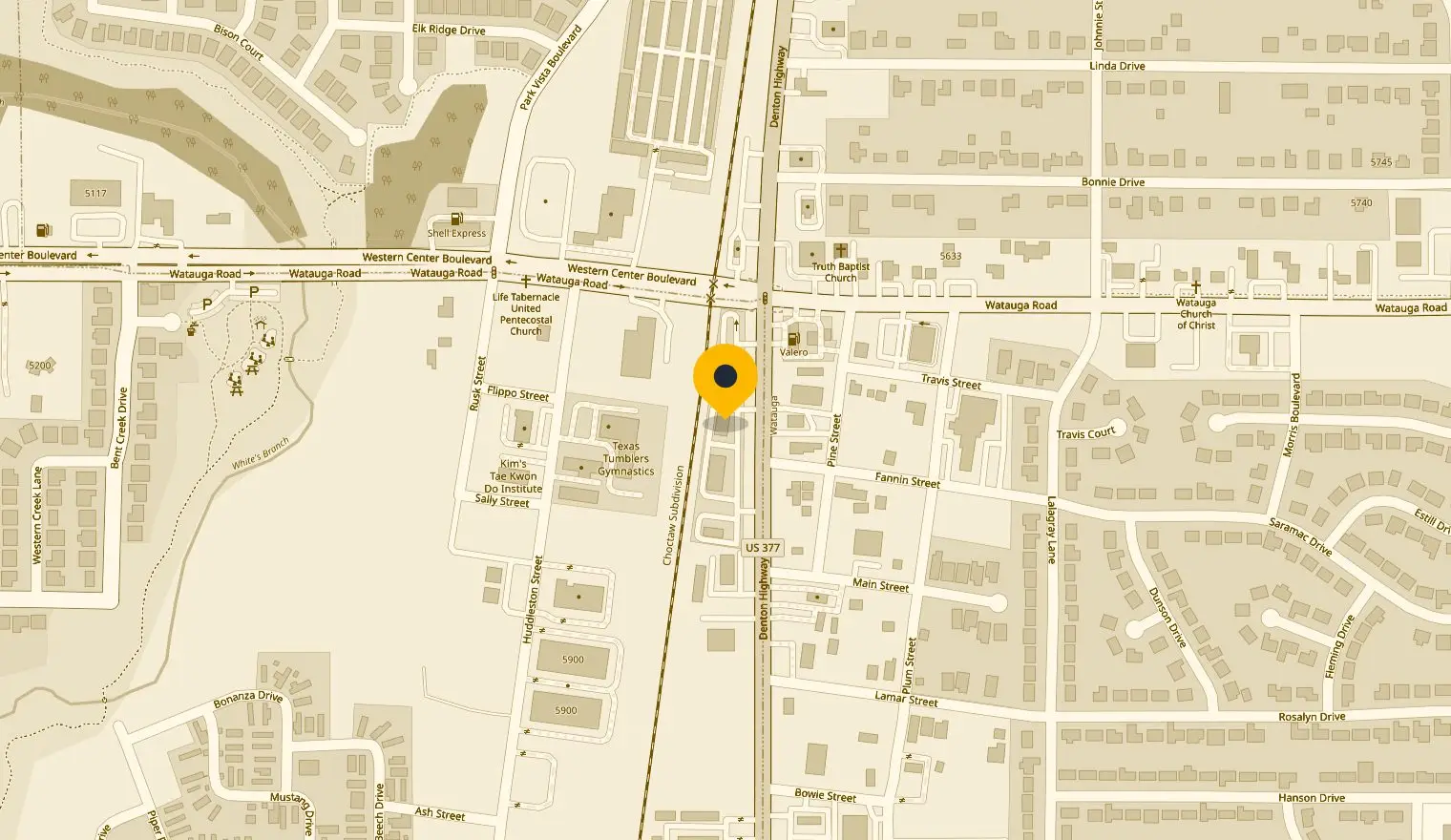
We are a full-service repair shop at 6211 Denton Hwy in Haltom City, serving drivers from Watauga, North Richland Hills, Fort Worth, Keller and nearby communities. Our ASE-certified technicians work on battery, alternator and starter service, electrical system and lighting repair, check engine diagnostics and the cooling and belt systems that charging problems often touch. No appointment is required, so you can come in when the first symptom appears.
If the repair is one that qualifies, it may be covered by our 24-month/24,000-mile warranty, which applies to qualifying repairs only. Eligible repairs may also qualify for third-party financing through Snap Finance, subject to provider approval and applicable terms. You can read more on our auto repair financing page.
Fleet managers and rideshare or delivery drivers get a particular benefit from catching this early: a car that quits mid-shift costs more in lost work than the repair does.
Our view: test the system, not just the part
We see charging complaints as electrical-system problems until a test says otherwise. A dark warning light tells you very little, and a replaced alternator that does not fix the symptom is frustrating and costly.
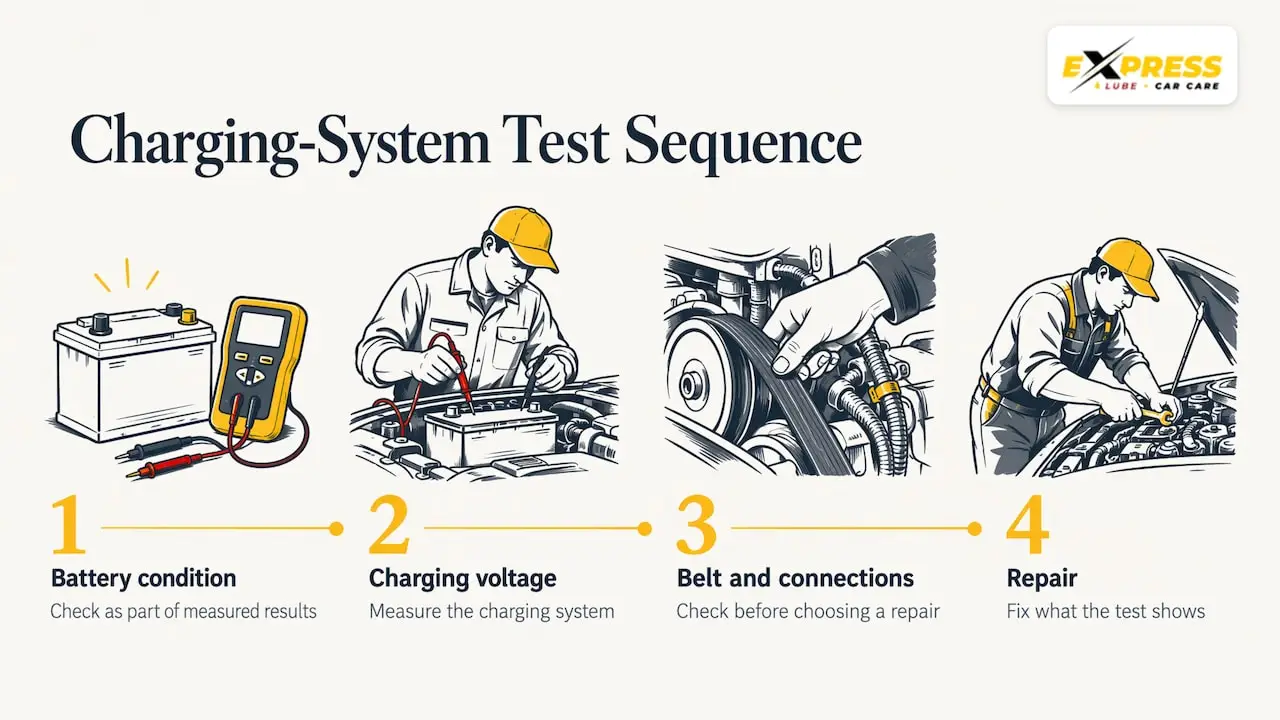
That is why we begin with measured results: battery condition, charging voltage, belt and connections, then the repair. Our digital inspections put photos and technician notes in front of you, so the recommendation is something you can see.
For drivers with trucks, SUVs, European models or work vehicles, we keep the same approach: diagnose first, explain it plainly, and repair what the test shows.
Express Lube & Car Care
Get the charging system checked
If your headlights pulse, your engine cranks slowly or your electronics misbehave, bring the car to Express Lube & Car Care. We will test the battery, alternator, belt and connections and explain the results in plain language. See our full list of services or visit our website.

Military members, first responders and anyone who needs a quick turnaround are welcome to walk in. Ask us about what applies to you when you visit.
FAQ
Can an alternator go bad without the battery light coming on?
Yes. The light runs on its own circuit, and a blown bulb, bad fuse, poor ground, broken wire or relay problem can keep it dark. Some failures are also intermittent, so the light may never stay on long enough to notice. Watch for dimming lights and slow starts instead.
How can I tell an alternator problem from a bad battery?
The two share many symptoms, so a voltage test is the reliable method. A rough clue is that a car that starts with a jump but soon stops points to the alternator, while one that keeps running points to the battery. A shop can measure resting voltage, cranking voltage and charging voltage to be sure.
What voltage should a healthy charging system show?
Haynes gives about 13.5 volts at idle and over 14 volts with the engine revved, but not above 15 volts, measured at the battery. Readings outside that range call for a professional look, since the cause could be the alternator, wiring or the control system.
Can I drive with a failing alternator?
Only as far as needed to reach safety. AAA warns a car may lose power completely in under 15 minutes once the alternator stops supplying power. Turn off nonessential electrical loads, keep the engine running until you arrive, and arrange a tow if you are unsure.
Does Express Lube & Car Care need an appointment for an electrical check?
No appointment is required, but you can schedule one at our appointment page or call (817) 281-3300. We are at 6211 Denton Hwy, Haltom City, TX 76148.
Sources
- KTR alternator service manual, 2024
- DENSO TechTip: Diagnosing Alternator Faults the Right Way
- Haynes Manuals: What Is an Alternator on Your Car
- HELLA: Checking the alternator
- Haynes Manuals: Troubleshooting Common Charging System Issues and Causes
- Vehicle Service Pros: Electrical system testing techniques
- Alternator troubleshooting and diagnostics service document (NHTSA)
- AAA: What to Do When Your Car Breaks Down
- ConsumerAffairs: Cost of an Alternator Replacement