
You're driving through Haltom City, maybe heading down Denton Highway or crossing over to North Richland Hills, and a low hum starts coming from the front of the car. It isn't loud at first. Then it gets more noticeable as speed goes up, or it changes when you lean into a turn.
That's where a lot of drivers get stuck. Is it a tire? A CV joint? Brakes? Or is it one of the front wheel bearings?
Front wheel bearings are components rarely considered until they start making noise. By then, the question usually isn't just what they are. It's how to tell whether the sound is serious, whether you can keep driving, and whether the repair needs to happen now or later. The answer depends on good diagnosis, because several front-end problems can sound similar at first.
What Front Wheel Bearings Do For Your Car
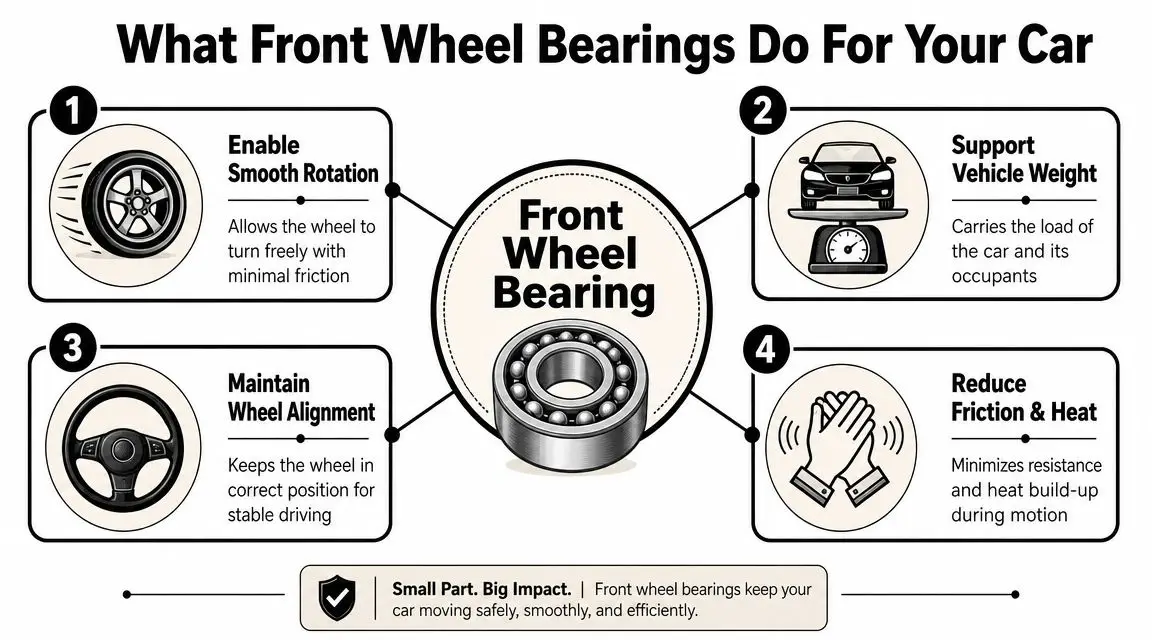
A front wheel bearing has a simple job with serious consequences. It lets the wheel rotate smoothly while supporting the load placed on that corner of the vehicle. The easiest way to think about it is like the bearing in a skateboard wheel, except built to handle the weight, braking force, and cornering load of a full-size vehicle.
That matters every time you drive. The wheel has to spin freely, stay located where it belongs, and hold steady while the vehicle turns, stops, and rolls over rough pavement. If the bearing starts wearing out, you don't just get noise. You can also get looseness, vibration, and changes in braking or steering feel.
Why modern front wheel bearings are different
Most drivers don't realize how much these parts have changed. On most late-model vehicles manufactured since 1998, there's a sealed wheel hub assembly in each wheel, replacing older front-wheel setups on many rear-wheel-drive vehicles that used individual bearings and seals in the front hubs, according to Counterman's history of wheel bearing design.
That shift changed the repair approach. Older serviceable bearings could often be cleaned, repacked, adjusted, and put back into service if everything else checked out. Most modern front wheel bearings are part of an integrated hub assembly that's sealed from the factory and treated as a replacement unit once it develops play, roughness, or noise.
What that means on the road
Modern front wheel bearings do more than just spin. They also help maintain wheel position under load. On newer vehicles, the hub assembly may also work closely with the ABS system and wheel speed sensing, so a problem there can affect more than one system at once.
Practical rule: If the wheel doesn't stay stable, the rest of the front end can't do its job properly.
That's why a bearing issue can show up as a noise complaint first, but still affect steering precision, brake feel, and overall confidence behind the wheel.
Key Warning Signs of a Failing Wheel Bearing
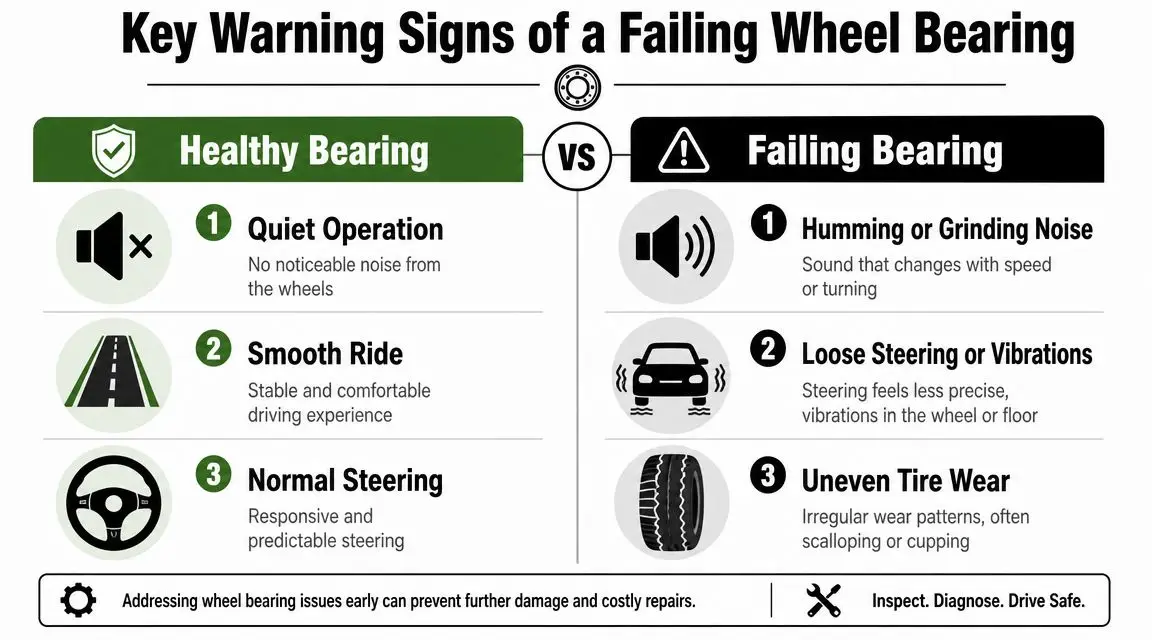
The most common complaint is a humming, growling, or grinding noise from one corner of the vehicle. It usually changes with road speed. In many cases, it also changes when turning because the load shifts from one side of the vehicle to the other.
A lot of drivers describe it as tire noise at first. That's understandable. The sound often starts subtle, then slowly gets louder over time. A Tire Review report on wheel bearing failure patterns notes that 51% of bad wheel bearings were identified because of a customer noise complaint, and that the average life of a sealed wheel bearing and hub assembly is about 85,000 to 100,000 miles.
What bearing noise usually sounds like
Bearing noise usually follows a pattern:
- It rises with speed. The faster the wheel turns, the more obvious the hum or growl becomes.
- It may change in a curve. A turn can load or unload the bearing enough to change the sound.
- It often comes from one corner. Drivers may hear it as front-end noise, but pinning down left or right by ear alone isn't always easy.
- It can progress from hum to rough grind. Once internal damage gets worse, the sound tends to get harsher.
If you want a more symptom-focused overview, this guide on signs of wheel bearing failure is a useful companion.
A quick sound example helps more than a description alone. This video gives a good real-world reference:
How to tell it apart from tire noise or a CV joint
People often get misled at this point.
A cupped or scalloped tire can make a rhythmic hum or roar that sounds very close to a bad bearing. The difference is that tire noise is often tied to tread wear, and you may feel or see the uneven pattern when the tire is inspected closely. Tire noise can also move if the tires are rotated.
A CV joint usually gives a different kind of warning. Instead of a steady speed-related hum, it often makes a clicking or snapping noise during sharper turns, especially under power.
Other clues can point away from the bearing too:
- Brake-related noise may scrape or pulse more directly with brake application.
- A worn hub or related front-end part can add vibration or looseness without producing the classic bearing growl.
- ABS issues can show up alongside a hub problem, which makes a one-symptom guess risky.
If the sound changes with speed, don't assume it's “just road noise.” Front-end noises overlap, and the repair path is different depending on the cause.
How Professionals Diagnose Front Wheel Bearings
A proper diagnosis starts with one basic rule. A hand spin alone isn't enough.
A wheel can feel decent in the air and still show a problem once side load is applied. That's why trained techs don't rely on one quick check and call it good. They look at the tire, wheel, hub, and related steering parts together so they don't mistake one issue for another.
What gets checked first
The first step is usually simple inspection. Tire condition matters because irregular wear can mimic bad front wheel bearings. If the tire is chopped up, feathered, or badly cupped, that has to be considered before blaming the hub.
Then the vehicle is lifted safely and the wheel is checked for movement. The troubleshooting guidance discussed in GMB's wheel bearing overview highlights checking for play at the wheel, which is a practical starting point before any parts get replaced.
The shake test and dial indicator
Professional inspection procedures put more emphasis on loaded movement than most DIY checks do. Timken's inspection method, shown in this wheel hub diagnostic video, emphasizes a 9-and-3 o'clock shake test and using a dial indicator placed perpendicular to the wheel pilot for accurate movement measurement. The same guidance says any measurable looseness or roughness is a strong indicator the hub should be replaced.
That dial indicator matters because small movement can affect more than noise. It can also influence rotor runout, steering feel, and ABS signal quality.
A front hub can be noisy, loose, or both. The job is to prove which corner is bad before parts go on.
Why road feel and vibration matter
Bearing diagnosis also overlaps with vibration diagnosis. Noise alone doesn't always tell the full story, especially when the problem is still early. For readers who want to understand how vibration patterns help identify bearing faults in rotating components, Forge Reliability's fault detection insights offer helpful background.
For vehicle owners, the practical takeaway is simpler. If a shop inspects the car, checks for play, verifies the tire condition, and measures hub movement instead of guessing by sound alone, that's a better process. This local article on what hub bearing sound can mean is also helpful if you're trying to match what you hear with what a technician may find.
Common Causes of Premature Wheel Bearing Failure
Front wheel bearings wear out over time, but age isn't the whole story. A lot of early failures come from outside damage, not normal mileage.
That's important because it changes how you think about prevention. If a bearing fails early, the part itself may not be the only issue. Road impact, contamination, or poor installation may be the actual reason it didn't last.
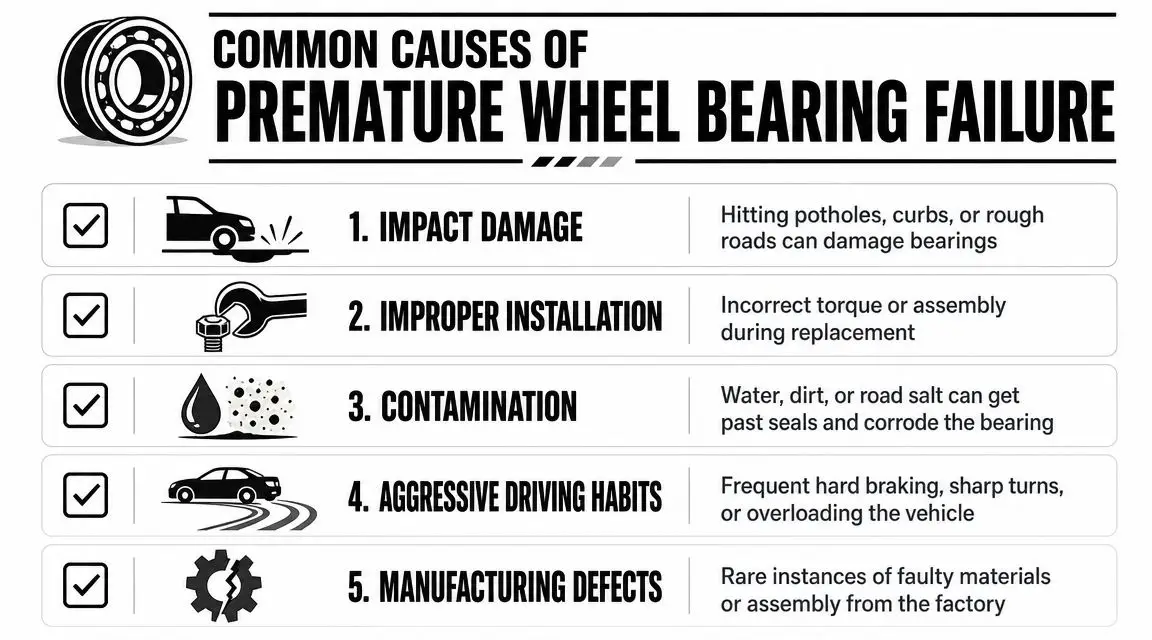
The three causes that show up most often
According to NYZ Bearing's overview of wheel bearing and hub assembly failure, many front wheel bearings fail early because of external factors. The biggest ones are pothole or impact damage to the raceways, contamination past damaged seals, and incorrect axle-nut torque during installation.
Here's how those problems usually play out:
Impact damage
A hard pothole hit or curb strike can dent internal raceways. The damage may start small, then turn into a repeating noise as the rollers or balls pass over the damaged area.Contamination
Once a seal is compromised, water, dust, and road grime can get into a part that depends on clean lubricant and tight clearances.Installation error
This is the one that surprises people. A brand-new hub can fail early if it's installed incorrectly, especially if torque procedures aren't followed.
What drivers in Haltom City should take from that
Local roads, traffic, and heat don't help. Neither do repeat curb hits in tight parking lots or rough pavement that jars the suspension. Drivers can't avoid every pothole, but they can avoid casual installation work that skips torque specs and proper procedures.
Shop habit that matters: A quiet new bearing doesn't prove the install was right. Correct torque and careful handling are what give it a chance to last.
DIY vs Professional Wheel Bearing Replacement
Some repairs are realistic for a skilled do-it-yourselfer. Front wheel bearings can be one of them on the right vehicle, with the right tools, and with a clear understanding of the procedure. But on many modern cars and SUVs, this isn't a casual driveway job.
The reason is precision. Most newer front wheel bearings are sealed hub units built with a factory-set preload. That preload isn't something you “feel out” by hand. If the assembly is tightened incorrectly, the bearing can be damaged before the vehicle even leaves the garage.
Where DIY can make sense
On older setups with serviceable bearings, an experienced DIY owner may be able to clean, inspect, repack, adjust, and reinstall components correctly. That work still requires care, but the design is more forgiving than a modern sealed hub assembly.
On newer vehicles, DIY replacement can still be possible, but only if you have the right equipment and information. Depending on the design, that may include a torque wrench, slide hammer, puller tools, press support, and the exact service procedure for that vehicle.
Where professional service has the advantage
Tire Review's lesson on wheel bearing preload and installation explains that modern sealed hub units are designed with a specific factory-set preload. It also warns that over-tightening increases heat, breaks down lubricant, and can cause the new bearing to fail very quickly.
That's the part many people underestimate. The repair is not just “remove old part, bolt on new part.” The assembly has to sit correctly, mating surfaces have to be clean, and the axle nut has to be torqued the right way for that design.
| Factor | DIY Approach | Professional Service (Express Lube) |
|---|---|---|
| Vehicle type | More realistic on older serviceable bearing setups | Better fit for modern sealed hub assemblies |
| Tools required | May require pullers, torque wrench, and model-specific tools | Shop equipment and diagnostic tools are already on hand |
| Diagnosis | Risk of replacing the wrong part if the noise source is misread | Inspection can separate bearing noise from tire, brake, or steering issues |
| Installation precision | Depends heavily on experience and exact procedure | Torque procedure and fitment checks are part of the job |
| Risk | Incorrect preload or handling can ruin the new part | Lower risk when the hub is installed to spec |
If you're already dealing with uncertain front-end noise, it's smart to start with proper testing rather than guessing. A local diagnostic overview on auto diagnostic services can help you understand what a professional inspection should include.
The practical choice
If you've done this type of repair before and your vehicle setup is straightforward, DIY may be reasonable. If the car uses a sealed front hub assembly, if the axle nut procedure is critical, or if you're not fully sure the bearing is the problem, professional replacement is usually the safer move.
That's especially true when the symptoms overlap with tire cupping, brake noise, or steering component wear. Replacing a good hub won't fix the wrong problem.
Your Local Experts for Wheel Bearing Service in Haltom City
For drivers in Haltom City, Keller, Watauga, and North Richland Hills, front-end noise shouldn't turn into a guessing game. If your car has a hum, growl, vibration, or looseness that seems to come from the front, the right next step is a careful inspection that confirms the source before any parts are replaced.
That matters with front wheel bearings because the symptom list overlaps with several other problems. Tire wear can mimic a bad hub. Brake issues can create scraping or vibration. A CV joint can sound bad in turns for a different reason entirely. Good service starts by separating those possibilities, then fixing the actual fault.
Drivers around Denton Highway need a shop that understands both diagnosis and installation. A correct repair means checking the hub properly, confirming whether related parts were affected, and following the torque procedure that fits the vehicle. If you're comparing local options, this page on Haltom City auto repair gives a clear picture of what a full-service local shop should offer.
A wheel bearing problem usually gets more expensive when it gets ignored. It rarely gets better on its own.
If the sound has started, or if the steering no longer feels as planted as it should, now is the time to have it checked.
If your vehicle in Haltom City is making front-end noise and you want a clear answer without guesswork, schedule an inspection with Express Lube and Car Care. Their team can pinpoint whether you're dealing with front wheel bearings, tire noise, brake issues, or another front suspension problem, then recommend the right repair for safe, dependable driving.