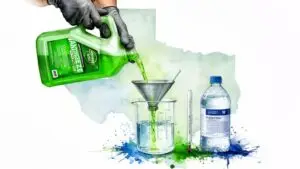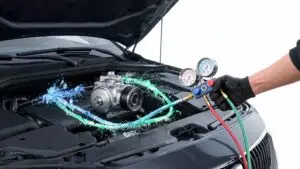

You’re standing in the coolant aisle, looking at a row of jugs that all seem close enough. One says green. Another says Asian green. Another says all vehicle. If you drive around Haltom City, Watauga, or North Richland Hills long enough, you’ll eventually hit this exact moment and realize coolant isn’t as simple as matching colors.
That’s where people make expensive mistakes.
A cooling system can tolerate a lot of neglect right up until it suddenly can’t. Then the temperature gauge climbs, the heater stops acting right, the reservoir turns murky, or the radiator starts pushing out sludge. In North Texas, where traffic, heat, and long commutes all load the cooling system, the wrong coolant choice can turn a simple maintenance job into radiator, water pump, or head gasket trouble.
Green prestone antifreeze still has a place. But only in the right vehicle, with the right service interval, and without mixing it blindly with whatever’s already in the system.
More Than Just a Color in a Jug
A lot of drivers assume the old-school green jug is the safe choice because it looks familiar. That used to be a more reliable shortcut than it is today.
In the shop, the common pattern is simple. Someone notices the reservoir is low, buys a green coolant, tops it off, and figures they handled it. Then later the system starts running hotter, the coolant looks dirty, or the vehicle develops a leak that was already there but got ignored because the focus stayed on the bottle color.
What local drivers are really dealing with
In Haltom City, cars sit in drive-thrus, idle in traffic, run A/C hard, and rack up stop-and-go miles. That kind of use exposes weak coolant faster than mild driving does.
Older trucks and high-mileage daily drivers are the ones I worry about most. Many of them have had years of top-offs, partial drain-and-fills, and unknown prior service. Once the service history gets fuzzy, coolant choice stops being a shelf decision and becomes a compatibility decision.
Green on the label doesn’t tell you enough. The chemistry inside the jug is what matters.
The mistake to avoid
If you remember one thing, remember this. Coolant color is only a clue, not a specification.
Before adding anything, check what the vehicle calls for. If you don’t know what’s in the system now, guessing is the risky move. On a modern cooling system, “close enough” isn’t a maintenance strategy.
Decoding the Original Green Prestone Antifreeze
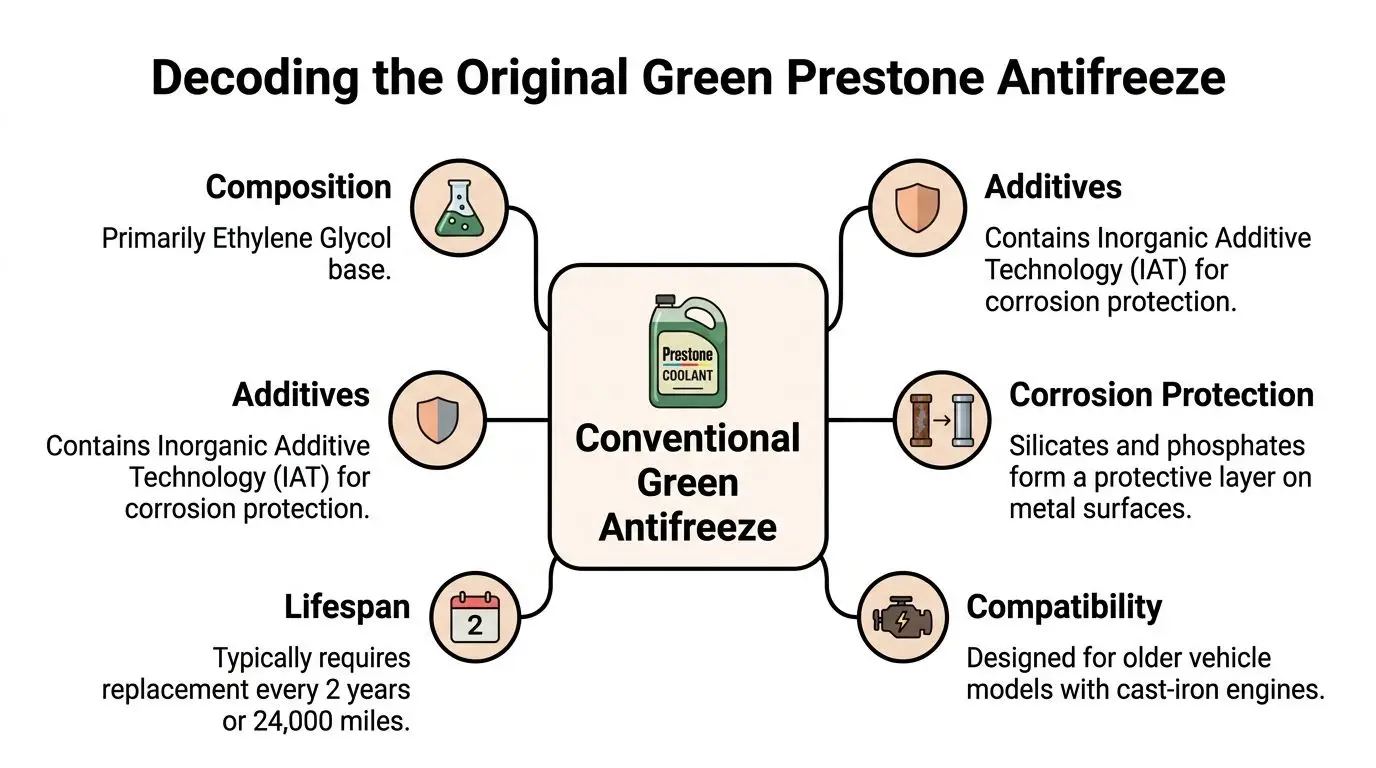
The classic version of green prestone antifreeze refers to conventional green IAT coolant. IAT means Inorganic Additive Technology. It was developed for older cooling systems built with materials like cast iron, copper, brass, and solder.
Prestone introduced the world’s first commercially available ethylene glycol-based antifreeze in 1927, and that original green coolant used silicates and phosphates to protect the metal parts common at the time, according to Prestone’s history of antifreeze development.
What the formula is doing
Think of conventional green coolant like a fast-acting protective coating. Its inorganic inhibitors don’t wait around. They lay down a barrier on metal surfaces to reduce corrosion.
That’s why it worked so well in older systems. Those engines and radiators used materials that needed that kind of blanket-style protection.
Where it fits best
Prestone Prime Conventional Green is a low-silicate IAT formula made for vehicles that specifically require conventional green coolant. It provides 25,000 miles or 2 years of protection when used as directed and meets ASTM D3306 and D4985 standards, according to Prestone Prime Conventional Green product details.
That matters most for vehicles designed around traditional coolant chemistry, not just traditional coolant color.
Practical signs you’re in IAT territory
Some vehicles are better candidates for conventional green than others:
- Older cooling system materials: Cast iron, brass, copper, and soldered components are the classic match.
- Service records that specify conventional green: If the manual or prior service history clearly points to IAT, stick with that requirement.
- Classic and high-mileage vehicles: These often do best when the chemistry stays consistent and the system gets fully flushed instead of casually topped off.
If you want a broader foundation before sorting formulas, this plain-language guide on What is engine coolant is a good primer.
Shop rule: Match coolant to the vehicle specification first. Match the dye color second.
The Great Color Confusion Why Green Isn’t Always Green
The biggest coolant myth I run into is this one. If the old fluid is green, any green coolant must be fine.
That’s wrong.
Prestone MAX Asian Vehicles Green is also green, but it uses P-HOAT, which stands for phosphated hybrid organic acid technology. It’s designed for specified Asian vehicles and offers 15+ years or 350,000 miles of protection in those applications, according to Prestone MAX Asian Vehicles Green. That chemistry is completely different from old-school IAT green.
Coolant Technology at a Glance
| Technology | Common Colors | Primary Chemistry | Best For |
|---|---|---|---|
| IAT | Green | Inorganic additives such as silicates and phosphates | Older vehicles that require conventional green coolant |
| P-HOAT | Green | Hybrid organic acids with phosphate-based protection | Specified Asian models using that exact formula |
| Universal formulas | Varies | Varies by product | Only when the product and vehicle specs genuinely align |
That’s why color matching is a gamble. Two bottles can look nearly identical on the shelf and behave very differently in the radiator.
What to check instead of color
Use a short checklist:
- Owner’s manual requirement: Start there if you still have it.
- Exact product label: Look for terms like IAT or P-HOAT.
- Vehicle application statement: “For Asian vehicles” or “conventional green” is not decorative wording.
- Existing coolant history: If the system’s history is unknown, a flush is safer than a blind top-off.
If you want a quick explanation of the terms people often mix up, this article on the difference between coolant and antifreeze helps clear up the language. For another side-by-side look at color assumptions, this local breakdown of https://www.expresslubehaltom.com/blog/green-coolant-vs-red-coolant/ is useful.
Critical Risks of Mixing Different Coolant Formulas
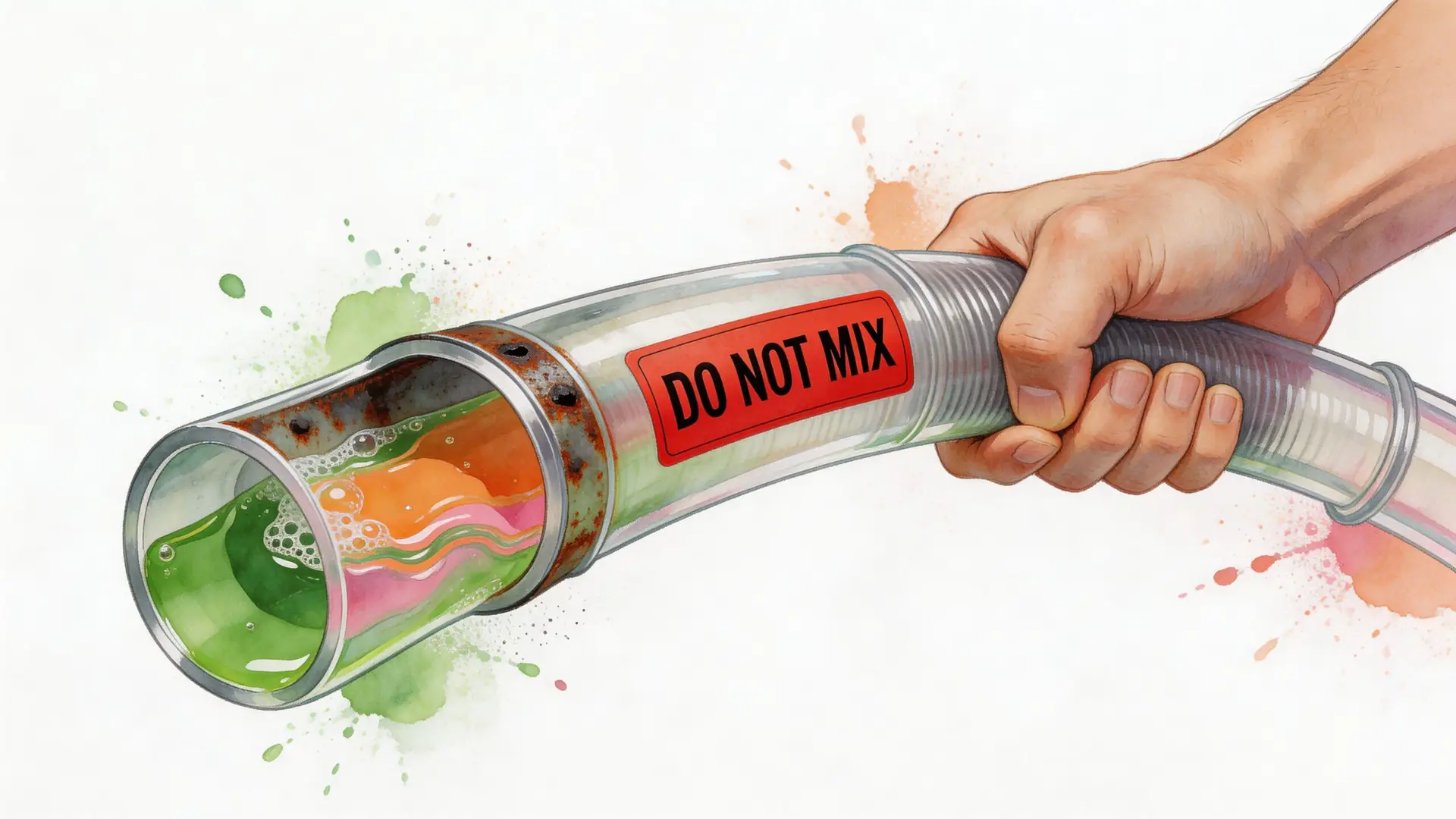
A lot of North Texas coolant problems start with a simple top-off. The engine runs a little warm in Haltom City traffic, the reservoir looks low, and someone pours in whatever green jug is on the shelf. That shortcut can turn a manageable service into a radiator flush, heater core restriction, or water pump repair.
Mixing coolant formulas can trigger chemical incompatibility inside the system. Conventional IAT green uses one inhibitor package. Many newer coolants use a different one. When those additives react poorly together, they can form sludge, gel, or hard deposits that restrict flow through the smallest passages first.
Why this gets expensive fast
Cooling systems in Texas already work hard for a living. Summer heat, long idle time, and stop-and-go driving in Watauga or North Richland Hills leave less margin for a partially clogged radiator. Even a thin layer of scale inside the system can cut heat transfer in a meaningful way, which is why contaminated coolant shows up as overheating faster here than it might in a milder climate.
Once heat transfer drops, coolant temperature rises. Then the weak points show up. The radiator sheds less heat. The heater core starts plugging. The water pump seal sees dirt and abrasive particles it was never meant to handle. Keep driving it hot, and the repair bill climbs from maintenance to engine work.
What mixing can damage
Contaminated coolant usually affects more than one part:
- Radiator passages: The narrow tubes clog first and reduce cooling capacity.
- Heater core: Weak cabin heat can be one of the first signs.
- Water pump: Debris and unstable coolant chemistry can shorten pump life.
- Reservoir and hoses: Sludge, staining, and residue often collect there early.
If the coolant already in the vehicle is unknown, guessing is the expensive option. Identify the correct spec first, or flush the system and refill it with the right formula. For a closer look at mixing coolants safely, use that local guide before topping anything off.
How to Check Your Coolant and Spot Early Warning Signs
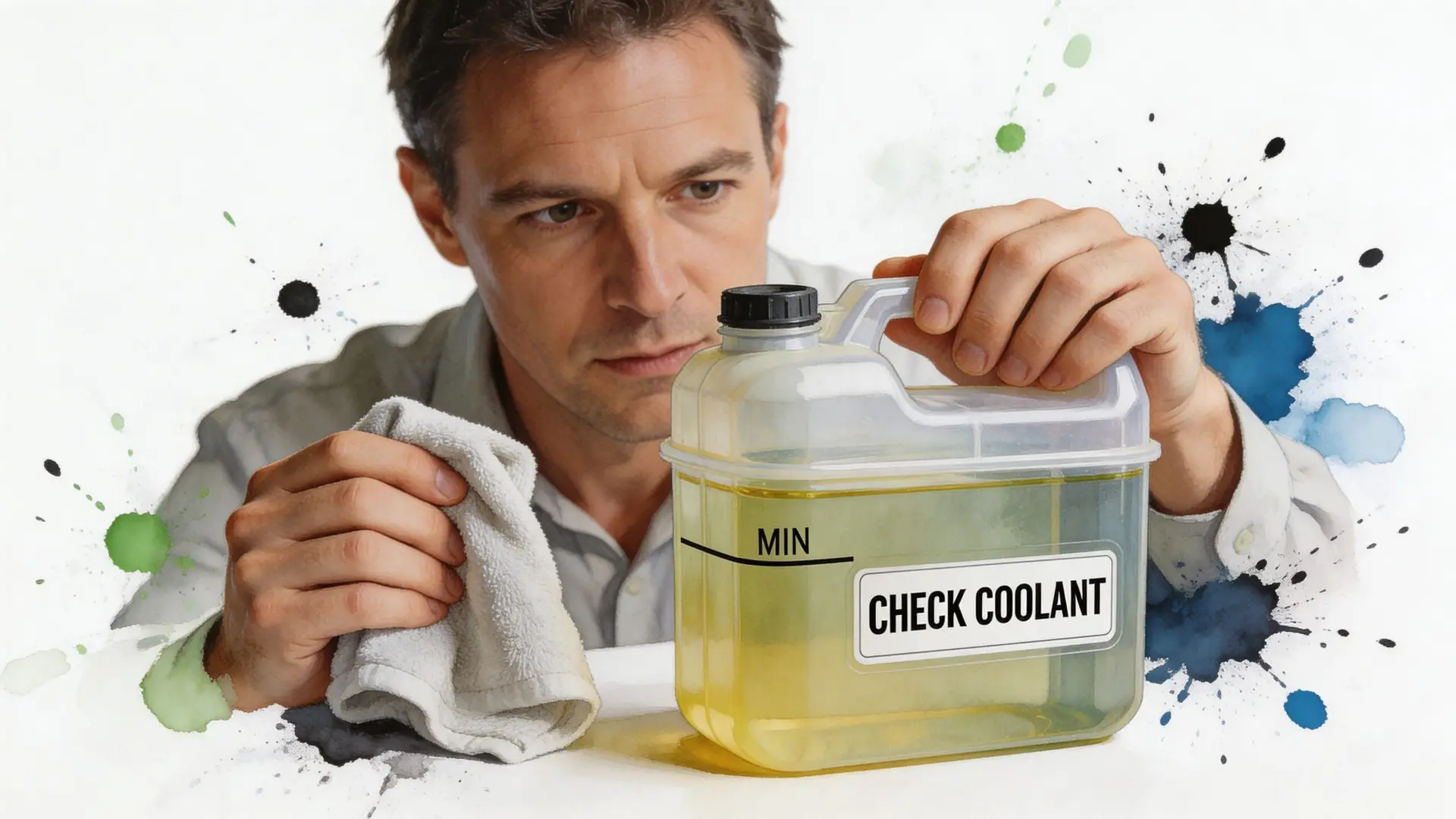
You can catch a lot of cooling system problems early if you check the system the right way. The key word is cool. Never open a hot radiator or reservoir cap.
Start with the overflow reservoir when the engine is fully cooled down.
A simple inspection routine
Use this order so you don’t miss anything:
- Check the level. The fluid should sit where the cold mark indicates for a cooled engine.
- Look at the color and clarity. Clean coolant should look consistent. Muddy, rusty, or separated fluid needs attention.
- Inspect the reservoir walls. Staining, crust, or oily film can signal contamination.
- Look underneath the vehicle. Green puddles or dried residue matter, even if the level only seems slightly low.
What your nose and gauge can tell you
Not every coolant problem is visible from above.
- Sweet smell under the hood: Often points to a leak.
- Sweet smell inside the cabin: Heater core issues move higher on the suspect list.
- Temperature gauge creeping upward: Don’t dismiss that as normal summer behavior.
- Low coolant that keeps returning low: That’s a leak until proven otherwise.
A visual walkthrough can help if you’re unsure what a leak pattern looks like:
When the coolant itself is the warning sign
Conventional green coolant doesn’t stay healthy forever. As the protective additives wear down, the fluid can lose its protective ability and turn discolored.
If the reservoir looks rusty brown, cloudy, or gritty, don’t just top it off. Find out why the fluid changed.
If you suspect leakage rather than old fluid alone, this page on https://www.expresslubehaltom.com/blog/find-coolant-leak/ can help you narrow down what you’re seeing.
Essential Coolant Maintenance for the Texas Climate
Texas heat doesn’t destroy the ethylene glycol base. The bigger issue is additive depletion.
With conventional green IAT coolant, the silicate and phosphate inhibitors wear out over time. According to Hagerty’s explanation of coolant chemistry and service life, conventional green IAT coolant typically needs service every 2 years or 60,000 miles, and some variants call for service as early as 3 years or 36,000 miles because those inhibitors deplete even though the glycol base remains stable. Their coolant guide is here: Hagerty on making sense of coolant types and intervals.
Why local driving is hard on coolant service life
In Haltom City and nearby areas, cooling systems deal with:
- Long idle time: A/C on, traffic not moving, fan cycling constantly.
- High ambient heat: Weak coolant protection shows up faster in summer.
- Mixed driving patterns: Short trips and repeated heat cycles can expose neglected maintenance.
Top-off versus flush
A top-off fixes level. It doesn’t restore a worn-out inhibitor package.
A proper flush and fill removes old coolant, suspended debris, and whatever incompatible leftovers may still be in the system. If you’ve ever wondered when water belongs in the mix and when it doesn’t, this local article on https://www.expresslubehaltom.com/blog/antifreeze-mix-with-water/ lays out the practical difference.
For conventional green systems, routine service is preventive maintenance. It’s cheaper than waiting for corrosion or restricted flow to announce itself.
Your Haltom City Experts in Radiator and Coolant Care
The hardest coolant jobs aren’t the obviously bad ones. They’re the uncertain ones. Older Ford trucks are a good example.
There’s real confusion around whether a modern green or “universal” formula is safe in systems that were designed around traditional green coolant. That confusion matters more in Texas, where heat makes any weak point in the cooling system show itself sooner. Prestone’s own Q&A content highlights this uncertainty and reinforces the practical answer: when compatibility is in doubt, a full flush with the correct fluid is the only guaranteed safe approach. That discussion appears in Prestone’s coolant questions and answers.
When a pro should handle it
A shop inspection makes sense if any of these apply:
- You bought a used vehicle: The coolant history is unknown.
- You drive an older Ford, Chevy, or Dodge truck: These are often where compatibility confusion starts.
- The reservoir color doesn’t match the service record: That’s a sign to stop guessing.
- You’ve already mixed products: The safest next step is correcting the system, not hoping it works out.
Why local service helps
A proper coolant service isn’t just pouring in fresh liquid. It means checking the condition of the old fluid, looking for contamination, inspecting for leaks, and filling the system with the formula the vehicle calls for.
For drivers in Haltom City, Keller, Watauga, and North Richland Hills, that local judgment matters. The right answer for a classic truck, a commuter sedan, and an Asian import won’t be the same.

If you’re not completely sure which coolant belongs in your vehicle, don’t gamble with your radiator or engine. The team at Express Lube and Car Care can inspect your cooling system, identify the right fluid for your vehicle, and perform a proper flush and fill at 6211 Denton Hwy for drivers in Haltom City, Watauga, Keller, and North Richland Hills.