
You feel suspension problems before you understand them. The truck starts hopping over patched pavement on Denton Highway. Your SUV dips harder than it used to at the stoplight. A freeway seam on Loop 820 that used to be a thump becomes a whole-body shudder.
Around Haltom City, Keller, Watauga, and North Richland Hills, that kind of change matters. North Texas driving mixes daily commuting, heat, expansion joints, potholes, drainage dips, and the occasional rough parking lot entrance that hits harder than it should. When the ride quality slips, comfort is only part of the story. Your shocks and struts also help control braking, cornering, and tire contact with the road.
This guide is built for local drivers who want a straight answer on shock and strut replacement. No vague “your suspension is bad” talk. Just what these parts do, how to spot trouble, how a shop should diagnose them, what a proper repair includes, and what questions are worth asking before you approve the job.
Your Guide to a Smoother Ride in Haltom City
A worn suspension usually shows up gradually. That's why drivers often live with it longer than they should. The vehicle still starts, steers, and gets them to work, so the problem gets pushed down the list.
But shocks and struts don't exist just to make the ride feel softer. They control spring motion and help the tires stay planted. When they wear out, the vehicle can start to bounce, dive, sway, and wear tires in ways many drivers don't immediately connect to suspension.
Why local roads make the issue obvious
Haltom City drivers don't need a test track to notice worn damping. Regular roads do the job. Repaired pavement, concrete joints, railroad crossings, and sharp driveway transitions expose weak shocks and struts fast.
A healthy suspension absorbs the hit, settles the body, and gets back under control. A worn one lets the vehicle keep moving after the bump is over.
Good suspension doesn't make bumps disappear. It stops the vehicle from reacting to the same bump twice.
What matters most to drivers
Most customers come in with one of these complaints:
- It feels bouncy: The car keeps moving after a bump instead of settling.
- It dips when I brake: The front end drops more than it used to.
- It feels loose on the highway: Steering corrections start to feel larger and more frequent.
- The tires are wearing oddly: The tread starts showing cupping or uneven patches.
- It rides rough but nothing looks broken: Internal wear often shows up before an obvious leak or failure.
That's where a real inspection helps. A proper suspension diagnosis should connect what you feel behind the wheel with what the technician sees underneath.
What Are Shocks and Struts Anyway
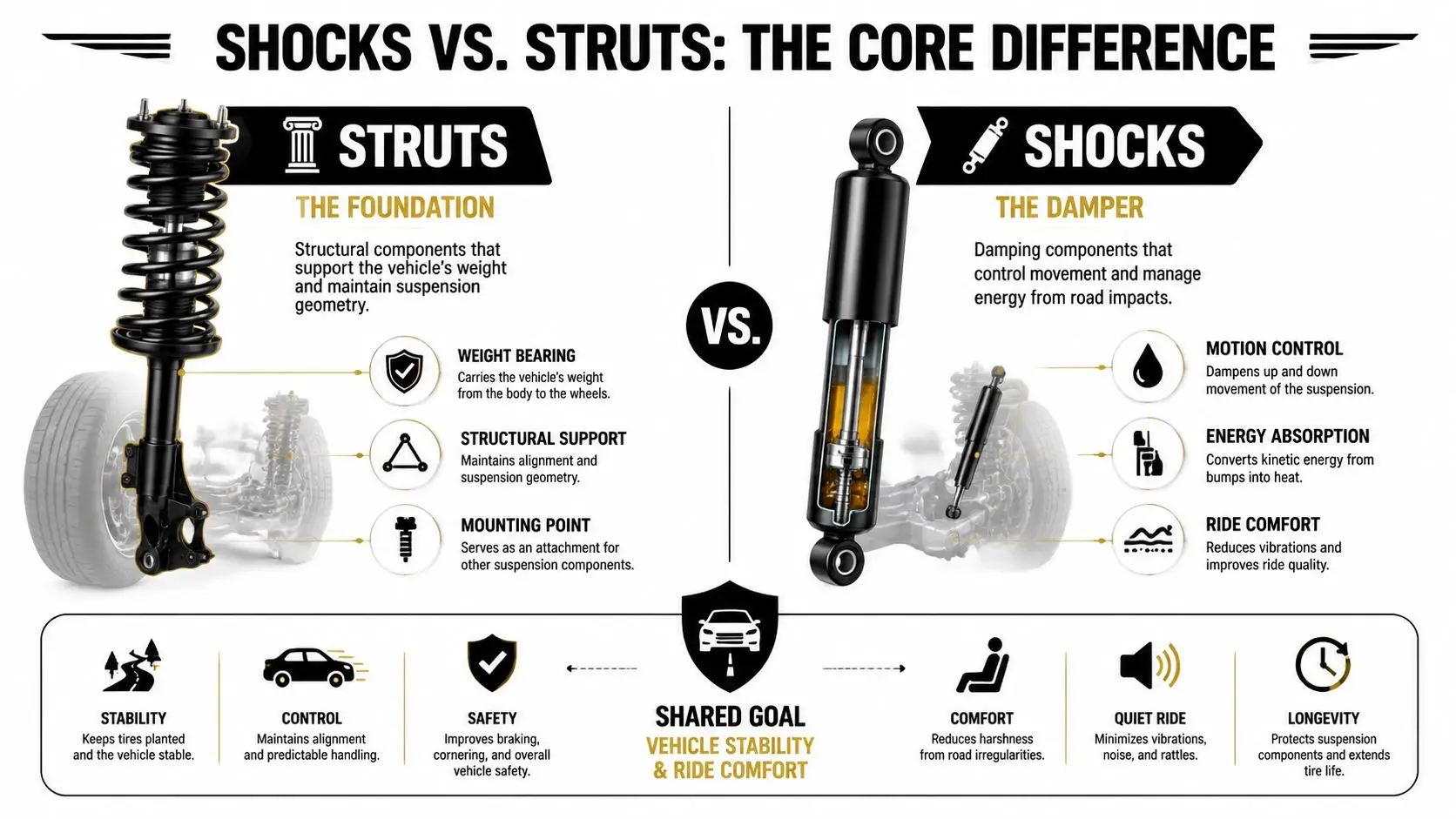
Most drivers use the terms interchangeably, and that's understandable. Both parts control suspension motion. Both wear out. Both affect ride and handling. But they aren't the same component.
The simple difference
Shocks are stand-alone dampers. Their main job is to control spring rebound and compression so the vehicle doesn't keep bouncing after a bump.
Struts do that too, but they're also part of the suspension structure. A strut assembly is load-bearing and can be tied directly into steering and alignment geometry. That's why strut work is usually more involved than a basic shock swap.
A useful way to think about it is this:
| Component | Main role | Why service is different |
|---|---|---|
| Shock absorber | Controls motion | Usually simpler to remove and replace |
| Strut assembly | Controls motion and supports suspension structure | Affects geometry and often requires alignment attention |
Why they wear out even if the car still feels normal
Suspension wear is sneaky because it's gradual. According to KYB's explanation of shock and strut motion, shocks and struts can move up or down 1,500 to 1,900 times per mile on even well-paved roads. KYB also notes that by 50,000 miles, a vehicle may have put each unit through roughly 75 million to 95 million suspension movements.
That helps explain why drivers don't always notice the decline right away. The vehicle adapts slowly, and so do you.
Which one is on your vehicle
You usually won't know just by looking through the wheel opening, and that's fine. Many passenger cars and crossovers use struts up front. Many trucks and SUVs use shocks in some positions and struts in others. Some vehicles use shocks at all four corners. Others mix components depending on axle design.
What matters is understanding the repair path:
- Shock service is usually more straightforward.
- Strut service involves more labor, more assembly detail, and more attention to post-repair geometry.
- Loaded strut assemblies can replace multiple worn pieces at once, which can simplify the job and reduce the chance of reusing tired hardware.
If a shop tells you that your vehicle needs shock and strut replacement, the first thing worth asking is which positions are involved and whether the repair is for shocks, struts, or both.
Telltale Signs Your Suspension Needs Replacement
Drivers usually describe suspension problems by feel, not by part name. That's normal. Very few people walk into a shop and say, “My right front strut has progressive damping loss.” They say the car feels off.
What you may feel on the road
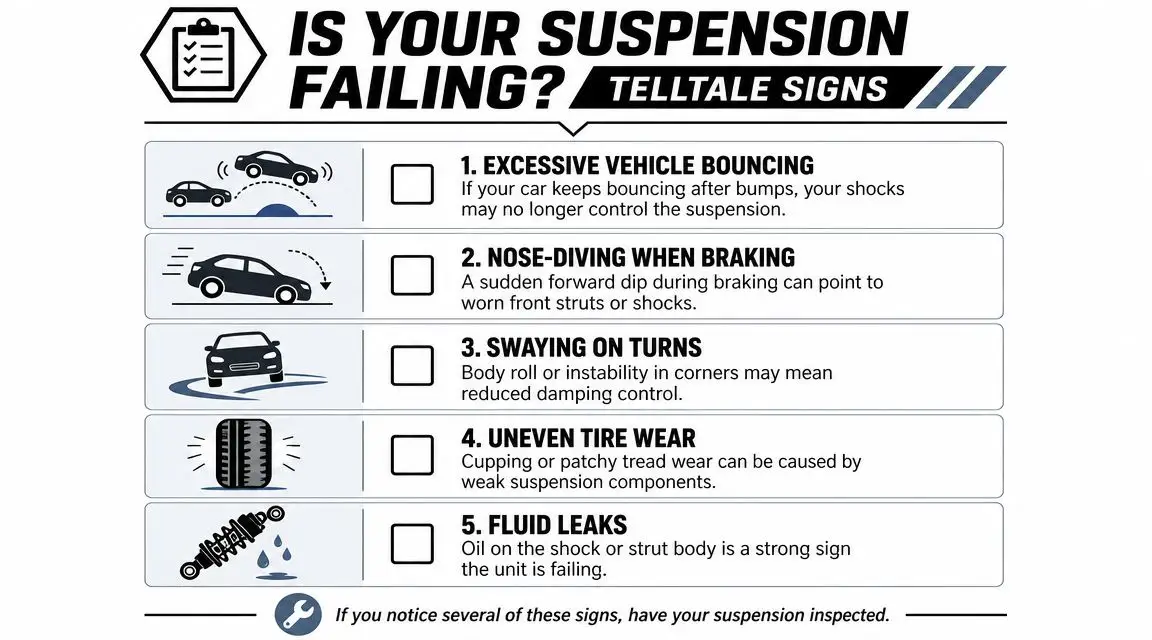
The most common signs show up in ordinary driving:
- Extra bouncing after bumps: You hit a dip, speed hump, or patch in the road and the body keeps moving longer than it should.
- Nose dive during braking: The front end drops hard when you stop, especially in traffic.
- Body sway in turns: The vehicle leans more and feels less settled during lane changes or ramps.
- Rear squat under acceleration: The back end sinks more than expected when pulling away.
- A harsh, unsettled ride: Instead of one clean impact, the vehicle feels choppy and busy over rough pavement.
Those complaints can overlap with tire, steering, or spring issues, but they often point toward worn damping parts.
What your tires may be telling you
Tires often tell the story before a driver sees anything leaking underneath. If the shocks or struts can't keep the tire planted consistently, the tread can start wearing in a cupped or scalloped pattern.
That kind of wear doesn't just shorten tire life. It can also create noise that some drivers mistake for bad wheel bearings or aggressive tread. If you've heard a rhythmic road hum and want to compare it with other common sounds, this guide to common car noises and what they mean is a helpful reference.
Here's a quick visual way to think about symptom patterns:
| Symptom | What it often suggests |
|---|---|
| Bounces after a bump | Weak damping control |
| Front dives on braking | Reduced front suspension control |
| Leans or sways in corners | Wear affecting body control |
| Cupped tire wear | Tire losing consistent road contact |
| Fluid on shock or strut body | Seal failure or advanced wear |
A short walkthrough can also help you recognize the difference between normal suspension movement and a real problem:
What you might see in the driveway
Sometimes there are visual clues:
- Fluid leakage on the body of the shock or strut
- Uneven ride height
- Broken or damaged mounts
- Visible damage after a pothole or curb strike
Practical rule: If the vehicle feels less controlled and the tires are starting to show odd wear, don't wait for a dramatic failure. Suspension wear usually announces itself through behavior first.
A lot of drivers delay service because the car still feels “good enough.” That's where they get caught. Suspension problems often cross the line from annoyance to safety issue before they become obvious enough to ignore.
How Professionals Diagnose Worn Shocks and Struts
A proper suspension diagnosis shouldn't be guesswork. It starts with the customer's complaint, but it doesn't end there. A technician has to match that complaint to actual wear, damage, or geometry issues.
The first conversation matters
The process usually starts with simple questions. Does the bounce happen in the front, rear, or all around? Is the problem worse when braking, cornering, or driving over rough pavement? Did it start gradually, or right after an impact?
Those answers help narrow the search. A vehicle that floats at highway speed tells a different story than one that clunks after hitting a pothole.
What the technician checks in the bay
Once the vehicle is in the shop, the inspection moves beyond feel. A technician may perform a basic bounce evaluation, but the most critical information comes from looking underneath.
Common checks include:
- Shock and strut bodies: Looking for fluid leakage, dents, or impact damage
- Mounts and bushings: Watching for cracks, looseness, or separation
- Coil springs and seats: Checking for breaks, sagging, or poor seating
- Tire wear patterns: Looking for cupping that supports the suspension complaint
- Related steering parts: Verifying whether play elsewhere is contributing to the symptom
If the concern involves vague steering feel, uneven tire wear, or multiple warning symptoms, broader testing may be part of the process. Many shops combine the suspension inspection with auto diagnostic services when the complaint overlaps with steering, traction, or ride-control concerns.
Why a road test still matters
The lift tells one part of the story. The road test tells the other. A trained technician is listening and feeling for how the body settles after a bump, how the front responds in braking, and whether the vehicle tracks cleanly without excess correction.
Sometimes the customer says, “It just doesn't feel planted anymore.” That's actually useful. Good techs know how to translate that into a repeatable test.
A strong diagnosis also rules things out. Not every rough ride means bad shocks. Tire pressure, worn control arm bushings, broken springs, and alignment issues can mimic suspension failure. The goal is to identify the failing part without selling the wrong repair.
The In-Shop Replacement Process Explained
A Haltom City driver usually notices the difference after the first few miles. The front end stops floating over patched pavement, the rear quits hopping on I-820 expansion joints, and the car settles down instead of taking two or three extra motions after every bump. That result comes from careful parts selection and installation, not just swapping one piece for another.
Replacing shocks is usually the simpler job
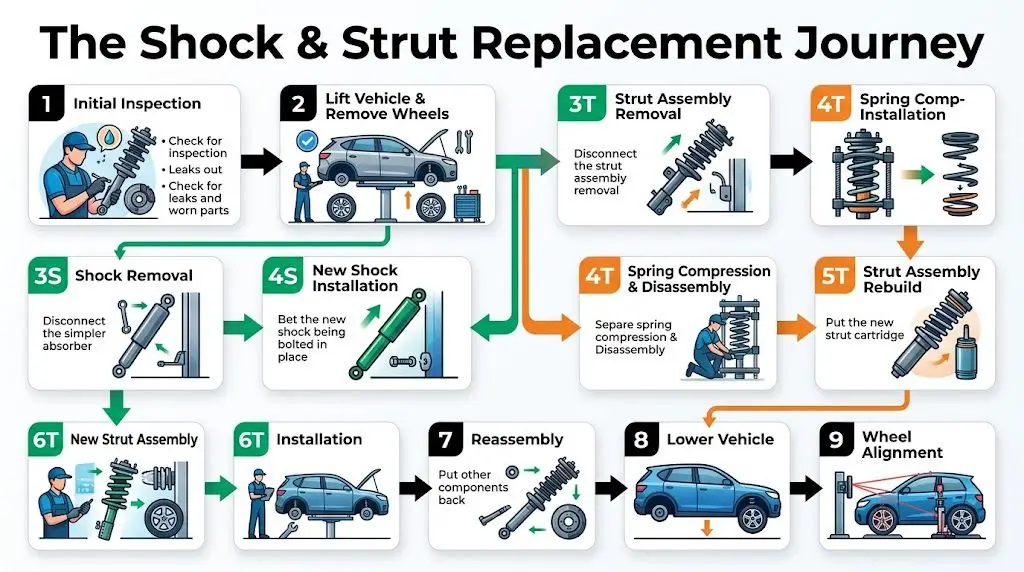
On many vehicles, a shock is a stand-alone damper. The technician raises the vehicle, removes what is blocking access, supports the suspension as needed, then removes the old unit and installs the new one to spec.
Simple does not mean casual.
Good shock replacement also includes checking the mounting points, bushings, sleeves, and hardware. North Texas vehicles often show extra wear from heat, road grime, and miles on broken pavement, so rusty fasteners and worn upper mounts are common enough to plan for. If those details get ignored, the new part may fix the bounce but leave behind a clunk or rattle.
Strut replacement takes more precision
A strut is tied into the suspension structure and steering geometry, so the job has more steps and more ways to get it wrong. As noted in Tomorrow's Technician guidance on shock and strut service, strut service is load-bearing, alignment-sensitive work, and replacement is typically done in pairs on the same axle.
In the shop, that means more than removing and reinstalling parts. The assembly has to come apart safely, the new components have to go back together in the correct order and orientation, and the final setup has to support stable handling and even tire wear. On a daily driver that sees rough city streets, freeway joints, and the occasional pothole after a storm, those details show up quickly in how the vehicle tracks and brakes.
Loaded struts versus rebuilding the assembly
Shops generally go one of two directions:
| Option | What it means | Trade-off |
|---|---|---|
| Complete loaded strut assembly | New strut with spring-related hardware already assembled | Faster installation and fewer old wear parts reused |
| Bare strut replacement | Old spring and related parts are transferred over | Lower parts cost in some cases, but more labor and more dependence on the condition of the reused pieces |
Loaded assemblies often make good sense on higher-mileage vehicles because they replace more than the damper itself. New mounts, insulators, and related hardware can save labor and reduce the chance that an old mount starts making noise a month later.
Bare struts still have a place. If the spring and upper hardware are in good condition and quality parts are available, reusing those components can be reasonable. The trade-off is time, plus the risk that one worn leftover piece cuts into the value of the repair. If you want a pricing breakdown tied to those choices, this guide to strut repair prices helps explain what changes the estimate.
Why pairing matters
Replacing only one shock or strut on an axle leaves side-to-side damping uneven. The vehicle may still feel off in braking, lane changes, or quick transitions through curves and frontage road turns.
That is why experienced technicians usually recommend pairs. The goal is balanced control, not just replacing the visibly failed part.
Details that separate a quality job from a sloppy one
The best suspension work happens in the small steps. Spring seats need to clock correctly. Mounts need to face the right direction. Boots and bump stops need to be in place. Fasteners need to be torqued with the suspension positioned correctly where required by the design.
Then comes the final check. The vehicle gets road-tested again, listened to, and evaluated for ride quality and steering feel. If struts were replaced, alignment is often part of finishing the job properly.
At Express Lube & Car Care in Haltom City, that practical side of the repair matters. Local drivers are not trying to build a showroom car. They want a vehicle that feels settled on Denton Highway, stays predictable in DFW traffic, and does not chew through the next set of tires because the suspension job stopped at the parts swap.
Replacement Costs and Timelines for DFW Drivers
Most drivers want two practical answers. What's this likely to involve, and how long will I be without the car?
The honest answer is that suspension pricing varies a lot by vehicle design and by the parts being replaced. A rear shock job on a simple setup is a very different repair from replacing front struts on a crossover with worn mounts and alignment issues.
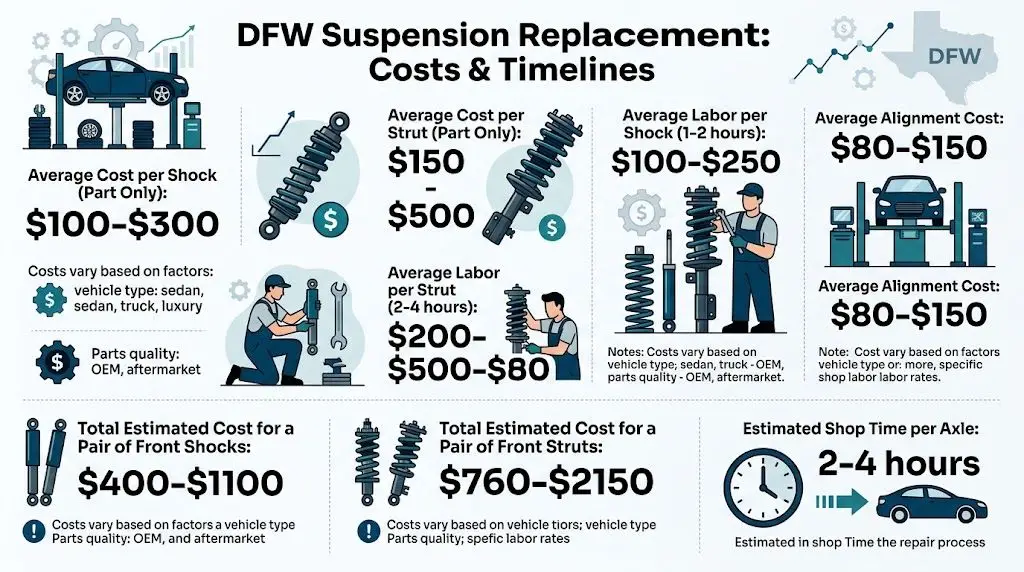
What changes the final estimate
A quote usually moves based on a few factors:
- Vehicle type: A compact sedan, half-ton truck, and three-row SUV won't use the same parts or labor path.
- Shock versus strut design: Struts generally require more labor and more related parts.
- Assembly choice: Loaded assemblies can change both parts cost and labor time.
- Condition of related hardware: Worn mounts, damaged springs, or seized fasteners can expand the job.
- Alignment needs: Many strut repairs need alignment service after installation.
If you want a broader pricing overview tied specifically to this kind of work, this page on strut repair prices gives useful context.
Why timelines vary
Shocks are often quicker than struts. Rear shocks on some vehicles are straightforward. Front struts usually take longer because access is tighter, the assembly is more complex, and alignment often follows the repair.
A same-day repair is common for many suspension jobs when parts are available and no additional damage is found. But rusted hardware, impact damage, or the need to replace more than the original estimate can stretch the timeline.
The trade-off between cheaper and better
Customers can make a smart or expensive decision here.
A low quote may leave out related wear items. It may assume only one side is being replaced. It may use a bare strut where a loaded assembly would produce a more complete repair. None of those choices are automatically wrong, but each has consequences.
The right estimate explains what's included, what's being reused, and what follow-up service the vehicle will need after installation.
The most useful question isn't “What's the cheapest way to do this?” It's “What repair returns stable handling and doesn't leave me paying twice?”
Maintain Your Suspension and Drive Safely in Haltom City
Suspension parts rarely fail all at once. They wear down by degrees, and that's what makes them easy to postpone. The car still moves. The steering still responds. Nothing feels urgent until the ride gets sloppy, the tires start wearing unevenly, or braking stability drops enough that you notice.
That approach costs drivers twice. First in comfort, then in related wear. Weak shocks and struts can push extra stress into tires and other suspension parts, and they make the vehicle less settled on the same North Texas roads you drive every day.
A practical maintenance benchmark
A solid rule of thumb comes from Monroe. In its shock and strut inspection guidance, Monroe recommends that shocks and struts be inspected every 12,500 miles and notes that replacement is often needed by 50,000 miles because internal wear can become significant even without visible leakage.
That benchmark is useful because it reminds drivers of something important. A suspension can be worn before it looks obviously broken.
What works better than waiting for obvious failure
For local drivers, the practical approach is simple:
- Pay attention to changes in ride behavior: Bouncing, diving, swaying, and harshness matter.
- Check tires regularly: Tread wear often gives early warning.
- Inspect on a schedule: Don't rely on leaks alone to tell you when the parts are worn.
- Bundle suspension checks with routine maintenance: It's easier to catch wear early when the car is already in the shop.
If you're not sure where your vehicle falls in its service life, a mileage-based maintenance guide like this car maintenance schedule by mileage helps put suspension checks in context with the rest of the vehicle.
For drivers in Haltom City, Keller, Watauga, and North Richland Hills, timely shock and strut replacement is one of those repairs that makes the whole vehicle feel right again. Better control. Better tire behavior. Less drama over rough pavement. That's not cosmetic. That's how a safe daily driver is supposed to feel.
Frequently Asked Questions About Shock and Strut Service
Do shocks and struts always need to be replaced in pairs
Yes, on the same axle, that's the standard approach. Pair replacement keeps damping balanced from left to right. If one side is fresh and the other is badly worn, the vehicle can feel uneven in braking, cornering, and general body control.
Do I always need an alignment after replacement
Not always, but often. According to Shop Owner Magazine's explanation of replacement struts and alignment angles, alignment is almost always needed after strut replacement, while some suspension designs may not require it if only the shock absorber is replaced. That's why the answer depends on the vehicle design and the parts changed.
Can a bent strut be repaired or straightened
No. A bent strut shaft should not be straightened. That's a structural and safety issue, not a cosmetic one. If impact damage bends the strut, replacement is the safe repair.
If the car still drives okay, can I wait
You can wait, but that doesn't mean you should. Suspension wear is progressive. Many vehicles with worn shocks or struts still feel “fine enough” until tire wear, braking instability, or handling imbalance becomes harder to ignore.
Is a leak the only sign that replacement is needed
No. Leakage is one sign, but it's not the only one and not even the most common early clue. A lot of worn units lose performance internally before a driver sees obvious fluid on the outside.
Are shocks and struts only about comfort
No. Ride comfort is what most drivers notice first, but these parts also affect control. They help manage how the vehicle reacts under braking, over bumps, and through turns. That's why suspension work belongs in the safety conversation, not just the comfort conversation.
If your vehicle has started bouncing, diving, swaying, or riding rough on North Texas roads, it's worth having the suspension checked before the problem spreads to tires and related parts. Express Lube and Car Care serves drivers in Haltom City and nearby communities with suspension inspection and repair, including shock and strut replacement, clear estimates, and recommendations based on what the vehicle needs.