

For most cars, the right tire rotation interval is every 5,000 to 8,000 miles, or about every six months if you drive less. NHTSA gives that range, and it adds that your owner’s manual has the final say on frequency and pattern (NHTSA tire safety). If you see uneven wear before the interval comes up, rotate sooner. Below, we break down what changes the number for your vehicle, which pattern to use, and what to do about the common 3,000, 7,500 and 10,000-mile questions.
TL;DR
- Start with your owner’s manual. If it gives no interval, rotating every 5,000 to 8,000 miles is the industry baseline.
- Trucks, SUVs, AWD and 4WD vehicles, performance cars and EVs usually sit at the shorter end of that range.
- Front-wheel-drive pattern: front tires go straight back, rear tires cross to the front. Directional and staggered setups follow different rules.
- Rotating every other oil change is an easy habit, but check your manual first, because some tire warranties name a specific interval.
- Uneven wear, vibration or pulling means get the tires and alignment looked at now, not at the next scheduled rotation.
Table of Contents
- How often should you rotate your tires?
- Is 3,000, 5,000, 7,500 or 10,000 miles right?
- What changes your interval?
- What is the tire rotation pattern for front-wheel drive?
- Signs your tires need attention before the next rotation
- Perspective: why we pair rotation with an inspection
- Tire rotation and the rest of your maintenance
- Get your tires checked on Denton Highway
- FAQ
- Sources
How often should you rotate your tires?
The numbers from tire makers and automakers cluster tightly:
| Source | Recommended interval |
|---|---|
| NHTSA | 5,000 to 8,000 miles, if the manufacturer recommends rotation, or sooner if uneven wear appears |
| USTMA tire care guide | 5,000 to 8,000 miles when the owner’s manual gives no period |
| Michelin | 5,000 to 7,000 miles, or every other oil change |
| Continental Tire | 5,000 to 7,000 miles or every six months, whichever comes first |
| Kia owner’s manual (2027 model) | Every 8,000 miles, or sooner if irregular wear develops |
| Mazda owner’s manual (2018 CX-9) | 7,500 miles at the latest, with 5,000 miles recommended for more even wear |
| Tesla Model Y service manual | 6,250 miles, or when tread depth differs by 2/32 in or more |
That is why 5,000 to 7,500 miles is the sweet spot most guides land on. If you want one number and your manual is silent, 5,000 to 6,000 miles is a safe, easy-to-remember choice.
Which recommendation should you follow?
Follow the one printed for your exact vehicle. Toyota says rotation frequency and pattern are vehicle-specific and owners should follow the manufacturer even when it differs from general advice (Toyota). Your owner’s manual’s maintenance schedule is the first place to look. Your tire maker’s warranty booklet is the second.
The warranty point matters. Continental says that to stay eligible for certain tire warranties you should rotate every 6,000 to 7,000 miles and keep a completed rotation record as proof (Continental Tire). Michelin also notes that some tire warranties specify an interval, and missing it can void mileage coverage. Keep your service receipts together with your tire paperwork.
Is 3,000, 5,000, 7,500 or 10,000 miles right?
These are the exact numbers drivers ask about, so here is a direct read on each, based on the intervals above:
- 3,000 miles: Not required for most daily drivers. It does match the low end for performance cars, which Bridgestone lists at 3,000 to 5,000 miles (Bridgestone). Ford’s owner’s manual also starts its range at 3,000 miles (Ford). Rotating this often is not harmful, but it is more visits than most vehicles need.
- 5,000 miles: The most widely applicable choice. It fits trucks, SUVs, AWD vehicles and new tires, and it lines up with many oil change schedules.
- 7,500 miles: Acceptable for many sedans and crossovers if your manual allows it. Mazda calls 7,500 miles the latest point for its CX-9, and Chevrolet lists 7,500 for the Suburban. Treat it as a ceiling, not a target.
- 10,000 miles: Longer than every tire maker and automaker figure above. Wear patterns can start to set in by then, particularly on front-wheel-drive cars, so we would not stretch to it.
And if the tires already show uneven wear across the tread face, rotation alone will not fix it. AAA notes that rotation is typically unnecessary when tires are worn unevenly or already need replacing (AAA Via). That is a job for an inspection and an alignment check.
What changes your interval?
Drivetrain and vehicle type
Tires on different axles do different work. On a front-wheel-drive car, the front tires steer, brake and deliver power, so they wear fastest. Bridgestone describes this as the reason rotation matters especially on new tires with deep, fresh tread. Bridgestone’s guidance table gives a useful starting point:
| Vehicle | Bridgestone guidance |
|---|---|
| Sedans and coupes | 5,000 to 7,000 miles or 6 months |
| SUVs and crossovers | 5,000 to 7,500 miles or 6 months |
| EVs | 5,000 to 6,000 miles or 6 months |
| Performance cars | 3,000 to 5,000 miles or every oil change |
| Light trucks, pickups, AWD and 4WD | 5,000 miles or less, especially with heavy hauling or off-road use |
With AWD and 4WD, matching tread depth matters for the drivetrain too. Michelin says matched tread helps protect driveline components. Continental points out that uneven tire circumference puts stress on an AWD system. If you drive a truck or SUV, plan on the 5,000-mile end.
How and where you drive
USTMA lists the habits that wear tires faster: hard stops and starts, hard cornering, potholes and curbs, plus road surface and hills (USTMA guide). It also says vehicles that tend to show a wear difference should be rotated more often.
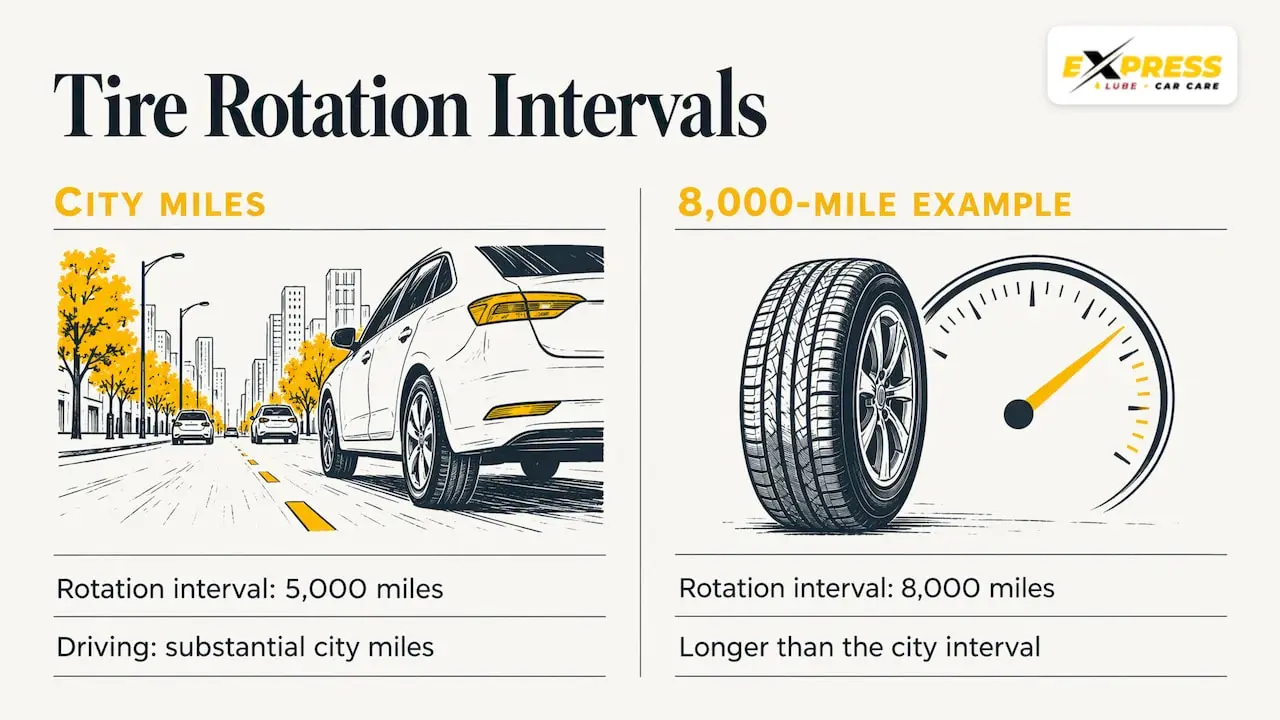
Here in the Haltom City area, that is an everyday picture. Think of the stop-and-go stretches along Denton Highway, short hops between Haltom City, Watauga and North Richland Hills, and highway commutes toward Fort Worth or Keller. Add Texas summer pavement and the occasional pothole, and a driver who covers a lot of city miles may do better at 5,000 miles than at 8,000. We cover the local patterns in what causes uneven tire wear on Haltom City roads.
Heat also affects tire pressure, and pressure affects wear. Michelin notes that consistent pressure promotes even wear when combined with regular rotation, and USTMA says to set pressure to the vehicle manufacturer’s specification after a rotation. Check pressure when the tires are cold, using the number on the driver’s door jamb placard.
New tires, towing and hauling
Bridgestone says to rotate new tires by 5,000 miles, since fresh tread is more susceptible to uneven wear. If you tow a trailer or haul heavy loads with a pickup, the shorter interval makes even more sense, because the rear axle takes extra load.

What is the tire rotation pattern for front-wheel drive?
The Tire Industry Association gives the general rule: cross the free-rolling axle (Tire Industry Association). For front-wheel drive, that means:
- Front tires move straight back to the same side.
- Rear tires cross diagonally to the front.
The other common patterns, per the same source:
- Rear-wheel drive: Front tires cross to the back. Rear tires go straight to the front.
- AWD and 4WD: A double X pattern.
- Directional tires: Front and rear swap sides-to-same-side, unless a tire is demounted from the rim.
Check your own manual before assuming any of these. Kia states that asymmetric radial tires should be rotated front to rear only, not right to left. Mazda says the same for unidirectional tires and asymmetric treads. USTMA adds that some vehicles with different front and rear tire sizes have rotation restrictions.
Staggered setups, with wider tires on the rear axle, are the clearest example. If you want to understand why they cannot be crossed like a standard set, this breakdown of staggered versus square tire setups explains what each layout allows.
One more rule, from Ford: a dissimilar spare should not be included in a rotation. If you only replace two tires, Tesla’s manual says to put the new ones on the rear for wet-road stability, since understeer at the front is easier for most drivers to manage than a rear that lets go.
Signs your tires need attention before the next rotation
Do not wait for the odometer if you notice any of these:
- A steering wheel vibration at highway speed
- The vehicle pulling to one side
- Tread that looks lower on one edge or one tire than the others
- Tread-wear indicators showing across the tire. Chevrolet’s manual lists three or more visible indicators, exposed cord or fabric, or cracked or cut tread and sidewall as replacement signs.
- A new noise that changes with speed, which can also point to a wheel bearing. See signs of wheel bearing failure.
Pirelli notes that if you have had alignment or balance problems, it is best to rotate the tires when you fix the issue (Pirelli). It also explains that unrotated tires wear unevenly and lose traction in snow and wet conditions, and that unequal tread depths strain drivetrain parts designed around matching tire diameters.
Perspective: why we pair rotation with an inspection
We see tire rotation as the cheapest chance to look at everything that touches the road. With the wheels off, a technician can see brake pad thickness, rotor condition, suspension and steering components, and the tires themselves.
That is why our ASE-certified technicians treat a rotation as a short inspection, not just a position swap. If one tire is wearing on the inner edge, we want to say so before it becomes a replacement. Our digital vehicle inspections include photos and technician recommendations, so you can see what we see.
Our advice is simple: pick the interval in your manual, tie it to your oil change when you can, and bring the car in sooner if something feels off. We diagnose first and recommend repairs second, and where a repair qualifies, our 24-month/24,000-mile warranty may apply.
Express Lube & Car Care
Tire rotation and the rest of your maintenance
Because rotation lands in the same range as many oil change intervals, it is easy to bundle. Our oil change and preventive maintenance service fits that habit, and our car maintenance schedule by mileage shows what else comes due at each stage. If you are wondering what the visit costs, see what tire rotation costs and what adds to the price.
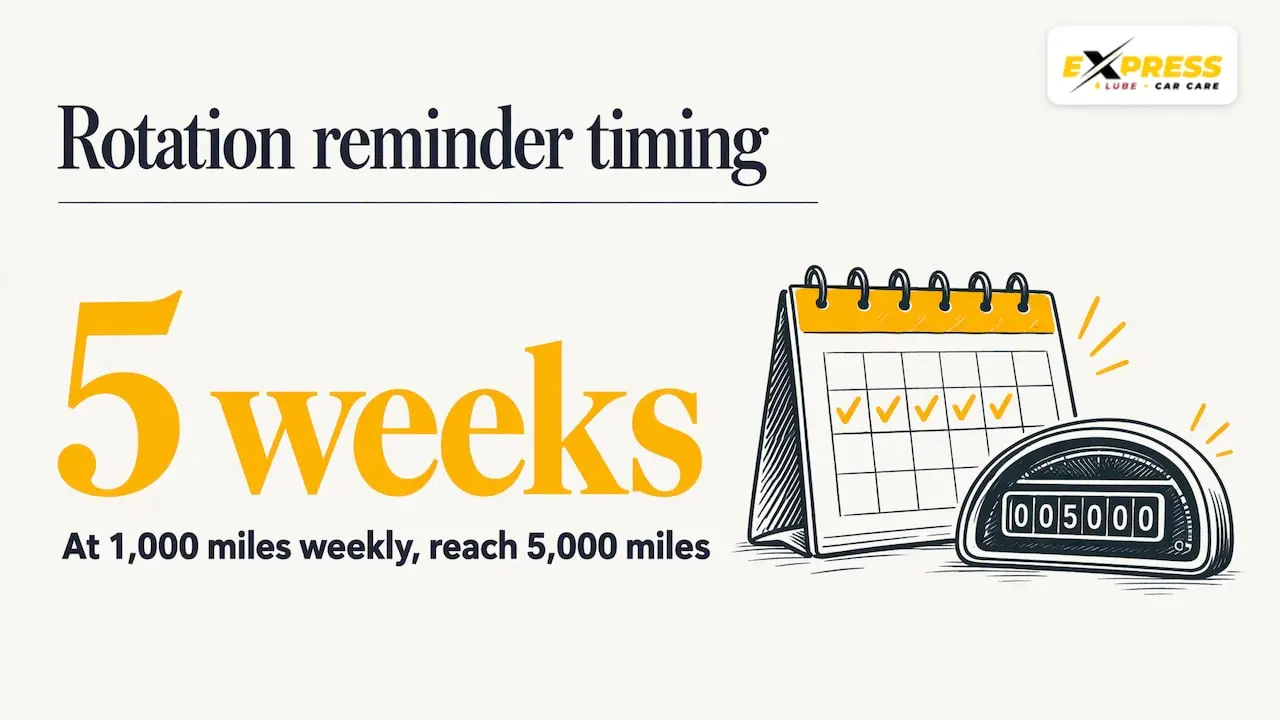
For Uber, Lyft and delivery drivers, or for fleet vehicles, high mileage means rotation comes up fast. A driver adding 1,000 miles a week reaches 5,000 miles in about five weeks, so a calendar reminder works better than guessing.
Get your tires checked on Denton Highway
We are at 6211 Denton Hwy, Haltom City, TX 76148, and we take walk-ins with no appointment needed. If you would rather plan ahead, request an appointment online or call (817) 281-3300. We can check your wear pattern, rotate the tires to the right pattern for your drivetrain, and flag brake, suspension or alignment concerns that show up along the way.

If the inspection finds a repair, eligible repairs may qualify for third-party financing through Snap Finance, subject to provider approval and applicable terms. See all of our automotive repair and maintenance services on the Express Lube & Car Care website.
FAQ
Do I really need to rotate my tires every 5,000 miles?
Not necessarily exactly 5,000, but it is a sound number. Tire makers recommend somewhere between 5,000 and 8,000 miles, and your manual may set a specific figure. Trucks, SUVs, AWD vehicles and new tires benefit most from the shorter end.
Is it okay to rotate tires every 7,500 miles?
Often yes, if your manual allows it. Mazda and Chevrolet both list 7,500 miles for certain models. If your tires show uneven wear, or you drive a lot of stop-and-go miles, rotate sooner.
Can I rotate tires every 10,000 miles?
We would not. That is past the top of the ranges from NHTSA, USTMA and the tire makers above, and wear patterns can set in before you get there. Aim to stay at or below 8,000 miles.
Does a tire rotation interval change for front-wheel-drive cars?
The interval usually stays in the same range, but the front tires wear faster, so staying on schedule matters. Use the front-wheel-drive pattern: fronts straight back, rears crossed to the front, unless your tires are directional or staggered.
Do I still need an inspection in Texas to drive?
Since January 1, 2025, most non-commercial vehicles in Texas no longer need an annual safety inspection, but emissions testing is still required in 17 counties including Tarrant (TxDMV). Qualifying commercial vehicles remain subject to applicable safety inspection rules. See our Texas emissions and commercial inspections page for details.
Sources
- NHTSA: Tire safety
- USTMA: Tire care essentials
- USTMA: Tire care and safety guide (PDF)
- Michelin USA: Tire rotation guide
- Continental Tire: Tire rotation
- Bridgestone: How often to rotate tires
- Toyota: Tire rotation guide
- Kia owner’s manual: Tire rotation
- Mazda owner’s manual: Tire information
- Tesla Model Y service manual: Tire rotation
- Ford owner’s manual: Tire care
- Tire Industry Association: Tire rotation
- AAA Via: When should you rotate your tires?
- TxDMV: Vehicle inspection changes
- Staggered vs. square tires