

That bright red puddle under your car is a classic "uh-oh" moment for any driver in Haltom City. It’s a tell-tale sign that something’s wrong, and more often than not, it points to a transmission fluid leak. The most common culprits are usually simple wear and tear: things like a damaged transmission pan, worn-out seals, or cracked fluid lines. While it’s definitely a serious issue, it's also a common one that can be fixed if you catch it early.
What That Red Puddle Means for Haltom City Drivers

Think of transmission fluid as the lifeblood of your gearbox. This isn't just oil; it’s a complex fluid that cools, lubricates, and provides the hydraulic muscle your car needs to shift gears. When it starts leaking, your transmission is at risk of overheating, slipping gears, or even failing completely. For anyone driving around Haltom City, that’s not just an inconvenience—it's a major safety hazard.
Ignoring a small red spot on your driveway is a gamble that can quickly turn into a repair bill costing thousands. The good news? Spotting the problem early saves you a world of hurt. Of course, not all leaks are the same. If you're not sure what fluid you're seeing, our guide on what causes cars to leak oil can help you tell them apart.
Common Causes and Urgency
Your car's transmission is a sealed unit, so any fluid getting out means something, somewhere, has failed. The daily grind for a Haltom City driver—potholes, stop-and-go traffic, and just general use—puts a lot of stress on these components, and eventually, they wear out.
To help you understand what might be happening, here's a quick look at the most common issues we see.
Quick Guide to Transmission Fluid Leaks
This table breaks down the usual suspects behind a transmission fluid leak, what you’ll likely notice, and how quickly you need to act.
| Common Cause | What You Might See | Recommended Action |
|---|---|---|
| Damaged Transmission Pan | A steady drip or puddle right under the middle of the car. Look for scrapes or dents on the pan itself. | High Priority. Get it inspected right away to prevent major fluid loss. |
| Worn-Out Gaskets and Seals | Slow, greasy seeping where parts connect. The leak might look worse after you've been driving. | Medium Priority. You'll need a pro in Haltom City to find the exact seal that's failing. |
| Cracked Fluid Lines | A more serious leak, often near the front of the car. The fluid can drain out surprisingly fast. | Urgent. A broken line can empty your system in no time. Don't drive the car—call for service. |
Think of that red puddle as a warning light you can see on the ground. The sooner you act, the better.
A transmission fluid leak is your car's way of asking for help. The sooner you listen, the less likely you are to face a catastrophic failure on the road.
At Express Lube & Car Care, our certified Haltom City technicians have the diagnostic tools to trace that leak right to its source. We know it’s stressful to deal with car troubles, which is why we’re committed to giving you clear answers and honest estimates before we start any work. A leak is a clear warning sign, but with the right help from a local Haltom City shop, it’s just a manageable repair that keeps you safe and protects your vehicle.
The Transmission Pan and Gasket: The #1 Leak Culprit
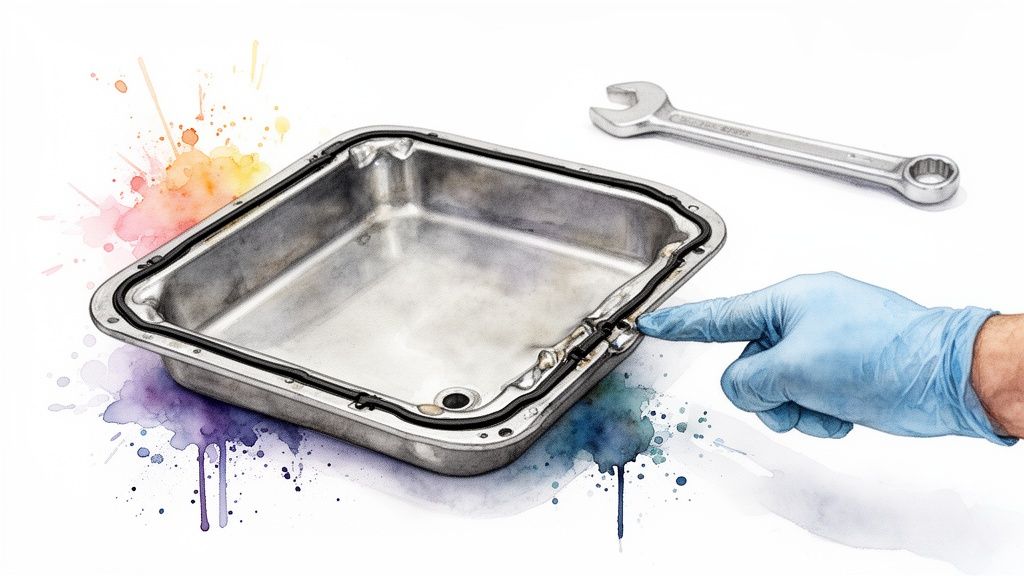
If you're asking, "what causes transmission fluid to leak?", your investigation almost always starts at the same spot: the transmission pan. Just think of it as a shallow reservoir bolted to the bottom of your transmission, much like the oil pan for your engine. Its whole job is to hold the fluid that keeps your transmission running smoothly.
Because this pan hangs out on the underside of your vehicle, it's right in the line of fire for every bump, rock, and stray piece of road debris. This vulnerable position makes it, by far, the most common source of transmission fluid leaks for Haltom City vehicles.
How Everyday Driving in Haltom City Takes Its Toll
Driving around Haltom City means you’re navigating everything from uneven pavement to surprise construction zones. Every time you hit a nasty pothole, bottom out on a steep driveway, or hear something smack the undercarriage, your transmission pan is taking a risk.
A direct hit from a rock can easily puncture the pan, causing an immediate and very obvious leak. But even a dent can be trouble, warping the pan just enough to break the seal and start a slower, sneakier drip.
The Unsung Hero: The Pan Gasket
What keeps all that fluid from seeping out between the metal pan and the transmission case? A thin, flexible part called the transmission pan gasket. It creates a fluid-tight seal, but it can't do its job forever. Over thousands of miles, the constant cycle of heating up and cooling down makes the gasket material hard, brittle, and prone to cracking.
Once that gasket loses its flexibility, it can no longer maintain a perfect seal. This natural wear-and-tear is a leading cause of those slow, persistent leaks that seem to get a little worse over time. The good news? Swapping out a bad gasket is a pretty routine and affordable fix for any qualified Haltom City mechanic.
Your transmission pan and its gasket are the first line of defense against fluid loss. When they fail, you get that dreaded red puddle. Luckily, this is often the most straightforward transmission leak for a technician to diagnose and fix.
Sometimes, the problem is even simpler. The constant vibration of driving can actually work the pan bolts loose over time, creating tiny gaps for fluid to escape. In fact, mechanics will tell you that loose pan bolts are behind roughly 15-20% of all transmission leak repairs.
Fortunately, problems with the pan are usually the most accessible and cost-effective transmission repairs you can face. A standard pan gasket replacement typically runs between $150 and $300 for parts and labor. That’s a small price to pay to prevent the kind of major transmission damage that comes from running on low fluid. You can learn more about the common causes of leaks and their repair costs to see why it pays to act fast.
Why You Can't Afford to Wait in Haltom City
Given its exposed location, the transmission pan is a major trouble spot, especially for anyone navigating the road conditions around Haltom City and North Texas. Whether it’s a direct hit from debris on Denton Highway or a gasket that’s just given up after years of service, the result is the same: a critical loss of transmission fluid.
Because pan and gasket issues are so common—and relatively simple to fix—there’s zero reason to put off an inspection. Ignoring a small drip allows fluid levels to drop, which can cause your transmission to overheat and suffer serious internal damage. What starts as an affordable fix can quickly snowball into a multi-thousand-dollar nightmare.
If you spot that red puddle under your car, bring it over to Express Lube & Car Care in Haltom City for a professional look. Our certified techs will pinpoint the source of the leak and get you safely back on the road.
Cracked Fluid Lines and Worn Hoses: A Common Culprit
After you've checked the transmission pan, the next place to look for that tell-tale red puddle is the network of fluid lines and hoses. Think of these as the arteries and veins of your transmission. They form a critical circulatory system that pumps fluid from the transmission to a cooler (which looks a lot like a small radiator) and then sends it right back.
This constant flow is all about managing heat. Your automatic transmission is a hotbed of friction, and without this cooling cycle, the fluid would cook, break down, and cause the intricate parts inside to fail. These lines are the unsung heroes keeping your transmission from a meltdown.
The problem is, these hardworking lines are also a major weak point, especially dealing with the kind of conditions we see here in Haltom City.
How Haltom City Heat and Road Hazards Take Their Toll
The materials that make up these lines—usually a combination of rigid metal tubes and flexible rubber hoses—are always under assault. The brutal summer heat in Haltom City makes everything under your hood expand, and then winter temperatures cause it all to contract. This constant back-and-forth cycle eventually wears things out.
- Metal Lines Get Brittle: After years of these heat cycles, the metal lines can lose their flexibility. They become brittle and can develop tiny, hairline cracks that start to seep fluid.
- Rubber Hoses Dry Out: The rubber sections are even more susceptible. High heat literally bakes the life out of them, causing the rubber to dry, harden, and crack, particularly right where they connect to other parts.
- Road Debris: Just like your transmission pan, these lines are right in the line of fire. A rock kicked up on I-820 near Haltom City can easily dent or even puncture a line, turning a small issue into a sudden, massive leak.
It's no surprise that these lines and hoses account for roughly 20-25% of all transmission fluid leaks. Mechanics in the Haltom City area see thousands of service calls every year for fluid line failures, which just shows how common this problem really is. If you want to dive deeper into the common causes, you can explore detailed insights on transmission leak causes from other experts.
Why a Line Leak is a Ticking Time Bomb
A leak from a cracked fluid line is usually a much bigger deal than one from a bad pan gasket. A gasket might just leave a slow, annoying drip on your driveway. A ruptured hose or a cracked line, on the other hand, can bleed out fluid at an alarming rate.
A major leak from a cooler line can empty most of the fluid from your transmission in just a few minutes of driving. This is one of the quickest ways to cause catastrophic, and often permanent, transmission damage.
Fixing a damaged fluid line can run anywhere from $250 to $750, depending on how hard it is to get to. It’s not cheap, but it’s a drop in the bucket compared to the $4,000+ bill for a full transmission replacement that you’ll be looking at if you ignore it.
How to Do a Quick Visual Check
You don’t need to be a professional mechanic to take a quick peek. Once the engine is cool, you can usually trace the lines as they run from the side of the transmission up toward the radiator at the front of the car.
Here’s what to look for:
- Wet or Grimy Spots: Check for any hoses that look wet, oily, or are caked in a thick layer of gunk. Leaking fluid is a magnet for dirt, which can actually help you pinpoint the problem area.
- Visible Cracks or Bulges: Look closely at the rubber sections. Do you see any obvious cracks, splits, or weird bulges? Those are clear signs the hose is about to fail.
- Dents or Corrosion: Scan the metal parts of the lines for any dents, kinks, or patches of heavy rust.
A basic visual check can help you spot a major problem, but many leaks start off incredibly small and are tough to see without the right equipment. If you even suspect a line is leaking, the smartest and safest thing to do is bring your vehicle to Express Lube & Car Care in Haltom City. Our techs have the tools to safely pressurize the system and find the exact source of the leak, turning a potential disaster into a manageable repair.
Failing Seals and Leaking Torque Converters
Sometimes, a transmission fluid leak isn't caused by something obvious like a cracked hose or a banged-up pan. The real culprit can be lurking deeper inside your transmission, where critical seals and a major component called the torque converter are doing the heavy lifting. When these parts give up, the leaks they cause are often serious and a whole lot trickier to fix.
Think of your transmission as a sealed, high-pressure hydraulic system. Anywhere a spinning part, like an axle or driveshaft, needs to enter or exit that sealed case, you'll find a specialized seal. These seals are the unsung heroes, holding back hot, pressurized fluid while shafts spin at thousands of RPMs.
But nothing lasts forever. After years of constant heat cycles, these rubber seals start to harden, lose their flexibility, and eventually crack. Once a seal gets brittle, it can't hold that tight fit any longer, and fluid starts to find its way out.
The Different Types of Transmission Seals
Your transmission has several of these crucial seals, and a leak from any one of them spells trouble. Pinpointing which one has failed is definitely a job for a pro in Haltom City, as most of them are buried deep within the drivetrain.
- Input Shaft Seal: This one is right at the front of the transmission where it bolts up to the engine. A leak here often shows up as a drip from the bell housing, and it’s easily mistaken for an engine oil leak.
- Output Shaft Seal: You'll find this at the very back of the transmission, where the driveshaft connects. Leaks here will leave drips near the rear of the transmission case.
- Axle Seals: On a front-wheel-drive car, these seals are where the CV axles slide into the transmission. If one of these fails, you’ll see fluid dripping down onto the axle shafts.
- Shift Lever Seal: A smaller seal, but just as important. It stops fluid from leaking out where your shifter linkage connects to the transmission.
Here's the frustrating part about fixing a bad seal: the part itself is cheap. We're talking a few dollars. The real cost is the labor. To get to one of these seals, a mechanic might have to remove the driveshaft, axles, or in some cases, pull the entire transmission out of the car.
The Role of the Torque Converter
Another major source of a nasty leak is the torque converter. If you’ve ever wondered how an automatic car can sit still at a red light while in "Drive," this is the part that makes it possible. It’s a fluid-filled coupling that acts like a clutch, connecting the engine to the transmission.
This donut-shaped component is under constant, immense stress. Over time, it can develop cracks in its housing or suffer an internal failure, leading to a significant leak.
The torque converter is a high-stress component that can develop cracks in its housing or have its internal bearings fail. When this happens, it can lead to a substantial fluid leak at the front of the transmission, often mistaken for other issues.
A leaking torque converter is a huge red flag. You're not just losing fluid; a failing converter can shed metal shavings into the transmission, destroying clutches and gears from the inside out. This type of leak almost always shows up right between the engine and transmission. If you’re also noticing that your car's transmission is slipping, it could be a sign of these deeper problems.
Figuring out if a leak is coming from an internal seal or the torque converter takes more than a quick look underneath. Here at Express Lube & Car Care in Haltom City, our technicians have the tools and experience to trace these hidden leaks to their source. We know these are bigger jobs, so we always provide a clear, upfront estimate. Catching these problems early is the best way to prevent a small leak from turning into a catastrophic transmission failure.
How to Perform a DIY Leak Check at Home
So, you’ve noticed a few tell-tale signs and think you might have a transmission fluid leak. Before you start worrying about repair bills, there are a couple of simple checks you can do right in your own driveway in Haltom City. These steps are easy, require no special tools, and can give you a much clearer idea of what’s going on with your vehicle.
Start With the Dipstick
The first and easiest place to start is by checking the transmission fluid dipstick. Think of it just like your engine oil dipstick—it’s a quick way to gauge the fluid’s level and health. For the most accurate reading, you’ll want to have the engine warmed up and running, with the gear selector in Park or Neutral.
Go ahead and pull the dipstick out, wipe it clean with a rag, and push it all the way back in. Pull it out a second time and take a close look. The level should be between the "Full" and "Add" marks. If it’s low, that's a pretty solid clue you’ve got a leak somewhere.
Now, check the fluid itself. Healthy transmission fluid should be a bright, almost translucent red. If what you see is dark brown, black, or has a burnt smell, that’s a red flag. It means the fluid is breaking down from excessive heat, which often points to a deeper issue within the transmission.
The Old-School Cardboard Trick
One of the best, time-tested ways to confirm a leak is the simple cardboard test. It's low-tech but incredibly effective at telling you what’s dripping and from where.
- Find a clean, level spot to park, like your garage floor or a flat section of your driveway in Haltom City.
- Slide a big piece of clean cardboard under the car. You’ll want it to cover the area from the front of the engine to about the middle of the vehicle.
- Just leave the car parked there overnight. This gives even the slowest drips a chance to make their mark.
- In the morning, pull the cardboard out and play detective. Look for any new spots. A reddish or pinkish-brown stain located toward the center of the car is the classic signature of a transmission fluid leak.
This initial evidence you gather is exactly where a professional technician starts their diagnosis for more complex issues.
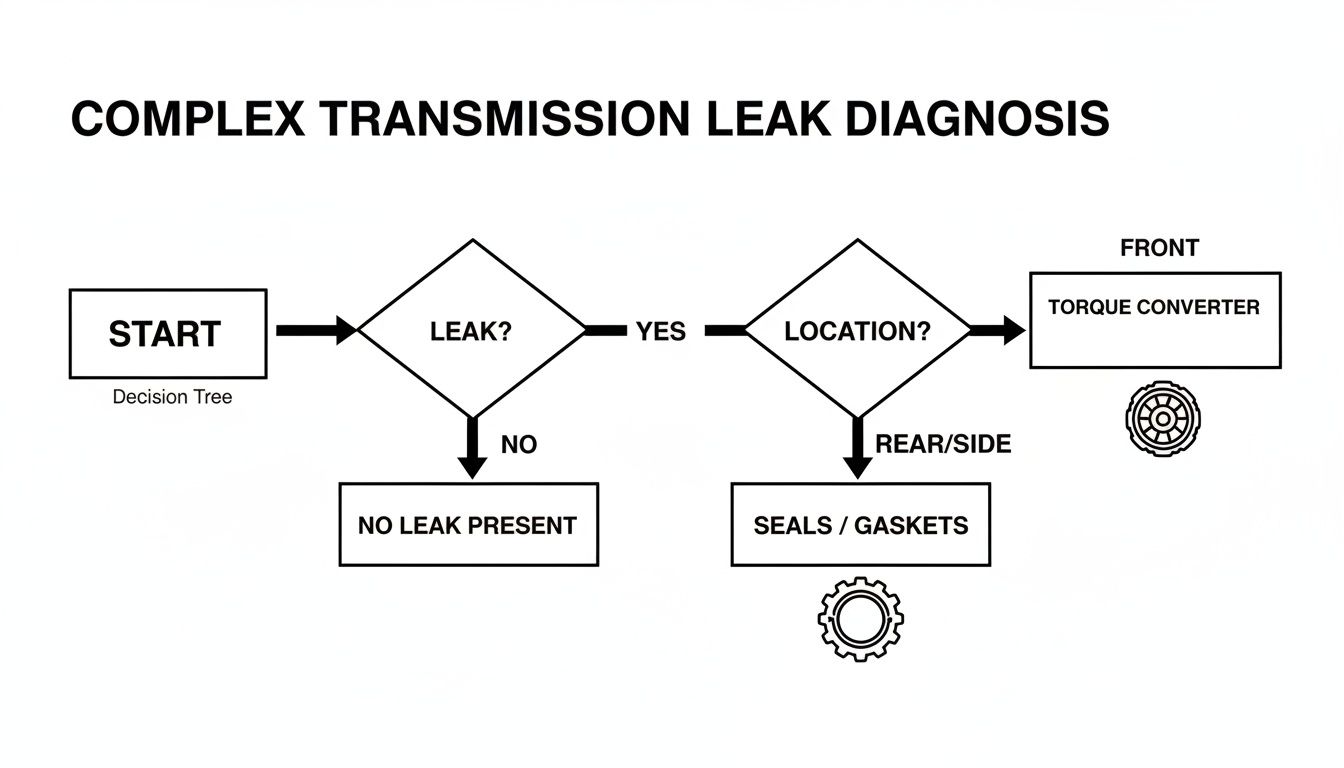
As you can see, once a leak is confirmed, figuring out where it's coming from—the pan, a seal, or a cooler line—is the next critical step in pinpointing the real problem.
Is It Really Transmission Fluid?
Your car is full of different fluids, and it’s surprisingly easy to mistake one for another. That spot on the ground could just as easily be engine oil, coolant, or even power steering fluid. The color and location of the drips on your cardboard are your best clues for telling them apart. Knowing a little about where transmission fluid is located in your vehicle can also help you narrow down the source.
To help you figure out what you're seeing, here's a quick cheat sheet.
Identifying Your Vehicle's Fluid Leaks
| Fluid Type | Typical Color | Consistency | Common Leak Location |
|---|---|---|---|
| Transmission Fluid | Bright Red to Dark Brown | Thin and slightly oily | Middle of the vehicle, but can be near the front |
| Engine Oil | Light Brown to Black | Thicker and very slick | Front of the engine |
| Coolant (Antifreeze) | Bright Green, Pink, or Orange | Watery and slightly sticky | Anywhere in the engine bay, often near the radiator |
| Power Steering Fluid | Reddish or Light Brown | Very thin, similar to transmission fluid | Front of the vehicle, near the belts and pulleys |
Knowing which fluid is which gives you a huge advantage before you even talk to a mechanic.
Taking a few minutes to do these DIY checks is incredibly valuable. You’ll have a much better idea of how urgent the problem is and can give a technician specific, helpful details that lead to a faster and more accurate diagnosis.
Of course, these home inspections have their limits. It's almost impossible to tell the difference between a leaky pan gasket and a failing output shaft seal without getting the car up on a lift for a proper look.
That’s where we come in. Once you've done your initial check, your next best move is to bring your vehicle to Express Lube & Car Care in Haltom City. Our certified technicians will take it from there, performing a thorough, professional inspection to find the exact cause of the leak and lay out a clear plan to get it fixed right.
Why Professional Service in Haltom City Is Your Best Bet
So, you've done your homework and popped the hood. You might even have confirmed your suspicion: there's definitely a leak. But finding a drip is one thing; knowing exactly where it’s coming from and why is a whole different ballgame.
Ignoring that little puddle is a huge gamble on one of the most complex—and expensive—parts of your car. What starts as a minor annoyance, like a slight hesitation or slipping gears, can quickly snowball. Low fluid leads to overheating, which fries internal seals and clutches, and before you know it, you're looking at total transmission failure. That’s a repair that can easily run into the thousands of dollars.
Your Trusted Local Experts in Haltom City
For folks in Haltom City, Keller, Watauga, and North Richland Hills, Express Lube & Car Care is your go-to neighborhood shop. A good auto shop operates with the same professionalism as any top-tier contractor, sometimes using tools like an answering service for contractors to make sure every customer call gets the attention it deserves. We bring that exact same commitment to service every time you pull into one of our bays.
Our ASE-certified technicians don’t rely on guesswork. We use modern diagnostic tools to trace the leak right to its source, whether it's a worn-out pan gasket or a tricky internal seal. This precision means we get the repair right on the first try, saving you time and headaches.
A professional inspection does more than just find the leak. It can spot underlying problems that are just waiting to cause bigger issues down the road, ultimately saving you money and stress.
We're serious about quality, too. We only use premium parts and fluids that meet or exceed your car manufacturer's specs. This isn't about slapping on a quick patch; it's about providing a durable, long-term solution that protects your vehicle. You can see the full scope of what we offer by checking out our professional transmission repair services and our commitment to keeping cars running right here in Haltom City.
Don't let a small leak turn into a driveway disaster. At the first sign of trouble, give us a call and let us take a look. Keeping your car safe and reliable starts with one simple, smart choice.
Answering Your Questions About Transmission Leaks
Even after digging into the common causes of transmission leaks, we find that most drivers in Haltom City still have a few questions on their minds. It's completely understandable. Here are some of the things we get asked most often at the shop, along with some straight-shooter answers.
Can I Keep Driving if My Transmission Is Leaking?
I'm going to give it to you straight: it's a really bad idea. Driving with a transmission fluid leak, even a seemingly small one, is a huge gamble.
When that fluid level drops, it doesn't take long for things to go south. Your transmission can start to overheat, you'll feel jerky or weird shifting, and you're on the fast track to causing major internal damage. If you spot a big reddish puddle or your car starts acting up, the best thing you can do is pull over safely. Get it towed to a trusted Haltom City shop—it could be the difference between a simple fix and a catastrophic failure.
What's the Typical Cost to Fix a Transmission Leak in Haltom City?
This is a tough one to answer without seeing the car, because the price tag is tied directly to what’s actually leaking. Here in Haltom City, some repairs are quick and easy, while others are a whole different ballgame.
- Simple Fixes: A leaky transmission pan gasket is a classic. Swapping that out is usually pretty straightforward and might run you somewhere between $150 and $300.
- Moderate Repairs: If a fluid line is cracked or damaged, the repair could fall in the $250 to $750 range. A lot depends on how hard it is to get to the line.
- Complex Jobs: Now, if we're talking about an internal seal or a bad torque converter, that's a much bigger job involving a lot more labor, and the cost will reflect that.
The best way to keep costs in check is to get a solid diagnosis from the get-go. We always give our Haltom City customers a clear, detailed estimate before we pick up a single wrench. No surprises.
Why Not Just Keep Topping Off the Fluid?
Think of topping off the fluid as a temporary patch—just enough to get you to the repair shop, and that's it. It’s not a fix. The leak is still there, so you're literally just pouring money onto the ground.
More importantly, you're constantly running the risk of the fluid level dropping too low again. Driving on low fluid grinds away at the transmission's insides, causing wear and tear that you can't undo. A proper repair from a Haltom City expert is always the smarter, safer, and cheaper choice in the long run.
If you think you've got a transmission leak on your hands, don't put it off. The certified team at Express Lube & Car Care in Haltom City is ready to pinpoint the problem and get it fixed right. Schedule your inspection today and drive with confidence.