

Most timing chain and gear set replacements land between $1,463 and $1,853 when you factor in both parts and labor, according to RepairPal’s national estimate. That number can climb fast on complex engines once tensioners, guides, or a water pump get pulled into the job. Before you approve anything, get a proper diagnosis and ask for a written, itemized estimate.
TL;DR:
- The average cost for timing chain and gear set replacement is between $1,463 and $1,853, mainly driven by labor hours, engine layout, and component accessibility.
- Replacing the chain often involves additional parts like tensioners, guides, and sometimes water or oil pumps, which should be explicitly itemized in the quote.
- Commonly replaced related parts include tensioners, guides, water pumps, and oil pumps, especially on interference engines susceptible to valve or head damage.
- Signs of a worn chain include rattling noises, misfires, and check-engine codes, but accurate diagnosis requires live data and physical inspection to avoid unnecessary repairs.
- DIY replacement is challenging and risky without proper tools and experience; consulting a professional and obtaining detailed, itemized estimates can prevent overspending.
Table of Contents
- What you’re actually paying for: labor, parts, and fees
- Related repairs that can raise your final bill
- How your specific engine changes the ballpark
- Warning signs your timing chain needs attention now
- Doing it yourself versus calling a professional
- Getting an accurate estimate: questions to ask before you approve anything
- Why two shops can quote the same job differently
- Getting your timing chain diagnosed and repaired at Express Lube & Car Care
- Where these cost figures and guidance come from
- Sources
- FAQ
What you’re actually paying for: labor, parts, and fees
A timing chain quote is never just one number. It is a mix of labor hours, physical parts, shop fees, and sometimes taxes, and each of those pieces can shift the total in a different direction.
RepairPal’s estimator breaks the national average down into labor costs of $830 to $1,217 and parts costs around $634. Labor is consistently the bigger line item, which makes sense once you consider what the job involves: getting to the timing chain usually means removing covers, brackets, and sometimes major accessories just to expose the part that needs replacing.
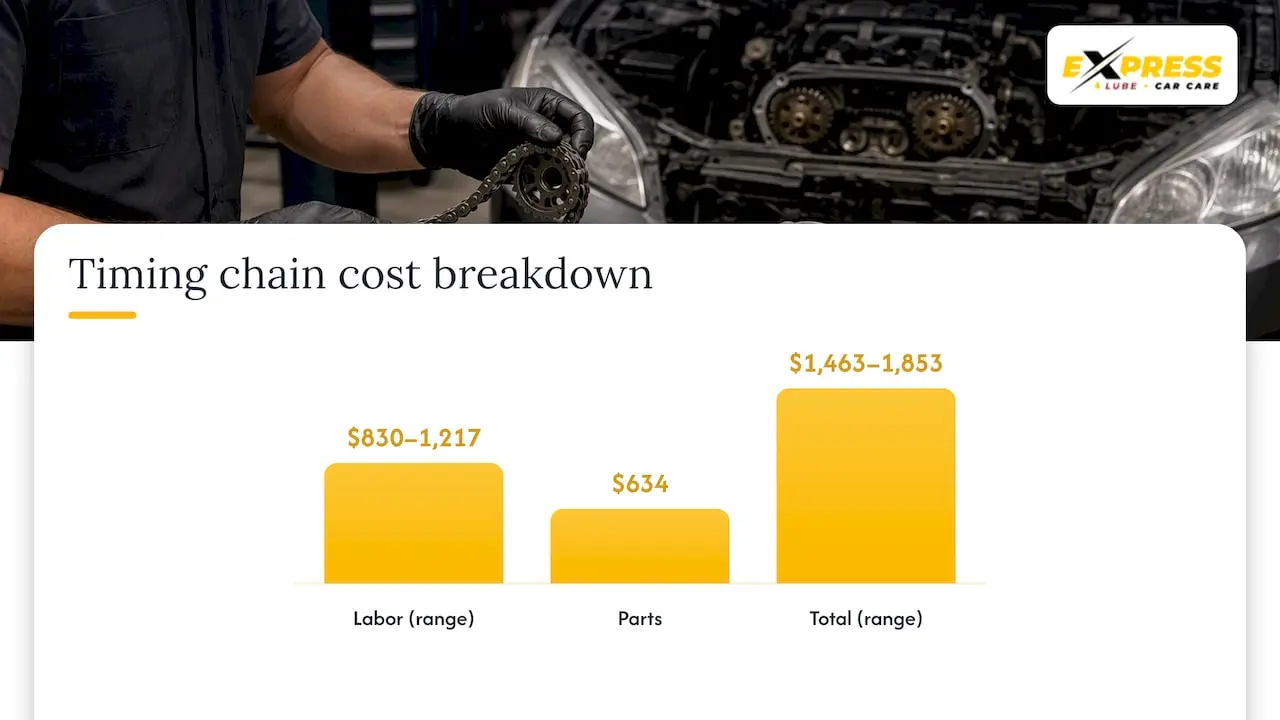
RepairPal’s data shows the average timing chain and gear set replacement runs $1,463 to $1,853 nationally, with labor as the larger share of that cost. RepairPal notes this range excludes taxes and fees and can shift based on your location and the shop you choose.
Several factors drive how many labor hours a shop bills for this job:
- Engine layout determines how much has to come apart before the technician can even reach the chain.
- Access difficulty varies widely. Some engines put the timing chain at the front, which is straightforward, while others bury it behind the transmission.
- Accessory removal adds time when the intake manifold, alternator, or other front-end components sit in the way.
- Engine size matters too. A V6 or V8 typically has more components to remove than a compact four-cylinder.
On top of labor, expect a parts list that includes the chain itself, tensioners, guides, gaskets, and sometimes oil or coolant lines that get disturbed during the teardown. A shop that quotes you only “timing chain replacement” without breaking out these components is giving you an incomplete picture. Ask for the itemized version so you know exactly what you’re paying for and can compare it against another shop’s quote.
Shop fees and local taxes are the final piece, and they’re easy to overlook when you’re comparing two quotes side by side. One shop’s “all-in” number might already include disposal fees and taxes, while another’s does not, which can make an otherwise higher quote look artificially competitive. Always ask whether the number you’re seeing is the final price or just the starting point.
Related repairs that can raise your final bill
A timing chain rarely fails in isolation, and that’s the part many drivers don’t see coming when they get a quote. The tensioners and guides that keep the chain seated properly wear alongside it, and in a lot of engines, the water pump or oil pump is driven by that same chain.
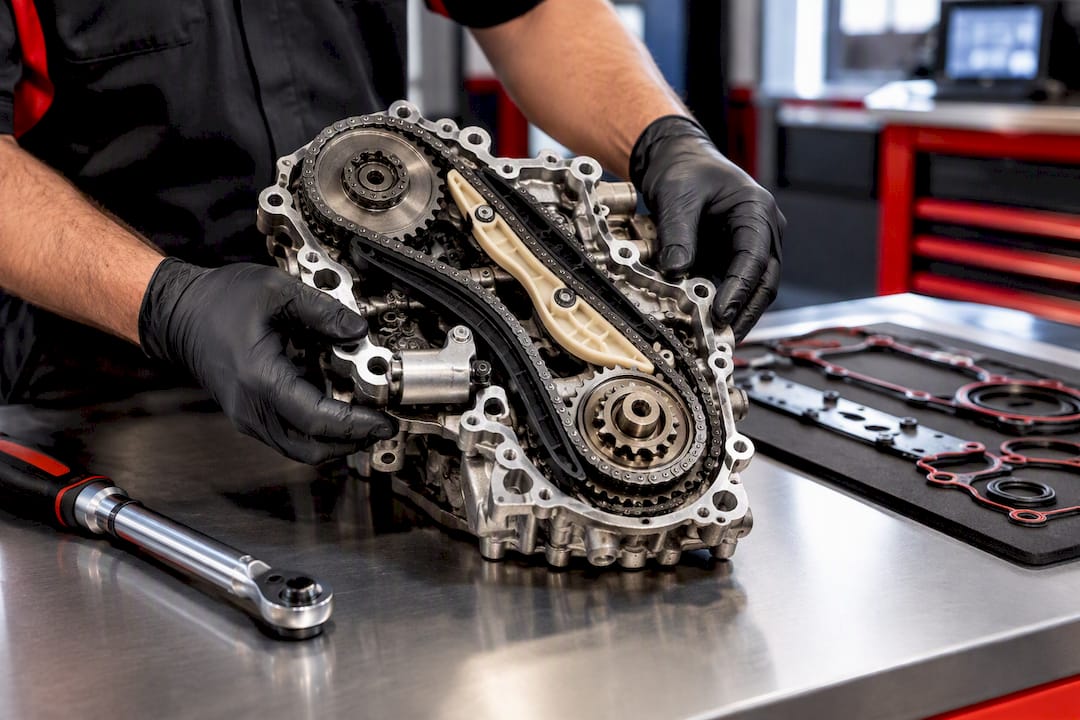
When a shop opens up the front of your engine for a timing chain job, it makes sense to address anything else that’s already exposed and showing wear, rather than closing everything up and paying for a second teardown later. According to AAA’s Car Doctor Q&A, replacing chain-driven components like water pumps at the same time as the chain is often necessary rather than optional, since accessibility and reuse risks make a separate repair down the road both harder and more expensive.
Here’s what commonly gets added to a timing chain estimate:
- Timing chain tensioners and guides, which wear at a similar rate to the chain itself and are frequently replaced together.
- Water pumps, when the pump is driven by the timing chain rather than a separate belt.
- Oil pumps, on engines where the timing chain also drives oil circulation.
- Valve or head work, if your engine is an interference design and the chain has already jumped time or damaged valves.
That last point is the one that turns a moderate repair into a major one. On an interference engine, a chain that skips even slightly can let pistons and valves collide, and that kind of damage can mean cylinder head repair or a full engine rebuild rather than a straightforward chain swap. Related interior damage of this kind is one reason a “timing chain replacement” quote can sometimes balloon into an engine repair conversation instead.
AAA’s guidance also points out that when a chain drives other accessories, removing the intake manifold or front-end components to reach it can multiply the labor hours involved, turning what looks like a modest repair into a much larger bill.
Pro Tip: Before you approve any timing chain estimate, ask the shop point-blank which related parts, tensioners, guides, water pump, oil pump, are included in the price you’re looking at, and which ones are optional recommendations.
How your specific engine changes the ballpark
Not every car falls into the same cost band, and the design of your engine matters more than the brand on the hood. Here’s how the ballpark tends to shift across common engine types:
- Economy four-cylinder engines usually land toward the lower end of the range, since these engines have fewer components blocking access to the timing chain and generally require fewer labor hours.
- Common V6 engines often sit in the moderate range. Some V6 designs place the tensioner in a spot that adds complexity, which can push labor hours, and therefore cost, higher than a comparable four-cylinder.
- Transverse-mounted or European V6 and V8 engines frequently land at the high end. These layouts often demand more disassembly, and RepairPal’s vehicle-specific pages, including estimates for a Ford Expedition timing chain tensioner and a BMW 528i xDrive tensioner job, show labor as the dominant cost driver on these platforms.
Your owner’s manual is worth pulling out here, since it will tell you whether your engine uses a chain or a belt, and some manufacturers list inspection intervals for chain-driven systems even though chains aren’t swapped on a fixed schedule the way belts are. For comparison, manufacturer intervals for timing belts typically fall between 60,000 and 100,000 miles, while timing chains are built to last considerably longer and are usually replaced only when wear or symptoms show up rather than on a mileage schedule. If your vehicle uses a chain instead of a belt, it’s still worth understanding how timing belt intervals work so you know which system you’re dealing with.
Warning signs your timing chain needs attention now
A worn timing chain rarely fails without warning, and catching it early is what keeps this a moderate repair instead of a catastrophic one. Pay attention to these symptoms:
- A rattling or metallic noise at startup, especially one that fades once the engine warms up and oil pressure builds.
- Check-engine codes in the timing or camshaft correlation range, often appearing as codes in the P0xxx series tied to timing performance.
- Misfires or a noticeable loss of power, which can happen when chain stretch throws off valve timing.
- Engine hesitation or rough idle that doesn’t clear up with a basic tune-up.
A proper diagnosis goes beyond just reading a code. According to AAA’s Car Doctor, a thorough check includes live scan-tool data, a physical inspection of the tensioner, a check of timing marks, and sometimes a compression test or scope inspection, since variable valve timing solenoid problems can mimic timing chain symptoms almost exactly. That distinction is worth confirming before you pay for a chain replacement you might not need.
If you hear a persistent rattle that’s getting louder, or your check-engine light comes on alongside rough running, stop driving the vehicle and get it looked at. A chain with enough slack to skip timing can cause sudden, severe engine damage.
Doing it yourself versus calling a professional
Timing chain replacement is one of the harder DIY jobs on a modern engine, and it’s not a place to save money if you’re not confident with precision work. Getting the timing wrong by even one tooth on the sprocket can bend valves or wreck a piston on an interference engine.
Specialty tools are often required, including camshaft locking tools, crankshaft holding tools, and sometimes a chain tensioner compression tool, none of which are cheap to buy for a single job. Add in gasket and seal kits, a torque wrench calibrated for precise specs, and the real time investment, often a full day or more for a first attempt, and the savings over a shop job shrink quickly.
DIY can make sense if you’ve done timing work before and have the tools already. It is strongly discouraged if this is your first attempt at engine timing, since a mistake here can turn a $1,500 repair into an engine replacement.
Pro Tip: If you’re on the fence about tackling this yourself, invest in a professional diagnosis first. Knowing exactly what’s worn, and what related parts need attention, tells you whether this is a job worth attempting at all.
Getting an accurate estimate: questions to ask before you approve anything
Comparing quotes only works when you’re comparing the same scope of work. Before you approve a timing chain repair, ask each shop:
- Is there a diagnostic fee, and does it apply toward the repair if you move forward?
- How many labor hours are quoted, and what is the hourly rate?
- What parts are included by line item, chain, tensioner, guides, gaskets, and are any related repairs, like the water pump, bundled in?
- Does the quote include taxes and shop fees, or are those added separately?
- What warranty applies to the parts and labor?
A trustworthy itemized estimate should show labor hours separately from the hourly rate, list every part by name rather than a vague “misc parts” line, and flag any related repair the technician found during inspection. Be cautious of a shop that gives you a single lump number with no breakdown, refuses to itemize when asked, or quotes unusually few labor hours compared to what you’ve seen elsewhere. Any of those is a reason to get a second opinion before you sign off.
Why two shops can quote the same job differently
Two shops can look at the same engine and land on different recommendations, and that’s usually a diagnostic depth issue rather than one shop trying to oversell you. A quick code scan tells you a fault exists. Live data, tensioner activation tests, and a physical inspection tell you why, and that distinction changes what gets recommended and what it costs.
We document our findings with photos and notes so you can see exactly what a technician found before any work begins, and we itemize labor and parts separately so you’re never guessing what a number represents. That kind of record also makes a second opinion easier, since another shop can review the same findings instead of starting from scratch.
If a quote feels off, ask for the diagnostic notes. A shop confident in its findings will hand them over without hesitation.
— Express Lube & Car Care
Getting your timing chain diagnosed and repaired at Express Lube & Car Care
A timing chain quote is only as good as the diagnosis behind it, and that’s where our approach saves you from guessing. Our ASE-certified technicians run a full diagnostic before recommending anything, and our RepairPal certification reflects the same commitment to fair, transparent pricing that this guide has walked you through.

Here’s what that looks like when you bring your car to us:
- Digital inspection with photos, so you can see exactly what our technicians found, tensioner wear, chain slack, or a failing solenoid, before you approve anything.
- Itemized written estimates that break out labor hours, parts, and any related repairs, the same checklist covered above.
- Same-day diagnostic availability with no appointment required, so you’re not stuck waiting days just to find out what’s wrong.
- A warranty on completed repairs, so you’re covered after the work is done.
If you’ve already got a check-engine code or a diagnostic report from another shop, bring it with you. It speeds up our evaluation and helps us give you a faster, more accurate estimate. Visit our services page to see the full range of repairs we handle, or head to our appointment page to get started.
Where these cost figures and guidance come from
The cost ranges in this guide come from RepairPal’s timing chain and gear set estimator, which tracks national averages for parts and labor. Diagnostic and repair guidance draws on AAA’s Car Doctor Q&A and AAA Club Alliance’s advice on timing belt intervals. For related repair costs, see our guides on water pump replacement and engine repair costs, or visit our engine repair service page.
Sources
- Timing Chain and Gear Set Replacement Cost Estimate
- Q&A With AAA’s Car Doctor: May 2026 – Your AAA Network
- When Should Timing Belts Be Replaced? | AAA Club Alliance
FAQ
Is it worth fixing a timing chain?
Yes, in almost every case, because ignoring a worn timing chain risks catastrophic engine damage that costs far more than the repair itself. Catching the issue early, when you first notice a rattle or a timing-related code, keeps the job closer to the RepairPal average of $1,463 to $1,853 rather than a full engine rebuild.
Can you drive a car with a bad timing chain?
You can drive short distances with early symptoms, but it’s risky once you hear persistent rattling or notice misfires, since a chain with too much slack can skip timing and damage pistons or valves. If your check-engine light is on alongside unusual noise, it’s safer to have the vehicle diagnosed before continuing to drive it.
How do I know if my timing chain is bad?
Common signs include a metallic rattle at startup, timing-related check-engine codes, misfires, and a rough idle that doesn’t clear with a basic tune-up. A proper diagnosis includes live scan-tool data and a physical inspection, since, according to AAA’s Car Doctor, other issues like a failing solenoid can produce nearly identical symptoms.
Is timing chain replacement a big job?
It’s a moderate to major repair depending on your engine, since labor typically makes up the largest share of the cost according to RepairPal’s estimator. Engines that require removing the intake manifold or other front-end components to reach the chain take considerably longer than engines with easier access.