

Most drivers pay between $400 and $1,100 for a shop-installed water pump, with RepairPal reporting an average between $891 and $1,135 once parts and labor are combined. The single biggest factor is whether your pump is easily accessible or buried behind the timing belt. Get two or three local quotes before you commit, and use the checklist further down to compare them apples to apples.
TL;DR:
- Water pump replacement costs typically range from $400 to $1,100, with a national average of $891 to $1,135, depending on vehicle complexity.
- The main factors influencing price are part type and how difficult it is to access the pump, especially for timing belt-driven units that can double labor costs.
- Replacing the water pump alongside the timing belt is recommended if the belt is due for service within 20,000 miles to avoid paying for disassembly twice.
- DIY replacement only makes sense for simple, externally mounted pumps because timing-driven pumps pose a high risk of engine damage if reassembled incorrectly.
- Always get detailed, itemized quotes with labor hours and ask whether coolant flushes are included, to avoid hidden fees and unnecessary repairs.
Table of Contents
- How Much Does Water Pump Replacement Cost by Vehicle Type?
- What Factors Affect Water Pump Replacement Price?
- Should You Replace the Water Pump With the Timing Belt?
- Is DIY Water Pump Replacement Worth the Savings?
- How Do I Get an Accurate Water Pump Quote?
- Why Transparent Estimates Matter for Cooling System Repairs
- What Drivers Get Wrong About Water Pump Costs
- Get a Clear, Local Water Pump Quote in Haltom City
- Sources
- FAQ
How Much Does Water Pump Replacement Cost by Vehicle Type?
The range is wide because the job itself varies so much from car to car. Kelley Blue Book puts typical shop pricing closer to $400–$800, while RepairPal’s broader dataset lands higher, averaging $891–$1,135 nationally. Both are right. They just reflect different mixes of vehicles.
Here’s the general breakdown you’ll see on a shop invoice:
- Parts: roughly $525–$598 for the pump itself, per RepairPal’s cost data, though aftermarket units on easy-access engines can run $37–$128 at the parts-store level.
- Labor: roughly $366–$536, driven almost entirely by how many hours the technician needs.
- Total: $400 on the low end for a simple, accessible pump; $1,100 or more when the pump lives behind the timing cover.
Quick numbers to know: RepairPal’s national average sits at $891–$1,135 for a complete replacement, parts and labor included. That figure is a useful benchmark, not a guarantee. Your actual bill depends on your engine layout and local labor rates.
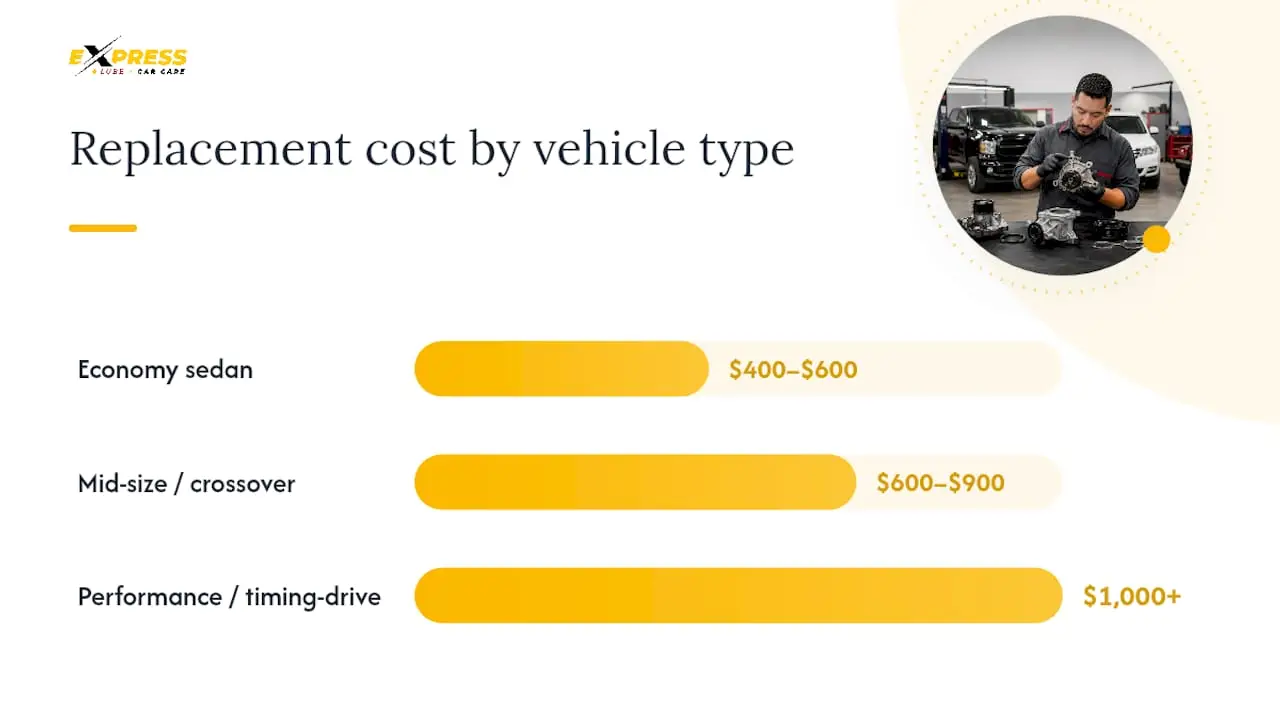
Three examples make this concrete. A small economy sedan with a belt-driven, externally mounted pump often lands near the $400–$600 mark, since a technician can reach it in under three hours. A mid-size sedan or crossover with a slightly more crowded engine bay tends to run $600–$900. A performance engine or a vehicle where the pump is driven off the timing chain or belt can push past $1,000, sometimes considerably more, because the technician has to disassemble half the front of the engine just to get to it.
What Factors Affect Water Pump Replacement Price?
Two things drive most of the variation you’ll see between quotes: the part itself and how hard it is to reach.
Parts quality and pump type. A standard aftermarket mechanical pump is usually the cheapest option, and it’s often a perfectly reasonable choice for daily driving. OEM pumps cost more but tend to match factory tolerances more precisely. Electric water pumps, found on some newer and hybrid platforms, carry a real premium over mechanical units and sometimes require additional wiring or module work.
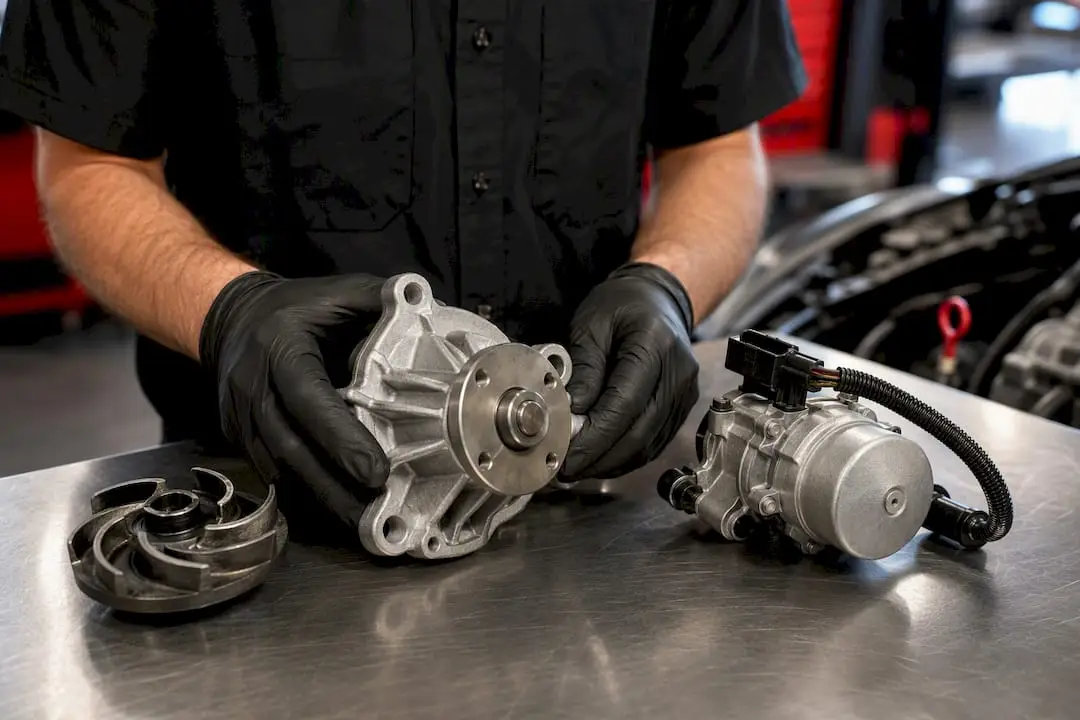
Labor access. This is the part most drivers underestimate. An externally mounted, belt-driven pump might take a technician 2–3 hours. A pump driven by the timing belt or timing chain, buried behind covers and other components, can take 5–8 hours, according to difficulty guides on the job. That labor gap alone can double the bill.
A few add-ons tend to sneak onto the invoice:
- Fresh coolant and a system flush
- New gaskets or seals for the pump housing
- A new serpentine or timing belt, if the old one is worn
- Tensioners, pulleys, or idler bearings disturbed during the job
- Disposal fees for old coolant
Pro Tip: Ask your shop whether the quote already includes coolant and a system flush. Some estimates leave that out, then add it back in as a surprise line item.
Should You Replace the Water Pump With the Timing Belt?
If your water pump is driven by the timing belt or timing chain, the labor to reach it overlaps almost entirely with the labor needed to replace that belt. Cars recommends doing both at once for exactly this reason: paying for the same disassembly twice makes no sense.
Here’s how that plays out in practice:
- Replace the pump alone later: you pay full labor, 5–8 hours, to access a component that’s already exposed if you’d done it during the timing service.
- Replace the pump with the timing-belt kit: the labor is shared, so the incremental cost of the pump is mostly just the part itself, often a few hundred dollars.
- Skip the pump during timing service, then have it fail two years later: you pay for the teardown a second time, essentially doubling your labor cost over the life of the vehicle.
A reasonable rule of thumb: if your timing belt is due within roughly 20,000 miles, replace the pump at the same time even if it’s not leaking yet. It’s the cheapest insurance you’ll buy on that engine.
Is DIY Water Pump Replacement Worth the Savings?
Parts-only DIY costs typically run $50–$400, according to AutoZone’s repair guidance, against a professional total of $400–$1,500. The gap looks tempting on paper.
The math changes fast on timing-driven pumps. Getting the timing marks wrong on reassembly can bend valves or destroy the engine, turning a $200 DIY project into a $4,000 repair bill. Stripped fasteners, skipped gaskets, and incomplete coolant bleeding are the other common failure points. Air pockets left in the cooling system after a DIY job can cause localized overheating even with a brand-new pump installed correctly.
- DIY makes sense for: easy-access, externally mounted pumps on drivers comfortable with basic hand tools and a torque wrench.
- Hire a professional for: any pump driven by the timing belt or chain, or if you don’t have a way to properly bleed and pressure-test the cooling system afterward.
How Do I Get an Accurate Water Pump Quote?
A ballpark figure from an online calculator is a starting point, not a final number. Local labor rates and vehicle-specific labor-hour tables are what actually set your price, so turn that estimate into a real quote with a short conversation.
- Ask if the quote is OEM or aftermarket, and get the part brand named specifically.
- Ask for the labor hours billed, not just a flat labor charge, so you can compare shop to shop.
- Confirm whether coolant and a flush are included, since that’s a common hidden add-on.
- Ask if a timing-belt inspection or replacement is recommended alongside the pump.
- Get the warranty length in writing for both the part and the labor.
Bring your VIN, your engine code if you know it, and a rough timeline of when your timing belt was last serviced. A shop quoting a price without asking any of these questions is a red flag worth noting.
Pro Tip: If two quotes differ by more than a couple hundred dollars, ask each shop to itemize parts versus labor. The gap almost always traces back to OEM parts, timing-belt bundling, or labor-hour estimates, not a mystery markup.
Why Transparent Estimates Matter for Cooling System Repairs
Water pump quotes vary enough that trust in the shop matters as much as the number on the page. Express Lube & Car Care’s ASE-certified technicians diagnose the actual failure before recommending a repair, and the shop carries RepairPal certification, a signal built around fair, transparent pricing practices.
- Digital vehicle inspections with photos show you exactly what’s failing before you approve any work.
- Itemized estimates break out parts, labor, and any add-ons like coolant flushes, so nothing shows up as a surprise on the final bill.
- Larger cooling-system repairs can be paired with flexible financing options when the total climbs higher than expected.
If your symptoms point to something bigger than the pump itself, scheduling a timely appointment can get you a clear diagnosis instead of a guess.
What Drivers Get Wrong About Water Pump Costs
The conventional advice on this topic stops at “get three quotes,” which is true but incomplete. What actually determines whether you’re getting a fair price is whether the shop can explain, in plain terms, why the labor hours are what they are. A pump replacement quote without a labor-hour breakdown is a guess dressed up as a number.
We’d also push back gently on the instinct to chase the cheapest quote reflexively. The lowest bid on a timing-driven pump job sometimes means aftermarket parts of uncertain quality, rushed reassembly, or a shop that skips the timing-belt conversation entirely, setting you up for a second repair bill down the road. The highest bid isn’t automatically the safest either.
What we’d prioritize first: ask for photos of the failing component and a written labor-hour estimate before you approve anything. That combination, more than the dollar figure itself, tells you whether you’re dealing with a shop that diagnoses carefully or one that’s guessing along with you.
Get a Clear, Local Water Pump Quote in Haltom City
Express Lube & Car Care turns a vague online estimate into an exact number for your vehicle, backed by a digital vehicle inspection with photos so you can see the failing pump, the coolant condition, and any related wear before you approve a single dollar of work.

That transparency matters most on cooling system repairs, where the line between a $500 job and a $1,200 job comes down to labor access and whether the timing belt needs attention at the same time. Technicians walk you through both options honestly, and no appointment is required to get started. If the repair total runs higher than expected, flexible financing options may be available to spread out the cost. Ready to find out what your water pump repair will run? Schedule a visit and get a written, itemized quote before any work begins.
Sources
- Water Pump Replacement Cost Estimate
- Water Pump Replacement Prices
- Water pumps: what you need to know
FAQ
Can I drive with a bad water pump?
Driving on a failing water pump is risky because it can lead to sudden overheating, and continuing to drive after the engine overheats can cause serious internal damage; besides mechanical concerns, you should also regularly follow safe car-care steps to maintain your vehicle’s overall condition. If you notice coolant leaking near the front-center of the engine, a whining noise from the pump bearing, or the temperature gauge climbing, get it inspected before your next drive.
Is it worth fixing a water pump?
Yes, in almost every case. A failed water pump left unrepaired typically leads to overheating and can cause far more expensive engine damage, so the repair cost is almost always smaller than the alternative.
How do I know when a water pump is going bad?
Watch for coolant leaks near the front-center of the engine, a whining or grinding noise from the pump bearing, rising engine temperature, and visible steam under the hood. Any one of these warrants a diagnostic check.
Is changing a water pump a big job?
It depends entirely on where the pump sits. An externally mounted, belt-driven pump is a moderate job that a shop can often finish in a couple of hours, while a pump driven by the timing belt or chain is a major job requiring significant disassembly and 5 to 8 hours of labor.