

Strut replacement in the U.S. typically costs a few hundred to close to a thousand dollars per strut (parts and labor combined), ranges from several hundred to around one to two thousand dollars for a front or rear axle pair, and can run into the low thousands for a full four-corner job, depending on your vehicle class and whether you use an independent shop or dealership. Per Lemonade’s cost guide, parts alone for a pair generally fall in a few hundred to over a thousand dollars range, with labor adding additional substantial cost per strut on top.
Two rules apply to every strut job, regardless of vehicle: replace in pairs (both fronts or both rears together), and require a four-wheel alignment immediately after. Skipping either one costs you more in the long run.
Quick reference: A straightforward front-pair job at an independent shop takes roughly 2–4 hours of total shop time, including alignment. Budget additional cost for the alignment itself, and confirm it is a full four-wheel alignment, not a cheaper front-only service.
Key Takeaways
Strut replacement typically costs several hundred to around one thousand dollars for a front axle pair at an independent shop, and a four-wheel alignment after the job is considered mandatory on modern vehicles.
| Point | Details |
|---|---|
| Expect $680–$1,350 per axle pair | Independent shop total for parts, labor, and alignment on most mainstream vehicles. |
| Always replace in pairs | Mismatched damping side-to-side accelerates wear and usually means a second labor charge within a year. |
| Four-wheel alignment is mandatory | Skipping alignment causes cupped tire wear within a few thousand miles and negates the repair. |
| Ask for itemized part numbers | Request OEM vs. aftermarket designation, labor hours, and alignment type on every written estimate. |
| Express Lube & Car Care | Provides same-day strut service with digital inspection photos, itemized work orders, and financing options in Haltom City. |
Table of Contents
- How does the strut replacement cost break down on an invoice?
- What variables change your strut replacement quote the most?
- What symptoms tell you it’s time to replace your struts?
- How long does a professional strut replacement take?
- Should you replace struts yourself or hire a professional?
- How can you reduce costs and what should you ask the shop?
- What do struts typically cost by vehicle class?
- Why worn struts are a safety issue, not just a comfort issue
- Strut work done right, with no surprises on the invoice
- Sources
- FAQ
How does the strut replacement cost break down on an invoice?
Every shop estimate is built from the same four buckets: parts, labor, alignment, and shop fees. Knowing what each should cost lets you spot a padded quote immediately.
Ranges reflect mainstream vehicles at independent shops. Empire Auto Protect’s 2026 pricing survey confirms these bands, with dealer pricing pushing toward the upper end on luxury and AWD models.
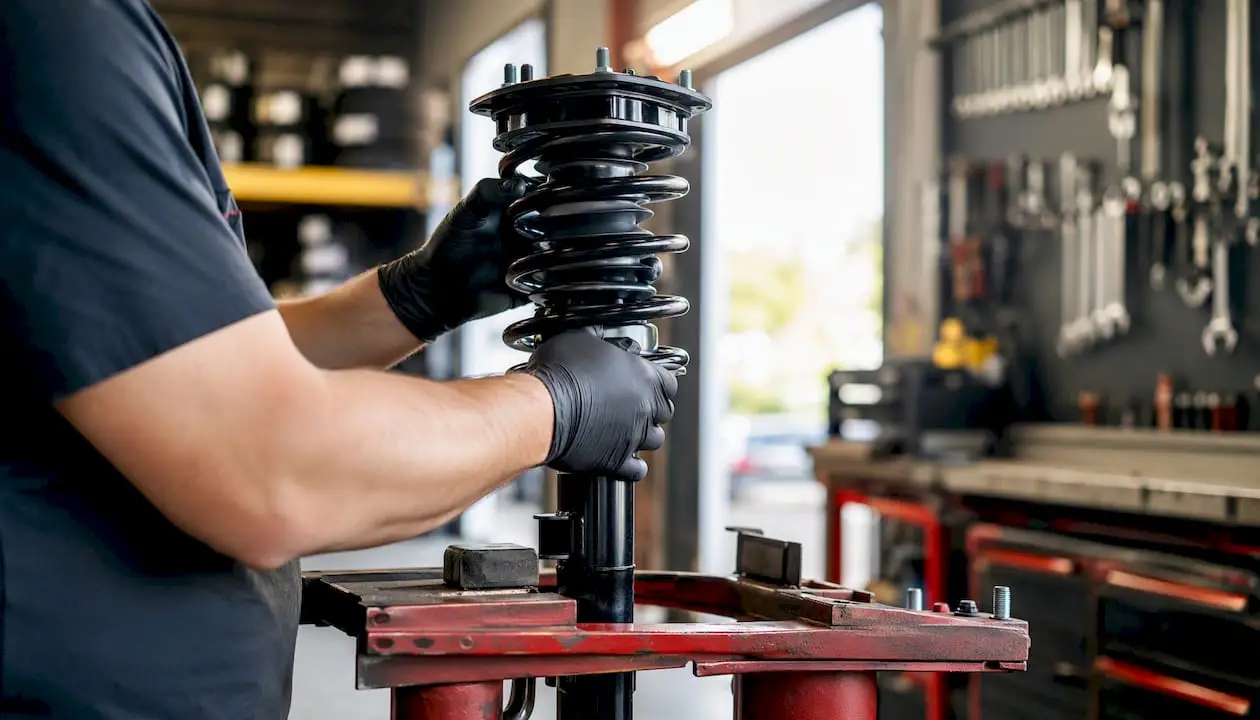
Quick-strut (loaded) assemblies vs. component swaps make a real difference to how the labor and parts lines split. A quick-strut assembly comes pre-loaded with the spring, mount, and bearing already installed. You pay more for the part, but the shop spends less time on it. A component-level swap uses your existing spring and mount, which costs less in parts but requires spring compression, adding labor time and shop risk. For most mainstream vehicles, quick-strut assemblies are the better value overall.
Common add-on costs to watch for:
- Strut mounts and bearings: Additional costs may apply per corner if charged separately, per Empire Auto Protect
- Coil springs: Occasionally replaced at the same time on high-mileage vehicles
- Sway bar end links: Often inspected and sometimes replaced during the same job
- Shop supply fees: Typically 5–10% of labor, sometimes listed as a flat fee
Pro Tip: When a shop says alignment is included, ask specifically: “Is this a four-wheel alignment or front-only?” A front-only alignment on a vehicle that needs four-wheel geometry correction is cheaper for the shop but leaves your rear tires wearing unevenly within a few thousand miles.
What variables change your strut replacement quote the most?
Two shops can quote the same car $400 apart and both be fair. Here is what drives the gap.
- Vehicle make, model, and year. A Honda Civic and a BMW 5 Series are not the same job. European and luxury brands use tighter tolerances, proprietary parts, and longer labor times.
- Front vs. rear struts. Front struts are more accessible on most vehicles; rear struts on sedans and hatchbacks can require partial interior disassembly, adding labor time.
- OEM vs. aftermarket parts. OEM parts carry the manufacturer’s spec and warranty but cost 30–60% more than reputable aftermarket brands. Aftermarket assemblies from established suppliers are a legitimate choice for most daily drivers.
- Adaptive, magnetic, or air suspension systems. These are a different category entirely. Single-damper parts for adaptive systems can run $900–$1,500 or more, and recalibration of ride-height sensors or suspension control modules adds both time and cost.
- Local labor rates. Cost Insider’s 2026 guide notes regional variance of 10%–25% on labor and parts between urban and rural markets. A shop in a major metro area carries higher overhead, and that shows up on the invoice.
- Ancillary components. Mounts, bearings, springs, and sway links are often worn by the time struts need replacing. A thorough shop will flag these; a rushed one won’t.
- Dealer vs. independent shop. Dealers charge dealership labor rates and typically require OEM parts. Independent shops can source quality aftermarket assemblies and often charge $30–$60 less per labor hour.
Checklist before you approve any estimate: Ask the shop to itemize every part by name and mark each one as OEM or aftermarket. That single request filters out vague estimates and lets you compare quotes accurately.
What symptoms tell you it’s time to replace your struts?
AutoZone’s symptom guide explains that struts combine a damper and a coil spring into one structural unit, which means wear shows up in both ride quality and handling. Prioritize these signs:
- Excessive bounce after a bump. Your car should settle in one or two oscillations. Three or more means the damper is no longer controlling the spring.
- Nose-dive under braking. The front of the car dips sharply when you brake, which shifts weight forward and reduces rear tire contact.
- Clunking or knocking over joints and rough pavement. Often a worn strut mount rather than the damper itself, but the strut assembly still needs attention.
- Cupped or scalloped tire wear. Uneven wear patches around the tread circumference are a direct sign the tire is bouncing rather than rolling smoothly.
- Visible fluid leakage on the damper body. Oil streaking down the strut body means the seal has failed. This is a clear replacement indicator.
The safety consequences go beyond a rough ride. GEICO’s worn-strut guide notes that worn struts reduce tire contact with the road and increase stopping distance, which is a measurable safety risk, not a comfort preference.
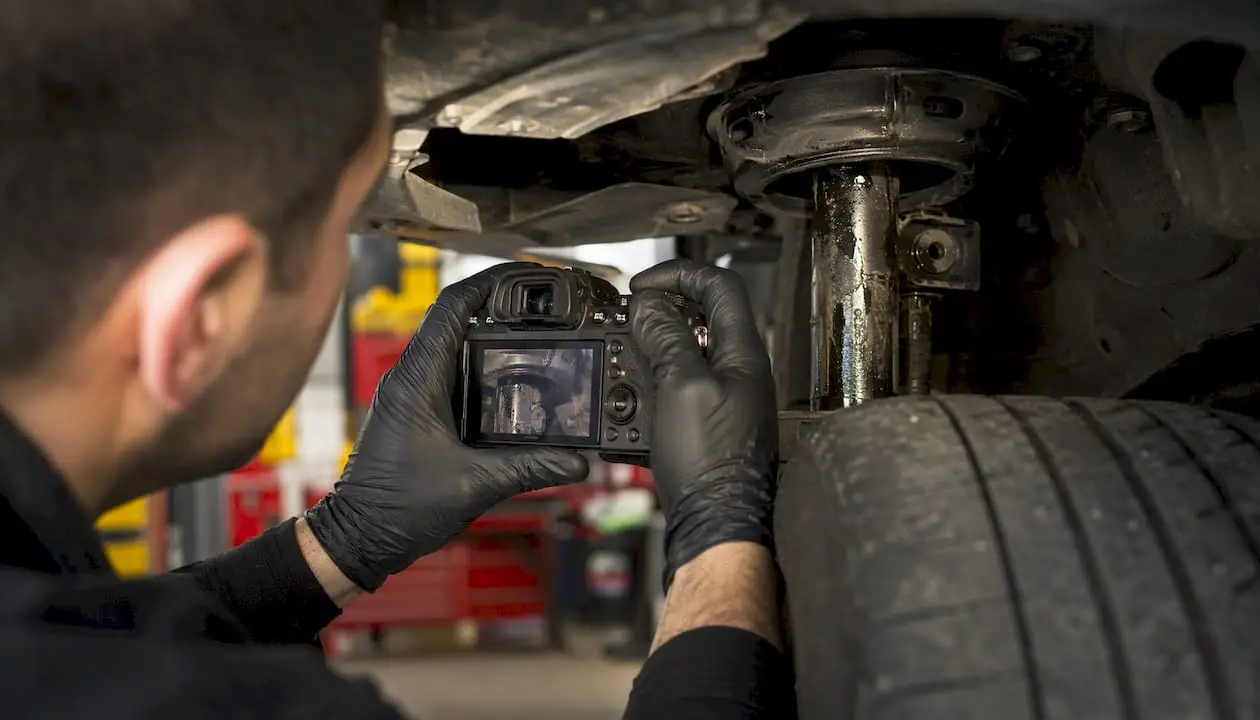
Pro Tip: During a digital vehicle inspection, photograph the strut body from the side to capture any oil streaking, and photograph the tire tread from directly above to document cupping. Those images give you documentation for comparison quotes and, if the vehicle is under a service contract, for warranty claims.
How long does a professional strut replacement take?
Time in the shop depends almost entirely on which type of assembly the job uses and whether anything is seized.
Strutreplacementcost breaks it down clearly: quick-strut assemblies typically require around an hour to slightly over an hour per axle, while component-level swaps that require spring compression take 2–3 hours per axle. Add 30–45 minutes for a four-wheel alignment, and you have a realistic total.
Factors that push the job longer:
- Rusted or seized fasteners (common in northern states with road salt exposure)
- Seized spring seats or corroded strut towers
- Adaptive suspension recalibration after replacement
- Additional parts discovered during disassembly (mounts, bearings, end links)
A practical timeline comparison:
- Straightforward front-pair job (quick-strut, no complications): 2.5–3.5 hours total, including alignment
- Complex four-corner job (component swaps, older vehicle, alignment): 5–8 hours, sometimes split across two days at a busy shop
If same-day service matters to you, call ahead and confirm the shop has your parts in stock. A job that waits on a parts delivery adds hours regardless of labor complexity.
Should you replace struts yourself or hire a professional?
DIY strut replacement can save real money on parts, but the risk profile is not trivial.
Cost comparison for a front pair on a mainstream vehicle:
- DIY parts only (aftermarket quick-strut assemblies): roughly $200–$600
- Professional installation (parts + labor at an independent shop): $680–$1,350
- Potential savings: $200–$500, before tool rental and your time
Tools you need for a component-level swap include a spring compressor, torque wrench, ball joint separator, and basic socket sets. The spring compressor is the critical item. A spring compressor failure under load can cause serious injury. AutoZone’s guide specifically recommends preloaded quick-strut assemblies for DIYers because they eliminate the spring-compression stage entirely.
Other considerations before you decide:
- Most shops will not warranty labor on parts they did not supply, so a DIY install that develops a problem leaves you paying twice.
- Alignment is still mandatory after a DIY swap. You cannot do a four-wheel alignment at home, so budget $80–$150 for a shop alignment regardless.
- AWD vehicles, luxury brands, and anything with adaptive suspension should go to a professional. The calibration steps alone are not DIY-friendly.
Pro Tip: If you go the DIY route, buy preloaded quick-strut assemblies rather than bare dampers. You skip the spring-compression step, cut your install time roughly in half, and reduce the single biggest injury risk in the job. Then schedule your alignment appointment before you start the swap so you can drive straight there when you’re done.
How can you reduce costs and what should you ask the shop?
A few straightforward moves can trim $100–$300 from a strut job without cutting corners on safety.
Cost-reduction checklist:
- Replace in pairs, not individually. Single-strut replacement leaves mismatched damping side-to-side and usually means a second labor charge within a year.
- Ask for a quote on both quick-strut assemblies and component repair. On some vehicles, the labor savings from a quick-strut assembly outweigh the higher part cost.
- Bundle with other scheduled services. If your vehicle is also due for a brake inspection or tire rotation, combining visits saves a second alignment fee and reduces total shop time.
- Consider reputable aftermarket assemblies. Brands with a warranty and a return policy are a legitimate alternative to OEM on most non-luxury vehicles.
- Avoid used or reconditioned struts. The labor cost to install them is the same, and you have no reliable way to assess remaining service life.
Questions to ask every shop before approving work:
- “Is this part OEM or aftermarket? Can I see the part number?”
- “Is the alignment included in this quote, and is it a four-wheel alignment?”
- “How many labor hours are you charging, and what is your hourly rate?”
- “Will you replace the strut mounts and bearings, or are those separate?”
Invoice line items to request explicitly: parts list with part numbers, labor hours broken out by task, alignment type (four-wheel), and any shop supply fees listed as a separate line rather than buried in labor.
What do struts typically cost by vehicle class?
Use these ranges as benchmarks when comparing local quotes. All figures reflect parts, labor, and a four-wheel alignment at an independent shop.
Sources: Empire Auto Protect 2026 survey; Lemonade cost guide.
A few scenarios worth noting:
- A front pair on a Toyota Camry or Honda Accord at an independent shop typically lands in the $750–$950 range, including alignment, using quality aftermarket assemblies.
- The same job at a dealership on a BMW 3 Series with OEM parts commonly runs $1,400–$1,800 for the front pair alone.
- Vehicles with GM’s Magnetic Ride Control or air suspension (common on Cadillac, Land Rover, and some Ram trucks) can see single-corner part costs of $900–$1,500 before labor, per Empire Auto Protect’s adaptive suspension data.
For a local price check specific to the DFW area, the strut repair prices guide for Haltom City covers regional benchmarks and what to expect from independent shop pricing near you.
Why worn struts are a safety issue, not just a comfort issue
GEICO’s worn-strut resource makes the point plainly: worn struts reduce tire contact with the road and increase stopping distance. That is not a ride-quality complaint. It is a braking and control problem that worsens in wet or emergency conditions.
Safety note: Industry experts warn that drivers who delay strut replacement are not just accepting a rougher ride. They are operating with reduced braking performance and less predictable handling, particularly in sudden maneuvers.
The connection to tire wear compounds the cost argument. Worn struts cause cupped tires, and cupped tires need early replacement. A $900 strut job that gets delayed can easily generate a $600 tire replacement on top of it. Budget for the four-wheel alignment as part of the repair, not as an optional add-on, because it is what protects the new tires from the same fate.
For a full symptom checklist and timing guidance specific to DFW drivers, the shock and strut replacement guide for Haltom City covers when to schedule and what to watch for between inspections.
What independent shops know about pricing that dealers don’t always tell you
Independent shops save customers money in two consistent ways: they source quality aftermarket loaded strut assemblies instead of defaulting to OEM, and they charge lower labor-hour rates than dealerships. On a front-pair job, that combination can mean $300–$600 in savings with no meaningful difference in outcome for a mainstream vehicle.
That said, there are situations where dealer service is the right call. If your vehicle has adaptive damping, magnetic ride control, or air struts, the recalibration steps after replacement often require manufacturer-level scan tools that independent shops may not carry. Warranty-covered work is another clear case for the dealer.
At Express Lube & Car Care, every work order lists part numbers, labor hours, and alignment type explicitly. You see exactly what was installed and how long the job took, which makes it straightforward to compare against any other quote you received. Transparency on the invoice is not a bonus feature; it is how a shop earns your trust on a repair this size.
Strut work done right, with no surprises on the invoice
Strut replacement is one of those repairs where the difference between a fair quote and an inflated one comes down to knowing what to ask. At Express Lube & Car Care in Haltom City, our ASE-certified technicians handle strut replacement with a digital vehicle inspection that documents wear with photos before any work begins. You see the condition of your struts, mounts, and related components before you approve anything.

Every strut job includes a four-wheel alignment confirmation on the work order, so you are never left wondering whether that step was completed. If the repair cost is a concern, flexible financing through Snap Finance is available, and a $45 mechanical repair coupon is currently on the site. No appointment needed. Call or stop in, and we will get you a written, itemized estimate the same day.
Sources
- Strut Replacement Cost: What You’ll Actually Pay | Lemonade
- Strut Replacement Cost in 2026 | Empire Auto Protect
- Suspension Strut Replacement Cost Guide for U.S. Shoppers 2026 – Cost Insider
- Symptoms of Bad Shocks and Struts – AutoZone
- Strut Replacement Cost, 2026 Pricing Guide for Every Vehicle
- 7 signs of worn shocks and struts – GEICO
FAQ
How much should a strut job cost?
A front axle pair at an independent shop typically costs several hundred to around one thousand dollars, including parts, labor, and a four-wheel alignment. Luxury, AWD, and adaptive suspension vehicles push that range significantly higher.
Can you drive with bad struts?
You can, but it is not safe. Worn struts increase stopping distance and reduce tire contact with the road, which worsens handling in wet conditions and emergency maneuvers.
Is replacing struts worth it?
Yes, particularly when you factor in tire wear. Worn struts cause cupped tires that need early replacement, so delaying the repair often costs more overall than scheduling it promptly.
How long does it take a mechanic to replace a strut?
A front-pair job using quick-strut assemblies takes roughly 1–1.5 hours of labor per axle, plus 30–45 minutes for alignment. Total shop time for a straightforward front-pair job is usually 2.5–3.5 hours.