
Most heater core replacements run between $500 and $1,900, with many repairs landing in the $1,375 to $1,912 range once labor and parts are combined, according to RepairPal’s cost estimator. Labor drives most of that total because the part sits deep inside the dashboard, and vehicle design changes the price more than the part itself. If coolant is visibly leaking or your engine is running hot, stop driving and get it looked at before scheduling the repair.
TL;DR:
- Labor costs usually dominate the total heater core replacement bill because the part sits behind the dashboard, which can vary greatly in complexity.
- Vehicle design and dashboard layout influence the repair time, with simpler access shaving hours off the job and complex setups extending it to a full day or more.
- Additional charges often include coolant, hoses, clamps, gaskets, and recharging the A/C system, especially if refrigerant recovery is necessary.
- Certified technicians perform detailed pressure tests and vehicle inspections before replacing the core, with transparent, itemized quotes that specify parts and labor separately.
- DIY replacement is risky due to fragile trim, wiring, and EPA refrigerant rules, making professional diagnosis and repairs more reliable and compliant.
Table of Contents
- What drives the heater core replacement cost: parts, labor, and add-ons
- What technicians do and how long the repair takes
- Heater core leak symptoms and how urgent they really are
- DIY vs professional replacement, and why EPA rules matter here
- How to get an accurate quote without overpaying
- How Express Lube & Car Care approaches a heater core diagnosis
- The real question isn’t the price, it’s what’s driving it
- Book a heater core inspection with Express Lube & Car Care
- Sources
- FAQ
What drives the heater core replacement cost: parts, labor, and add-ons
The heater core itself is rarely the expensive part. According to RepairPal, parts typically cost several hundred dollars, while labor usually involves a higher expense reflecting the work involved. That split matters because it tells you where to focus when comparing quotes. A shop charging low for the part but high for labor, or the reverse, can still land at roughly the same bottom line.
Labor usually makes up the majority of the total bill, since the heater core sits inside the HVAC housing behind the dashboard, according to RepairPal. That single fact explains why two vehicles with similarly priced parts can carry very different invoices. A car with a dashboard that comes apart in a few steps costs far less to service than one where the steering column, center console, and infotainment unit all have to come out first, a point echoed in PartCatalog’s breakdown of the job.
A few line items tend to show up on the invoice beyond the core and the base labor charge:
- Coolant replacement, since the system has to be drained and refilled with the correct type and volume.
- New hoses and clamps, especially on vehicles where the old ones are brittle or corroded from age.
- A/C recovery and recharge, when the HVAC housing removal forces the refrigerant system open.
- Gaskets and seals for the heater core housing, which are inexpensive but easy to overlook in a rough quote.
Aftermarket parts sit at the lower end of that parts range, while OEM cores run higher but often fit with fewer surprises. The total you’re quoted should reflect your specific vehicle’s dashboard complexity, not just a generic “heater core” line item.
What technicians do and how long the repair takes
A proper heater core replacement follows a fairly consistent sequence, even though the specific steps behind the dashboard vary by make and model.
- Confirm the failure. Technicians verify symptoms like weak heat or a sweet coolant smell, then check coolant levels and look for external leaks before assuming the core itself is the problem.
- Pressure test the cooling system. This isolates whether coolant loss is coming from the heater core, a hose, or somewhere else entirely, following the kind of careful testing limits outlined in technical guidance from 4S.
- Discharge the A/C system if needed. On vehicles where the HVAC housing is shared with the A/C evaporator, refrigerant has to be recovered before disassembly can continue.
- Remove interior components. This often includes the center console, steering column, dash panels, and infotainment unit, exactly the labor-heavy work PartCatalog points to as the main cost driver.
- Replace the core, then reassemble and test. Once the new core is in, the system gets refilled, bled of air, and checked for leaks and proper heat output before the vehicle leaves the shop.
Simple jobs on vehicles with easy dash access can take half a day. Dash-heavy vehicles can take a full day or more, especially when technicians find brittle clips, corroded fasteners, or wiring that needs careful rerouting.
Pro Tip: Ask your shop whether they replace heater hoses and clamps while the dash is out. It’s a small add-on cost now versus paying full labor again in a year.
Heater core leak symptoms and how urgent they really are
A failing heater core rarely fails without warning. Watch for these signs:
- Weak or no heat, even with the temperature control turned all the way up.
- A sweet smell inside the cabin, which usually means coolant is leaking into the ventilation system.
- A foggy windshield, especially one that clears slowly or returns quickly after defrosting.
- A wet or stained passenger-side floorboard, from coolant pooling under the dash.
- Coolant level that keeps dropping without a visible puddle under the car.
A heater core that’s leaking or clogged can lead to engine overheating, since lost or restricted coolant flow reduces the engine’s ability to shed heat, according to Carparts. That’s the real risk here: it’s not just a comfort issue, it’s a cooling system issue that can escalate into expensive engine damage if ignored.
If you notice coolant loss combined with a rising temperature gauge, treat it as urgent by following our guide on Why Car Overheating Happens to understand causes and safe steps before seeking repair. Pull over safely, let the engine cool, and check for visible leaks before continuing. Our guide on checking for a car overheating walks through what to check before you decide whether it’s safe to keep driving or time to call for a tow.
DIY vs professional replacement, and why EPA rules matter here
Heater core replacement is one of the more tempting DIY jobs to skip paying labor for, and one of the more disappointing ones to actually attempt. The core itself is inexpensive. The problem is everything around it.
- Hidden fasteners and fragile trim make dashboard removal slow and easy to damage, even for experienced home mechanics.
- Airbag and wiring harness connections behind the dash carry real risk if disconnected or reconnected incorrectly.
- A/C system access often requires refrigerant recovery, which brings in a regulatory requirement most DIYers can’t legally meet on their own.
That last point is worth taking seriously. EPA Section 609 rules require certified technicians and approved recovery equipment to handle refrigerant in motor vehicle air conditioning systems, and restrict who can purchase certain refrigerants at all. If your vehicle’s HVAC housing shares space with the A/C evaporator, discharging that system legally means a certified shop, not a driveway repair.
Some vehicles allow a short-term mechanical bypass, coupling the heater hoses together to stop a cabin leak, but this leaves you without heat and should only be used to get the car to a shop safely, according to RepairPal.
DIYers often underestimate the time investment, too. A job budgeted for a weekend can stretch into a week once a broken clip or a stuck bolt shows up, and a mistake with the A/C system or a cracked dashboard panel can turn a $600 parts purchase into a repair bill larger than a shop quote would have been in the first place.
How to get an accurate quote without overpaying
Getting comparable quotes starts with giving shops the same information every time.
- Have your VIN and symptom history ready. When the heat stopped working, whether you’ve noticed coolant loss, and any recent cooling system service all help a technician diagnose faster.
- Ask for an itemized quote. Labor hours and parts should be listed separately, not bundled into one number you can’t compare against other estimates.
- Clarify whether A/C work is included. If your vehicle needs refrigerant recovery and recharge, that should appear as its own line item, not a surprise add-on later.
- Ask about OEM versus aftermarket parts. Higher-quality cores cost more upfront but tend to hold up better long term than cheaper plastic-ended units.
Pro Tip: If a shop won’t give you a written, itemized invoice before starting the work, treat that as a red flag and get a second estimate.
Vague labor-hour estimates, refusal to break down parts costs, and pressure to approve work on the spot are all signs to slow down. A shop confident in its pricing will walk you through the invoice line by line.
How Express Lube & Car Care approaches a heater core diagnosis
A reliable heater core diagnosis starts with confirming the symptom, not assuming it. Technicians check for coolant loss, inspect for a sweet smell or fogged windshield, and pressure test the cooling system to rule out a hose or radiator issue before pointing to the heater core itself.
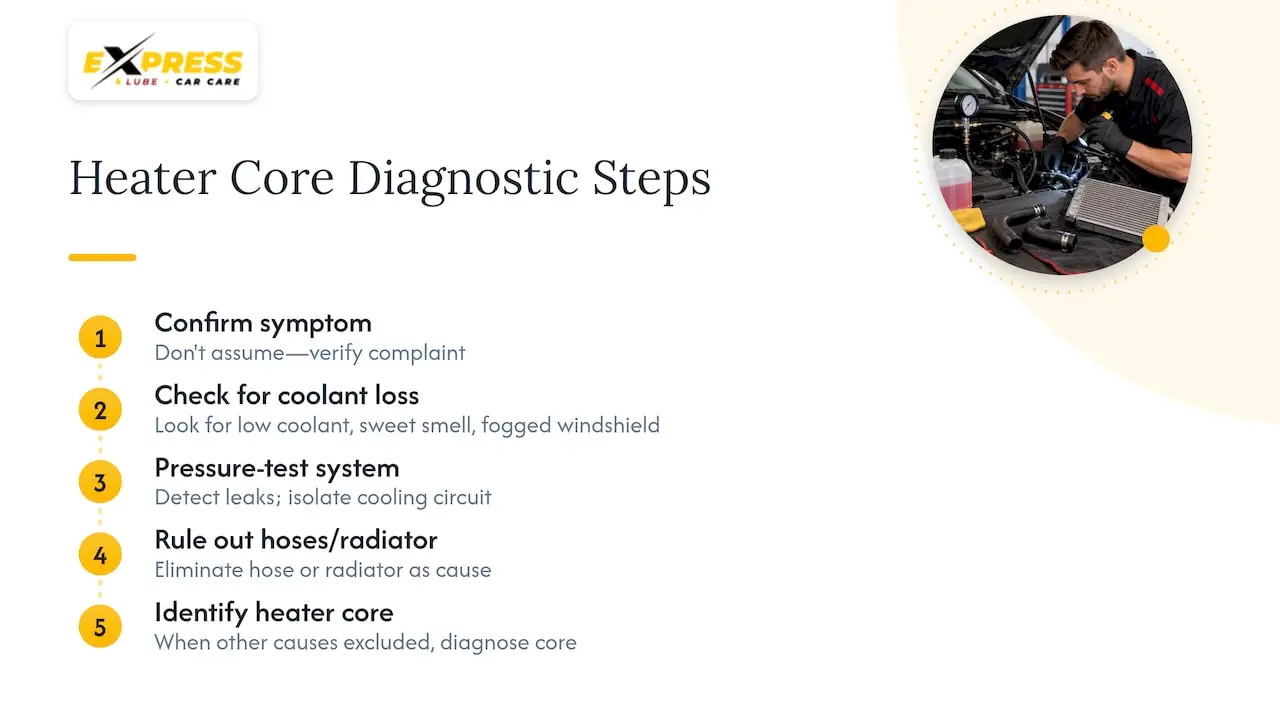
From there, an itemized estimate should separate labor hours from parts costs, including whether A/C discharge and recharge are part of the job. Vehicle inspections with photo documentation provide a clear picture of what a technician found, rather than a verbal description you have to take on faith.
Technicians working under certification guidelines bring a level of accountability to that process: the diagnosis, the parts selection, and the labor estimate should all hold up to scrutiny. Ask what warranty applies to both the part and the labor before work begins, since that detail reflects confidence in the repair.
The real question isn’t the price, it’s what’s driving it
The heater core replacement conversation gets stuck on a single number when it should focus on a single variable: labor complexity. Two drivers can get wildly different quotes for what sounds like the same repair, and the difference almost always comes down to how many components a technician has to remove to reach the core, not the quality of the shop.
Conventional advice tends to treat the parts cost as the headline figure, when it’s really the smallest piece of the decision. The more useful question to ask isn’t “how much does a heater core cost,” it’s “how many labor hours does my specific vehicle require, and what else needs to come apart to get there.”
If you take one thing from this guide, make it this: prioritize an itemized, vehicle-specific estimate over a ballpark number pulled from a forum or a quick phone quote. The shops worth trusting are the ones willing to show their work.
— Express Lube & Car Care
Book a heater core inspection with Express Lube & Car Care
If you’re dealing with weak heat, a fogged windshield, or coolant loss, getting a clear diagnosis beats guessing at the cost. Express Lube & Car Care offers Auto A/C & Heating Repair alongside Radiator & Cooling System Repair and full diagnostics, so the same visit can confirm whether the heater core, a hose, or something else in the cooling system is the real problem.

When you book, ask for an itemized estimate that separates labor from parts, and confirm whether your vehicle’s repair will require A/C refrigerant recovery so that cost is included upfront rather than added later. Digital inspection photos come standard, so you can see exactly what a technician finds before approving any work. No appointment is required, and financing is available through Snap Finance for repairs that don’t fit neatly into this month’s budget.
- Same-day diagnostic and repair scheduling in most cases.
- Itemized, transparent pricing before work begins.
- ASE-certified technicians backed by RepairPal certification.
Ready to get a real answer instead of a guess? Schedule your visit today.
Sources
- Heater Core Replacement Cost Estimate — RepairPal
- Carparts
- Section 609 of the Clean Air Act: Motor Vehicle Air Conditioning — EPA
- Heater core replacement cost — PartCatalog blog
- Heater core failures and replacement — technical guidance (4S)
FAQ
Can I drive a car with a bad heater core?
Driving with a leaking or clogged heater core risks engine overheating, since lost or restricted coolant flow reduces the engine’s ability to cool itself, according to CarParts.com. Short trips may be manageable if there’s no visible coolant loss, but a rising temperature gauge means you should stop and have the cooling system checked.
Can you fix a heater core without replacing it?
Some vehicles allow a temporary mechanical bypass, coupling the heater hoses together to stop a leak into the cabin, according to RepairPal. This is a stopgap only, since it leaves you without cabin heat and doesn’t address the underlying failure.
Is heater core replacement worth it?
Yes, in most cases, since a failing heater core can lead to coolant loss and engine overheating if left unaddressed, according to CarParts.com. The repair itself, typically in the $1,375 to $1,912 range according to RepairPal, is generally far less costly than repairing overheating-related engine damage.
What are the symptoms of a failing heater core?
Common symptoms include weak or no heat, a fogged windshield, a sweet smell in the cabin, and a wet passenger-side floorboard, according to CarParts.com. A dropping coolant level without a visible puddle under the car is another common early sign.