

If your car cranks slowly, clicks, or won’t start at all, the battery is the more likely culprit. If it starts fine but the lights dim, a warning light comes on while you drive, or it dies after a jump, suspect the alternator. The two parts fail in overlapping ways, so the symptoms are clues, not a verdict. A proper test of the battery and charging system is what settles it.
We see this at our shop on Denton Highway all the time: a driver replaces a battery, and a week later the car is dead again because the alternator never recharged it. This guide helps you read the signs, run a few safe checks, and know when to stop guessing.
TL;DR
- Battery trouble usually shows up at startup: slow cranking, clicking, no crank, or dim lights before the engine runs.
- Alternator trouble usually shows up while driving: a charging warning light, lights that dim or get brighter, erratic gauges, whining or growling noises, and a car that stalls.
- A jump-start is a rough clue. If the engine starts and then dies soon after, the alternator is a prime suspect. If it keeps running, the battery is more likely.
- Belts, cables and corroded connections can imitate both problems, so a full charging-system test comes before any part is replaced.
- Stalling in traffic is a safety issue. Get the car looked at promptly rather than waiting for it to fail completely.
Table of Contents
- What the battery and alternator each do
- Signs of a bad battery
- Signs of a bad alternator
- Battery vs. alternator: a side-by-side comparison
- How to tell which one it is: practical checks
- Other problems that can look like a charging issue
- What to do if the car starts and then dies, or the battery keeps going flat
- Our perspective: diagnose first, replace second
- Get the charging system tested in Haltom City
- Heat, traffic, and what they do to your charging system
- FAQ
- Sources
What the battery and alternator each do
The battery stores the electrical energy that cranks the engine and powers the car before it runs. Once the engine is turning, the alternator takes over. It runs off the engine’s belt, powers the electrical system, and recharges the battery.
That hand-off explains most of the confusion. When the alternator fails, the battery keeps the car going for a while, then runs down. According to HowStuffWorks, a car with a bad alternator can run only for a short period, and once the battery is drained the vehicle will not start. So a dead battery is often the final symptom of an alternator problem, not the root cause.
Signs of a bad battery
Battery symptoms tend to appear when you turn the key. Kelley Blue Book lists these common signs of a failing battery:
- No crank, or a clicking sound from the starter
- Slow cranking
- No dome light
- Dark or flickering headlights
- Fluid leakage
- A swollen or cracked battery case
KBB also points out that starter, alternator, and other electrical faults can mimic these signs. That is why a single symptom is never enough.
You can add one visual check: look at the terminals. Fuzzy white or blue-green buildup, loose clamps, or a case that looks bulged are all worth noting. Corrosion alone can keep a healthy battery from delivering its power, and we cover prevention in our guide to battery terminal corrosion.
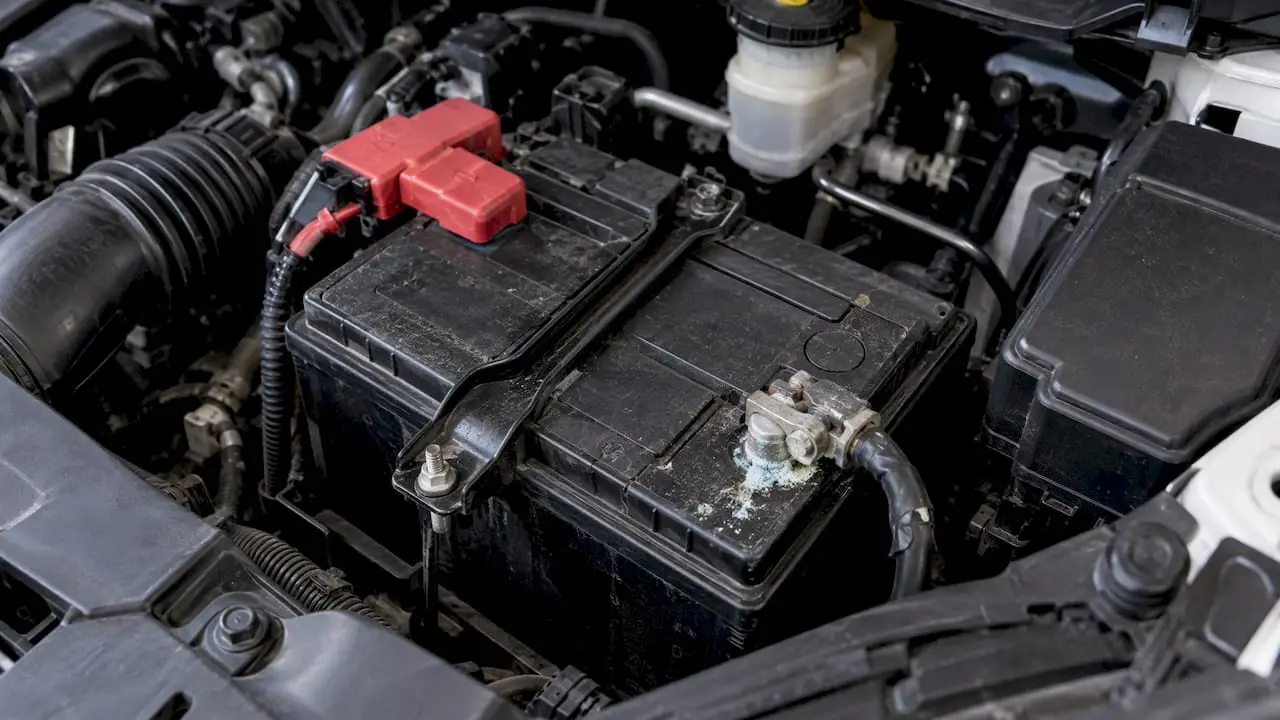
A practical example: You park at work on a hot afternoon, and when you come back the engine turns over slowly and the dash lights are dim. On the drive in, everything seemed normal. That pattern, trouble at startup with no warning lights on the road, points toward the battery.
Signs of a bad alternator
Alternator symptoms usually appear while the engine is running, because that is when the alternator is supposed to be working. HowStuffWorks describes a failing alternator as one that can cause:
- Dim, flickering, or unusually bright lights
- Erratic or dead gauges and accessories
- Warning lights
- Difficult starting
- Eventual stalling once the battery runs down
- Growling or whining noises
Delco Remy adds squealing, frequently failing bulbs, and an instrument-panel voltage reading that is too high or too low. HELLA also notes that a faulty alternator can make bulbs burn out faster than normal.
One detail trips people up: the battery-shaped warning light. It points to a charging-system problem, which is not always a bad battery. When it comes on while you’re driving, treat it as a charging alert, not a battery alert.
A practical example: You’re heading up Denton Highway at dusk, and the headlights seem to pulse dimmer and brighter as the car idles at a light. The radio cuts out, and the battery light flickers on. The car may restart fine in the morning, which makes it easy to ignore, but the alternator is the likelier cause.
Battery vs. alternator: a side-by-side comparison
| What you notice | More likely the battery | More likely the alternator |
|---|---|---|
| When it happens | At startup, after sitting | While driving or idling |
| Cranking | Slow, clicking, or no crank | Starts, then may stall later |
| Lights | Dim before the engine starts | Dim, flicker, or brighten as you drive |
| Dashboard | Often no warning light | Charging warning light, odd gauge readings |
| Noises | Clicking when you turn the key | Whining, growling, or squealing from the engine bay |
| After a jump-start | Car keeps running | Car starts, then dies soon after |
| Physical signs | Corrosion, leaks, swollen case | Burning smell, worn or loose belt |
Treat the table as a starting point. Both parts can be weak at the same time, and an alternator that has been undercharging can leave a battery too damaged to recover.
How to tell which one it is: practical checks
These checks are safe for most drivers and give you something concrete to tell a technician.
Does a jump-start help?
HowStuffWorks suggests a rough rule: if the engine starts after a jump but soon dies, the alternator is likely failing. If it keeps running, the battery is more likely at fault, according to its bad alternator vs. bad battery guide. It’s a clue, not a diagnosis. A battery that is very old may also fail to hold a charge after a jump, and a car that keeps running may still be undercharging.
When do the lights dim?
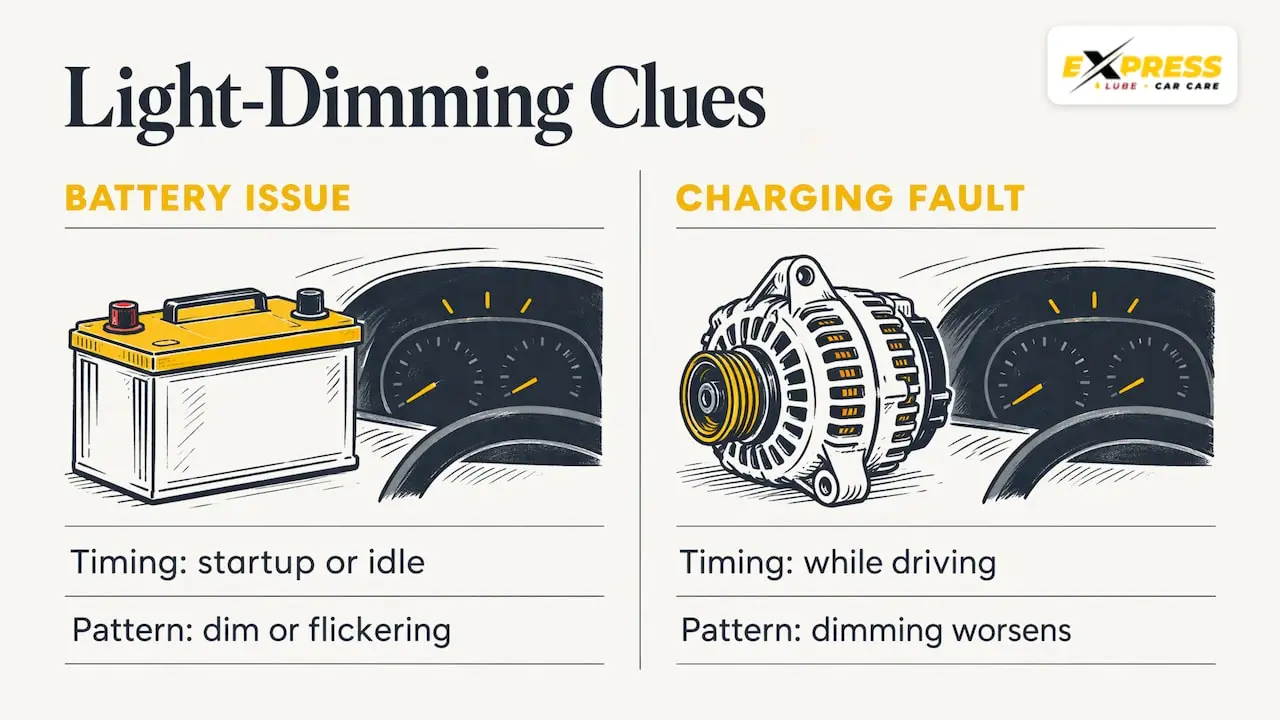
Roadside Good Sam says dim or flickering lights at startup or idle typically suggest a battery issue, while dimming that gets worse as you drive points to a charging-system fault. Pay attention to the timing. It’s one of the most useful things you can observe.
Look before you touch
Before blaming a part, look for the simple stuff. Delco Remy recommends checking the belt’s condition and tension, the cables and connections for corrosion or looseness, and the battery itself before deciding whether the alternator needs replacement. HELLA gives the same advice: rule out a faulty battery, loose drive belt, or bad electrical connection first.
A squealing belt that slips can mean an alternator that spins too slowly to charge, even though the alternator itself is fine. Replacing the alternator in that case wastes money and leaves the real problem in place.
Measuring voltage, and why it’s not the whole story
A multimeter can help. Haynes says a properly charging system should read about 13.5 volts at idle and more than 14 volts with the engine speed raised, and it should not exceed 15 volts. Belt, wiring, and connection faults can also cause undercharging.
There is a catch with newer cars. Tomorrow’s Technician explains that a voltage reading on a running engine does not confirm the alternator is bad, because modern systems may intermittently stop charging to save fuel. Many late-model vehicles need a scan tool to see the commanded charging voltage, since one-size-fits-all voltage targets no longer apply.
That is the main reason we recommend a shop test for anything built in the last decade or so.
Safety while you check
Never disconnect a battery cable or short a terminal while the engine is running. HELLA warns that voltage peaks can damage vehicle electronics. Keep hands, hair, and loose clothing away from the belt and fan when the engine is on. If you aren’t comfortable under the hood, skip the checks and call us.
Other problems that can look like a charging issue
Not every electrical complaint is the battery or alternator. Here are other causes that we rule in or out during a diagnosis:
- Starter problems. A single click or a grinding sound can come from the starter, not a weak battery. Our battery, alternator and starter service covers all three because they are tested together.
- Belts and tensioners. A worn serpentine belt can cause a squeal, a weak charge, and a charging light, all at once. We also handle belts, hoses, and timing belt service.
- Wiring, grounds, and fuses. Corroded cables or a loose ground strap can cause flickering lights, intermittent no-starts, and dead accessories. Intermittent electrical faults are the hardest to pin down. For a general approach to finding intermittent faults, a step-by-step process and good notes on when the problem happens make a big difference.
- Engine and ignition faults. A rough start or stumble can come from spark plugs, coils, or fuel delivery, not from the electrical supply. If the check engine light is on, a code scan is the right first step, and our engine diagnostics work starts from there.
- Cooling system trouble. An overheating engine can stress belts and electrical components. If your temperature gauge climbs along with the electrical symptoms, mention it.
- A/C load. In a North Texas summer, the A/C blower, fans, and compressor put a heavy demand on the electrical system. A marginal battery or alternator that gets by in October can show its weakness in July. If your electrical symptoms appear mostly when the A/C is on, say so.
- Transmission and drivetrain. Shifting complaints are rarely charging-related, but low voltage can cause odd behavior in electronically controlled systems. A good diagnosis checks the power supply before chasing deeper problems.
If you drive a European or imported vehicle, the charging system is often more tightly integrated with the car’s computers, and parts can be harder to source. A preventive maintenance guide for imported cars gives a useful overview of keeping those systems in good shape.
What to do if the car starts and then dies, or the battery keeps going flat
This is the situation that sends many drivers to buy a new battery. A battery that goes flat repeatedly has one of three explanations: it can’t hold a charge, something is drawing power while the car is off, or the alternator isn’t recharging it.
Here is a sensible order of steps:
- Get to a safe place. If the car stalls, put on your hazards and coast to the shoulder or a parking lot. Stalling in traffic on a busy road is a real hazard. Roadside Good Sam says a car that stalls while driving or loses electrical systems on the road can pose safety risks and calls for immediate assistance.
- Reduce the load. Turn off the A/C, radio, seat heaters, and unneeded lights to stretch the remaining battery power.
- Don’t keep jump-starting it. One jump to get to a shop is reasonable. Repeated jumps can hide the problem and strain both parts.
- Note the pattern. Did it die right away, after a few minutes, or only the next morning? Did a light come on first? These details speed up diagnosis.
- Have the whole system tested. A battery test alone won’t catch an alternator problem, and an alternator test on a half-dead battery can give misleading results. Some manufacturers explicitly say to confirm the battery is in good condition before charging-system diagnosis. One manufacturer service bulletin for certain vehicles states that low voltage may prevent the engine computer from engaging the starter properly, and tells technicians to test the battery first, then the alternator on the vehicle.
That sequence, battery first, then charging system, then belts and wiring, is what a methodical diagnosis looks like.
Our perspective: diagnose first, replace second
We see two kinds of charging-system visits. In the first, the driver already replaced a part and the problem is still there. In the second, the driver brought the car in at the first sign of trouble and the fix was straightforward.
The difference is almost always a proper diagnosis. A battery that tests weak, an alternator that isn’t keeping up, and a corroded cable can all produce the same dim headlights. Our ASE-certified technicians check the battery, the charging output, the belt, and the connections before recommending anything, and our digital vehicle inspections include photos so you can see what we see.
Clear, upfront pricing and honest recommendations matter most when you’re stuck with a car that won’t start. If a repair qualifies, it may be covered by our 24-month/24,000-mile warranty, and we’ll tell you up front whether it does.
Express Lube & Car Care
Get the charging system tested in Haltom City
We test batteries, alternators, and starters at our shop at 6211 Denton Hwy, Haltom City, TX 76148, and we also handle the rest of the car, from brakes and suspension to A/C and transmissions. Visits are no-appointment and same-day service is available, so you can come in as soon as the symptoms appear. If you already know the battery is the problem, our battery replacement service covers that, and our full list of services shows everything else we do.

If the repair is larger than you planned, eligible repairs may qualify for third-party financing through Snap Finance, subject to provider approval and applicable terms. You can read the details on our auto repair financing page. Qualifying repairs may also be covered by our 24-month/24,000-mile warranty, so ask us what applies to your repair.
Heat, traffic, and what they do to your charging system
North Texas summers are hard on batteries and alternators. Under-hood heat speeds up the wear on a battery, and the electrical system works harder when the A/C is running through stop-and-go traffic. If you commute on Denton Highway, Loop 820, or I-35W, long idle stretches at lights mean the alternator spins slowly just when the electrical demand is highest.
Trucks and SUVs add their own load, with towing lights, extra accessories, and larger blowers. Rideshare and delivery drivers who run phones, chargers, and the A/C for hours will often notice a weak charging system sooner than someone who drives short trips. Cold snaps matter too: a battery that has been marginal all summer often gives out on the first freezing morning.
A simple habit helps: have the battery and charging system checked before summer and again before winter, and any time you notice symptoms. A routine look at the belt, cables, and terminals is part of our preventive maintenance and inspection approach. For a deeper explanation of the alternator side, see our Haltom City alternator guide.
FAQ
Can a bad alternator ruin a new battery?
Yes, it can. If the alternator isn’t recharging, a new battery will drain just like the old one, and repeated deep discharges shorten any battery’s life. That is why we test the charging system whenever we replace a battery. It protects the new part and saves you a second breakdown.
How long can I drive with a bad alternator?
Not long, and there is no reliable number. The battery supplies the car until it is depleted, and then the engine stalls and won’t restart. How far you get depends on the battery’s condition and how much power you’re using. If your charging light is on, head straight to a safe place or a shop instead of finishing your errands.
What else can be mistaken for a bad alternator?
A loose or worn belt, corroded or loose battery cables, a failing battery, and bad grounds can all look like alternator failure. Delco Remy and HELLA both advise checking these before replacing the alternator. Starter problems and some engine faults can also confuse the picture.
Do I need an appointment to have my battery or alternator tested?
No. You can come to 6211 Denton Hwy in Haltom City without one, and same-day service is available. If you’d rather reserve a time, you can request an appointment online or call us at (817) 281-3300, and we’ll test the battery, alternator, belt, and connections before recommending a repair. Visit Express Lube & Car Care to see everything we offer.
Sources
- How Stuff Works: Bad alternator vs. bad battery
- How Stuff Works: 10 bad alternator symptoms
- Kelley Blue Book: Is my car battery dead?
- Roadside Good Sam: 10 car battery warning signs
- Delco Remy: Troubleshooting the alternator charging system
- HELLA: Checking the alternator
- Haynes: Common charging system issues and causes
- Tomorrow’s Technician: Battery charging and diagnostics
- Manufacturer service bulletin on battery and alternator testing (NHTSA)